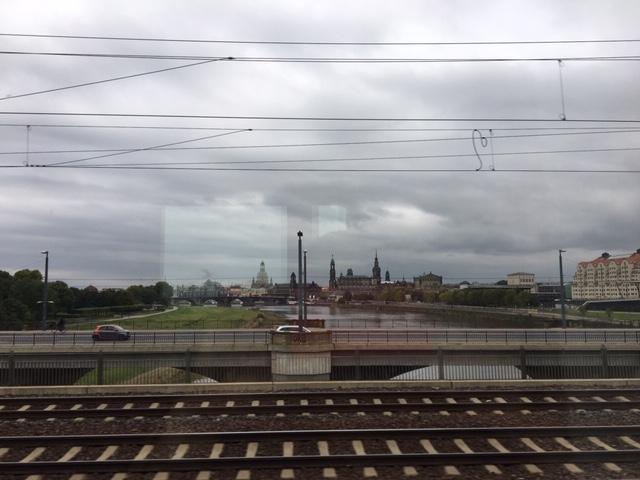
CONTEXT: The ‘we’ mentioned in this piece from my 2016 travels in Europe is my friend Paul from Boston, who was with me for the middle part of my travels, from Salzburg to Berlin. We traveled by train, and saw numerous ground-level points of interest that way; especially this one.
Our train made some stops in Czech lands, then several more in Germany before Berlin. At one station, a young man joined us in our compartment; he discovered we were American, and wanted to practice his English (I practiced speaking German to him; his English was far better than my German). I knew that Dresden, supposedly the greatest Baroque city on Earth till it was bombed to ashes near the end of World War II, was nearby, and asked him if we would pass through its center. He said we would not be in its heart, but that it would be visible from the station where we would stop (he also gave us helpful information for our arrival at Berlin’s mammoth central train station).
Here is a picture of Dresden taken while our train was stopped there. I recognized the dome at the left as the Frauenkirche (Lady Church). This is a restoration, the original having been wrecked in the 1945 bombing, along with most buildings in the city center (and an unknowable number of dead, estimated at 80000, one of the greatest number of people ever to perish in a non-nuclear bombing). Dresden lay within Communist East Germany, and until the end of the Cold War there was neither enough money nor inclination to try to restore all of it to its original splendor. Only after the reunification of Germany were additional historic structures rebuilt; no doubt, Dresden can never be what it once was, but is surely far closer to it now.
As noted, Prague, not far away, got accidentally bombed in that attack – but could have been utterly laid waste, had the Czechs tried to fight the Nazis in 1938.
Dresden was not so lucky, and can serve as a stern reminder – bearing in mind it was devoured in a whirlwind of conflict the Germans themselves had sown – that destruction is easy, but creation is hard. The exquisite beauties the city accumulated over 200 years of building were wiped out in a single day. Civilization, as the empowerment of the Nazis itself showed, is often no match for the brute force of primitive savagery. At least, not in the short term.
However, if stone cannot survive such violence, sometimes the human spirit can; for unlike stone, it may have the power of regeneration. In a gesture of reconciliation, the cross atop the new Frauenkirche dome was forged by a British blacksmith whose father had been a crew member on one of the bombers that had destroyed Dresden. Also, the church displays a “Cross of Nails” made of Medieval spikes taken from the ruins of Coventry Cathedral in England – itself devastated by German bombing – the gift of the people of Coventry.
The Nazis gave the world good reason never to pardon them, or Germany. Yet, it has been observed that bitterness is an acid that eventually corrupts any vessel used to store it. Sustained hatred – no matter how justified – may consume the humanity of those who contain it. Surely, that is what happened to the Nazis themselves, in their ferocious resentments of perceived enemies.
The scale of crimes they committed makes it impossible to exact adequate justice, but there are few better counter-gestures to the criminal pride National Socialism embodied than to at least try to forgive Germany (if not the truly committed Hitlerites). That is something the Nazis never would, nor could, have done, and thus may be the most practical repudiation of them one might make. That alone may make it a worthy goal – even if for many people, it is, understandably, an impossible one.
The Frauenkirche, once a refined expression of order and hope lost to the havoc of war, was a well-chosen place to suggest, tangibly, the restorative power of forgiveness.
 All Things Gaul