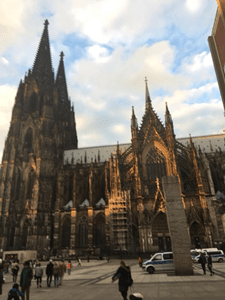
CONTEXT: From my 2016 Europe trip, posted: Only completed to its original Medieval plans in 1880, this is considered perhaps the greatest Gothic church in the world. Cologne began as a Roman provincial capital, and has been a major city ever since. During World War 2, the vicinity of the cathedral was pulverized by Allied bombing, and most of its prewar buildings were not rebuilt, replaced with modern structures. However, some Roman remnants, which had been covered over centuries earlier, were exposed by the bombing, then fully brought back to light during the post-war reconstruction.
This is a closer view of the same side of the church as in my hotel room picture, here burnished by the setting sun. I believe the vertical pillar here was some ancient artifact from Cologne’s origins as Roman ‘Colonia.’
It would be interesting (though melancholy) to see photos taken from this spot before World War II’s catastrophic impact. It was probably a crazed network of largely unreformed Medieval streets and buildings, all now gone forever. It is worth noting that, in addition to being the site of two previous cathedrals, this spot has been a locus of pulsing urban activity since before the Colosseum was built in far-off Rome. By some accounting, Cologne was the largest city north of the Alps till ca. 1450 – long before today’s vast Berlin was of the least importance.
The warm solar glow on all this artful stone may be a metaphor for both change and constancy. There may be ‘nothing new under the sun’ – it shines, indifferent, on all our plans, triumphs and failures – but this city’s ancient, intricate story is an exceptional panoply for our steadfast star to overlay. This structure is one of the very finest works of man, yet sunlight floats on it effortlessly as golden mist, taking no note of the great shrine, just as it glows, unchanging, in the face of all human events. For me, there is an indefinable yet definite comfort in that sense of both chronological and physical continuity.
 All Things Gaul