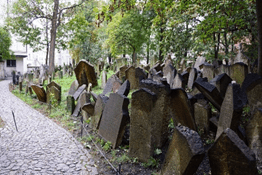
CONTEXT: From my 2016 Europe trip. My only picture from Prague from a great many I took in an overnight stop there in 2016, I include as one of my Introductory blog posts, considering it a semi-sacred duty to put this one here, for reasons explained in the text.
This is a last picture from my visit to Prague, posted separately from all the others to call special attention to the long Jewish presence there. It is my small contribution to helping to thwart Hitler’s dream that not only all of the world’s Jews, but any memory of their very existence, should be obliterated.
Long before the Nazis definitively eradicated it, the venerable Jewish community there had a tempestuous and often violent history. The tale of the “Golem,” a mythical monster created to protect Jews from persecution, originated in Prague.
These tombstones had a calm dignity that made them very different from the only other graveyard I made a point to visit in Europe, Pere Lachaise in Paris. That place is far newer; its first graves seem to have been from around the time this one accepted no more. There have been no burials at this location for some 200 years, and many of the stones are so old they are slowly sinking into the soil, as if to mimic the “dust to dust” return to Earth of those who lie beneath them.
But many tombs in Pere Lachaise were the virtual opposite, in spirit, of these simple memorials. Most were at least ostentatious, others over-the-top Gallic theatrical. Those Parisian monuments, made with wrought iron or intricately carved stone, are now deteriorating badly, no longer the proud spectacles their owners probably hoped would last forever. These in Prague, much less elaborate (usually just a Hebrew inscription and some image to mark the owner’s work in life, like grapes for a wine merchant) are much less liable to such decay.
I can only speculate on why there was such a stark contrast in how eternity was approached in these two places. It may just have been that the Jews of Prague couldn’t afford anything finer, or that religious authorities there prohibited ostentation. Or it may have been a resignation to mortality that the Parisians refused, trying to resist the anonymity of death with elaborate tombs. No such pretense is apparent among these gravestones of Prague and ironically, as the monuments at Pere Lachaise now rust and erode, they suggest the triumph of time more, not less.
I am still perplexed (though joyful) at why the Nazis, who despoiled evidence of Jewish culture everywhere they conquered, left this cemetery and several old synagogues nearby, alone. These are all in central Prague; the Germans must have known they were there. Perhaps it was just their absurd concern for ‘appearances’ – of imagining Gentile Czechs wouldn’t think they were utter brutes if they left a few familiar local highlights – but not live Jewish people – untouched.
Such logic would be comical, if it weren’t so monstrous.
 All Things Gaul