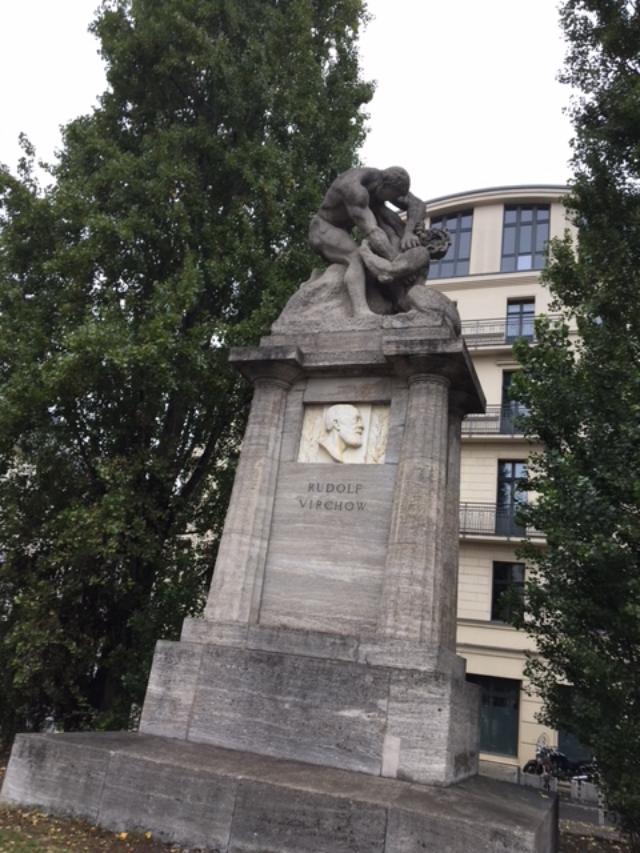
CONTEXT: This was the last of my photos of Berlin I had previously posted online from my visit there in 2016. Berlin was the nexus of my tour of Europe; no other place had played such an outsize role in global events in such a sudden and violent manner, due to its having been the epicenter of Hitler’s efforts to impose his ghastly vision on the world. Many of my posts about the city’s history and consequence focus on its Nazi era, when it was the site of bestial efforts to revive primal domination as human life’s supreme value, an effort undertaken using 20th Century science.
But Berlin before Hitler was a place of many great achievements for humanity, not against it. It deserves better than just a litany of crimes committed there by brutish men who hated its renowned free spirits, and did their worst to replace them with evil ones. So I ended my original online discussion about the city with this reminder of its level of contribution to civilization.
I had never heard of Virchow, who was honored by this statue near Humboldt University. Like Humboldt himself, he is not well-known in the English-speaking world; surely not as much as he should be. Piqued by this grandiose memorial, I researched Virchow, and learned that its drama is not excessive for his achievements.
He was one of Germany’s greatest scientists in the 19th century, a founder of public health studies – now a field of universal significance. He also rejected many racial theories the Nazis would later espouse (he died in 1902, long before their coming), using science to advocate generous perspectives about the fundamental brotherhood of the human family. Such theories were exceptional even for his own time, the Age of Colonialism, when Europeans and Americans were going forth to co-opt and exploit other parts of the planet, taking for granted their inherent supremacy as Caucasians, and their destiny to rule.
This memorial may be a post-war replacement. In view of Virchow’s assertion of the underlying equality of human ethnicities, it seems possible the Nazis might have destroyed any remembrance of him, as they had Lessing’s statue in Vienna. In any case, it now serves as a reminder of a life, and an era, of which Berlin and Germany may be justly proud, with no need to proclaim them the acts of bogus “Supermen.” Virchow’s actual deeds honored mankind’s potential more than any marble trophy could.
In addition to its stain by Nazism, Berlin deserves to have its very substantial contributions to our collective progress reclaim their role in how the city is perceived. Virchow was just one of its residents who made our world better in a practical sense, or even expanded our understandings of the universe (as did Einstein, a long-time Berlin resident).
At first, this statue seemed to be just one more gratuitous Germanic exaltation of strength. But it isn’t; the struggling figures are evidently meant to show the progress, in which Virchow played a major role, in subduing an ogre: Epidemic.
If that is the case, then this truly is a worthy image of an epic accomplishment of reason and enterprise, not a crude effort to warn the viewer to bow to power. Not about mere domination, this portrays our contending with one of the world’s worst scourges. And as such, this dramatic imagery is supremely appropriate.
Given Virchow’s counter-evidence to what the Nazis would later preach, this monument may also suggest how Man’s better instinct can vanquish his baser one, a pestilence often more insidious than those of Nature. This goal can be achieved by great personal exertions like his, or simply by treating life as something savory and thrilling, rather than as Hitler saw it: A blood sport, in which it is the right and duty of the strong to crush the weak.
As such, Virchow’s life seems a fitting end of my postings about Berlin, a partial offset to its being bound to Nazism in the world’s imagination. Stories like his might be truer to the city’s historical essence than its short-lived plague of Fascism. The latter must never be forgotten, but it is far from being Berlin’s whole, or principal, identity.
My last comment on this city, given all the diversity and openhearted (if not exuberant) “Luft” it showed me, is a hope that it may contribute positively to human enlightenment again – even more than the role it once played in our near-run reversion to beasts.
 All Things Gaul