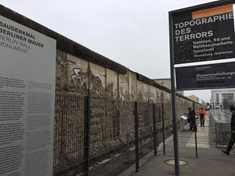
CONTEXT: A bleak artifact of the Cold War between the U.S./NATO and U.S.S.R./Warsaw Pact from about 1950 to 1990, and a focus of superpower military friction which we who lived at that time feared could spark World War III at any moment; a terrifying anxiety to constantly endure. I may repost more captions (referred to in here) about it that I wrote for my other pictures from Berlin later, on this blog.
But I include this item as one of my first blog posts, because in it I speculate that the Nazis’ beastliness could probably only be defeated by an even bigger beast, like Stalin’s U.S.S.R. A depressing, but plausible observation. The Russians overran eastern Germany and captured Berlin in Spring 1945, taking ferocious revenge on German civilians for Hitler’s unprovoked invasion of their land and the innumerable and unspeakable atrocities committed there by German armed forces. It must have seemed like the wrath of one of the warlike Norse gods the Nazis had revered (Thor?) was being visited on them. Nazism proudly lived by the sword, and – unsurprisingly – perished by it, taking much of the prior world with it in its collapse.
The Wall, mandated by pressure from that Soviet ‘bigger beast,’ was started in 1961, meant to stop the outflow of East Germans into (free) West Berlin. So it was actually, in effect a monument to the failure and dysfunction of ossified Communism to create a world most people would not flee if allowed to do so. This essay reflects on the dynamics that finally dissipated Marxism’s inflexible, sacrosanct ideology, as well as on the ultimately futile means deployed to impose and sustain it.
(As noted before, the ‘we’ mentioned in this piece is my friend Paul from Boston, who was with me for the middle part of my travels, from Salzburg to Berlin.)
This is not the same preserved Wall section I discussed in earlier posts, but one we saw from our passing tour bus. As I later learned, this is right next to the Topography of Terror, the memorial on the site of Gestapo headquarters, whose horrendous dungeons survived because the Wall’s Death Strip was later built over their ruins. In a bit of mordant irony, that Strip was one iniquity succeeding another (Gestapo HQ), until events rendered it too, unsustainable – though far less violently than the military apocalypse that subsumed the Gestapo along with all of Hitler’s other foul works.
The Berlin Wall finally fell because Mikhail Gorbachev, Soviet president in the late 1980s, had made clear to Soviet client governments in Eastern Europe that he would not use Russian armed force to keep them in power, as the U.S.S.R. had done in Hungary in 1956 and Czechoslovakia in 1968. And as it became obvious that the Iron Curtain was corroding, the East German regime – though willing to kill a handful of its would-be escapees – had no stomach to slaughter its own citizens en masse. Or at least, not without Russian backing. Or perhaps they finally realized there was no way they could do so with a straight face, and maintain their obviously sham pretense of being ‘a People’s government.’
The details of how the Wall finally ceased to imprison East Germans are complex, but its abrupt opening was sudden, fast and chaotic. On November 9, 1989, after the regime made an ambiguous announcement about loosening transit restrictions at the Wall, crowds of East Berliners approached it demanding to pass into West Berlin, and – almost miraculously – its guards, unsure what their superiors had really intended, let them do so. It was like the opening of the Red Sea to Moses.
Other Ossies (Easterners), on hearing this news, dropped what they were doing and sprinted past the barriers and into the West. They feared their rulers might capriciously change their minds, clamp the gates shut again, and massacre disobedient citizens (as had happened 5 months earlier at Tienanmen Square in Beijing). Many probably had only the clothes on their backs, unsure if they could ever return home, but were willing to abandon their whole prior lives for a straight-forward chance at the liberties they knew existed beyond the Wall. Only vicious force like the Nazis would have used, without hesitation – which the East German state would not – could have crushed such a huge popular upsurge.
The Wall ultimately turned out to be a futile, feeble thing, its grip inexorably worn down by the restive, rumbling hostility of millions of Europeans and their hopes for self-actualization, instead of a Socialist straight-jacket worldview. With wondrous irony, it was almost inadvertently opened by bureaucratic fumbling between the East German regime and its security forces.
(In Moscow’s Eastern Bloc, obedience to Marxist doctrine often counted for more than practical competence. The confusion that led to a sudden lapse of restrictions may have been partly a spectacular instance of people who got critical jobs because they were loyal, rather than because they were capable.)
And the evil spell of fear and helplessness in nations where the U.S.S.R. had imposed Stalinist Communism after World War II withered over a few breathtaking weeks, crushed under newly assertive popular aspirations. If you want to see the power of collective will and spirit, find and watch film of that electrifying November night at the Wall. It was astonishing, glorious, and intoxicating to people watching it on television, as much of the world did. East Berliners standing atop the Wall, with the Brandenburg Gate in the background, bashed at it with sledgehammers charged by decades of pent-up rage. That was an image for the Ages; the atmosphere in Paris after the fall of the Bastille may have felt much the same.
Lenin, father of the Soviet Union, once said that a successful revolution is usually just ‘the kicking in of a rotten door.’ And so it was; in 1989, the ‘Annus Mirabilis’ (Year of the Miracle), the festering Soviet Empire in Eastern Europe collapsed with relatively minor ripples. The West’s dynamics of individuals’ worth and autonomy – which, rather than sullen Russian passivity were the true opposites of the Nazis’ glorification and mobilization of our worst instincts – had finally outlasted the East’s downtrodden subservience.
Such a ruthless, despotic use of Soviet power had been essential to do most of the bloody, brute work of pummeling Hitlerism to death. But whether those Western style ‘dynamics’ have triumphed forever is still unfolding now, in 2017.
(And regrettably is still ‘unfolding,’ in 2022, as of this re-posting. Demolishing the concrete of the Wall was only the start, and possibly, the easy part, of making a truly ‘Free’ world.)
 All Things Gaul