CONTEXT: My 2016 journey through Europe began in Paris, but ended with less than a full day in Amsterdam. I selected that city as a departure point because I wanted to see Rembrandt’s masterpiece, ‘The Night Watch’ there (which I’ve written on extensively, items I may re-post here). Writing about that quick visit later brought out my inner historian, in my observations below about the Netherlands, especially in the mid-17th – mid-18th centuries when it was a principal world power.
Before Amsterdam, I had spent several days in Cologne, Germany inspecting and pondering its cathedral (the ‘Kolnerdom’, shown earlier in this blog, lit by the setting sun). In this piece, I graze upon the differences in the two worlds represented by Cologne’s great church, and the very different world nurtured in, and by post-Reformation Amsterdam (noting its most famous church, the Westerkerk, tellingly modest compared to the Kolnerdom).
The ‘Rijksmuseum,’ or ‘State Museum,’ houses many of the greatest works from the Dutch Golden Age of painting, including Rembrandt’s ‘Night Watch,” but it is not only an art collection. It displays items that show many aspects of the nation’s history and contributions, including the outsized role the little Dutch Republic played in the Seventeenth and Eighteenth centuries’ great burst of exploration of the wider world by Europeans.
I had hastened from lunch to see ‘The Night Watch’ before the museum closed. After paying that homage, I spent the remaining 40 minutes examining the rest of the paintings there (all of them Dutch, I think, as a place dedicated to telling only the homeland’s story, not of world culture in general).
So there was really no time for me to do more than pass through other galleries of artifacts of the nation’s scientific, commercial and maritime, etc., heritage, nor the many displays from Dutch colonial territories around the world. Their empire later ebbed in size, much of it taken over by the British, including their North American and South African possessions. The Dutch East Indies, modern Indonesia, remained their largest foreign colony until after World War II, when it became independent.
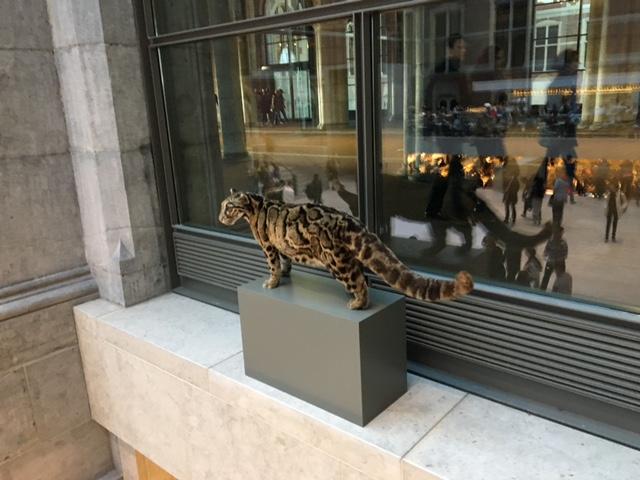
But this beastie in the Rijksmuseum caught my eye; there was no explanatory panel, but I think it is a stuffed ocelot. It was probably from some tropical colony of the Netherlands, brought (alive or dead) back to the homeland as trophy or curiosity. Presumably, elsewhere in the museum were also relics of the spice trade in the Far East, the greatest single source of wealth from Dutch overseas domains, and perhaps specimens of the plants on which the precious herbs grew.
Such items (likely privately acquired and eventually chosen for the Rijks) showed the people back home how wide and varied the world really was, very different from the flat Earth Medieval view that had preceded it. What Medieval Europeans knew (or thought they knew) about other parts of the world was mostly via convoluted and often inaccurate legends, but here were genuine articles brought from distant places previous Europeans had not even known existed, let alone seen.
Such questing and curiosity were consonant with the incipient Renaissance-Reformation mindset that human beings can control their fates and environments; very different from the other-worldly preoccupations of Cologne cathedral. However, looking back on how exploration, colonial exploitation and subsequent developments harmed other parts of the human and natural world – in some ways that still continue into the 21st Century – whether that new quest for control, propelled by still-imperfect men and their desires, was an unreservedly good development is not entirely clear.
Amsterdam was one of the places where the practical effect of Protestantism leading to greater individual self-actualization began to manifest itself most visibly and extensively. In that outlook, men did not have to believe that they were, more or less, essentially at the behest and mercy of divine manipulation and intervention.
That certainly is not, of itself, a bad thing, as I, steeped in the American culture of self-determination, will vigorously agree. It is splendid that we can better understand and manage the planet we inhabit, and human life today is unquestionably better in innumerable aspects than when either the Kolner Dom or Amsterdam’s (much later) Westerkerk were begun.
Yet, our world today – now, so much the product of human reason and individual autonomy – is still hardly Utopian. That is a realization that merits reflection.
 All Things Gaul