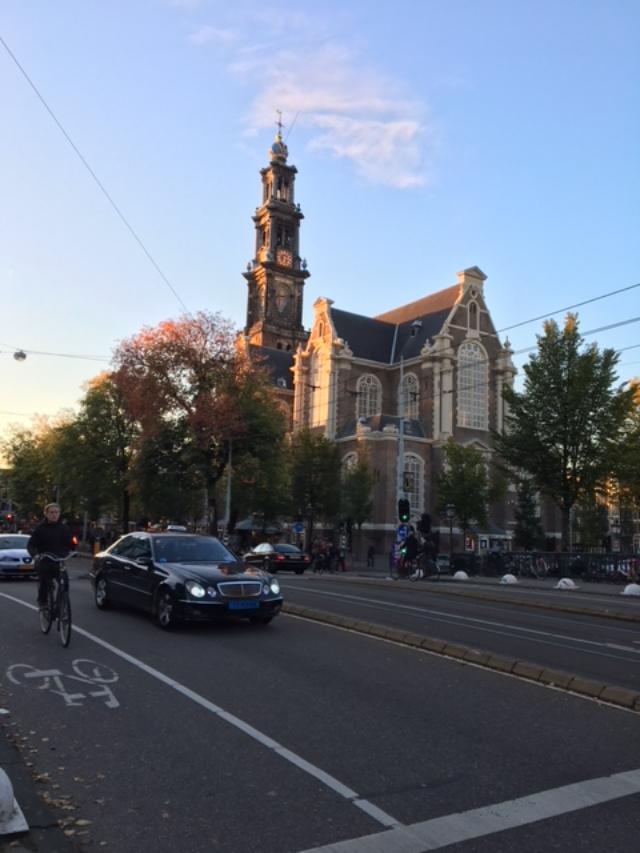
CONTEXT: This picture was among my last from my 2016 visit to Europe, as I prepared to return to the US via Amsterdam after seeing Rembrandt’s ‘Night Watch’ there. Before that, I had spent a week in Germany (Berlin, then Cologne). After returning home, I reflected on what I’d seen in the homeland of Nazism, to try to express in both historical and personal terms how the benefits released by individual empowerment (discussed below) played roles in putting us on paths to such outcomes as atomic weapons and Global Warming. Paths that were unforeseen.
But possibly not unforeseeable. The Reformation was surely pivotal in fostering our ideal of the primacy of the individual (and his right to pursue his own best interests), but here I consider whether that did, or could, make us truly ‘better’ – or if it also served, at least partly, to highlight the distinction between human intelligence and actual wisdom. And focusing on Amsterdam, a city whose immense role in creating the world and culture we know today, and which came to exemplify such primacy, led to me to consider – with benefit of hindsight – the implications of developments started, enhanced, or accelerated there. And to what consequences they ultimately led as they played out over time.
I used this building, the monumental ‘Westerkerk’ (West Church; this text refers to another picture I took of it from its front) and its origins in the Dutch Golden Age to serve as a referent for my observations here, on the questions above.
Also, the other post this one refers to at its end, is one I wrote about Rembrandt’s painting ‘The Jewish Bride.’ When these were first put online, they were, as it says, adjacent. But on this blog, they are separated by one entitled ‘Marvelous Beasts.’ If you wish to read my final post from Europe – offering my reflections on the impact of having visited Germany and its Nazi miasma – please look for ‘The Jewish Bride,’ published on this blog on December 22, 2022.
Westerkerk, Reflections: Here is the Westerkerk, looked at from a different angle from my previous image of it. I photographed this view partly just because it is a handsome structure I wanted to admire further, but also as a metaphor for trying to see more perspectives than the one that most immediately presents itself. And I don’t mean simply looking at it from another physical angle, or saying more about its history than I did with my earlier photo. I mean examining the cultural implications it represents – since its origin, up to our own time – as I did for the Kolner Dom.
As I write on my home computer, in preparation to post descriptions of my travels on the global bulletin board of the internet, I reflect (again) that the possibility of doing such things are just some of a multitude of modern phenomena from which I personally benefit, and am glad for. Others are the ability to travel the whole world, and the need such enormous distances spurred for faster communication. Westerkerk didn’t directly have a thing to do with creating any of those, but it represented the post-Medieval mindset that would drive the courage, incentives and ingenuity (and validate the desire for personal gain) to seek solutions for such travel, communication needs etc., and to fill them.
As noted in earlier Amsterdam posts, such an approach to life, in which Man could actively shape his own destiny, was a seminal leap beyond the constraints of the West’s consciousness in the Middle Ages. Earlier Europeans had simply assumed that life was inherently tenuous, and the world a place so massively mysterious that finite human minds were probably never even meant to fully grasp it. So they had deployed much of their ingenuity and resources into honoring the Christian understanding of eternity; their hope, and possible reward, for enduring the here-and-now, for appreciating the gift of merely existing, for possible redemption from every form of innate human imperfection, including mortality itself.
Amsterdam however, by virtue of its trading advantages and tradition, its primacy in the Protestant Dutch Republic, and by the industry of many of its citizens (who knew they would be applauded, not disapproved for seeking self-improvement), played a bigger role than most cities in creating the world we have today. Its rows of tidy, solid houses were the work of a society willing and able to make this world better, without focusing exclusively on an unseen, unknowable afterlife. Indeed, in the Westerkerk’s and related cultures, material wealth in this life was often assumed to be evidence of divine favor and proof of worthiness for further reward in the next. (Much later, that premise would have a role in Karl Marx’s critique of religion as he devised classical socialism, but that is far beyond the scope of this writing.)
But Westerkerk was a Christian church, and the Amsterdamers were not simply indifferent to dimensions of existence beyond this one; for them, Christ was still the irreplaceable key to Heaven, which remained the ultimate goal. However, their vision of it had far more room for human agency, in which our species had not just the ability and right, but a duty, to use its singular brain power to “tame the Earth and subdue it,” to benefit ourselves. Gradually, Western society has made the here-and-now its main preoccupation, the one sphere we can see, control, and rely upon. Hope of personal validation in some other plane of being has, incrementally, come to be tacitly rejected: A sort of “Paradise, Tossed.”
This leads me back to my “unforeseen costs” remark in my post about “The Night Watch,” as well as a prior reference about how Japan was a part of the Dutch trading network. Japan was never conquered outright as many other European imperial possessions were, but from the Seventeenth to the Nineteenth Centuries, its government permitted the Dutch, alone among Europeans, to trade within their country. (I’m not sure why they were chosen. Perhaps the Japanese feared that Britain was too powerful, and if invited onto their territory, might take over. The Dutch may have seemed less formidable potential foes.)
This arrangement led to a circumstance too tenuous to be considered a cause-and-effect connection, but nevertheless, one that strikes me as a coincidence so unlikely as to justify calling attention to it.
All the striving and inventiveness of the Dutch continued to interconnect and reverberate, augmented by accumulating scientific discovery across Europe, helping to shape the entire modern age. But improved science and technology wielded by unimproved humans – still too often driven by self-interest or aggrandizement – can bring fearsome results. By the time of World War II, the Dutch had long since lost their monopoly on access to Japan. Other western nations were active there, and Japan was the one non-Western society that became truly dynamic, and rose to national power and vigor elsewhere achieved only by Caucasians.
But the Japanese city in which the Dutch had their sole trading post for 200 years – through which they extracted local wares, and through which Japan, long deliberately isolated by its rulers, began to view and imitate the growing order and technology of the West – was Nagasaki. It was also where the second atomic bomb would be dropped, effectively ending World War II.
Far more portentously, it put apocalyptic power in fallible human hands.
No one could have anticipated that the West’s growing ability to manipulate the physical world would lead to the horrifying happenstance of Nagasaki’s fate. It is, I repeat, only a coincidence that the vigor Amsterdam helped, disproportionately, to radiate would eventually lead to the colossal forces that contended in global struggle, and to the stupendous scientific endeavors over the prior 300 years that had catalyzed it.
Still – What a coincidence. It seems to me the most significant of ironies that of all the cities on Earth, one of only two at which Man first brought Doomsday on himself happened to be where the inquiring, increasingly confident rational spirit that also built the Westerkerk had, for 200 years, entered the land upon which the bitterest fruit that grew (along with the sweet) from its tree of knowledge would fall to the ground – poisonous and world-shattering.
To say the least, Japan’s intercourse with the Dutch and their civilization was not ultimately an entirely beneficial encounter. Nor was western man’s rise above passivity (inflicted, during the 19th Century, on much of the non-Western world in the form of exploitative imperialism) accompanied by a fully offsetting increase in grateful, sensible benevolence. We were starting to release, in the interests of not being in the grip of Nature, unprecedented forces we lacked the comprehensive wisdom to wield, and whose full consequences we could not foresee. Seemingly harmless, tentative steps that often warped into something very different much later started, for good or ill, in places with spirits like Amsterdam.
And this tension between measurable gain and unforeseen detriment is still playing out, in less violent, if still dramatic ways. Because much of the Netherlands is at or below sea level, it has centuries of experience at compensating for rising water levels (dikes, polders, windmills, etc.). It is now selling that knowledge, augmented by computer modeling techniques, to other countries whose coasts are suddenly at risk of rising seas due to Global Warming. I applaud the Dutch for sharing that vital expertise, even as I note their (unintended) role in creating a world in which the glorification of the individual – his autonomy, abundance, convenience, amusement, etc. – became such an unstoppable force that efforts to serve it are now disrupting the natural functions of our planet.
Obviously, none of Rembrandt’s contemporaries worshiping in the Westerkerk could have foreseen all that, but it has arguably turned out to be one result of the West’s incremental focusing mostly on trying to make this world and life as near to Paradise as possible. For no amount of individual genius can fundamentally improve “this world and life” if there is no compelling bar to its being used (as Hitler used so much contemporary science) as a platform to serve unreformed forces such as greed and pride, that have so long degraded them. We dare not just accept those factors as intractable, and assume that science will somehow find a way to offset them.
Anne Frank’s terrified refuge, so near this building, might also remind us of that.
Am I glad for all the technology that flowed from the stout Dutch ships and all the science that they and other Europeans devised to enhance their lives, that continue to improve ours? Absolutely. Do I see them as ends, in and of themselves, that consummate and validate the entire human experiment, the peak of our potential accomplishment? No; if they are indeed our best, history suggests that malevolent impulses will likely eventually just outrace them – again.
In my view, scientific advances are a path, not a destination. Any true, full transformation – that is, positive Evolution – we achieve must come from elsewhere. For what would seem to me to be a better goal for us to aim at, collectively and individually, please see my next posting, my last for Amsterdam, and for my whole 2016 journey.
 All Things Gaul