CONTEXT: Today, January 6, 2023, is the second anniversary of the attempt to disrupt America’s lawful governance by mob violence. It is also – ironically – the Twelfth and last day of Christmas, and supposed date the Three Kings (Magi/Wise Men) reached Bethlehem to adore the newborn Jesus, an encounter called the ‘Epiphany,’ the revelation of Christ to the world.
That word also connotes realization, and as regards the anniversary, though American democracy survived that day, we all got a ‘realization’ of its fragility: We saw a self-absorbed U.S. President try to cling, criminally, to power with the help of legions of fanatical supporters. That barbaric spasm failed, but the fact it even happened implies the extent to which brute power may still be what ultimately rules our squalid plane of mortal being.
In contrast to which, my re-post below from 2018 references a source of personal affirmation very different from the motives of Americans willing to release primal passion (which suggests lesser, not greater humaneness) to uphold their longstanding supremacy, which they see as an entitlement.
That Riot and Epiphany were not connected, but are related by opposition. That is, if the Rioters practiced the outlook that underlay Epiphany, they would not serve a vain, foolish, cruel Narcissist who told them what they wanted to hear about their alleged grievances. If their status as Christians – as many rioters thought themselves – had been actual, not mere ‘identity,’ they would not have wanted what they did; nor behaved as they did.
As my blog Introduction says, ‘I try to articulate things that many people likely privately think, feel or simply need to believe. Such as the premise that life is worthwhile and benign, despite all evidence that it is not. To give substance to perceptions held by people who rarely speak of them aloud, and may even feel conflicted to admit to themselves. Even if they might benefit from them personally, and even consequently help make a better World.’
All of which my re-post here presumes to do: to suggest a basis in which personal worth need not come only from individual status or achievement – which are often as much about opportune circumstance as personal virtue. To point out a foundation on which we might build trust that our lives matter, regardless of whether or not we have ‘opportune circumstances.’ To draw attention to an expression of faith which may surpass self-aggrandizing appetites for domination and privilege.
Many rioters probably lacked significant real life advantages, which stoked their resentment at the erosion of their only (and bogus) one – traditional class and gender power – which they tried to claw back violently. My essay reconsiders a worldview in which that type of self-validation is unnecessary.
In our era, religion no longer seeks to explain the physical world. Reason has deciphered much of that sphere, and also greatly softened its harshness. But reason alone cannot satisfy desires like a widespread, integral sense that Life must have an ultimate purpose greater than increasingly comfortable longevity. That sense is not about what can be proved, but about where to repose sustaining reliance: Faith.
My post invokes the ancient Christian premise of individual worth: Every last one of us is loved by a gracious deity. Accepting such a datum point may enable us to complete a process arising from great rational achievements: Letting empathy seep like divine breath into our being, and making us willing to share more fully the abundance of an Earth that science has made capable of providing sustenance and dignity to ‘every last one’ of her children.
That premise may help us discover our best Selves, defining and enhancing the value of our personal time on this Earth – of our own humanity – at least as much as the alternative of fiercely focusing on priorities such as pride and dominion may diminish it.
An alternative so terribly displayed in our temple of Democracy, two years ago today.
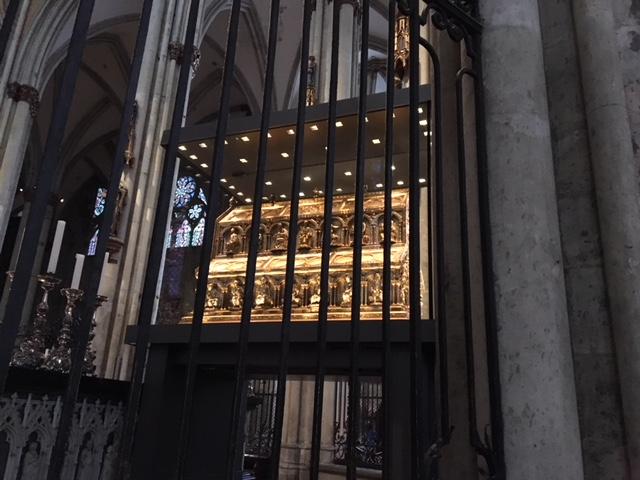
Cologne Cathedral, Reliquary of the Magi (the Three Kings): This gold, crystal and enamel cabinet, one of the most glorious artifacts of the entire Medieval world, took some of the best artisans in Northern Europe more than a generation to create, between the 12th and 13th Centuries. Nothing less than its intricacy and rare materials would have seemed suitable to honor the relics it contains, traditionally held to be bones of the three Kings who adored the newborn Jesus in the stable in Bethlehem. The irreducible preciousness of these objects has been an integral part of Cologne’s self-image since the era of the Crusades, and a major part of the reason it has so long retained its status as a place of great importance. Three crowns, representing the Kings, still appear in the city’s coat of arms.
This vessel definitely does contain human bones, and while it seems unlikely that they could actually be the Magi, their pedigree cannot be dismissed out of hand. They have a well-documented history, unbroken for more than 1600 years. I don’t know when they first entered the historical record, but Constantine gave them to a church in Byzantium (now Istanbul) in the Fourth century, then they were sent to Milan, in the Seventh. 500 years later, Holy Roman Emperor Frederick Barbarossa took them from Milan and gave them to Cologne in appreciation for its archbishop’s military assistance (to this day, some Milanese lament their loss). Several decades later, plans were begun to build this current church to house them in reverent resplendence; it has been their home ever since.
Today’s Kolner Dom was designed to be a suitable shrine, as evocative of Heaven itself as possible, for such objects of saving grace. Cologne became a major site of pilgrimage to venerate them, attracting economic activity that contributed greatly to its long term vibrancy. Although the cathedral was only finished to its original plans in the late 19th Century (by Prussian kings largely interested in the political advantage they might derive by doing so), the devotion that called it into being was fully Medieval. Its exuberant, yet solemn aesthetic had been meant to inspire beholders in a quest for Salvation, then assumed to be everyman’s ultimate goal, and deepest desire.
I don’t know a lot of details of the reliquary’s 800-year history, but suppose that it survived the tumult of the Reformation, during which uncountable pieces of ancient Christian religious art were destroyed as idolatrous by iconoclastic Protestants (a major heritage of Western creativity lost forever, owing to one of many violent passions of that time which we may no longer fully comprehend) because Cologne was in a part of Germany that stayed largely Catholic.
French Revolutionary troops attacked the still incomplete cathedral in 1794 and did damage to the reliquary that was later repaired. The Nazis extolled it mainly as a specimen of German genius (actually, master artisans from several lands – working when the cultural frame of reference was principally Christendom, not linguistic identity – contributed to its making), and removed it for safekeeping when Cologne became acutely liable to Allied bombing in the early 1940s. After peace returned, it was restored to its traditional sanctuary behind the main altar.
It is easy to see how things like this extravagant cabinet and its alleged contents may, to people of the 21st Century, chiefly suggest superstition, and exploitation of the gullible. And there is some truth in that, in terms of the general ignorance and unsophistication of most Europeans and their society at that time, and of the willingness of some church and secular authorities to profit financially from them.
But unconsidered disparagement of a past era (to the benefit of one’s own) is an historical snare against which I have cautioned before: Presentism. That often involves much oversimplification, of people from one age adversely judging an earlier one, without reflecting on why its outlook and resulting choices might in fact have been appropriate – or at least the best feasible option – for its own multifaceted context. Men who were simply stupid could never have conceived nor executed this sumptuous treasure, let alone devised the spectacular structure that would house it (nor similar ones completed all over Western Europe in the same era). The nature of their motivations – which were admittedly based on less knowledge of the physical world than our own – is surely more nuanced.
We in the 21st Century should not view Medievals and their deeds exclusively at a superficial level, simplistically attributing their priorities to wrong-headed ignorance. Doing so may whiff of un-self awareness, for any sense of our own having neared true enlightenment is belied by the global havoc in the 20th Century by mechanized warfare, for which science was harnessed – as well as ongoing human misdeeds in our own century. In fact, we really have far less excuse for folly than Medieval people had, yet are making Earth uninhabitable, overtaxing it to feed voracious consumerism. We are better informed, but not incontestably wiser.
Thus, if one wishes to be accurate (and fair) about where the truth may lie, one must look deeper. We should consider the sincerity of Medieval efforts to seek greater significance for human life than just prolonging the flesh, or hyper-focus on individual actualization. That is, on defining some significant purpose for it, in which everyone might share and from which everyone might benefit.
As acknowledged before, I certainly wouldn’t have wanted to live when the Dom was first being built, and not just because of the era’s appalling medicine, hygiene, etc. As one born in the 20th Century, and heir to the Catholic church’s Second Vatican Council’s seismic reconsiderations of religious doctrine and practice, I would have been repelled by the destructive parochial tribalism of Medieval Europeans, their tendency to validate themselves by devalidating others as heretics or infidels, treating other beliefs as loathsome, intolerable affronts. Such attitudes now seem to be misreadings of perceived divine intent, irreconcilable with the idea of God as love.
But they were not the whole story of that culture. Most peoples’ lives then were a relentless ordeal by our standards, of discomfort, filth, hunger, sickness, and manifold omnipresent perils. Many might have committed suicide to escape such unremitting burdens had they assumed they would just be extinguished by the grave anyway. Instead, their way of contending with those struggles was not wrought just in the masonry of their churches, but by the immaterial wealth they also presented: A faith in Divine affirmation, believed to offset extinction at death. For this, their individual deeds, and how they faced the adversities of this world (seen as parallels to the sorrows of the Crucifixion, itself endured to pierce the bounds of human frailty) determined merit for the reward of Paradise.
Such a faith may appear nebulous, or even irrational to us, but it enabled them to withstand hardships of which we might despair. They relied on it, as many now do on science (despite all its unintended consequences) ‘to save us.’ What may seem exaggerated reliance, or superstitious delusion, to one era or person, may be indispensable, sustaining grace to another; hope that makes life worth enduring.
A pilgrim trembling with devotion or ecstasy before the Magis’ relics believed that undertaking a journey to them brought him closer to One through whom Heaven might be opened to him. Such solace must have softened the jagged edges of his own very hard existence, and proffered some promise – in ways material security alone never could – for being free of want and sorrow, and of evanescence.
Spurious relics were an open scandal of life in the Middle Ages, used to pry money from trusting souls, and a legitimate grievance of Martin Luther. Many such objects were mistakenly attributed; others were undoubtedly deliberate fraud. But in their highest instances – the Kolner Dom’s Magi relics were one such, St. Mark’s in Venice (with the supposed bones of the Evangelist) was another – they were more plausibly what they presented to be. And they brought forth trenchant ingenuity, used to shelter them (like the Dom); then the masses of heartfelt meditations they evoked; and finally the great aura of longings, both awakened and fulfilled, with which they gradually, and almost tangibly, became lustered.
Such veneration was a part of the aspirations of a civilization in its quest – one that logic, alone, might never still, nor appease – for a fundamental reason for conscious life beyond its grim, visible character as “nasty, brutish, and short.” To the faithful who came here to ponder the Three Kings – especially to those who were not rich and powerful, nor brilliant and talented, just the common children of God – these objects helped to hallow and illuminate their lives, no matter how miserable, nor ultimately meaningless all rational evidence might suggest they were.
For at base, they asserted an absolute and universal benevolence for all men and women, everywhere and forever, through Christ’s incarnation.
And that premise of universal benevolence – now more generally understood to be fundamentally embraced by the righteous of the whole human family, not just a clique of the doctrinally sound – may still shine with accessible simplicity, burning like the dawn through mists of extraneous erudition or dogmatic encrustation, even through instances when its spirit was horrifyingly absent or misapplied, as in the Crusades. The potential harm caused by religious faith can undoubtedly be massive, but its potential to release, and even to help form, our better Selves may be just as great; and occasionally, greater.
Unlike excesses of fanaticism such as the Inquisition, Cromwell in Ireland, or our own era’s radical Islamic terror, most private successes of faith – lives quietly consummated by the work of the spirit in humility, meditation, charity, and deliberate efforts to make the world a better place out of gratitude for the gift of existence itself– seem too intimate and prosaic to appear in history books. But they were immense forces in the Europe that spawned this church, and satisfied needs that are still woven deeply into the fabric of human consciousness.
A desire that baffles and eludes the mind may nevertheless be insistent for the heart. Some of the most pervasive beliefs offer answers we may all share, because they refer to concerns (especially mortality) in which we also all share. The people who conceived the Dom treated the brevity and coarseness of their own lives as motivations to connect with something limitless, imperishable and perfect.
These may not really be the bones of three west Asian savants, but there was nothing false about the good they must often have done for pilgrims who placed, and found, hope in them. Whether or not they literally made the lame walk or the blind see, they must have wrought marvels just as vitalizing. They helped to rescue, with consolation and peace, what might, dispassionately, seem to be the pointless lives of undistinguished people who contemplated them – and found soothing succor in the radiant, redeeming Nativity story of which they were part.
The relic-like display of iconic documents such as the original American Declaration of Independence, or the embalmed remains of Lenin and Mao Zedong, suggest that the craving for visualization may appear even in cultures that consider themselves emphatically reason-driven. Presumably, this is because most of us ordinary folk benefit from seeing tangible emblems of rarified abstractions – talismanic of forces beyond troublesome, everyday reality – which might otherwise be grasped only by a sophisticated elite.
Thus, in many times, places and cultures, the appeal of objects held to be ‘sacred’ persists, symbiotic with the refracting power of the great lattice of personal perception and reference. In the case of the Magi relics, that is because what they simply are – old bones – is so far transcended by what they represent: An enduring, shared joy, glittering as the Star of Bethlehem, in the promise of Life, in defiance of the ephemerality of lives.
 All Things Gaul