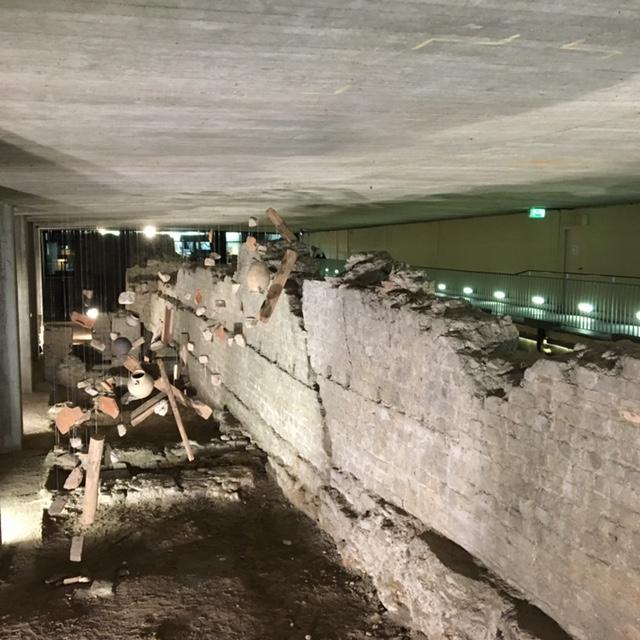
CONTEXT: This photo accompanied my post, below, from my 2016 Europe visit. It shows remarkable archeological treasure about 10 feet below Cologne’s present street level.
After central Cologne (‘Koln’ in German) was largely bombed to rubble in World War II, choices were needed about which structures to rebuild and which to consign to history, to save scarce restoration resources. Previously, the ‘Spanischer Bau’, ‘Spanish Pavilion’ for diplomatic activity when Cologne was a self-ruled Free City of the Holy Roman Empire, stood above the site shown here. The venerable Bau had been destroyed in the air attacks and was not rebuilt, replaced by new government offices (their floor slab is this ceiling).
Cologne was originally ‘Colonia,’ a provincial capital of the Roman Empire, its furthest north major city in continental Europe. The destruction of its urban fabric in Hitler’s war exposed remnants of many Roman structures (some known, some long forgotten) concealed for generations by later construction.
One such was the site shown here, foundations of the ‘Praetorium,’ palace of the local Imperial governor. Cologne had long been most renowned for its astonishing Gothic Cathedral, but when rebuilding the devastated city, it was decided to reveal many of its long-hidden antique vestiges into the public sphere, as the bomb wreckage over them got cleared.
For the Praetorium beneath the vanished Bau, the arrangement shown here was devised. The new municipal facility was built over the Imperial remnants, but designed to preserve them, while keeping them accessible to the public.
Cologne’s Roman beginnings are a fascinating part of its heritage, many physically re-emerging as a result of destroying Hitler’s Reich, the Teutonic heartland he rightly boasted the Empire had never effectively conquered. But as alluded to in my post below, Nazi Germany – showing barbarism akin to that for which the Romans had such contempt for Germans of long ago – was overcome, in part, by other forces that Classical culture consciously deployed: Rule of law, and much more channeled reason than unleashed passion.
Not visible from outside, this site is well worth following public markers to find. Not only for its artifacts but its intimations, as my post below tries to suggest.
Ruins with Suspended Artifacts: This view of the foundations of the Praetorium shows a flock of ceramic and clay pottery fragments, seemingly hovering in mid-air. These were artifacts discovered during the excavations of the site, now artfully suspended to show their exact positions in relation to the ancient stone and mortar when they were found. This was to illustrate the reality of archeology, in which items lost or discarded long before are uncovered in random disarray, unlike the tidy displays in museums.
Another section of this wall (not shown here) had a large, semi-circular gash like some monster had swooped from the sky to tear a bite out of it. This was identified as damage caused by a bomb that pierced the now lost Spanischer Bau above, then exploded down at this level.
The Nazi era is not my main focus for Cologne, but this detritus, seeming to float across time, moved me to meditate on Roman daily life. And I reflected how unlike their Colonia, this city today is the work of free people, not largely of slaves – another aspect of “Roman daily life” – to sustain the comfort of their owners, but whose own lives, let alone wishes, merited little sincere concern.
But not so very long ago, the Nazis tried to reverse the long momentum towards consigning slavery to evil memory by reviving it to support their war economy. Some 8 million people from their conquered territories, mainly from ethnic groups Nazi doctrine branded sub-human, were shipped to the Reich and forced to do jobs performed in peacetime by Aryan German workers or farmers, now off fighting Hitler’s wars; or dangerous weapons/munitions production under terrible conditions and violent supervision, for little or no pay, and dismal food and shelter.
(I don’t know if many such slave workers – “Sklavenarbeiter” – were made to work in Cologne itself or its near environs, but many surely toiled in the factories of the Ruhr area to the north. And a great many were killed, all over Germany, in the bombing of the strategic facilities in which they were forced to labor; innocent, collateral victims who didn’t even want to be there, much less to help Hitler.)
The real “sub-humanity” in all this was the Nazis’ hyena-like pressing of their (temporary) advantage. But that seemed only proper to true-believer National Socialists in thrall to the idea that Fate favored the ruthless wielding of power by anyone fierce and strong enough to snatch it. They tried to create a Teutonic version of Roman cultural values beyond whose inherent cruelty the Western world had largely long since evolved.
The British and Americans held that such attitudes were anathema to all progress of legitimate civilization, so repugnant that they had to be defeated regardless of the costs or means. So it seems a macabre irony that Cologne, former German locus of warlike Roman practices the Nazis sought to partly emulate, was thoroughly flattened in the horrendous struggle to thwart them from doing so.
Such observations are not directly connected to this picture of old rubbish, but the latter is an allegory for how fragile and transitory our species’ improvement – like so much busted crockery, though far more precious – can prove to be. Due to brutish efforts to push the world backward toward a grimmer reality, and to what it might have become again, had they been allowed to prevail. Slavery would not be merely a hateful footnote of a benighted past but, consistent with the Nazi concept of Germans as Earth’s ‘master race,’ a scourge revived on a vast scale.
The Romans, even rich, powerful ones, dwelt in a milieu of such omnipresent harshness (average life expectancy then was apparently about 35 years) that it was, arguably, unsurprising they might be hard-hearted enough to exploit their fellow men to make their own lives less generally dreadful. This does not excuse their callousness, but may at least help explain it. Besides, slavery was hardly unique to Rome; most pre-industrial societies practiced some form of it.
But Germans by the 1930s, the Nazi era, had myriad advantages people in antiquity lacked; superior medicine, safer food supplies, sanitary housing, greater knowledge of the natural world, the empathy commended by the 18th Century Age of Reason, etc. To say nothing of ages of exposure to the theoretically pervasive Christian ethos of “Love thy neighbor.”
Thus, unlike the Romans, 20th Century Germans – it seems to me – deserve no benefit of partial indulgence due to their own inescapably miserable circumstances, or to the social norms of their time. And unspeakable as World War I was, the Nazis’ crazed resentment at their country’s defeat in it doesn’t come close to excusing the bestial kill-or-be-killed theory of life they devised to avenge it, nor their attempted forced march backwards towards many evils – of which slavery was but one – of darker eras past.
It would be understandable if most ordinary Germans were unwilling to brave the the Third Reich’s ghastly terror apparatus, and tacitly accepted Hitlerism mainly out of fear. I myself wouldn’t have been nearly courageous enough to actively oppose it. But beyond the committed Nazis was a large cohort of Germans (if not a majority) who gladly overlooked Nazism’s overt monstrosity – at least while they were winning – in return for Hitler’s reviving the nation’s economy, for telling them that as Germans they were better than anyone else, and for showering them with booty like foodstuffs from conquered lands.
Such folk may have had private misgivings about Hitler, but put them aside for near-term advantages (many of them unethical at a glance). As such, they failed to show a shred of the generosity they might have, if only in gratitude for the good fortune of living amid the gentler realities of a gentler epoch.
Unlike ancient Romans, they should have known better; they should have sensed better. They had no persuasive rationalization for being witting accomplices to such profound malevolence.
Full stop.
 All Things Gaul