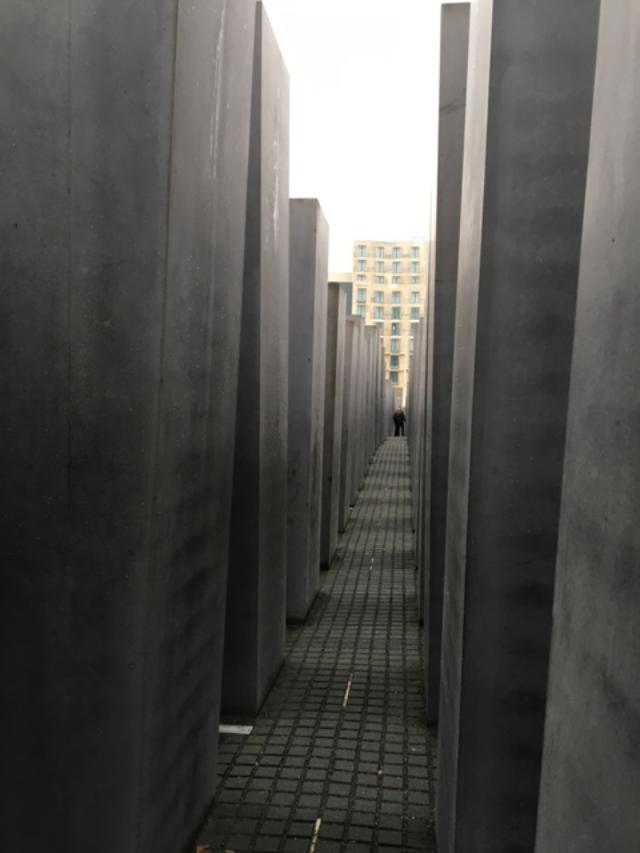
CONTEXT: Below is a re-post about Germany’s national monument to the Nazis’ murder of 6 million Jews, from my 2016 visit to Europe. Memorials should not just be passive reminders, they should help us grasp the gravity of events we did not personally experience; an urgent function of ‘History.’
To give an example of the importance of this which directly impacted many people reading, in 1933 Congress passed the Glass-Steagall Act in response to behavior that caused the Stock Market Crash of 1929 and Great Depression. It restricted the activities of banks and financial firms many of which had been reckless, gambling with the money of unsuspecting investors.
G.S.A. helped moderate Wall Street for decades, but by the late 1980’s most people actively involved in the ‘29 Crash had died, and such legislation began to seem (to a new generation) as useless impediments to free markets. So the financial industry got G.S.A. partly suspended, re-authorizing profitable but risky trading. Sure enough, by 2008, such gambles wrought another economic calamity. G.S.A. might not have prevented the Great Recession of 2009 but had it still been fully in force, financial firms might have been constrained from some reckless activities – and attitudes – which blew up then.
The adulterating of Glass-Steagall displayed how we may fail to apprehend the full import of events we did not witness ourselves. An infinitely more dire example is the Holocaust, which can show how lives – and our own worthiness as human beings – may be at stake for failure to learn lessons from the past.
As the last survivors of Hitler’s ethnic slaughter (and those who watched it happen) are now dying, the urgency of recognizing the implications – mass murder to solve some alleged problem like a ‘Jewish Question’ – of this hideous atrocity, along with the indifference or complicity that facilitated it, ceases to be a duty of memory.
It becomes instead a test of posterity’s moral conscience. Can we register, viscerally, horrors that are not in Living Memory? If we cannot or will not, can we ever advance beyond repeating them? This Memorial presents that as a challenge to our ability and willingness to recognize evil as an abstraction, then confront it before it hardens into harsh, concrete reality.
Holocaust Memorial (Claustrophobic view): Formally called the Memorial to the Murdered Jews of Europe, this maze-like battalion of multi-sized concrete blocks (“stele”) occupies a three football-field size site near the Brandenburg Gate on space left vacant after the Berlin Wall and its Death Strip were removed. As other land nearby got developed during the ‘90’s, it was decided that this area should be set aside for a fitting national shrine to the most massive criminal undertaking – of which there were many – by the Third Reich.
There is a superb information center here, but personally all I needed was awareness of the memorial’s subject to be impacted by my encounter with it. Some 2700 of these blocks, sightless, soulless sentinels whose function is to constrict and menace, mark aisles like this one. Many form canyons high enough to isolate visitors, visually cutting them off from the cityscape around them and from each other. Even more unsettling, the foot surface is deliberately not level, detectably undulating; walking through it was disorienting and subtly, but unmistakably, disturbing.
A visitor feels severed from all typical sensations, caught in an oblique world in which anything – no matter how horrific or contrary to basic assumption – can happen. That vaguely jarring dynamic is certainly what I felt, although the site’s architect (Peter Eisenman, an American) denied his design was meant to have any specific “limiting” interpretation.
Emerging from these chasms of grim, anti-organic monoliths (as I had to do after a short time, so sinister was their grip), hard and inhumane as Hitlerism itself, one may look differently at the normal world, if only temporarily so. As Europe’s Jews, relying on the rule of law, reason and the basic decency of their fellow beings found out, “normalcy” is not inevitable. It can be overtaken by a madhouse in which the very Earth one walks on – on which one’s foot does not quite fall where one expects – is suddenly not dependable. Even malevolent, treacherous.
Words must fail to capture the scope of crimes so infernal as to crowd out ordinary perception, or of the primitive hatred that propelled them. To try to convey those non-verbally, the memorial’s oddly disquieting environment prods visitors to confront how tenuous life may sometimes be. It calls to mind a situation in which all that is good is suddenly at risk, and where even supposedly neutral surroundings abruptly become hostile – even potentially lethal.
If ever there was an outrage whose implications we need desperately never to forget nor disregard as irrelevant just due to the passage of time, it was surely the Holocaust. That word came to be applied to Hitler’s Jewish genocide because it originally meant ‘burnt offering’; in this case human sacrifice, often by literally burning victims – dead or alive – to feed a madman’s frenzied visions.
A few years after this monument opened, in a noble effort to expand the definition of the “Holocaust” beyond just the Jews to anyone the Nazis targeted to achieve their ghastly conception of a pure Germany, smaller satellite exhibits were added to it commemorating their mass killing of Gypsies and homosexuals. The former were considered racially inferior larcenous vagrants, and the latter were pronounced morally repugnant. Can you imagine Nazis describing anyone else as ‘morally repugnant’? Now that’s what I would call truly perverted.
Finally (speaking of messages underfoot), I should note a more modest but inescapable form of remembrance of the Holocaust found throughout Berlin and increasingly in towns and cities across Europe, wherever people were killed for being proscribed by Nazi ideology. These are “Stolpersteine,” ‘stumbling stones,’ small brass plates engraved with the name and birth-death dates of Nazi prey (mostly Jews, but also Gypsies, Homosexuals, Communists etc.) cemented into the sidewalk outside their last known residence or workplace. These are randomly located – appearing wherever a murdered one happened to live or labor – and so are sporadic but recurrent perpetual reminders of Europeans seized by the jaws of a fiendish enterprise. Pedestrians come upon them unaware, as intended.
Powerful as large, central Memorials may be, the Stolpersteine, by their presence literally underfoot in daily life, tug viewers’ attention to the void left by each person whose life they commemorate and keep from being forgotten. Because they can be located anyplace routinely associated with a victim, they disallow complacency, serving as chilling evidence of the reality that evil can lurk and arise anywhere.
 All Things Gaul