CONTEXT: I am working on a couple of larger projects for this blog now, but meanwhile, will repost a few lightly revised items from my 2016 visit to Europe. Starting with some more from Berlin, the lynchpin destination, from my historian’s perspective, of that journey.
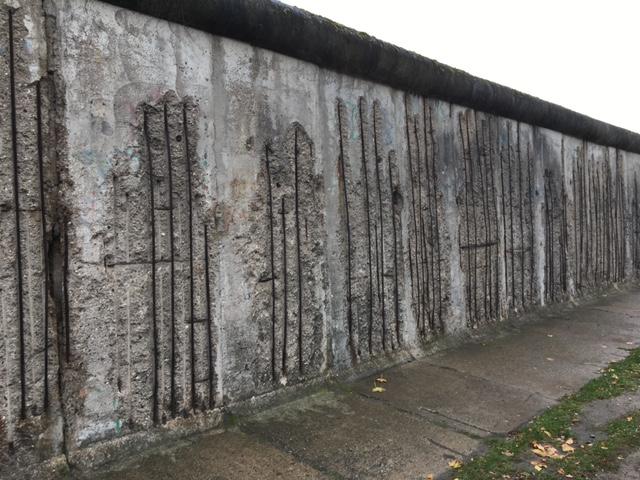
To my great surprise, the actual Wall (or at least this part of it) was relatively flimsy, just concrete a couple inches thick. It had disintegrated in spots, exposing rusting steel re-bar within; in some places it had crumbled away entirely, leaving a hole clear through to the other side. When it was intact, it may have appeared impregnable, but a few sledgehammer swings could have bashed holes right through it.
However, it didn’t have to be massive, just a solid barrier. Probably few East Berliners knew how insubstantial it really was, let alone had implements that could punch through its apparent muscle. When the Wall was new, simpler methods might still breach it. For example, a few fugitives drove large trucks straight into it, successfully battering into West Berlin, where the Wall guards dared not shoot or pursue. (Presumably Moscow, which usually had the last word on regime actions in Eastern Europe, ordered such restraint, unwilling to provoke the NATO powers over issues of non-critical strategic importance.)
The Wall complex was gradually enhanced by watch towers along its length with machine guns and total visibility firing lines. Eventually, the wide “Death Strip,” guard dogs, land mines, trip alarms were all added in response to the desperation and ingenuity of Ossies (East Germans/“Ostdeutscher”) to bypass it.
Communism in practice met neither its ideals nor promises, so during the 1950’s, a hemorrhage of East Germans, especially skilled, educated and energetic ones, crossed from their Workers’ Republic into West Berlin, then the easiest crossing point between the two Germanies. Aside from the embarrassment of masses of its people ‘voting with their feet’ thus, East Germany was hurt by the loss of many of its most gifted citizens. To put a halt to that outflow, in 1961, the boundary between east and west Berlin was temporarily closed with barbed wire while the Wall was built. (Harsh barriers had already been put at the East-West German border, ostensibly to prevent invasion by NATO. In fact, they were as much, if not more, to keep East Europeans behind the so-called “Iron Curtain,” the western edge of the nations of the Warsaw Pact, the post-war Soviet sphere of influence.)
Other parts of the Wall may have been more robust than this bit looked. But I wonder if, when it was first built, the East German authorities sincerely thought it would only be needed temporarily – and thus not need to be terribly sturdy – till their citizenry became lulled into loving Communism, and no longer wanted to flee to the wicked, decadent West. If they really believed that, it is a measure of how deep delusion can be: Why would anyone love a state that might kill them if they didn’t return its ‘affection’? And how could its rulers not realize how unrealistic that was?
Those questions are just rhetorical. More likely, they made the Wall just enough of an obstacle to slow down would-be escapees till they drew the attention of the guards and their machine guns. Rather than delusion, it was probably the hardest cynicism, the Regime knowing full well most people would never really want to live in a state that could give them no better than semi-poverty, watched and harangued them constantly – and could be murderous to retain control.
The Wall’s frailty, as shown here, proved an apt metaphor for the inherent weakness of Soviet-style Communism, or of any regime that can only survive by coercion, an ostentatious pretense of invincibility, and propaganda that is obviously in conflict with lived reality.
Surely, bondage by intractable doctrine cannot have been what Marx intended when he proposed Communism – communal ownership of means of production – to protect ordinary workers from the abysmal depredations laid on them by the raptor Capitalists of the 19th century (Labor unions, often demonized now, were instrumental in preventing outright Communism from arising in the West, but that’s another story). Nowhere was this perversion of initially benign intentions more starkly and brutally manifest than by the Berlin Wall.
But also, nowhere was it more splendidly overturned, as East Germans forced the Wall open, then hammered it down late in 1989. For Berlin, liberation was personal; for the World, that stepping back from the chilling peril of the Cold War caused a collective sigh of relief so great it felt as if it had blown away much of the 20th century’s fear, chronic anxiety, and basis for despair. Believe me; I remember feeling just that way then.
 All Things Gaul