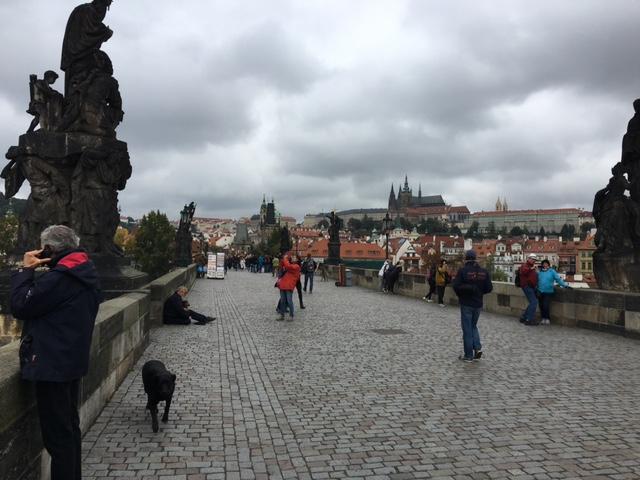
This is a classic view of Prague, showing some of its main monuments; for example, the spires of St. Vitus cathedral, standing proud above the red roofs of Hradcany Castle, are visible here. The gloomy skies notwithstanding, seeing this was a really singular experience; a panorama of characteristic Old World grandeur.
I took this picture from one of the city’s most beloved sights, its Medieval Charles Bridge (‘Karlov Most’) over the Vltava river, renowned for the sculptures that line it. Those had no unified theme, were clearly installed at different times in honor of different types of subjects, and given such prominent locations that many were probably major artworks in their own right. Most of the statues here are copies, the originals having been moved inside various venues to shield them from the elements.
Besides helping to discourage invaders, gates like those at each end of this bridge often had functions such as collecting tolls to pay for maintenance, or import taxes on transiting goods. Also, because bridges long enough to cross wide rivers were rare till the modern era, they often became focuses to spread information. For example, traitors’ heads were spiked on Old London Bridge as warnings; Venice’s Ponte Rialto was a prime place to hear news.
But Prague came close to having not survived to enchant us today. Heartbreaking as it was for the Czechs to yield their Sudetenland to Hitler in 1938 (after France and Britain warned them at the Munich Conference to do so, or fight the Third Reich alone), posterity should be grateful they submitted. Goering, head of the Nazi air force, had already threatened to bomb the city to dust – with regret, acknowledging it was a ‘lovely place’ – if the Czechs resisted this territorial theft.
All you see here might then have been destroyed, and lost. (As Paris might have been, had it become a battleground in 1940.)
We should also be glad Prague did not slash many wide, new streets through its venerable fabric for the sake of traffic efficiency (Paris and London did). A few such were added, but most of the central city still has an aura from less rational/regimented eras; small, labyrinthine byways. It is not the easiest urban geography to traverse or to learn, but there are plenty of towns that prioritize the needs of the car, and ease of navigation. Prague is rare both in scale and quality of ambience retained, for not having done the same.
In addition to surviving World War 2 mostly intact, the city’s historic center was largely left alone by the Communists who ruled Czechoslovakia from 1948 to 1989, which puts it in a small subset of places that history felicitously bypassed until their unfashionable, half-shabby prospect – by then rare – began to be admired. Prague, the national capital with some 1.3 million people in its region, is probably large enough to support skyscrapers, but none were visible. That suggests a deliberate decision after Democracy returned not to replace distinguished, elegant buildings in this core with new structures out of scale and harmony with such refined surroundings.
Czechoslovakia emerged from Nazi occupation, then Communist constraint in a subdued upheaval: The Velvet Revolution of 1989. After that, Prague, previously a treasure largely inaccessible behind the Iron Curtain, got rediscovered, to the delight of the world. And its charm – perhaps the word that best describes it – has been largely, and wisely, cherished and preserved since.
 All Things Gaul