CONTEXT: The next four posts are from my 2016 visit to Berlin. My friend Paul was with me, so he is the other part of any reference to ‘we’ in these.
I have already put several Berlin posts from that trip on this blog, but chose these to illustrate the whipsaw of history still visible, or manifest, in the city. That is, how the primitive priorities and bestial deeds of the Nazis came to appear, and to remain, amid the great achievements of previous, and 21st Century, German culture. They will show more about Berlin’s heritage as a place of civilization, but also lurking results of Hitler turning it into a stronghold of the unspeakable.
Realizing that such extremities can arise and abide within the same setting and society, may provide a tragic but worthwhile lesson about the breadth – for good and ill – of human capacities.
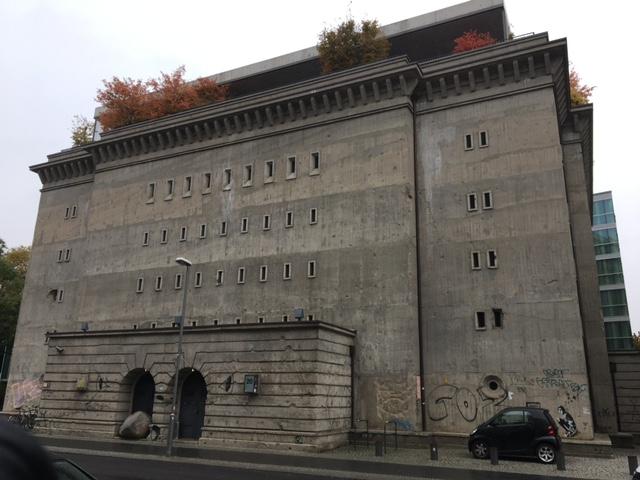
We were strolling aimlessly when we confronted this menacing apparition on Reinhardtstrasse. This was a platform for anti-aircraft guns (“flak”) to protect Berlin from Allied bombing during the war. It squatted there surrounded by ordinary new buildings; intricate construction to facilitate destruction.
It had the thickest cement walls I’ve ever seen, to resist direct bomb hits, an immovable relic of catastrophic violence like a facial wound that cannot be removed or fully hidden. Massive as this was, it was a lesser fortification; far larger such bastions were built in the Berlin area, some so immense that demolishing them might wreck precious infrastructure nearby. Those have just been allowed to deteriorate gradually, overgrowing with vegetation.
Thus this fearsome bulwark has been left in place, now housing creative-oriented businesses. Its solidity was hard to adapt, so office space got wedged into its existing voids brightened from their military austerity, with cosmetic exterior touches to soften its Bastille-like facade.
Even if one didn’t know its original purpose, there was no mistaking the grim demeanor of this sinister beast, making the harsh realities of war in every sense ‘concrete.’ It is a disfigurement of a city at peace – over which it still casts shadows – that made me shudder. Suggesting a vast dragon’s molar, it is a fittingly brutish image to reflect a regime that conceived and carried out a host of horrors of which the Holocaust was worst, if far from the only one.
The Nazis stole massively from their conquered territories; for example, nearly all concrete produced in occupied France was appropriated by the Germans for their own use, possibly including this tower. But like many Nazi policies, plundering defeated lands contributed to their own undoing, because starving subject national economies (and civilian populations) of resources and food for consumption in the Reich eventually weakened them too much to help the Nazi war effort. To say nothing of how the implacable rage that Germans exalting themselves as a ‘Master Race’ united overwhelming forces against them, including those starving civilian populations, avid for liberation and retribution.
Malevolence Hitler brewed in Berlin spread from the Pyrenees to the Volga like a great, swelling bladder of villainy till it burst, inevitably, on thorns that grew from the violence he had set loose on Earth. The feral aggression and depraved cruelty of Nazi Germany necessitated things like this tower to defend its own cities against counterstrikes by mighty foes it had provoked.
This bleak hulk failed in its original task of repelling the global onslaught a belligerent mindset had aroused, and now – exquisite irony – shelters creative activity instead. It is both a totem of war’s wastefulness, and an inadvertent, dire warning of what can happen if human reason is perverted to serve faith in brute force.
Quite a lesson there. Though sadly not all have learned it, as Russian ‘faith in brute force’ against Ukraine (as of June, 2023) shows. The fate of the Third Reich surely supports the premise that those who live by the sword are liable to perish by it. And rightly so; aside from all the harm they inflict, nothing less than the gradual improvement of human Nature itself may depend on such men, and such mindsets, not being allowed to prevail.
 All Things Gaul