After Berlin in 2016, I only meant to visit one other German city. It wasn’t easy to decide which, as there are so many rich in history, culture, picturesque settings, etc., but I selected Cologne (Koln) in southwest Germany, principle center of the Rhineland, the basin of the great river. This area was long a powerhouse of the nation’s Industrial, and now post-Industrial, economy, with Cologne one of a group of towns (Bonn, Essen, Dusseldorf, etc.) that have grown till their regional boundaries seem to nearly overlap.
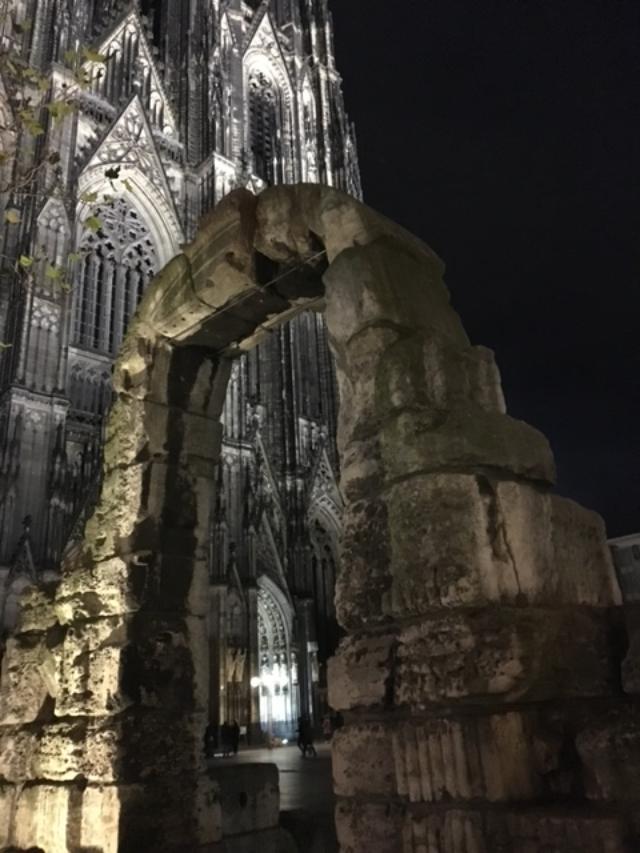
Two attractions, both referenced in this image, made me choose it. First, its heritage as one of Germany’s oldest municipalities; the Romans built an extensive urban outpost here, their Empire’s primary foothold in this part of Europe (Berlin, first documented ca. 1300 and long of little consequence, is comparatively new). Its name derives from Latin “Colonia” – Colony – which evolved to “Koln”; ‘Cologne’ is the French spelling. Considerable Roman ruins, including the rough arch shown here, still exist on and under its streets, and it has a superb museum of classical antiquities, mostly local.
Second in time, but more important to me personally, the city is home to what is arguably the greatest Gothic church on Earth, Cologne cathedral; in German, the Kolner Dom (formal name: St. Peter’s Cathedral). Its original design, conceived to hold the supposed relics of the Three Magi, was not completed till 600+ years after construction began; major currents of European history caused both its attenuation and its eventual completion. I’d been aware of this edifice since childhood, and felt that if I could only get to one place especially known for a splendid church, this may be the best of them all.
Cologne’s setting on the Rhine near its confluence with other waterways helped secure its long-term economic importance and prosperity. It remained substantial long after Rome fell, despite the general regression of the Dark Ages, through Medieval times and beyond, but during World War II its prominence and relative nearness to Britain (and its military airfields), made it a target of frequent Allied bombing. On the other hand, when the Third Reich was finally vanquished, the city, being far west, was captured by Americans, rather than Russians. So though already bombed nearly to dust, it was spared a paroxysm of street combat like Berlin suffered, and oppressive Soviet occupation.
I won’t write much on the Nazi era in Cologne as I did for Berlin, the historic focus of my travel in Europe, but it should be noted the Nazis regarded the place with suspicion. It had two alternate centers of power they could never fully co-opt nor crush: A robust presence of both Catholicism and Communism. The Church, though not as defiant of Fascism as it might have been, was by no means fully compliant with it, and was a stout obstacle to Hitler’s ultimate wish to scour Christianity from Aryan society. (In Nazism, Jesus was just another contemptible Jew, offering morality suitable only for vile weaklings. In fact, many Nazis felt that only weak and unworthy people needed the consolations of religion at all; in their view, the only truly worthy folk put their faith in strength, power and victory; ‘Sieg.’)
And Communism had been vigorous in the Rhineland’s vast labor base. The Nazis hated Marxism – like Christianity, a worldview with a Jewish founder – and decapitated the German Communist Party soon after taking power in 1933, imprisoning and killing its leaders, closing its newspapers, etc. But they couldn’t identify and coerce everyone who had ever voted ‘Bolshewik,’ so the heavily industrialized Ruhr Valley north of Cologne was one of several previously Red pockets in the Reich where National Socialism never fully took hold. Scorn, if not outright hostility to it, lay not far below the surface of Cologne’s vicinity; and Hitler knew it.
And his war brought cataracts of bombs down on the tepid town, as on most major German localities, although its lofty cathedral was relatively slightly damaged, deliberately spared by Allied warplanes to serve as a targeting coordinate. They apparently dropped their bombs on anything within ca. 2 miles around it, and thus most other cherished local buildings got smashed. Long after peace came, a few of those were painstakingly replicated, but it was impossible to restore all that were lost. Presumably, as in dozens of shattered urban areas across Europe, hard choices had to be made as to what had to be rebuilt immediately to return devastated, depopulated Cologne to life, and only then to revive its spirit.
Old photos include this arch, remnant of a large Roman gate, in front of the Dom, that seemed to show it had originally been about 15 feet lower. As part of reconstructing the wrecked city, the open space around the cathedral was raised so traffic can pass below it to allow unimpeded pedestrian access to the nearby main train station. The arch may have been lifted to the new grade level, but presumably in its previous horizontal location relative to the Dom, to (partially) preserve this remarkable spectacle, eloquently suggesting fundamental continuity between the distant past and present; of Cologne, and of the world.
Even so, disturbing this venerable artifact would have been a fitting metaphor for the epic upheavals this site, and city, have witnessed.
 All Things Gaul