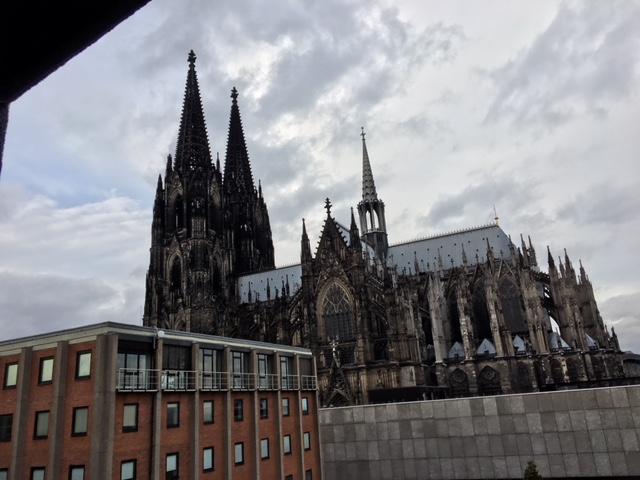
At check-in, the desk clerk of my hotel in Cologne, a brief walk from the train station, asked if I wanted a room facing towards the cathedral, or away from it. At first I asked for one on the far side, assuming it would be quieter and that the great church would probably turn out to be too far away to see decently anyway. But my mind changed for no conscious reason, and I asked for the room with a view.
I often record reminder “voicenotes” on my phone, and after entering this chamber, started to speak disinterestedly into it, recording my room number, hotel breakfast hours, its address, etc. I still have that note, and in it, my voice suddenly crackles with delight as I look out the window and discover this stunning prospect: An imagined fantasy made real, not some vague, quasi “view.” Very likely the most remarkable sight I will ever have from a window where I reside, even if briefly.
An exceptionally regal design was conceived for this glorious building because it was meant to house some of the most precious relics in Christendom, the alleged bones of the Magi (the Three Wise Men; the Three Kings ‘of Orient’) who, supposedly led by the star of Bethlehem, brought gifts to Jesus in the manger. The towers would have been the tallest structures in the world had they been completed during the Middle Ages (assuming they could have been finished with the building methods then). But within 30 years of the start of this building’s construction in the year 1248, the finances of the project had become unstable.
Cologne was rich (its location gave it access to both cargo ships from the North Sea and inland river-traffic trade), but it would be badly impacted by the discovery of America, which disrupted its profitable trading patterns. So work on the Dom sputtered on intermittently for more than 250 years before it came to a full halt, the original plans only about 30% built. And it would remain that way till construction was resumed in the middle of the 19th Century, for reasons (and motives) I will explain elsewhere.
This spectacle had the dazing effect on me that it might have been intended to have on a pilgrim coming to see the Relics of the Magi – even though, as a modern person, I have seen many other wondrous human works. And even though this building was not finished as shown here till long after the Middle Ages, for whose priorities it was conceived, were over. Unquestionably, the cathedral’s muscular grace, to say nothing of its tremendous scale, have the power to awe. The Kolner Dom is so immense that its whole mass could not be photographed in a single picture from the open spaces adjacent to it; it wouldn’t fit the frame. A vantage like this one, several hundred feet away, was needed to encompass it all. Conversely however, its garlands of exquisite stone carving cannot be fully appreciated in such a full-scale shot; detail like that must be seen from closer up.
I savored this sight repeatedly during my stay in that hotel, and will keep that voicenote with its abrupt tone shift from distraction to enchantment forever, as a cherished souvenir. (In another now-precious voicenote, the cathedral’s great, sonorous bells can be heard ringing in the background of my speaking.)
This celebrated structure is truly one of the world’s great buildings. Like the far lesser known Virchow monument in Berlin, it seems a sort of counterweight to the poison of Nazism, an admirable face of German achievement that deserves our appreciation. But its story is about far more than stone and mortar, and cannot be told with reference to them alone. In other re-posts, I will deal with other factors integral to its origins, history, unlikely realization, what it was meant to assert, and to what it can continue to offer today.
The cathedral had a profound, wide-ranging impact on me, likely more than on most visitors. With my historical background and personal spiritual inclination, I came better prepared to register a fuller spectrum of its ‘totality.’ But its many aspects, and the attendant impressions of which I will write, were not just flickers of my own projecting: The character and aura of places that strive to represent their societies’ highest efforts and deepest beliefs – the Kolner Dom, the Parthenon, the Great Pyramid, Ankor Wat, etc. – may be accessed by anyone who will stand outside the push and flow of time, rushing events, and cultural assumptions, to admit them.
They exalt human aspiration and potential in ways that transcend the Ages, and the constraints of creed and individual experience.
 All Things Gaul