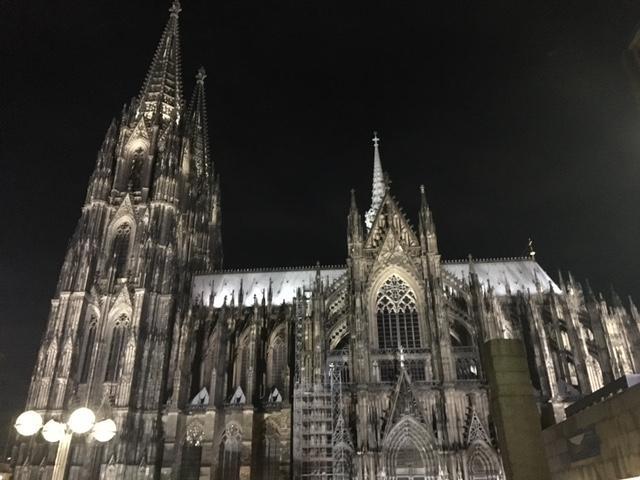
This view of the Kolner Dom illustrates the building’s history and evolution. The part of the church to the right of the transept (the pointed gable), the apse, is complete Medieval construction, finished by about the year 1320. The transept and nave (the long, main open space where most of the congregation gathered for religious services) to the left of it were completed only part way up the walls, till the will and money for construction ran out in the 16th century.
The tower shown here at the left was only a stump about 100 feet high, and its twin rose just a few meters above its foundation. The building remained in that condition – less than one-third complete – for some 300 years. A Medieval crane on the stub of the near tower was left in place that whole time, becoming part of the city’s skyline, and a symbol of hope for the project’s ultimate revival.
It should be noted that before the Dom was completed, Cologne was mostly famous for its several exceptional churches in the Romanesque style that preceded Medieval Gothic (Gross St. Martin’s was the city’s emblem till the completion of the Dom; St. Gereon had the largest dome built in Europe between the Pantheon in Rome, and Brunelleschi’s in Florence). They were ancient and venerable, but the Dom eclipsed them all in splendor and fame, then were all grievously damaged or destroyed when the city was bombed in the 1940’s. Most were later restored, considered to be as integral to the city’s historic self-image as the newcomer cathedral; if not even moreso.
When Cologne’s region became part of Prussia after the Napoleonic Wars, local Romantics, led by a vociferous Gothic-revering merchant, entreated the Prussian kings (the Protestant Hohenzollern dynasty) to finally complete the Kolner Dom according to a recently rediscovered 13th Century drawing of the original plans for its great front façade. At some point, it had been cut into 2 parts which ended up in different places, eventually recognized as intended for the Dom.
I don’t think original plans were ever found for the main nave and transepts, so their final as-built construction in the 19th Century probably had to be largely extrapolated from the façade drawing, the original apse, and the foundations laid long before for the unfinished nave. But I am unsure of that.
The Hohenzollerns agreed to patronize and help support the project. They had several likely reasons for doing so; they were famous for their militarism, so undertaking a legendary work of culture like the Kolner Dom could substantially refine their reputations. Also, finally finishing a great Catholic church, initiated long before the Reformation, would soothe the discomfort that many of their new, mainly Catholic, Rhineland subjects felt at suddenly being ruled by a leading Protestant realm.
Most important, the Hohenzollerns were already trying to position themselves (instead of the Catholic Austrian Habsburgs) as likely leaders of a future united Germany, and wanted to stimulate the spark of shared nationalism that was already stirring. The finally-consummated Kolner Dom would express German genius and artistry, as well as Prussian power and ambition. When eventually completed in 1880, its dedication was a national event, with the first Kaiser, Wilhelm I, in attendance.
A true architectural expert (unlike me) might dismiss today’s finished Cologne Cathedral as a latter-day adulteration of authentic Gothic design. But to most modern viewers, the building is a great aesthetic success; strong and graceful in a thoroughly Germanic manner, massive without being ponderous – and not semi-sensuous, as some French analog might be.
 All Things Gaul