Berlin; A Statue Suggestive of German Attitudes to Power?

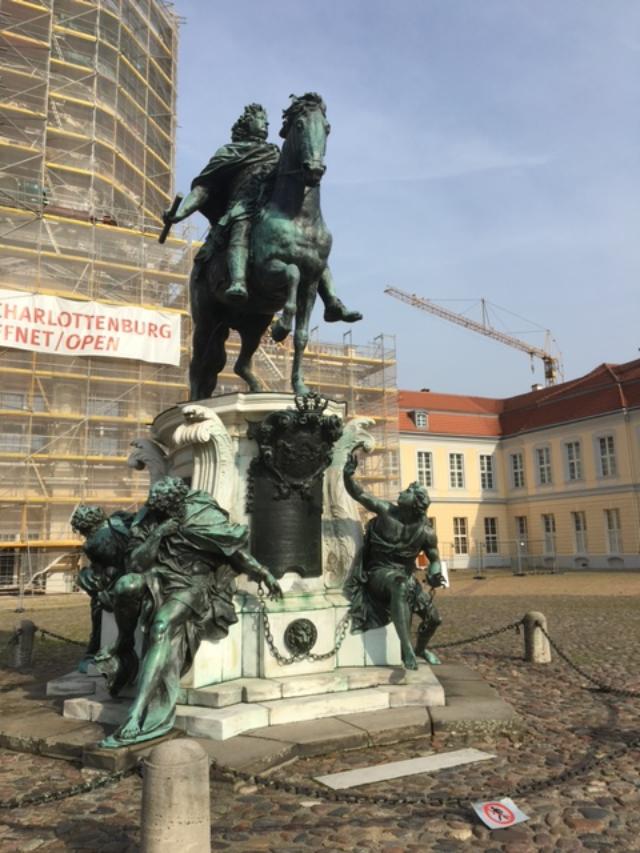
CONTEXT: As a self-styled historian, for me, going to Berlin was the linchpin of my 2016 visit to Europe, due to the city’s (not entirely willing) role in Nazism. Fellow traveler Paul and I visited Charlottenburg Palace, seat of Prussian kings, just west of central Berlin. The palace had no connection to the Nazis, but I used this statue – similar in spirit to ones I’d seen elsewhere in Austria, another German-speaking land, and at a Hapsburg castle in Prague – to propose a rarely-noted factor in why a flower of evil like Hitler might have sprung – germinated? – in German soil.

This statue of King Fredrick William I of Prussia, in Charlottenburg Palace’s courtyard was, of all the monuments I saw in Austria or Germany, the one that seemed to most bluntly portray strength as the greatest (or only) virtue.  The captives below the king’s horse writhe in terror at his sway, but he does not even bother to look at such wretches; instead, he gazes off to infinity in search of something more worthy of his noble eyes.

When this statue was made, kings were seen as bulwarks against the inherent chaos of life. However, the fact that Germans, in particular, seemed to not only accept such arrogance and menace from their rulers, but to approve and admire them, may obliquely help explain the attraction of Hitler.

This attitude may be rooted in the fact that the deepest national trauma of the German people before World War II was the Thirty Years War of 1618-1648, the worst of which was fought in their territory (there was no single “Germany” then, just dozens of small German-speaking states).  That ghastly conflict was even more destructive than mechanized warfare; what troops then lacked in lethal technology, they made up in vigorous bloodlust. 

In addition to soldiers’ deaths, about a third of the civilian population of “the Germanies” is thought to have perished, killed outright, or died of starvation, epidemics, and other miseries that flourished in the general pandemonium.  Crops went unharvested or could not get to hungry markets via roads infested with bandits, commerce and crafts collapsed in the turmoil, etc.  Civilization in these lands broke down then about as much as it possibly could.

Much of this horror happened at the behest of powerful neighbors, especially France (already a united realm), which wanted Germans to stay divided and feeble. From then on, the terrible cost of weakness was embedded in their folk memory, leading to an ingrained assumption that to be strong was to be “good.” The lesson the nation seems to have absorbed at indescribably dreadful cost in the 17th century was that without power, nothing else mattered.  In fact, the King portrayed here was pivotal in giving Prussia a pervasive military disposition, partly in response to dire experience: helplessness had yielded horror.

In 1871, German lands that had so often been at the mercy of others, were finally united under a single Prussian-led regime, as the German Empire: The Second Reich (the First Reich was the Holy Roman Empire).  But when the still relatively new unified ‘Germany’ was defeated in the Great War (World War I), many Germans wouldn’t accept that their talented, progressive nation, a major driver of the Age of Reason and Industrial Revolution, a dream unfulfilled for centuries, was not invincible.

Such people were susceptible to sinister explanations – especially to ones hissing that if their mighty Fatherland had been defeated in battle, it could only be due to some treachery.  This suspicion was the mud onto which Hitler would cast seeds alleging a Jewish conspiracy – called ‘a stab in the back’ – to keep Germany from attaining some glorious destiny. (In this implausible telling, the pivotal intervention of the U.S. in the war in 1917 did not affect its outcome; only betrayal led to defeat.)

Added to that resentment was the factor that democracy, post 1918, was still relatively new to this society.  The Kaiser’s abdication had led to the country becoming a republic, but many Germans reacted that perhaps they were culturally better suited for their prior authoritarian rule than parliamentary self-government. Especially when democratic politics did not solve their grievous economic woes during the Great Depression.  And if they couldn’t have another Kaiser, they would have a Fuhrer – Leader – to dominate them.

All this may seem like a lot to extrapolate from one statue.  Of course there were other factors in the rise of Nazism: unjust provisions of the Versailles Treaty (which was negotiated by the spineless ‘Weimar’ republic) – valid grievances Hitler exploited ruthlessly.  But this statue, and monuments in the same vein throughout Germanic lands, suggest an undercurrent of power worship, which may well be at least part of why Nazism appeared, then broadly appealed, there. 

Any culture that would consider an image like this normal – even praiseworthy – probably needed less convincing than most that Might Makes Right.

Amsterdam; Door of Anne Frank House:

CONTEXT: A post about my visit to Europe in 2016. ‘The Night Watch’ mentioned here is one of Rembrandt’s greatest paintings, referred to in depth in other online posts (which I may re-post here later) from my trip. I’d decided to return to the U.S. via Amsterdam explicitly to see it, at the city’s Rijksmuseum.

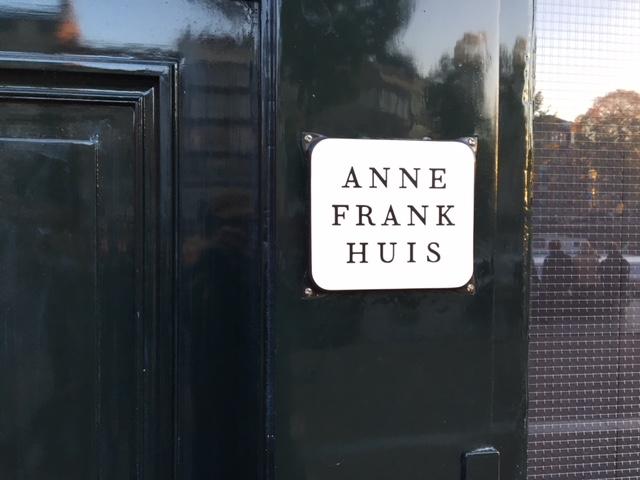
How very ordinary this renowned building looked, as if to emphasize Fate’s apparent indifference to the desperate fear, wrenching malice and now sorrow forever it has seen. I got here soon after viewing ‘The Night Watch’; a summit and an abyss of human endeavor – creativity and calculated cruelty – separated by a brief walk, yet from different worlds.

The relative nearness of this poignant shrine of barbarism to Rembrandt’s sublime intimations of what it is to be human called to mind the grinding of the tectonic plate of the Self’s will to power against that of its will to create, and to love. Never in Europe was I more aware of that primordial friction than as I stood before this door.

I would have liked to go inside, but hadn’t made the needed pre-reservation to do so. Instead, sentiments like those above flowed out of me here as silent, unbidden prayers.

Prague; Ancient Jewish Cemetery:

CONTEXT: From my 2016 Europe trip. My only picture from Prague from a great many I took in an overnight stop there in 2016, I include as one of my Introductory blog posts, considering it a semi-sacred duty to put this one here, for reasons explained in the text.

This is a last picture from my visit to Prague, posted separately from all the others to call special attention to the long Jewish presence there. It is my small contribution to helping to thwart Hitler’s dream that not only all of the world’s Jews, but any memory of their very existence, should be obliterated.

Long before the Nazis definitively eradicated it, the venerable Jewish community there had a tempestuous and often violent history. The tale of the “Golem,” a mythical monster created to protect Jews from persecution, originated in Prague.

These tombstones had a calm dignity that made them very different from the only other graveyard I made a point to visit in Europe, Pere Lachaise in Paris. That place is far newer; its first graves seem to have been from around the time this one accepted no more. There have been no burials at this location for some 200 years, and many of the stones are so old they are slowly sinking into the soil, as if to mimic the “dust to dust” return to Earth of those who lie beneath them.

But many tombs in Pere Lachaise were the virtual opposite, in spirit, of these simple memorials. Most were at least ostentatious, others over-the-top Gallic theatrical. Those Parisian monuments, made with wrought iron or intricately carved stone, are now deteriorating badly, no longer the proud spectacles their owners probably hoped would last forever. These in Prague, much less elaborate (usually just a Hebrew inscription and some image to mark the owner’s work in life, like grapes for a wine merchant) are much less liable to such decay.

I can only speculate on why there was such a stark contrast in how eternity was approached in these two places. It may just have been that the Jews of Prague couldn’t afford anything finer, or that religious authorities there prohibited ostentation. Or it may have been a resignation to mortality that the Parisians refused, trying to resist the anonymity of death with elaborate tombs. No such pretense is apparent among these gravestones of Prague and ironically, as the monuments at Pere Lachaise now rust and erode, they suggest the triumph of time more, not less.

I am still perplexed (though joyful) at why the Nazis, who despoiled evidence of Jewish culture everywhere they conquered, left this cemetery and several old synagogues nearby, alone. These are all in central Prague; the Germans must have known they were there. Perhaps it was just their absurd concern for ‘appearances’ – of imagining Gentile Czechs wouldn’t think they were utter brutes if they left a few familiar local highlights – but not live Jewish people – untouched.

Such logic would be comical, if it weren’t so monstrous.

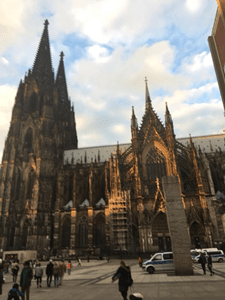
Cologne, Germany; Cathedral from Adjacent Plaza:

CONTEXT: From my 2016 Europe trip, posted: Only completed to its original Medieval plans in 1880, this is considered perhaps the greatest Gothic church in the world. Cologne began as a Roman provincial capital, and has been a major city ever since. During World War 2, the vicinity of the cathedral was pulverized by Allied bombing, and most of its prewar buildings were not rebuilt, replaced with modern structures. However, some Roman remnants, which had been covered over centuries earlier, were exposed by the bombing, then fully brought back to light during the post-war reconstruction.

This is a closer view of the same side of the church as in my hotel room picture, here burnished by the setting sun. I believe the vertical pillar here was some ancient artifact from Cologne’s origins as Roman ‘Colonia.’

It would be interesting (though melancholy) to see photos taken from this spot before World War II’s catastrophic impact. It was probably a crazed network of largely unreformed Medieval streets and buildings, all now gone forever. It is worth noting that, in addition to being the site of two previous cathedrals, this spot has been a locus of pulsing urban activity since before the Colosseum was built in far-off Rome. By some accounting, Cologne was the largest city north of the Alps till ca. 1450 – long before today’s vast Berlin was of the least importance.

The warm solar glow on all this artful stone may be a metaphor for both change and constancy. There may be ‘nothing new under the sun’ – it shines, indifferent, on all our plans, triumphs and failures – but this city’s ancient, intricate story is an exceptional panoply for our steadfast star to overlay. This structure is one of the very finest works of man, yet sunlight floats on it effortlessly as golden mist, taking no note of the great shrine, just as it glows, unchanging, in the face of all human events. For me, there is an indefinable yet definite comfort in that sense of both chronological and physical continuity.

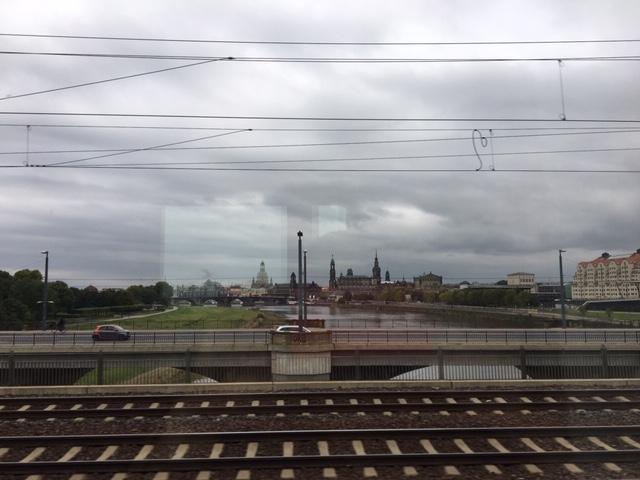
Dresden, Germany; Refinement, Defiled:

CONTEXT: The ‘we’ mentioned in this piece from my 2016 travels in Europe is my friend Paul from Boston, who was with me for the middle part of my travels, from Salzburg to Berlin. We traveled by train, and saw numerous ground-level points of interest that way; especially this one.

Our train made some stops in Czech lands, then several more in Germany before Berlin. At one station, a young man joined us in our compartment; he discovered we were American, and wanted to practice his English (I practiced speaking German to him; his English was far better than my German). I knew that Dresden, supposedly the greatest Baroque city on Earth till it was bombed to ashes near the end of World War II, was nearby, and asked him if we would pass through its center. He said we would not be in its heart, but that it would be visible from the station where we would stop (he also gave us helpful information for our arrival at Berlin’s mammoth central train station).

Here is a picture of Dresden taken while our train was stopped there. I recognized the dome at the left as the Frauenkirche (Lady Church). This is a restoration, the original having been wrecked in the 1945 bombing, along with most buildings in the city center (and an unknowable number of dead, estimated at 80000, one of the greatest number of people ever to perish in a non-nuclear bombing). Dresden lay within Communist East Germany, and until the end of the Cold War there was neither enough money nor inclination to try to restore all of it to its original splendor. Only after the reunification of Germany were additional historic structures rebuilt; no doubt, Dresden can never be what it once was, but is surely far closer to it now.

As noted, Prague, not far away, got accidentally bombed in that attack – but could have been utterly laid waste, had the Czechs tried to fight the Nazis in 1938.

Dresden was not so lucky, and can serve as a stern reminder – bearing in mind it was devoured in a whirlwind of conflict the Germans themselves had sown – that destruction is easy, but creation is hard. The exquisite beauties the city accumulated over 200 years of building were wiped out in a single day. Civilization, as the empowerment of the Nazis itself showed, is often no match for the brute force of primitive savagery. At least, not in the short term.

However, if stone cannot survive such violence, sometimes the human spirit can; for unlike stone, it may have the power of regeneration. In a gesture of reconciliation, the cross atop the new Frauenkirche dome was forged by a British blacksmith whose father had been a crew member on one of the bombers that had destroyed Dresden. Also, the church displays a “Cross of Nails” made of Medieval spikes taken from the ruins of Coventry Cathedral in England – itself devastated by German bombing – the gift of the people of Coventry.

The Nazis gave the world good reason never to pardon them, or Germany. Yet, it has been observed that bitterness is an acid that eventually corrupts any vessel used to store it. Sustained hatred – no matter how justified – may consume the humanity of those who contain it. Surely, that is what happened to the Nazis themselves, in their ferocious resentments of perceived enemies.

The scale of crimes they committed makes it impossible to exact adequate justice, but there are few better counter-gestures to the criminal pride National Socialism embodied than to at least try to forgive Germany (if not the truly committed Hitlerites). That is something the Nazis never would, nor could, have done, and thus may be the most practical repudiation of them one might make. That alone may make it a worthy goal – even if for many people, it is, understandably, an impossible one.

The Frauenkirche, once a refined expression of order and hope lost to the havoc of war, was a well-chosen place to suggest, tangibly, the restorative power of forgiveness.

Response to Paris Terrorism, November, 2015:

CONTEXT: This was the first long post I ever put on the web, galvanized by my shock and outrage at the multi-pronged onslaught on Paris in November, 2015 by Islamic terrorists, rabid to strike at a city that is both a laboratory and exquisite emblem of Western Civilization. Far more than just its elegant architecture or being the background of many illustrious lives, Paris helps define the vitalizing ideals that both shaped and animated our shared culture; and still do.

Here, I try to defend France (an imperfect society, as they all are, but one I deeply admire) by invoking what all of us in ‘the West’ owe to her. Much of that is among the attributes that drove those fanatics’ murderous hostility. And what it could mean if the dark energies behind that hostility should prevail.

As my friends know, I rarely post online. However, I am a Gallophile; a lover of France and French culture. And today, in response to the barbarism deliberately just inflicted on Paris, it may be timely to bear in mind that France’s contributions to the modern, Western world are far more than (just) its many glorious expressions of the arts of living well.

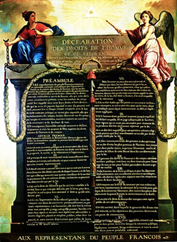
So here, I post “The Declaration of the Rights of Man and the Citizen,” promulgated by the revolutionary French National Assembly in 1789, just a few weeks after the fall of the Bastille, generally considered the initiation of the French Revolution. Diametrically opposed to the arbitrary power of kings and hereditary privileged ruling classes, the common rights it lists and defines have parallels to the American Bill of Rights. But unlike that document, it was created in the most powerful society in Europe, not in a peripheral wilderness as America then still was.

The Revolution’s ghastly Reign of Terror, then Napoleon would come later than these glowing ideals. But while those aftershocks are long gone, the Declaration still resonates with us today, as an expression of hope for a freer, happier, better world, shared by all the children of the “Supreme Being” of which it speaks.

It is always easier to destroy than to build; contrast the behavior of those who have brought such havoc to Paris with (for example) the Muslims who built the glorious water gardens of Cordoba in Medieval Spain. The nihilistic wrath visited on Paris certainly doesn’t carry on that constructive version of Islam, but again: It is easier to destroy (including self-imposed ‘martyrdom’) than to build (create).

After all, that’s too much like work. Including the work of nurturing Liberty, Equality, and Brotherhood.

The attacks in Paris targeted flesh and blood, but also tore at the sinew of civilization itself. That is, the precious desire of every person of good will to share our one world without fear, protected by law, reason and the better reflexes of humanity from lower passions that would destroy our world’s longed-for, uplifting – but delicate – harmony.

‘All of Gaul’

Mightier than the Sword?

‘Omnia Gallia,’ Latin for ‘All of Gaul,’ is a term Julius Caesar used when writing about ‘Gallia,’ now the territory of France. My surname is Gaul (Irish, not French), and I wanted the flexibility to write about whatever attracts my interest; that is, any aspect of my experience, or of intriguing matters beyond it. As an amateur historian, cultural observer, and Gallophile (a lover of things French), I will try to capture and sharpen my thoughts on matters that allure me, then share them here.

So ‘Omnia Gallia/All of Gaul’ seemed like a rather suitable blog name.

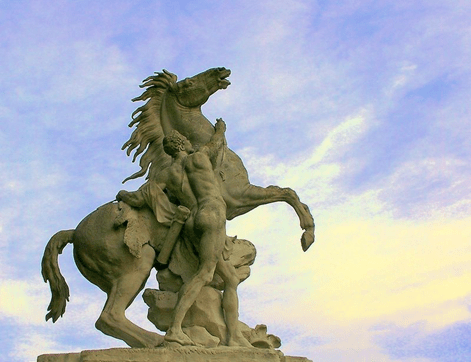
And to represent my approach to this project, above is an image of one of the Horses of Marly (Chevaux de Marly), imposing statues that mark the start of Paris’ Champs Elysees. Aside from being superb icons of French culture, these statues symbolize for me how wondrous the enterprise of life can be. Sometimes a struggle; often a hard, but rewarding undertaking. Illustrated here by a mighty horse harnessed and conducted with beauty, grace and genius, by human vigor, sensibility and reason – which may appear in any, and all of us.

That’s imagery enough to suggest my goal here: To ride wherever, whatever, inspiration transports me.

From the Horses’ sculptor Coustou, to the masons who wrought their stately pedestals, the draymen who moved them to the site undamaged, the pavers who precisely fitted the stones of the grand avenue they would enhance, etc. Every one of those deeds is part of a continuum of ‘human genius,’ of which no other beings on this Earth are capable. Even if talents are not equivalent contributions (and in any case, are bestowed by random genetics) they are all essential, and vary in their importance depending on the circumstances (e.g., the lowly pavers’ expertise made Paris’ grand boulevards like this one, worthy of marking with the Chevaux).

I am just a retiree living in modest comfort in Chicago; nobody influential. However, the ‘Mightier than the Sword?’ subtitle reflects my wish that my keyboard/pen might be resonant, persuasive, but not demanding – i.e., coercive or sword-like – about the point of view, if any, I wish to propose or advance. Or at least to try to offer readers something worth reading and considering.

I am no academic, so writing here, will explicitly try to connect to laymen like myself. I intend and hope that any reasonably well-informed person can – with moderate effort – understand my posts. Even if he or she thoroughly disagrees with their point, if any.

Generally speaking, I see it as useful to advocate for hope in many cases when despair would be easier. Advocating for validation by our collective experience, not just our individual achievements, I try to articulate things that many people likely privately think, feel or simply need to believe. Such as the premise that Life is worthwhile and benign, despite all evidence that it is not. To give substance to perceptions held by people who rarely speak of them aloud, and may even feel conflicted to admit to themselves. Even if they might benefit from them personally, and even consequently help make a better World.

For example, of the necessity to make full use of our Reason, but its insufficiency as a substitute for Heart – that is, for empathy – in reaching the fullest expression of our ‘Humanity.’ Whether individually, jointly or collectively.

To initiate OmniaGallia, I will re-post items that I wrote and posted online before, most of them photos and captions from my trip to Europe (just before the U.S. Presidential election of 2016) to acquaint readers with my style. My first posts here will be tagged ‘Introductory Material,’ selected as examples of my priorities and sensibilities. Other re-posts from my 2016 tour (which started in Paris, went to Venice, Austria, Germany, and ended in Amsterdam) will be categorized as ‘Travels.’

I will also add material here I have written as personal meditations, categorized as ‘Journey.’ Anything I post/re-post here that doesn’t fit either of those headings will be ‘Caprices.’ And of course, I will gradually be adding new material here, composed explicitly for OmniaGallia.

Intrigued? Puzzled? So am I, most of the time. Come along, and let’s see where all this may lead.

Bryan Gaul

Overtures:

Sample posts that I wrote, then posted online, at various times, on various topics or experiences that interest me, will appear as my first posts in this blog, tagged as ‘Introductory Material.’ These serve as ‘Overtures,’ to give newcomers here some sense of what I care about, and how I express and convey my observations. I will be writing new material for OmniaGallia of course, but these existing pieces are representative of what is near to my heart.

These are all among my personal favorites of my posts, and some of them have greatly moved previous readers. Some contain cross-references to other online posts or information not included within them, so I provide a CONTEXT preface where it seemed necessary.

After these samples, I will start posting more of my previous online writings here about my ‘Travels,’ the ‘Journey’ (of my heart or mind), or just random subjects that have attracted my interest, ‘Caprice.’ My posts here will all categorized or tagged as such.

Some readers may find my subject matter or my treatment of it overly conventional. Perhaps; but I hope my commentaries on such are exceptional examples of their type, so may you enjoy reading these as much as I felt energized while writing them. Many of them took considerable deliberation (and refining), so I hope they offer you cause to reflect as they did for me; enjoyably and fruitfully.

BG