On discovering this video recently, I reflected that if a picture is worth a thousand words, the value of the words and pictures together here is infinite; a boundless love song to Life itself. And as some of its images remind us, we may find such love throughout Life, not just in romance.
Savor this radiant expression of that hope; it may make your heart swell, and your eyes tear with joy.
In our culture, the term ‘yielding hero’ may sound like a contradiction. Heroes are meant to be forceful benders of Fate to their will, often indifferent to any ethical nuance or collateral harm they cause pursuing their glorious objectives. The very opposite of the passivity of ‘yielding.’
But in Mr. Biden’s case it is no contradiction. In recusing his candidacy for re-election, he has, for the sake of our nation’s well-being, yielded his most cherished personal ambition. Instead of gambling with America’s essence as a great experiment in freedom, he has now proven his love for her and her mission, beyond a shadow of a doubt.
As I posted on Independence Day, there is often nothing heroic about stubbornly pursuing a goal that has become impossible, counter-productive or even harmful. As some politicians have been known to do, apparently feeling that causing civic uproar is preferable to admitting defeat – as any mature, dignified adult, capable of caring about something more than his own fragile ego, would do.
So to suitably praise Biden’s honor and courage, I offer the accompanying music by Handel (of ‘Messiah’), ‘See, the Conquering Hero Comes.’ This version is instrumental, but the original lyrics refer to the triumph of Judas Maccabeus, a Jewish leader who led armed resistance against Greeks trying to repress the Hebrew faith.
This piece has long been used in tribute to those who have performed near super-human feats. Especially for ‘conquerors’ like Napoleon, Wellington, Grant, or Zhukov; people whose victories changed, or saved the world (though usually also making hordes of widows and orphans in the process). But it is occasionally deployed for others who perform truly epic, consequential acts, so I consider it a worthy tribute for what Mr. Biden has recently done.
If all that sounds grandiose, it is because this work is mainly played in the very grandest of contexts. That must surely include championing America as ‘a great experiment in freedom’ rather than as a bastion of ossified social privilege, with a phony self-image of virtuous equality maintained by self-deception and coercion.
So now I submit it with a title adjusted for Mr. Biden, truly a ‘yielding hero.’ He is likely too modest not to feel embarrassed at an accolade like this, but his deeds and devotion justify it. For anyone, especially one with the self-confidence and vast abilities to properly serve as U.S. President, setting aside one’s own vanity for a greater purpose is absolutely an act of Self-effacing courage that warrants admiration, and even awe. His feat may rescue our democracy from many who care about nobody’s freedom or well-being but their own, and thus it deserves to become legendary. Few would ever be called on to make so great an offering-up; fewer still would rise to the challenge.
Biden’s predecessor, unable to grasp or accept that the Presidency was not only, or mainly, about him, acted as if he saw the office largely in terms of personal advantage and self-validation. For instance: He was known to parade state secrets to foreign officials, bragging ‘I have great intel[ligence]!’ In reality, he was proving that, no matter how much ‘intel’ the CIA, NSA, etc. gave him, he lacked the brains for the most intricately sensitive job in the world. He was inexcusably obtuse about possibly putting espionage methods, output and the lives of human assets at risk by exposing them. This is but one stark example, among a great many, of how utterly unfit and dangerously out of his depth that person was.
(What must those sophisticated foreign visitors have thought of us, for electing someone so childishly fixated on flaunting his own status?)
Mr. Biden’s career has long demonstrated that he would never behave, nor think, that way. Now his withdrawal has affirmed this, showing unequivocally that he realizes there are things – like not compromising our significant progress towards recognizing the worth and autonomy of all our fellow citizens – greater than himself. That is something no Narcissist could do; and might well congratulate their own ‘character’ for being unwilling to do.
One might reasonably assume that no one could attain the Presidency without understanding that putting the nation first is one of the role’s sacrosanct duties, and being willing to act accordingly. Shockingly, recent history has shown that assumption cannot be taken for granted.
But in Joe Biden, faithfulness to those principles is manifest, and concrete. So countless thanks to him for displaying sound judgment, and a Patriotism pure and profound enough to put the peace and well-being of our Republic and her people before everything, including his own historical legacy.
Doing so may be the greatest service he ever renders his country, and that’s saying a great deal, given the COVID chaos he inherited, and how much his political skills subdued its consequences. To say nothing of sincerely upholding his oath to ‘preserve, protect and defend the Constitution,’ rather than treating it as a nuisance-obstacle to his personal affirmation.
Bravo, Joe; may history remember and esteem you as one who not only cherishes, but truly, deeply, comprehends America. And the daunting standards to which she should hold herself.
And as what an authentic ‘Winner,’ looks like; by yielding, rather than vaingloriously persisting.
My accompanying 2021 post, contrasting the ethics Mr. Gore showed in 2000 to those displayed on January 6, 2021, seems apt again; sadly. Because now, Mr. Biden, due to his performance in the June 27 debates (pressure on top of doing the most stressful job in the world, please remember) may confront a dilemma like Gore’s, between his own ambition and the sake of our nation, which he has served so long and so well.
As Gore did then, Biden may be facing a moment of truth: Does he love America enough to set aside his personal vanity, if necessary, to help ensure she does not revert to unfit, irresponsible governance? Enough to retire in favor of a more reliably electable nominee?
(The GOP candidate has proven he would never put America’s interests before his own. He is likelier to sneer at selflessness as the weakness of ‘suckers and losers,’ having done so before – then lied about it – upon encountering concepts like honor and patriotism. And decency.)
I am no political savant, and can’t specify where the line falls between being resolute and just stubborn; but I know there is such a line. I could wish Gore would reach out to Biden to ask (former V.P. to former V.P.) how great a sacrifice the latter would make in the interests of a greater good. No one else has as much standing, due to his own example, to ask that impudent question. That’s not going to happen, but seems appropriate.
In any case, if Biden decides to stay in the race, we can be reasonably sure it is because he has consulted, then made a clear calculation to do so, rather than a reflex never to defer to anything but his own ego.
——————————
In Honor of Al Gore:
This is an appropriate time to remember the actions of former Vice-President Al Gore late in the year 2000. As many of you will recall, he conceded that year’s election, and the Presidency, to George W. Bush, after the U.S. Supreme Court decided that the deadline for questioning the pivotal, feverishly contested vote in Florida had passed. Mr. Gore had good reason to believe he might have actually won Florida, but that possibility is not my subject here.
Rather, it is to hold up Gore for retrospective praise, now that we have just seen behavior in such stark contrast to his. Acting as any authentic patriot should (and would) have, he accepted personal defeat, subordinating his own ambition to the welfare of our nation. In yielding further plausible claims to victory, he sacrificed his hopes and ego for a greater good. Ironically, his decision strongly suggests he had the judgment and character to lead a superpower.
Anyone who would not have done the same is almost certainly unworthy of the crucial trust of high office.
Gore’s acquiescence brings to mind the Biblical judgment of Solomon, of a mother who so loved her child that she was willing to release it to a rival claimant rather than see it rent in half and killed. I doubt Gore is a saintly man; back then, he was probably seething privately at conceding. But at that pivotal moment, he was unwilling to be the cause of dangerous national divisiveness, admitting that the well-being of our Republic was more important than his own political destiny.
Some people are unwilling, or unable, to grasp ethics that high.
In light of recent events, Gore’s behavior long ago – deeply disappointed, but still accepting the authority of the law and putting the fate of America first – urgently deserves to be reflected on now.
His deed also rebuked the toxic, simian ‘Real Man’ concept of a winner as one who cares only about satisfying his pride; who thinks rules are for weaklings; who cares nothing for decency, let alone decorum; who feels entitled to victory simply for being ruthless enough to stop at nothing to achieve it; and who is brutishly indifferent to any harm he does while pursuing his Hubris.
But Real ‘winners’ Will concede; will grant that other people’s welfare is more important than their personal aspirations; will recognize that moral principle is more valuable than fleeting triumph. Gore showed honor, maturity, responsibility, and a degree of grace – even if somewhat grudgingly so. Thus he has won the right to deserve respect and gratitude forever.
So I hope those planning the 2021 Inauguration give him a prominent place there. His decision to yield in late 2000 – which has never looked more statesmanlike or wiser than now – deserves a standing ovation when he arrives.The recent counter-example to his behavior of 20 years ago should make us appreciate its value now, more than ever.
In 2003 I injured my right knee, causing tissue damage that took several years and surgery to fully heal. It was inconvenient, veered between aggravating and miserable, and was more than slightly frightening, as I felt too young to face permanent mobility impairment. But two invaluable lessons came from that ordeal: I promised myself never to take any fundamental ability like unrestricted freedom of action for granted again. Also, I accepted that my life need not be perfect to be very much worthwhile.
Ever since, I have tried not to lose sight of these realizations. Being without something so essential to autonomy, independence and enjoyment of day-to-day activity as ease of movement is a harsh, but relentless reminder not to lose sight of its value again. But also that even a constrained life may offer contentment, if one lets it in by not wallowing in resentment at misfortune. Both those lessons are proving useful now in the aftermath of COVID.
As that peril recedes, I am making a conscious effort to let something positive – or at least something other than ingrained pessimism – come of it. I’m trying not to revert to complacency about basic, but congenial aspects of life as I too often did (a habit, despite lessons from my knee) before the world around us tightened into a self-protective curl from the virus. Whatever a ‘congenial aspect’ means for each of us; climbing Yosemite, enjoying some long anticipated in-person event, reveling in a gathering of loved ones, or simply drifting along in some unconsciously-cherished routine.
As we have now seen, such things are not ‘granted.’ They can be lost, or at least compromised. However, we may cherish them more when, and if, they return.
For example, Talleyrand, the French aristocrat-politician whose career spanned (and abetted) several upheavals of history, once said ‘No one who did not live before the Revolution (of 1789) can know the true sweetness of living.’ Life was indeed sweet then for nobles like him, though miserable for most other French subjects whose labor and poverty sustained Elysium for a narrow elite.
Still: We might take a lesson from his perspective, belatedly appreciating our blessings as we recover from months of stressful anxiety. Talleyrand’s class privilege was never fully restored after the Revolution, whereas most of us can return to largely the same patterns our days had before COVID. If life was not always ‘sweet’ for us, perhaps neither were we fully attuned to its delights, grand to subtle. And at least it was not ambient dread, disruption and death for most of us, as it became after March, 2020.
Might we now grant such unremarked mellowness as much weight as we previously accorded our lives’ struggles, or mere monotony? Might we now viscerally grasp what a treasure being alive is, just in itself? After having our cocoons of personal freedom and safety ruptured, can we resolve not to return to dashing reflexively from one stimulus to the next as our acquisitive, tech-driven, Self-focused culture cumulatively prods us to do?
(I must note in passing how the Pandemic exposed and worsened many inequities in society. How it cast harsh, accusing light on whom our economy is meant to serve, and whose interests – even lives – are expendable for its benefit. Further, there are ‘elites’ in America today who’d do well to recall Talleyrand’s regrets at what can happen when a privileged few indifferently exploit the many. They may be rich, but are nevertheless fools if they assume such a reality will be tolerated forever. France’s pampered court at Versailles learned that in 1789.)
It may be salutary how COVID forced us all to face insecurities (financial, mortal, etc.) which confront many of our fellowmen constantly. Thus, the more sheltered among us could emerge more fully ‘human’ than mere consuming organisms if we now try to be more conscious of the challenges of others who share our nations and planet. As we revert to familiar pre-Pandemic regimens, we might, mindful of our own recent vulnerability, try to let our world expand to overlap more with the ‘worlds’ of others. Especially of those whose whole existence is chronically precarious, at least by being more sensitized to their daily struggles.
The types of experience which, prior to the great lockdown, bolstered us to carry on (and to which we would now return) are, as noted before, different for each of us. Many people draw peace, strength, contentment, etc. from the embrace of Nature – azure seas, mountains, fantastical tropics – absorbing vitality from the presence of such elemental power and beauty. Less adventurous souls, like me, prefer our man-made world; in my own case, most familiarly, the ‘Golden Mile of Broadway,’ my name for the nearby stretch of the main commercial street of my Chicago neighborhood.
Though very ‘pedestrian’ both literally and architecturally, pre-COVID Broadway was for me simultaneously invigorating and calming, thrumming companionably in a gritty gavotte of commercial and social interaction; my own concrete ‘comfort zone.’ But during lockdown, it became a hollow of its former self, its absence of life echoing a palpable presence of danger. I feared the minor magic of my Golden Mile might never revive fully. If at all.
And if such a throbbing artery could not pulse again, maybe no place could. Between the menace of the virus and the upheaval of social discontent (and reaction) forced to the surface when the dampers that had muffled it got jammed by shredded economic activity, who could be sure we were not falling into some new Dark Age? That didn’t feel implausible; and surely not just to me.
But Broadway has since revived; and seeing it now, changed but flourishing with vivacity, makes me feel finally, unreservedly safe to (metaphorically) let out a breath long held in from a sense of foreboding.
Perhaps withstanding the Pandemic – whether we, or loved ones got sick, or were lost to it – may now help us more consciously appreciate just being alive, rather than gravitate back to some materialist tunnel vision of what we lack. When forced to face an alternative like early death, we sure as Hell didn’t like it. A healthy Epiphany that, even if set in motion by a health calamity?
So now I will invoke memories of my handicapped/restored knee, to focus on all there is to give Thanks for in my life. Our individual worlds may not have been as luxuriant as Talleyrand’s, but COVID (during which we all largely lost ‘unrestricted freedom of action,’ as I did with my knee injury) certainly gave us a taste of just how bitter our spheres could become. Also perhaps reason to consider if our pre-Pandemic discontents were proportionate.
All of us who survived this catastrophe are still mortal, so we will pass away eventually. Humanity has faced worse misfortunes than COVID, but none has snuffed out the illumination of our species’ consciousness, and it will not be extinguished when we too are gone, for we are all part of a Continuity greater than our collective Individuality. The ‘Great Chain of Being’ will continue to unwind fundamentally as it should, even as we each choose to play a positive, or a harmful, part in that process.
Accepting this requires resignation, but this premise also yields some comfort: We are all sparks of an energy that will not just vanish after us. If acquiescing to this cannot dispel the melancholy of our mortality, it may at least shine a bright corona around the edges of its shadow, as the Sun does behind the Moon during an eclipse: The Light will never actually be gone.
And by making life ‘sweeter’ for anyone – making the world in general less harsh – we shall make it less so for ourselves. (One way of doing so might be accepting that workers in COVID-devastated industries deserve a decent living wage they didn’t always get, paid for in our higher charges for their labor. That is putting money where one’s mouth is, in espousing a kinder, fairer culture and society.)
My city, Chicago, is not widely thought of as a gentle place. Yet a natural reassurance can be sensed in its ambience, the promise of plenty inherent in a patch of Earth where a blue freshwater sea laps at soil so rich the first French explorers here thought they had found the Garden of Eden. Land from which thriving human activity now sprouts, ready to calm any who listen, with a wordless whisper: Don’t fret too much; if all else seems to fail, Nature can provide. And the world will unfold as it should.
If such a whisper may be heard in a place often seen as being lackluster as is Chicago, perhaps you, dear reader, will find that some comparable version may sprout wherever you call home, too.
But experiencing that may be more a matter of yielding than pursuing. Trying to ensnare something as unquantifiable as a tranquil aura may be like trying to seize iridescent mist with your hands; it will just flow through your fingers. Perhaps you must just let its presence steal over you. Although this runs against our culture’s ideal of self-realization, it may be that bliss does not come when bidden, but when it finds us ready for it.
For me, a ‘blissful,’ restorative sensation, which soothes yet strengthens, is present in Scarlatti’s exquisite song, ‘Gia’ il Sole dal Gange,’ ‘The Sun Shines Brightly on the Ganges’ (a glorious performance is provided below), whose imagery also reminds me of glittering Lake Michigan. This music’s comely merriment seems so detached from much of our human domain’s upheaval as to assert resolutely that there is always – if we look – more to our world than ‘upheaval.’
Perhaps listening to it will help you feel the same.
And if you do so, please also ponder this cycle: Sorrow goes and Joy comes – and vice-versa. We should reflexively seek to overcome hardship if possible, but should not be despondent that it even exists. The same power that spawned COVID also offers us means to make surviving it very much worth our struggles to do so, tantalizing us with sparkling images like the Ganges, Lake Michigan, the faces and voices of loved ones, or whatever makes existence brighter – like a passing eclipse – for each one of us.
Such things are every bit as much present on our Earth as are reasons for sorrow and despair. The Pandemic has been a global nightmare, but if we waken from it having learned to be thankful for graces we previously ignored, then our experience may be like a broken joint (as with my injured knee) that may emerge from a daunting trial better than it was before.
I will be putting up a full post on Queen Elizabeth and her reign by the time of her funeral, Monday. But for now, an interim observation:
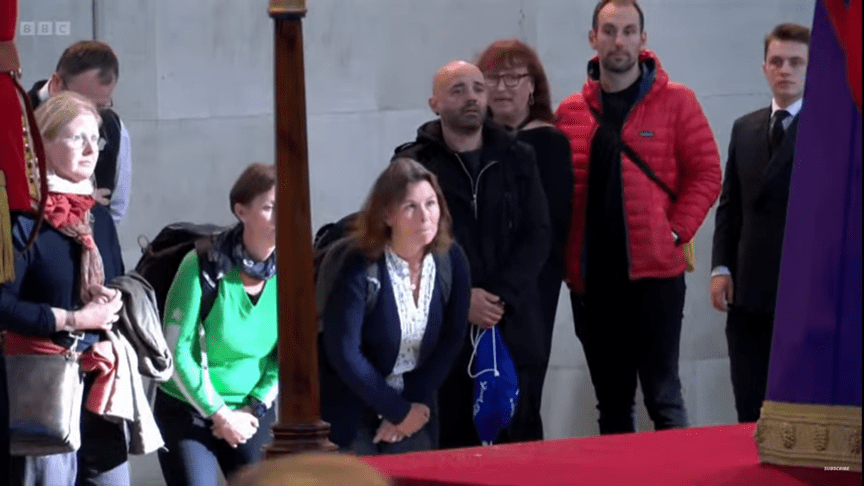
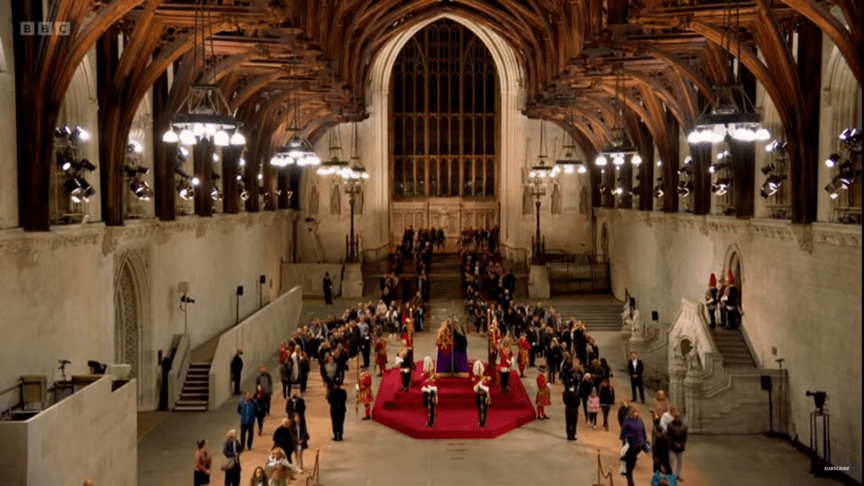
Judging by the live BBC video of her lying in state, the reaction and behavior of her people is perhaps the finest reflection of, and tribute to the personal example she set. They are waiting for more than 10 hours in line, for only about 10 seconds near her coffin. Apparently without misbehavior or histrionics, and with a quiet dignity.
Her Majesty would have been proud of their acts of decorous duty – as she long performed her own duty – as well she should be. Common people, acting not at all ‘common.’
I am not sure such decorum would prevail in similar situations elsewhere. But then, there probably are few, if any ‘similar situations elsewhere,’ because the Queen’s office and role in the life of her nation were so unique. ‘Majesty,’ in every sense, as much for them as for her.
And as if to honor that dynamic, here, traditional British values are emerging again, to show the bond between Elizabeth and so very many of her subjects. Few mourners are wearing the sort of dark, formal clothes probably worn at the funeral of her father, George VI, 70 years ago; they are dressed comfortably for a long wait out of doors. But such externalities aside, the synergy of respect and affection – long reciprocated between them and her – is apparent, and vital.
The regal setting and flawless ceremonial are marvelous to watch, but perhaps the greatest spectacle is seeing her legacy of leaving a nation still willing, able and glad to act in a seemly manner – and not just in a ceremonial occasion like this – as expressed by a line in a hymn sung at her coronation, addressed to ‘All People that on Earth do Dwell’:
‘For it is seemly so to do.’ Even in grief, as part of the ongoing story of British civilization.
One need not be British to find this absolutely charming. At first, I couldn’t believe this wasn’t some CGI Platinum Jubilee stunt, but it is in fact Her Majesty, proving that being ‘regal’ need not mean being serious to the point of pomposity. Would that every renowned person – and no one alive has (ever?) been so renowned, for so long, as the Queen – displayed such easy and gracious aplomb.
I approve on principal that hereditary monarchs no longer have substantial power. But cursory observation shows that popular election does not invariably yield deserving, trustworthy or competent leaders. And a sovereign like Elizabeth shows there is much to be said for having a stabilizing institution that embodies reassuring continuity and solidarity, its legitimacy granted by Fate (birth), rather than political clout obtained through crass maneuvering, often beholden to interests at odds with those of a nation as a whole.
CONTEXT: Lest new readers assume that I only think, or write about serious matters, here is something that appealed to my taste for communal mirth. I often try to articulate things people may be aware of, but only consider in passing. But in this post, I just let myself get caught in the current of a charming bit of silliness that wafted across my (cyber-) path. Because life should be ‘savored,’ not just ‘chewed upon.’
As many of you know, I am a stalwart Gallophile, a lover of France, her people, culture etc.
But cruising YouTube recently, I found this video, a reminder of the marvelous eccentricity of which British society (for all its supposed stiff-upper lip values) is capable. A gloriously silly song being performed by its creator, while the audience thrills and deftly contributes. It happened at the enormous, august Royal Albert Hall (RAH) in London, the site of many such wonders of public whimsy and informality. RAH has certainly seen terrific high-art performances, but its massive size makes it inherently ‘popular’; even ‘democratic’ (witness the audience participation here).
So for a venue dedicated to the memory of the late Prince Albert by his stubbornly-grieving widow (and reputed royal killjoy) Queen Victoria, RAH has seen some highly eccentric, but hugely entertaining spectacles. Perhaps some have even coaxed unintended smiles out of Victoria and Alberts’ spirits?
(I incidentally wish Good Queen Bess – as I call Elizabeth II now, as Elizabeth I was known late in her reign – had been there for this shared fest, joining in the fun.)
To hearten anyone shell-shocked by COVID and all the world’s other travails of late, here is a paraphrase of a line from the poet Shelley, in which Life may be speaking to us all:

 All Things Gaul