For Independence Day: Recognizing True Patriotism

My accompanying 2021 post, contrasting the ethics Mr. Gore showed in 2000 to those displayed on January 6, 2021, seems apt again; sadly. Because now, Mr. Biden, due to his performance in the June 27 debates (pressure on top of doing the most stressful job in the world, please remember) may confront a dilemma like Gore’s, between his own ambition and the sake of our nation, which he has served so long and so well.

As Gore did then, Biden may be facing a moment of truth: Does he love America enough to set aside his personal vanity, if necessary, to help ensure she does not revert to unfit, irresponsible governance? Enough to retire in favor of a more reliably electable nominee?

(The GOP candidate has proven he would never put America’s interests before his own. He is likelier to sneer at selflessness as the weakness of ‘suckers and losers,’ having done so before – then lied about it – upon encountering concepts like honor and patriotism. And decency.)

I am no political savant, and can’t specify where the line falls between being resolute and just stubborn; but I know there is such a line. I could wish Gore would reach out to Biden to ask (former V.P. to former V.P.) how great a sacrifice the latter would make in the interests of a greater good. No one else has as much standing, due to his own example, to ask that impudent question. That’s not going to happen, but seems appropriate.

In any case, if Biden decides to stay in the race, we can be reasonably sure it is because he has consulted, then made a clear calculation to do so, rather than a reflex never to defer to anything but his own ego.

——————————

In Honor of Al Gore:

This is an appropriate time to remember the actions of former Vice-President Al Gore late in the year 2000. As many of you will recall, he conceded that year’s election, and the Presidency, to George W. Bush, after the U.S. Supreme Court decided that the deadline for questioning the pivotal, feverishly contested vote in Florida had passed. Mr. Gore had good reason to believe he might have actually won Florida, but that possibility is not my subject here.

Rather, it is to hold up Gore for retrospective praise, now that we have just seen behavior in such stark contrast to his. Acting as any authentic patriot should (and would) have, he accepted personal defeat, subordinating his own ambition to the welfare of our nation. In yielding further plausible claims to victory, he sacrificed his hopes and ego for a greater good. Ironically, his decision strongly suggests he had the judgment and character to lead a superpower.

Anyone who would not have done the same is almost certainly unworthy of the crucial trust of high office.

Gore’s acquiescence brings to mind the Biblical judgment of Solomon, of a mother who so loved her child that she was willing to release it to a rival claimant rather than see it rent in half and killed. I doubt Gore is a saintly man; back then, he was probably seething privately at conceding. But at that pivotal moment, he was unwilling to be the cause of dangerous national divisiveness, admitting that the well-being of our Republic was more important than his own political destiny.

Some people are unwilling, or unable, to grasp ethics that high.

In light of recent events, Gore’s behavior long ago – deeply disappointed, but still accepting the authority of the law and putting the fate of America first – urgently deserves to be reflected on now.

His deed also rebuked the toxic, simian ‘Real Man’ concept of a winner as one who cares only about satisfying his pride; who thinks rules are for weaklings; who cares nothing for decency, let alone decorum; who feels entitled to victory simply for being ruthless enough to stop at nothing to achieve it; and who is brutishly indifferent to any harm he does while pursuing his Hubris.

But Real ‘winners’ Will concede; will grant that other people’s welfare is more important than their personal aspirations; will recognize that moral principle is more valuable than fleeting triumph. Gore showed honor, maturity, responsibility, and a degree of grace – even if somewhat grudgingly so. Thus he has won the right to deserve respect and gratitude forever.

So I hope those planning the 2021 Inauguration give him a prominent place there. His decision to yield in late 2000 – which has never looked more statesmanlike or wiser than now – deserves a standing ovation when he arrives.The recent counter-example to his behavior of 20 years ago should make us appreciate its value now, more than ever.
In Honor of Al Gore (originally posted online, January 10, 2021):

CONTEXT: I would hope that any American who truly loves his or her country would agree with the sentiments of this post, written a few days after the barbarous tumult of January 6, 2021 – a date that should live in infamy. No one who believes that our Republic should be about inclusion, not a fossilized status quo, could approve allowing crudely released passion to try overturning the operation of law (which, it bears remembering, hadn’t happened when the Electoral college voted in 2017 – even though the electee then had lost the popular vote). I wrote this in shock and dread at the forces recklessly and selfishly exploited by a man floridly unfit to be president; let alone to be re-elected.

This is an appropriate time to remember the actions of former Vice-President Al Gore late in the year 2000. As many of you will recall, he conceded that year’s election, and the Presidency, to George W. Bush, after the U.S. Supreme Court decided that the deadline for questioning the pivotal, feverishly contested vote in Florida had passed. Mr. Gore had good reason to believe he might have actually won Florida, but that possibility is not my subject here.

Rather, it is to hold up Gore for retrospective praise, now that we have just seen behavior in such stark contrast to his. Acting as any authentic patriot should (and would) have, he accepted personal defeat, subordinating his own ambition to the welfare of our nation. In yielding further plausible claims to victory, he sacrificed his hopes and ego for a greater good. Ironically, his decision strongly suggests he had the judgment and character to lead a superpower. Anyone who would not have done the same is almost certainly unworthy of the crucial trust of high office.

Gore’s acquiescence brings to mind the Biblical judgment of Solomon, of a mother who so loved her child that she was willing to release it to a rival claimant rather than see it rent in half and killed. I doubt Gore is a saintly man; back then, he was probably seething privately at conceding. But at that pivotal moment, he was unwilling to be the cause of dangerous national divisiveness, admitting that the well-being of our Republic was more important than his own political destiny.

Some people are unwilling, or unable, to grasp ethics that high.

In light of recent events, Gore’s behavior long ago – deeply disappointed, but still accepting the authority of the law and putting the fate of America first – urgently deserves to be reflected on now.

His deed also rebuked the toxic, simian ‘Real Man’ concept of a winner as one who cares only about satisfying his pride; who thinks rules are for weaklings; who cares nothing for decency, let alone decorum; who feels entitled to victory simply for being ruthless enough to stop at nothing to achieve it; and who is brutishly indifferent to any harm he does while pursuing his Hubris.

But Real ‘winners’ Will concede; will grant that other people’s welfare is more important than their personal aspirations; will recognize that moral principle is more valuable than fleeting triumph. Gore showed honor, maturity, responsibility, and a degree of grace – even if somewhat grudgingly so. Thus he has won the right to deserve respect and gratitude forever.

So I hope those planning the 2021 Inauguration give him a prominent place there. His decision to yield in late 2000 – which has never looked more statesmanlike or wiser than now – deserves a standing ovation when he arrives.

The recent counter-example to his behavior of 20 years ago should make us appreciate its value now, more than ever.
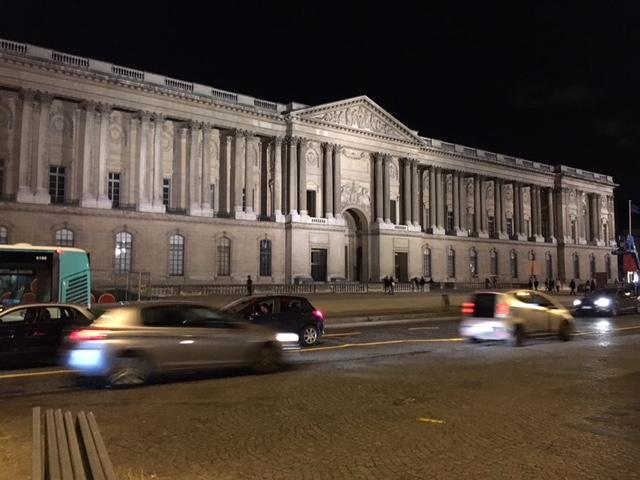
Paris; Eastern Facade of the Louvre:

CONTEXT: A prior online posting from my 2016 tour in Europe, which began in Paris (where I’d been 4 times before). This is the only one of my INTRODUCTORY MATERIAL pieces for this blog that I have extensively expanded from its brief original, done to re-affirm here my affection for, and joy in, French culture and aesthetics. Many of my postings from Germany (some of which will appear in the TRAVELS category/tag here) are much longer than my captions of photos taken in my first destinations, Paris, Venice and Salzburg were. This is because German power, ambition and excess so impacted the 20th Century that once I had originally started posting those online with explanatory captions, I often felt moved to compose long, quasi-essays for pictures I took in Berlin and after, discussing their implications within an historical setting.

But this view is one of my very favorite marvels of anyplace I have traveled, a breathtaking apparition of sheer majesty – a reason for admiration, not meditation. So I have enlarged my original caption for it in honor of how dear it is to me personally. And in hopes that any visitor to Paris may come to seek and savor this vision of loveliness; overlooked, like Cinderella – but unlike her, with a well-scrubbed surface.

To my eyes, this may be the grandest façade anywhere, a perfect combination of ideal proportion and regal demeanor. Despite its auspicious location at the eastern end of the world’s greatest art museum, it is overlooked by many visitors to Paris, overshadowed by the main entrance to the galleries dominated by I.M. Pei’s glass Pyramid portals. At one time, this was the main entrance to the palace, and if now often underappreciated, its cool, elegantly understated aesthetic (the work of a committee, though mainly credited to Claude Perrault) is keenly admired by perceptive architects and art students.

And by me. Paris’ sumptuous pre-World War I, ‘Belle Epoque’ architecture is the city’s most immediate, attention-grabbing appeal for me, and this exterior (some 200 years older than the period cited above) is in my opinion the very best of the best of that rarefied standard: The pinnacle compliment I can pay. Imitation is the sincerest flattery, and this has been a basic template for palaces and other uniquely illustrious buildings elsewhere, ever since its completion. It is visible evidence, imperturbable in granite, of how far above the ever-present squalor of life our ingenuity can enable us to rise.

Ironically, though this front was meant to be a suitably noble prospect for a principal royal residence, it had that status for only a short time. Within a few years of its being finished in 1670, France’s King Louis XIV, who had commanded it to be built, left it and Paris behind. A main reason for this was that he distrusted the city because of political violence that had threatened him there when he was a child monarch. And no doubt the scope and impression of this addition to the Louvre was partly intended to awe the local populace as a display of absolute royal power.

Nevertheless, by the mid-1670’s Louis was creating his huge new palace complex at Versailles, then about an hour’s swift horseback ride from central Paris. Not only did his permanent relocation to Versailles by 1680 allow Louis to avoid the potential tumult of his capital (along with its noise, smells, pestilence etc.), but that vast residence was purpose-built to house a full royal court where all the important aristocrats of France could be gathered, housed, diverted – and discreetly kept under the watchful eye of the regime, far from their own domains, where they might misuse their unchecked local authority.

Personally, I find the Descartes-like austere grandeur of this design more handsome than the sensuous Baroque exuberance of Versailles. I don’t know if Louis regretted having to leave behind a setting magnificent enough for one who styled himself ‘le Roi du Soleil’ (the Sun King), but this marvelous construction – still virtually brand new then – more or less languished after his departure, with little regular role in royal life. And such was the unregulated density of Paris at the time that common hovels got built nearly up to these very walls (as at Notre Dame), till all of those were removed as the city was rebuilt for orderly urban function in the mid-19th century, partly to give less cluttered surroundings and more edifying views of such venerable edifices.

I strongly recommend that you seek out this spectacle of reserved stateliness if you visit Paris. Like many of her great sights, it is floodlit at night; this picture was taken on a Saturday evening when thousands of Parisians strolled this neighborhood of illuminated, world-famous landmarks. As noted, locals seem to take their epic cityscape for granted – what a fantastic privilege! – but they evidently occasionally disregard the familiarity of their extraordinary surroundings, to acknowledge and fully appreciate them.

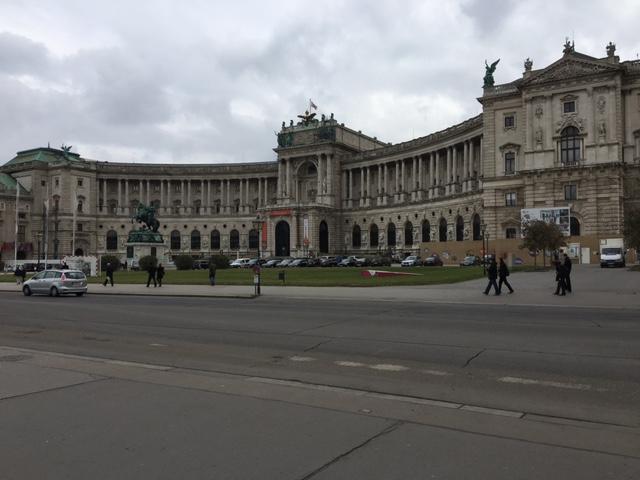
Vienna; Hofburg Palace:

CONTEXT: The most determinedly grand façade I saw in Europe (though not as succesful the colonnade of the Louvre), the main frontage of the imperial palace in Vienna, the Hofburg. Built as a suitable setting for august royal ceremony, it would also be the site of one of history’s most ominous spectacles, as described below; a frenzy of xenophobic vainglory. A jolting contrast to all this elegant dignity. There is also a passing reference to sculptural portrayals of strength, noted in other posts, as an apparent Germanic fixation.

The Habsburgs’ main residence, enlarged over six centuries. This handsome, curved façade was its last major expansion, completed in 1913, the year before the Empire provoked The Great War (World War I) that led to its own demise. Nowhere, it seemed to me, was their Imperial, dynastic prestige more manifest than in this literally majestic edifice. But there were so many distracting sights in the vicinity that I forgot about what was probably the worst event it ever witnessed: From its central balcony in 1938, Hitler proclaimed the union (“Anschluss”) of his native Austria to Nazi Germany, to the wild cheers of tens of thousands of enthralled spectators.

Few places of Hitler’s triumphs remain in Berlin, which was largely leveled in World War II, so I wish I’d remembered at the time what had happened on that balcony, and reflected on it even if it made me shudder. The Habsburgs had treated their fellow Austrian-Germans as first among their subject peoples, but not with toxic ethnic chauvinism. It was left to Hitler to replace the primacy of royal blood with the inherent supremacy of German-Aryan genes.

Perhaps it was the loss of the higher status they’d had under the Empire that made so many Austrians so thrilled to be led into the Third Reich, with its seductive promises of restoring Germanic glory and dominion. By the way, the Hofburg is where the hyper-muscled statues I’d earlier contrasted to French ones are. That cultural preoccupation with power seems telling, for Hitler chose this very place to, effectively, extol strength as man’s chief virtue – and the only true determinant of his Fate.

1918/2018; 100 Years since America’s Arrival on the World Stage:

CONTEXT: Originally posted online, October 15, 2018: I composed this shortly before U.S. Congressional elections in 2018 to suggest the duty Americans have to follow our ideals, evoked exactly a century earlier, when a world numbed by grief and horror might have collapsed beyond restoring without the example we then offered.  I felt it urgent to point out how the centennial of America’s first having global influence was coinciding with elections that might – considering those who craved power in 2018 – have irretrievably impaired our Democracy.

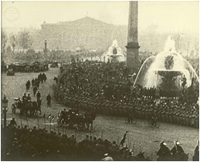
[Image: Rapturous crowds in Paris’ Place de la Concorde greet U.S. President Woodrow Wilson in 1919 as a virtual Savior after the end of the First World War (in which France herself had suffered beyond reckoning). Wilson had come to help negotiate the Treaty of Versailles, formally ending the war with Germany and trying to build ‘a just and lasting peace.’]

‘That the world be made safe for Democracy’

By November 1918, after four years of unimaginable violence in The Great War (now known as World War I), much of Europe had been bled white, wrecked, bankrupted and entire societies were disintegrating. Exhausted and gripped by despair, Europeans looked to America – the vigorous, visionary “New World” that had joined the War on the side of the western Allies in mid-1917 – to save the Old World.

President Wilson had said his country’s mission in sending its young men to prevent the defeat of France and Britain by militarist Imperial Germany was that “the world be made safe for Democracy.” American arms were crucial to the Allies’ eventual triumph, forcing the Germans to cease fighting by the Armistice of November 11, 1918.

(An unapologetic racist whose concern for equality and personal liberty was only for Caucasians, Wilson is less revered in our era. But ideals are often more inspiring than coarse reality, and the ones he promoted might help pull us all beyond his backward, disappointing underlying attitudes: A fitting irony.)

It was arguably the first time America had ever commanded the global stage, having been summoned to rescue Europe from the calamity of miscalculations by its traditional rulers. And even more than U.S. military help, many dazed, desperate Europeans (from both sides of the war) hoped for an advent of American-style governance: That ordinary people might be able to lead themselves better than those ‘traditional rulers’ ever could, with wisdom, justice and decency.

So this November, 2018, Americans should proudly recall the optimism that our great experiment in freedom offered 100 years ago to a continent prostrate with catastrophe. And we can show again, in deeds, the same luminous promise our nation once represented for humanity by acting consistent with our hopes of what we might build together, rather than have our passions, resentments and fears exploited by those who would control us (from the shadows) for reasons of their own.

Please reflect on this precious mission – Democracy made safe, again, by Americans – if you vote this November, 2018. You may help to reinvigorate the ideals for which the world once looked so urgently to us.
(Reposted in July 2022, as a still-relevant reminder of the importance of civic engagement)

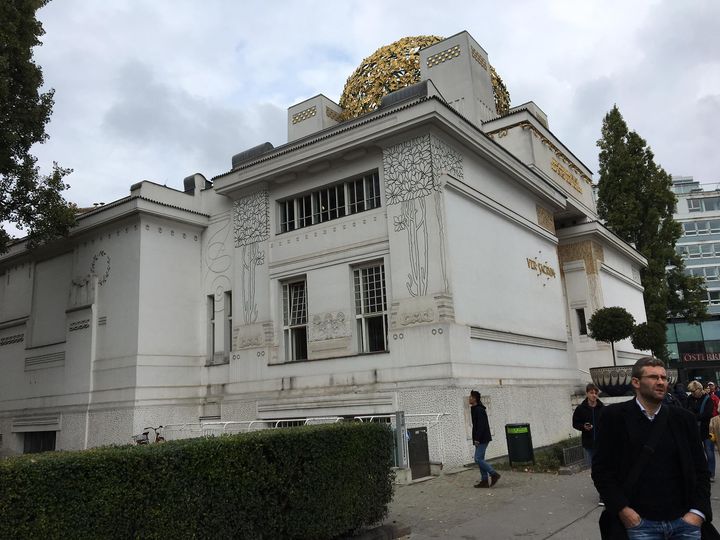
Vienna; Secession Exhibition Building:

CONTEXT: This picture is from my 2016 visit to Vienna, Austria with my friend Paul. It shows a modest, but deliberately, stridently unique building, created in reaction against the stultifying aesthetics and society of the late Austro-Hungarian Empire.

An exhibition hall in proudly non-traditional architecture, this was opened in 1898, to display the work of non-conformist artists, who had “seceded” from the academic official art of the Empire, which they found banal and sterile. This building is emblematic of a remarkable irony: in the early 20th century, as Imperial Austria stagnated, resisting political change happening elsewhere, Vienna was the site of some staggering innovations. Freud, Schiele, Klimt, Schoenberg and Zweig all lived and worked there, creating whole new sciences or paths of creativity. I don’t know why such immense novelty burst forth then, but it was likely one of the things Hitler – an impoverished provincial youth then living in the city, ferociously sensitive to affronts to traditional German culture – most hated about the place.

Further, the adulation painters like Klimt got must have inspired very personal jealousy in Hitler, himself a failed artist (of very limited imagination). I am frankly surprised the Nazis didn’t destroy this structure when they ruled Vienna, as it represented a freethinking Intellectualism that they lethally despised, a violation of their ideal of abandoning the ‘Self’ to the will of a single heroic leader – Fuehrer.

“Remember Me.” Honoring the Victims of September 11, 2001:

My friends know that many of my online posts advocate for hope and optimism. But the 20th anniversary today, of the September 11, 2001 terror attacks inflicted on peaceable Americans, is a very heavy lift for such advocacy. The horror and malevolence were too concrete; monstrous, unwarranted ambushes in settings whose safety we should take for granted.

Events as ghastly as the ones remembered today are abhorrent to what we would believe is both people’s basic decent Nature, and our ability to evolve for the better. So much so, they may seem to call into question how different we really are from creatures with fangs and claws, obviously designed for killing. But I will suggest a way we may try to evoke light out of a dark calamity in which it is not, otherwise, to be found.

Of all the heartbreaking images that emerged in the unspeakable aftermath of the New York attacks, the one that struck me hardest was a photograph showing masses of portraits – smiling, relaxed, unsuspecting of their Fate – of people who had died at the World Trade Center just for going to work that Tuesday morning. They appeared to be all small (but uniform) posters on standard office paper. The victim’s name appeared below the image with a simple directive: ‘REMEMBER ME,’ printed above.

This was apparently an organized memorial. Hundreds of such posters were put up in Lower Manhattan, grim pleas to onlookers not to let these slaughtered innocents simply dissolve into forgetting, as they had vanished into the flames and dust of the attacks. I have not been able to find that specific picture, but the one shown here is very close, minus the ‘REMEMBER ME’ headings.

Much could be said about the moral, political and cultural implications of this act of consummate ferocity, but if there is one profoundly personal lesson we should all take from the infamy of September 11, it must be how precious, frail, transient and uncertain life is. How it can placidly glow like a rainbow of motes of dew, only to be swept away as abruptly as it had appeared. And to treat our own lives and those we love as the incomparable treasures they are.

Yet perhaps we may also ‘evoke light’ by helping those murdered so terribly to avoid a second passing away: By being utterly forgotten.

Most of the dead presumably led ordinary lives, and the world would likely never otherwise have heard of them. But if their lives were ordinary, their deaths were the very essence of tragedy. And that alone should entitle them to more than that all memory of them should just be swallowed by the gray maw of Time and disappear.

Thus, if we strive to think upon these dead strangers, even occasionally, we rise above the maniacal self-absorption of the terrorist bandits who stole their very existences. Paying such attention is a gift of our own Selves – our time and memory – which restores a vestige of ‘being’ to them instead of sheer, bereft absence.

Remembering the dead of September 11 is a relatively small task but it ensures that the annihilating intent of that nightmare on a sunny day in New York does not fully succeed. We may thwart their killers’ wish to destroy utterly by doing the duty of the righteous: To help build. And to sustain. So please:

Remember them.

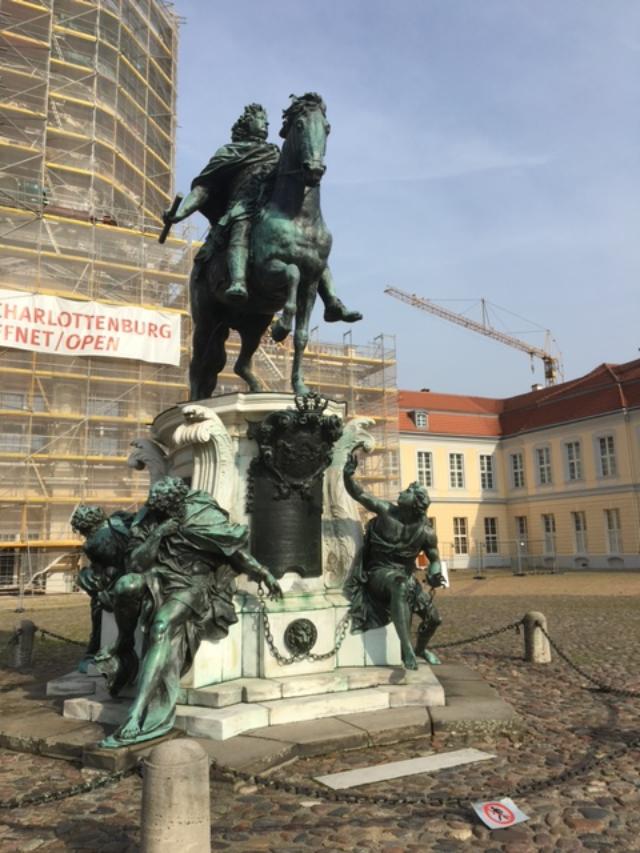
Berlin; A Statue Suggestive of German Attitudes to Power?

CONTEXT: As a self-styled historian, for me, going to Berlin was the linchpin of my 2016 visit to Europe, due to the city’s (not entirely willing) role in Nazism. Fellow traveler Paul and I visited Charlottenburg Palace, seat of Prussian kings, just west of central Berlin. The palace had no connection to the Nazis, but I used this statue – similar in spirit to ones I’d seen elsewhere in Austria, another German-speaking land, and at a Hapsburg castle in Prague – to propose a rarely-noted factor in why a flower of evil like Hitler might have sprung – germinated? – in German soil.

This statue of King Fredrick William I of Prussia, in Charlottenburg Palace’s courtyard was, of all the monuments I saw in Austria or Germany, the one that seemed to most bluntly portray strength as the greatest (or only) virtue.  The captives below the king’s horse writhe in terror at his sway, but he does not even bother to look at such wretches; instead, he gazes off to infinity in search of something more worthy of his noble eyes.

When this statue was made, kings were seen as bulwarks against the inherent chaos of life. However, the fact that Germans, in particular, seemed to not only accept such arrogance and menace from their rulers, but to approve and admire them, may obliquely help explain the attraction of Hitler.

This attitude may be rooted in the fact that the deepest national trauma of the German people before World War II was the Thirty Years War of 1618-1648, the worst of which was fought in their territory (there was no single “Germany” then, just dozens of small German-speaking states).  That ghastly conflict was even more destructive than mechanized warfare; what troops then lacked in lethal technology, they made up in vigorous bloodlust. 

In addition to soldiers’ deaths, about a third of the civilian population of “the Germanies” is thought to have perished, killed outright, or died of starvation, epidemics, and other miseries that flourished in the general pandemonium.  Crops went unharvested or could not get to hungry markets via roads infested with bandits, commerce and crafts collapsed in the turmoil, etc.  Civilization in these lands broke down then about as much as it possibly could.

Much of this horror happened at the behest of powerful neighbors, especially France (already a united realm), which wanted Germans to stay divided and feeble. From then on, the terrible cost of weakness was embedded in their folk memory, leading to an ingrained assumption that to be strong was to be “good.” The lesson the nation seems to have absorbed at indescribably dreadful cost in the 17th century was that without power, nothing else mattered.  In fact, the King portrayed here was pivotal in giving Prussia a pervasive military disposition, partly in response to dire experience: helplessness had yielded horror.

In 1871, German lands that had so often been at the mercy of others, were finally united under a single Prussian-led regime, as the German Empire: The Second Reich (the First Reich was the Holy Roman Empire).  But when the still relatively new unified ‘Germany’ was defeated in the Great War (World War I), many Germans wouldn’t accept that their talented, progressive nation, a major driver of the Age of Reason and Industrial Revolution, a dream unfulfilled for centuries, was not invincible.

Such people were susceptible to sinister explanations – especially to ones hissing that if their mighty Fatherland had been defeated in battle, it could only be due to some treachery.  This suspicion was the mud onto which Hitler would cast seeds alleging a Jewish conspiracy – called ‘a stab in the back’ – to keep Germany from attaining some glorious destiny. (In this implausible telling, the pivotal intervention of the U.S. in the war in 1917 did not affect its outcome; only betrayal led to defeat.)

Added to that resentment was the factor that democracy, post 1918, was still relatively new to this society.  The Kaiser’s abdication had led to the country becoming a republic, but many Germans reacted that perhaps they were culturally better suited for their prior authoritarian rule than parliamentary self-government. Especially when democratic politics did not solve their grievous economic woes during the Great Depression.  And if they couldn’t have another Kaiser, they would have a Fuhrer – Leader – to dominate them.

All this may seem like a lot to extrapolate from one statue.  Of course there were other factors in the rise of Nazism: unjust provisions of the Versailles Treaty (which was negotiated by the spineless ‘Weimar’ republic) – valid grievances Hitler exploited ruthlessly.  But this statue, and monuments in the same vein throughout Germanic lands, suggest an undercurrent of power worship, which may well be at least part of why Nazism appeared, then broadly appealed, there. 

Any culture that would consider an image like this normal – even praiseworthy – probably needed less convincing than most that Might Makes Right.

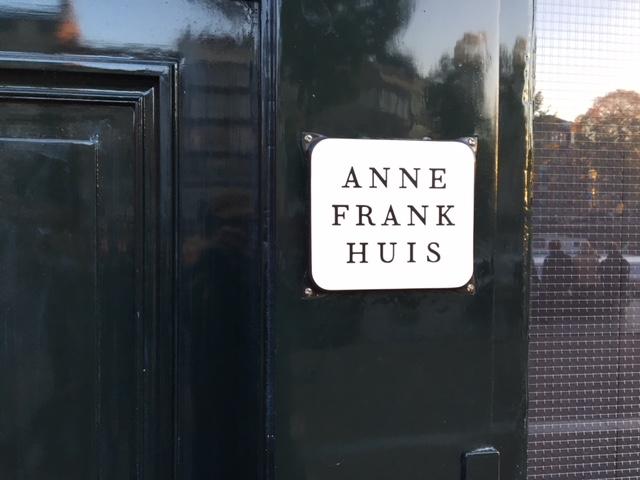
Amsterdam; Door of Anne Frank House:

CONTEXT: A post about my visit to Europe in 2016. ‘The Night Watch’ mentioned here is one of Rembrandt’s greatest paintings, referred to in depth in other online posts (which I may re-post here later) from my trip. I’d decided to return to the U.S. via Amsterdam explicitly to see it, at the city’s Rijksmuseum.

How very ordinary this renowned building looked, as if to emphasize Fate’s apparent indifference to the desperate fear, wrenching malice and now sorrow forever it has seen. I got here soon after viewing ‘The Night Watch’; a summit and an abyss of human endeavor – creativity and calculated cruelty – separated by a brief walk, yet from different worlds.

The relative nearness of this poignant shrine of barbarism to Rembrandt’s sublime intimations of what it is to be human called to mind the grinding of the tectonic plate of the Self’s will to power against that of its will to create, and to love. Never in Europe was I more aware of that primordial friction than as I stood before this door.

I would have liked to go inside, but hadn’t made the needed pre-reservation to do so. Instead, sentiments like those above flowed out of me here as silent, unbidden prayers.

Prague; Ancient Jewish Cemetery:

CONTEXT: From my 2016 Europe trip. My only picture from Prague from a great many I took in an overnight stop there in 2016, I include as one of my Introductory blog posts, considering it a semi-sacred duty to put this one here, for reasons explained in the text.

This is a last picture from my visit to Prague, posted separately from all the others to call special attention to the long Jewish presence there. It is my small contribution to helping to thwart Hitler’s dream that not only all of the world’s Jews, but any memory of their very existence, should be obliterated.

Long before the Nazis definitively eradicated it, the venerable Jewish community there had a tempestuous and often violent history. The tale of the “Golem,” a mythical monster created to protect Jews from persecution, originated in Prague.

These tombstones had a calm dignity that made them very different from the only other graveyard I made a point to visit in Europe, Pere Lachaise in Paris. That place is far newer; its first graves seem to have been from around the time this one accepted no more. There have been no burials at this location for some 200 years, and many of the stones are so old they are slowly sinking into the soil, as if to mimic the “dust to dust” return to Earth of those who lie beneath them.

But many tombs in Pere Lachaise were the virtual opposite, in spirit, of these simple memorials. Most were at least ostentatious, others over-the-top Gallic theatrical. Those Parisian monuments, made with wrought iron or intricately carved stone, are now deteriorating badly, no longer the proud spectacles their owners probably hoped would last forever. These in Prague, much less elaborate (usually just a Hebrew inscription and some image to mark the owner’s work in life, like grapes for a wine merchant) are much less liable to such decay.

I can only speculate on why there was such a stark contrast in how eternity was approached in these two places. It may just have been that the Jews of Prague couldn’t afford anything finer, or that religious authorities there prohibited ostentation. Or it may have been a resignation to mortality that the Parisians refused, trying to resist the anonymity of death with elaborate tombs. No such pretense is apparent among these gravestones of Prague and ironically, as the monuments at Pere Lachaise now rust and erode, they suggest the triumph of time more, not less.

I am still perplexed (though joyful) at why the Nazis, who despoiled evidence of Jewish culture everywhere they conquered, left this cemetery and several old synagogues nearby, alone. These are all in central Prague; the Germans must have known they were there. Perhaps it was just their absurd concern for ‘appearances’ – of imagining Gentile Czechs wouldn’t think they were utter brutes if they left a few familiar local highlights – but not live Jewish people – untouched.

Such logic would be comical, if it weren’t so monstrous.