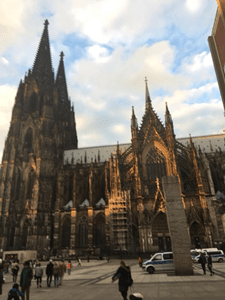
Cologne, Germany; Cathedral from Adjacent Plaza:

CONTEXT: From my 2016 Europe trip, posted: Only completed to its original Medieval plans in 1880, this is considered perhaps the greatest Gothic church in the world. Cologne began as a Roman provincial capital, and has been a major city ever since. During World War 2, the vicinity of the cathedral was pulverized by Allied bombing, and most of its prewar buildings were not rebuilt, replaced with modern structures. However, some Roman remnants, which had been covered over centuries earlier, were exposed by the bombing, then fully brought back to light during the post-war reconstruction.

This is a closer view of the same side of the church as in my hotel room picture, here burnished by the setting sun. I believe the vertical pillar here was some ancient artifact from Cologne’s origins as Roman ‘Colonia.’

It would be interesting (though melancholy) to see photos taken from this spot before World War II’s catastrophic impact. It was probably a crazed network of largely unreformed Medieval streets and buildings, all now gone forever. It is worth noting that, in addition to being the site of two previous cathedrals, this spot has been a locus of pulsing urban activity since before the Colosseum was built in far-off Rome. By some accounting, Cologne was the largest city north of the Alps till ca. 1450 – long before today’s vast Berlin was of the least importance.

The warm solar glow on all this artful stone may be a metaphor for both change and constancy. There may be ‘nothing new under the sun’ – it shines, indifferent, on all our plans, triumphs and failures – but this city’s ancient, intricate story is an exceptional panoply for our steadfast star to overlay. This structure is one of the very finest works of man, yet sunlight floats on it effortlessly as golden mist, taking no note of the great shrine, just as it glows, unchanging, in the face of all human events. For me, there is an indefinable yet definite comfort in that sense of both chronological and physical continuity.
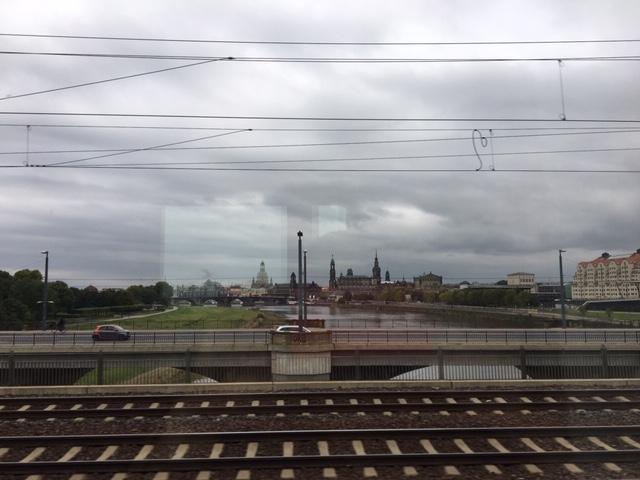
Dresden, Germany; Refinement, Defiled:

CONTEXT: The ‘we’ mentioned in this piece from my 2016 travels in Europe is my friend Paul from Boston, who was with me for the middle part of my travels, from Salzburg to Berlin. We traveled by train, and saw numerous ground-level points of interest that way; especially this one.

Our train made some stops in Czech lands, then several more in Germany before Berlin. At one station, a young man joined us in our compartment; he discovered we were American, and wanted to practice his English (I practiced speaking German to him; his English was far better than my German). I knew that Dresden, supposedly the greatest Baroque city on Earth till it was bombed to ashes near the end of World War II, was nearby, and asked him if we would pass through its center. He said we would not be in its heart, but that it would be visible from the station where we would stop (he also gave us helpful information for our arrival at Berlin’s mammoth central train station).

Here is a picture of Dresden taken while our train was stopped there. I recognized the dome at the left as the Frauenkirche (Lady Church). This is a restoration, the original having been wrecked in the 1945 bombing, along with most buildings in the city center (and an unknowable number of dead, estimated at 80000, one of the greatest number of people ever to perish in a non-nuclear bombing). Dresden lay within Communist East Germany, and until the end of the Cold War there was neither enough money nor inclination to try to restore all of it to its original splendor. Only after the reunification of Germany were additional historic structures rebuilt; no doubt, Dresden can never be what it once was, but is surely far closer to it now.

As noted, Prague, not far away, got accidentally bombed in that attack – but could have been utterly laid waste, had the Czechs tried to fight the Nazis in 1938.

Dresden was not so lucky, and can serve as a stern reminder – bearing in mind it was devoured in a whirlwind of conflict the Germans themselves had sown – that destruction is easy, but creation is hard. The exquisite beauties the city accumulated over 200 years of building were wiped out in a single day. Civilization, as the empowerment of the Nazis itself showed, is often no match for the brute force of primitive savagery. At least, not in the short term.

However, if stone cannot survive such violence, sometimes the human spirit can; for unlike stone, it may have the power of regeneration. In a gesture of reconciliation, the cross atop the new Frauenkirche dome was forged by a British blacksmith whose father had been a crew member on one of the bombers that had destroyed Dresden. Also, the church displays a “Cross of Nails” made of Medieval spikes taken from the ruins of Coventry Cathedral in England – itself devastated by German bombing – the gift of the people of Coventry.

The Nazis gave the world good reason never to pardon them, or Germany. Yet, it has been observed that bitterness is an acid that eventually corrupts any vessel used to store it. Sustained hatred – no matter how justified – may consume the humanity of those who contain it. Surely, that is what happened to the Nazis themselves, in their ferocious resentments of perceived enemies.

The scale of crimes they committed makes it impossible to exact adequate justice, but there are few better counter-gestures to the criminal pride National Socialism embodied than to at least try to forgive Germany (if not the truly committed Hitlerites). That is something the Nazis never would, nor could, have done, and thus may be the most practical repudiation of them one might make. That alone may make it a worthy goal – even if for many people, it is, understandably, an impossible one.

The Frauenkirche, once a refined expression of order and hope lost to the havoc of war, was a well-chosen place to suggest, tangibly, the restorative power of forgiveness.

Response to Paris Terrorism, November, 2015:

CONTEXT: This was the first long post I ever put on the web, galvanized by my shock and outrage at the multi-pronged onslaught on Paris in November, 2015 by Islamic terrorists, rabid to strike at a city that is both a laboratory and exquisite emblem of Western Civilization. Far more than just its elegant architecture or being the background of many illustrious lives, Paris helps define the vitalizing ideals that both shaped and animated our shared culture; and still do.

Here, I try to defend France (an imperfect society, as they all are, but one I deeply admire) by invoking what all of us in ‘the West’ owe to her. Much of that is among the attributes that drove those fanatics’ murderous hostility. And what it could mean if the dark energies behind that hostility should prevail.

As my friends know, I rarely post online. However, I am a Gallophile; a lover of France and French culture. And today, in response to the barbarism deliberately just inflicted on Paris, it may be timely to bear in mind that France’s contributions to the modern, Western world are far more than (just) its many glorious expressions of the arts of living well.

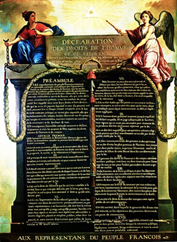
So here, I post “The Declaration of the Rights of Man and the Citizen,” promulgated by the revolutionary French National Assembly in 1789, just a few weeks after the fall of the Bastille, generally considered the initiation of the French Revolution. Diametrically opposed to the arbitrary power of kings and hereditary privileged ruling classes, the common rights it lists and defines have parallels to the American Bill of Rights. But unlike that document, it was created in the most powerful society in Europe, not in a peripheral wilderness as America then still was.

The Revolution’s ghastly Reign of Terror, then Napoleon would come later than these glowing ideals. But while those aftershocks are long gone, the Declaration still resonates with us today, as an expression of hope for a freer, happier, better world, shared by all the children of the “Supreme Being” of which it speaks.

It is always easier to destroy than to build; contrast the behavior of those who have brought such havoc to Paris with (for example) the Muslims who built the glorious water gardens of Cordoba in Medieval Spain. The nihilistic wrath visited on Paris certainly doesn’t carry on that constructive version of Islam, but again: It is easier to destroy (including self-imposed ‘martyrdom’) than to build (create).

After all, that’s too much like work. Including the work of nurturing Liberty, Equality, and Brotherhood.

The attacks in Paris targeted flesh and blood, but also tore at the sinew of civilization itself. That is, the precious desire of every person of good will to share our one world without fear, protected by law, reason and the better reflexes of humanity from lower passions that would destroy our world’s longed-for, uplifting – but delicate – harmony.

Overtures:

Sample posts that I wrote, then posted online, at various times, on various topics or experiences that interest me, will appear as my first posts in this blog, tagged as ‘Introductory Material.’ These serve as ‘Overtures,’ to give newcomers here some sense of what I care about, and how I express and convey my observations. I will be writing new material for OmniaGallia of course, but these existing pieces are representative of what is near to my heart.

These are all among my personal favorites of my posts, and some of them have greatly moved previous readers. Some contain cross-references to other online posts or information not included within them, so I provide a CONTEXT preface where it seemed necessary.

After these samples, I will start posting more of my previous online writings here about my ‘Travels,’ the ‘Journey’ (of my heart or mind), or just random subjects that have attracted my interest, ‘Caprice.’ My posts here will all categorized or tagged as such.

Some readers may find my subject matter or my treatment of it overly conventional. Perhaps; but I hope my commentaries on such are exceptional examples of their type, so may you enjoy reading these as much as I felt energized while writing them. Many of them took considerable deliberation (and refining), so I hope they offer you cause to reflect as they did for me; enjoyably and fruitfully.

BG