For Easter Monday: Echoes of Resurrection

(This post was conceived, and largely composed, before the death of Pope Francis. Now I dedicate it to his memory, and to hopes his joyous proclamation of Christ’s meaning for Humanity may continue to ‘go forth and multiply.’)

This image shows Pope Francis kissing a man with a ghastly skin disease. I don’t know if this encounter was prearranged, or if Francis just spotted this poor soul in a crowd. Either way, he responded as Christ did with lepers, who were then shunned for fear of contagion, and prejudice that they were spiritually ‘unclean.’

Francis’ parallel act of surpassing kindness reverberates as an unaffected demonstration of what love beyond one’s Self may enable us to do. As here, when it likely required overcoming reflexive revulsion, and fear of possible contagion, to comfort a child of God who has likely often been ‘shunned.’

Our best deeds are often not our most rational ones, but a response like this to suffering is fitting for anyone who thinks it worthy to emulate Jesus. Especially for a successor to Saint Peter.

If this meeting was spontaneous, the Pope had to trust the man’s (presumable) assurance that his condition was not highly communicable. But in his role as ‘Vicar of Christ,’ he may have felt obliged – in fact, inspired – to follow Jesus’ example with outcasts. This is a breathtaking illustration of how care for the misery of a brother being – here, one who has surely endured much isolation – may enable us to set aside our sensibilities, and even our own safety.

Caring for another as oneself may be a joyful gift to give, simultaneously a denial of Self, and yet the Self’s finest affirmation. Here, we witness someone heavy laden, being reminded that he need not carry the cross he has been given to bear, alone.

In basic Christian belief, love enabled Jesus, the Christ, to physically transcend death itself. We ourselves cannot do that, but here we behold the transcending power of love in action. I cannot know if Jesus’ bodily Resurrection literally happened, but can have faith that its implications can change the World. That is a reality we may create, and by which we may be re-created; that is, made anew.

Francis could not miraculously cure this man, as Scripture asserts Jesus did on numerous occasions. But short of that, what might Jesus do in such a situation?

Surely, something like the gesture in this picture.

Music for Good Friday: ‘Sweet Cross’

Here is music from Bach’s ‘Saint Matthew Passion,’ his incandescent depiction of Christ’s somber death: ‘Komm Susses Kreuz’ – ‘Come, Sweet Cross.’

Its title may puzzle; how could a cross, an object of abysmal cruelty, be ‘sweet?’ But in Bach’s milieu, it also symbolized comfort, consolation and deliverance: For as Jesus endured His cross, He will help us withstand ours. Thus assisted, we may tremble less, to face our own tribulations.

Such seeming passivity may affront our inclination to problem-solve, rather than to withstand. But while human efforts have hugely improved life, none of us gets through it avoiding all fear, pain, sorrow etc. But that does not make life inherently futile, for as Bach intimates here, when we face adversity our own efforts cannot redress or soothe – yet facing such feels unbearable – we may avail ourselves of hope that resigned anguish need not be our only response to it.

Hope that Christ enrobes us with unfathomable love of which we are rarely conscious. It should be no disgrace to need help beyond what we (or the full genius of our species) are capable of, for the premise that all we really are is bustling sparks of carbon is more than most of us might want to accept with equanimity. Faith is willingness to grasp comfort, strength and hope in things than are not rational. Things like ‘unfathomable love.’

The aria’s lyrics ask of Jesus, ‘give your cross to me,’ offering to carry it for Him. This also suggests how ministering to others enriches us by transcending the limits of the Self. We often see evil in the world, but rarely unimaginable goodness, like Jesus’ sacrifice of Self, in every sense. How to respond to such? Bewilderment? Dismissive incredulity? Awed that it is even conceivable, and inspired to follow its example?

I chose this performance by Thomas Quasthof, who was deformed at birth by Thalidomide. As if in rare compensation, he was bestowed a fabulous voice which, as here, can do justice to Bach’s art. Still, if Quasthof curses God every day for his afflictions, I couldn’t blame him.

But in such resentment, as in his gift, he would personify an extreme example of the sorrows and joys, challenges and rewards, defects and wonders of being human. Quasthoff’s very existence implies how, because we are all imperfect, we would be wiser to help bear each other’s burdens, as well as share in each other’s gifts.

Enabling us to enter Paradise was Jesus’ mission on this day. And unless our own malign actions prevent it, we may also rejoin the essence of Creation: That unfathomable love, which is ‘sweet’ indeed.

And the mournful, yet ecstatic tones which Bach deploys here, may ease us into embracing that transforming grace. 

Come, Rejoice.

I often post a version of ‘Veni, Veni, Emmanuel’ for Christmas. This year I have chosen one that pleads, with awed splendor, for a consolation beyond any other to enter and lighten our world. For some of us – fearful of the future – such beauty counters the sense that life holds little other than dread.

If this music lets you feel comfort, hope and peace, revel freely, not trying to justify or rationalize them. Comfort, hope and peace are often less of the mind than the heart, which must at times prevail, lest it shrivel; and us with it.

For example, the initial refrain of ‘Gaude,’ ‘Rejoice,’ here is a chord of piercing beauty, but trying to dissect that would defeat the purpose of artistry. A desire to understand how things work can be hugely beneficial, but the arranger, Kodaly, wanted to summon uplift and inspiration, not provide a cognitive exercise.

For most of us experiencing wonder, joy, etc. – sensations that make life feel worth living – their underlying mechanics are irrelevant. Instead of trying to capture wonder, we should let it, peacefully, capture us. It is unnecessary to understand exactly why this happens, and can even be another case of ‘defeating the purpose’ – here, of personal peace.

As to the message of the lyrics, ‘Emmanuel’ translates as ‘God with us,’ but may also imply ‘God in us.’ If we are watchful, we may recognize echoes of divinity in our midst; Angels, not in the guise of winged men. That is, any of us may transcend our Self to act, without consideration, for the benefit, comfort or rescue of an Other, and thus be revealed – even to our Selves – as agents of benevolence surpassing our apprehension.

So perhaps, we are not a lost cause after all. Indeed, Christmas commemorates a supreme instance – in need of no validation beyond the sustaining hope it affords – of love, incarnate, offering grace greater than the fallen state of Humankind.

We must not be blind to the harshness of the world, but neither should we blind ourselves to marvels it may present. That can become a self-fulfilling prophecy in which darkness is all we ever perceive, depriving us of the full spectrum of our personhood.  

We do not all share the same advantages and burdens, but may all share in the same wonders; as well as the same dreads. In a world of dispiriting facts, it is a mark of being human – imperfect, vulnerable and constrained – to need, feel, and embrace respite such as this majestic, melodic invitation to Hope holds out, luminous, before us.

‘Veni, gaude’; Come, rejoice.

Music for Easter Monday:

This song is not about Easter, but it is what Easter is about: ‘Love, sweet love.’ And always was, and should be, about.

Nothing I could say about Easter’s doctrine or metaphysics could be more moving than the pure import of these lyrics, nor than the desire of these youthful performers to offer hope and solace amid Covid. So I will only add that those feel fully in accord with Jesus’ heart of love, of which, there is indeed ‘just too little’ in our world.

When this music was new, during the U.S.-U.S.S.R. Cold War, it had the same vibe shown here: Appealing especially to young people not yet hardened by adult responsibilities, nor seduced by self-interest.

Rejecting hopeful ideals is often seen as shrewd maturity, but this pop classic is a case where simplicity is more compelling than sophistication. Perhaps this song, with its message dear to the Angels, will kindle hope for you too, even if life has encumbered such for you, as it does for many who live long enough to be laden with its burdens.

As someone far pithier than me said, ‘You are as old as your fears, and as young as your hopes.‘ Idealism is easier before the duties of adulthood must be shouldered; Life’s stern realities can be rocks on which we can be wrecked, but they don’t have to be. Even for us who are no longer young, yet who still care about making this Life less awful for a dearth of sweet love (and indifference to that dearth may eventually backfire on ourselves), the promise of such an ideal can be embraced, and celebrated.

Music for Good Friday, Message for All of Time:

I last posted this video several years ago, first deploying it in 2014 for the Easter after the death of my father. Then, it felt needful to me to believe that the certain, eventual loss of those we love need not affirm that life is largely meaningless. Such feelings have stirred again for me now, with the death of my best friend, Dr. Joe P. in November, as noted in recent posts.

For unlike my 93 year-old father, Dr. Joe’s passing seemed callous and even perverse, in that he was far younger and had done so much good in his life for others.  And as great as were the contributions (as a physician) of his extreme intelligence, in my view, his kindness and compassion were even finer gifts to the world. Truly noble and more fully human, ‘gifts’ whose value our current culture does not recognize, observe or honor enough. But the artistry in this video seemed to offer a bearable answer – which sensibility might, but reason, alone, cannot – to the ephemerality of even a life like Joe’s.

Rarely is a truly iconic image of Western Art like Michelangelo’s sublime Pieta combined with folk music like this Appalachian tune, yet in this astonishing video, this partnership is appropriately ‘wondrous.’ The force of the premise that super-human love could rescue all of us from our imperfect nature and consequent fixations may have inspired Michelangelo to create the breathtaking image of melancholy beauty here. As well as the singer who has given us this impossibly poignant interpretation of this hymn.

Though ‘wondrous love’ is especially associated with Jesus’ crucifixion, recalled on Good Friday, it would be a waste to evoke its power only once a year. It is not just available year-round; its presence, promise and succor encompass the beginning of time, to beyond its end.

We may reflect on wondrous love today as manifest in Christ’s sacrifice of His life, but can also rely on its constant ambience, like the air on which we depend, though seldom notice. Love of such scope is a dimension like time and space, background context of everyone and everything, a defining attribute of ‘Creation’ itself.

If Christmas is presented as being when incomprehensible, inexpressible hope entered the world, Easter is when that hope came full cycle  – a cycle I rejoice in now, in Joe’s memory – unveiling a death-negating tranquility. In effect, it offers us the option of ultimately joining an in-gathering of all things to God Himself, as at the ‘beginning of time.’

Sharing the Universe with such accessible bliss, we are never in this life ‘alone,’ even when we may fear or presume – or even wish – that we are. We are parts of something so inconceivably vast and pervasive that we may not even recognize that it exists, something implicitly greater than the Self alone, which Jesus surpassed, and overcame, on the cross.

And the ‘Other love’ shown on Good Friday, consummated in the Resurrection, asserts insistently that our lives have value – not always apparent even to ourselves, and not just as the instinct for self-preservation – for whose sake even crucifixion is worth suffering.

The Sustaining of the Light: Christmas Consolation.

A major life event has, up to now, distracted me from writing any posts for this Christmas season; my best friend Dr. Joseph Piszczor, died in November.

It was sudden, unexpected, and pummeling; yet it is exactly at such tribulation that the pull of faith that there must be more to life than ‘tribulation,’ that the vitalizing implications of Christmas may offer the most invaluable re-assurance and solace.

Today, the third Sunday of Advent, is called Gaudete – Rejoice – Sunday, a departure from contemplating Jesus’ approach, to yielding to its transforming joy. Thus, I post the venerable Christmas music, ‘Gaudete,’ whose breathless, urgent tone is more than encouragement, though less than command: It is exhortation.

And I have chosen to submit to its intensity; and to look upon the kindness of those around me, aware of my sorrow, as evidence of how we are all in this together. And that a desire to not be consumed by despair – for some hope beyond logical hope – is valid, beneficial, possibly even essential, by making it easier to bear the eventual loss of those we love, a de-emphasis of the Self – by embracing faith that it is but one part of a greater and glorious continuum – which makes us more fully alive and human.

My main post for Christmas is still being written, and will be dedicated to Joe, especially fitting, as he was a lover of great music. And in his memory and honor, I do, and shall rejoice.

Perspectives of Cologne Cathedral, Germany: Interior, Facing Medieval Apse

CONTEXT: Seeing this great edifice was a comfort for me, an example of truly fine German culture after my exposure to remnants of its heinous Nazi spasm in Berlin.

Further perspective about my meditation on the Kolner Dom; as I wrote this in summer 2023 at my home in Chicago, I smelled the smoke from wildfires hundreds of miles away in central Canada. Those were almost certainly intensified, if not actually caused, by human-driven Global Warming, exemplifying what I have in mind as I try to make a distinction between ‘intelligence’ and ‘wisdom.’ Roughly differentiated, the first is what one Can do; the second is what one Should do.

For example, human brain power created the internet on which I post this blog. And when the web was new, few observers foresaw anything but benefits arising from it, yet it has not worked out like that (consider its impact by those who use it to sow dissent, reap ill-got gain, etc.). Technology has given many of us, in many lands, much better lives, but if presumed wholly beneficial and allowed to run free, it has/can also be instrumental in creating, stimulating and exploiting a consumerist ideal whose insatiable maw for resources is now disrupting the terrestrial cycles of our planet. 

That all arose from our intelligence, but certainly not from our wisdom. A mass-culture of material goals beyond actual needs – oversized vehicles and homes, disposable appliances, energy-intensive food production – is spreading, like swamping waves, far beyond its First World origins to ever-larger segments of the world’s human population, helping to proliferate quasi-natural disasters like those Canadian fires. The very Earth is reacting to having its material gouged out, processed, and the resulting detritus expelled into its atmosphere and oceans, manifesting as rising temperatures and sea levels.

This, despite science having long known of these terrifying ecological implications – because the long view of science – and for that matter, of most religions – is no match for a hyper-energized appetite for individual validation expressed through material acquisition. It cannot offset cultural priorities in which the fulfillment of the individual, not the long-term good of the community, is the prime focus. (To say nothing of marketing by short-term focused businesses that benefit from ‘hyper-energized appetites.’)  

For moderation to prevail, wisdom – ‘what one Should do’ – rather than mono-dimensional acumen used to exploit urges for immediate gratification (and revenue) must guide us. Moreover, wisdom, even when recognized, often gets ridden over. Since the Industrial Revolution, it has frequently been sidelined to pursue technologies, products, services, etc. devised to address (and profit from) some problem or aspect of Life, but distracting us from broader and deeper perceptions of it.

So sniffing that Canadian smoke makes me want to both laugh and weep at the assertion that Man is able to fully master his Fate, or even if he were, reliable to use that mastery appropriately while still so in thrall to self-interest. Our knowledge of physical reality has increased throughout time, but our control over it remains marginal; that is, we can better observe our physical World, but we didn’t make it, and our role in its unfolding has long been trivial. Up to now, when our misuse of much of that knowledge has made us become substantially destructive.

Thus, those flames in Canada may portend our vanities making a bonfire of us, rather than the other way round.

As an alternative to validation by materialism or cravings for self-involved fulfillment, I remind readers of the ingrained human heritage of pondering and valuing the immaterial, as the Kolner Dom does, though in stone, slate and glass. I noted in my January 1, 2023 post, ‘Entrancing’ (which I encourage you to read after this one), that all the life-improving knowledge modern science has gained for us has not truly altered our immutable relationship with eternity – Mortality – even as it has distorted it, by postponement. That elongation may have persuaded us to believe that mortality is a reality not worth contemplating because it is, in a rational sense, ‘immutable.’

But places like this cathedral were meant to confront that issue in ways from which we today, believing we control Nature as much as we need to (or at least as much as possible) might shrink. The imperative that drove its construction was a belief that, fundamentally, human activity was peripheral to inconceivably more encompassing forces of Creation. Such sacred spaces seek to define a role – for humans and for humanity – within that only semi-autonomous context.

In that interpretation, ‘Existence’ is an enterprise whose purpose is immeasurably more complex and wondrous than any and all of its discrete mechanisms that we may ever discover; they are not its ‘meaning, its underlying and overarching significance. Like some great spaceship, Existence’s actual purpose bodes to be far more than its separate parts might suggest, awesome beyond human quantification, substitution or emulation.

But not beyond human contemplation; not if we avail ourselves of doing so.

If we cannot evade physical Death no matter how long we can forestall it, visions of Life like those which summoned and raised this church assert that our awareness of mortality may serve a positive purpose. In its Christian context, a hope of Salvation as reward, but conceptually, a dimension in which whatever good we do in this world doesn’t simply vanish with us. Including love we have of others, be they family, friends, or everyone; for love beyond the Self is too worthy and vitalizing to be accepted as some mere ephemerality.

Thus, having some degree of care and acts for the benefit of others can expand our Being to overlap with theirs, and thus enlarge who we are beyond the boundaries of our own organism. And fixating on ‘our own organism’ (far beyond self-preservation) has been no small part of the impulse driving those forest fires, as results of the exaltation of the individual being presumed preeminent (and also quantifiably profitable).

The Nazis, it should be remembered, detested any ideas of love beyond one’s own ‘Volk’ – ‘Race’ – as ludicrous affronts to the eat-or-be-eaten laws of Nature, and intended to root them out of German thought, society and culture (for example, Hitler famously called conscience ‘a Jewish invention’).  It may be instructive to bear in mind how such terrible men, heartlessly focused on the good of their own rather than of Mankind, viewed empathy-based religions or philosophies; and on the unspeakable values they felt should replace them.

Nazism could not respect anyone who might need or benefit from the consolations, and propulsion, of extra-factual faith to face, and even exceed, the challenges of this life. In Nazism, there was only a primal pursuit of domination.

‘Anachronism’ is generally understood as something that is out of its own time, but I suggest it may also be something that is out of – beyond – time itself. Like the ageless treasure of transcending our impulses and narrow logic, both of which helped lead to, and facilitate, those Climate Change-intensified Canadian fires (and a host of other events caused by that same menace), to care for that which is beyond one’s Self alone.

The Nazis are gone, but the Dom remains, honoring the coming into the world of One believed to personify love beyond one’s Self, a consummation that we all, and each, are right to pursue. By following any path that is best for us individually, as those who conceived, built – and needed – the Dom, and its proffered reassurance, followed theirs.

Gothic churches were designed with powerful upward optics to suggest ascent to Heaven, and Cologne is surely one of the most successful examples of that intent. This is still a functioning church, and this image of its nave was taken from just inside its main entrance.

As a child, I had an unusual fascination with Gothic architecture. Back then I saw pictures of this interior, and so assumed I knew, more or less, what to expect when seeing the actual place. But I was wrong; no photograph could prepare me for its full, unfolding and enfolding reality, my presumptions brushed aside by the limpid intensity of the actual encounter. All churches of this style follow this basic template, but Cologne is one of its greatest achievements to proclaim a sacred space.

Upon entering, the sweep of its elemental verticality, softly augmented by the shimmering lavender haze of its stone and austere, yet sensual jewel-like glow through spare stained glass, was literally staggering; its time-stopping tranquility halted me in my tracks a few feet inside the door. My breath was gently squeezed out as if stepping up onto some threshold from one dimension to another, leaving me slightly panting with genuine awe, hushed and possibly on the cusp of a sob. It was arresting, but not intimidating.

The space seemed to absorb all noise of others present with a sense of sacred awe; if Eternity has a sound, it seemed that I was hearing it at that moment; non-substantial, yet mighty. And those were all fitting effects for a structure conceived as a regal repose for presumed relics of men who had knelt before the newborn Jesus, at a time when Western culture generally saw such objects as inexpressibly sacred milestones on a path to Paradise, a goal more easily sought and sustained in a setting like the Dom.

I admit to being more suggestible to such effects than many people, but here, that proved an asset, not a vulnerability. I have often been in ‘holy’ sites before, but this engagement felt truly different, and deeper in scope, like what can happen if sensibility is given leave to surpass rationality. That is not some inherently bad thing, when it is consoling and strengthening, beyond the harsh dictates of verifiable evidence – which is not necessarily proof.

This view faces the apse, the oldest part of the cathedral. It seemed melancholy that no one in the Medieval era, so largely dependent on religious faith to give meaning and resolution to human consciousness, ever got to see this vista. As noted in a prior post, the Dom was not completed until long after the worldview that spawned it was no longer predominant (if never entirely gone). For 300 years, the front end of the building, where this picture was taken was unfinished, with a low, wooden ceiling above it, surely blocking this sight of the high, graceful arc of the apse. Only in the mid-19th century were the entire nave, with this stunning view, fully realized as a pinnacle articulation of the Gothic aesthetic; and vision.

There are cathedrals with higher ceilings than Cologne’s, but its nave has the most extreme height-to-width ratio of any in the world. This vertiginous impression is enhanced by its configuration; it is relatively short, with only five bays of windows in front of the transept and four behind it. In most Gothic churches, the nave between the entrance and the transepts is longer, making the building look like a cross from overhead; Cologne looks almost like a plus sign. This abbreviation increases the already insistent sense of the ceiling’s altitude, and may have been the visual purpose for such horizontal compression. The interior proportions are ideal to seem intimate yet uplifting, not merely cavernous.

Polite, red-robed ushers answered questions and urged decorum, but for the latter, they hardly seemed to be needed. A space like this may leave a viewer speechless, whatever his or her everyday beliefs. Most visitors were at least quieted – if less dramatically so than my own reflex intake of breath, which had felt acute enough to seemingly draw me upward as the interior’s architecture pulls the eye.

During the Middle Ages, the exteriors of large churches were often likened to great ships, vessels to navigate the currents and storms of this world, and carry the righteous faithful – saved from its ordeals – safely to a longed-for port. Conversely, their serene interiors could hint at the security of the womb. And like a womb, this soaring, exquisite void feels as potent as the premise it is meant to convey: A life force opposed to the extinguishing power of the grave. It defines an embracing enclosure whose scale and sheltering volume allude to a root benevolence of ‘Creation,’ both as verb and noun.

Such impact, beyond easy description or facile appreciation, is visceral, and must resonate with amenable visitors (willing or unguarded), possibly even startling them as it did me. Its effect on a viewer arises from more than its artful stone and glass, and effortlessly glides above full capture by words. Contrary descriptors like ‘uplifting’ and ‘reposeful’ may both seem fully appropriate, yet still feel inadequate as I struggle to describe phenomena that are inherently indefinable in any ordinary sense.

The Kolner Dom may be as effective a monumental locus as anywhere, built to entice a beholder to venture beyond an exclusively rational grasp of life and respond to what is apprehended, not just to what is understood. I have been inside other spaces held to be sacred in some sense (they need not be gigantic to be overwhelming), but none made me feel so markedly enclosed yet unconfined; so invited to merge with something infinite.

The Medieval impulse to create such places, where beholders might rejoice just for being part of the same Creation as that which inspired their marvelous surroundings, was a great communal assertion (as well as evidence by its determined ingenuity) that human existence, in reflecting the agency of a benevolent deity, has worth, validity and purpose beyond that of creatures whose only plausible objective is winning a brutish contest of prolonging their own physical lives.

Of course, for individual persons, a desire for such prolongation is both necessary and natural. But for us as a species, it is not sufficient; and filling that insufficiency, somehow, may be a worthy life goal of each of us. In places like Cologne’s St. Peter’s Cathedral, one may observe, and even share in the endeavor of embracing hope for something beyond the apparent oblivion of death and nothingness. Faith that our worth and wondrousness reside, equally, in our transient singularity and in our everlasting commonality.

The transfixing calm of this setting seemed to both summon a reflexive questioning of whether there is more to life than we can see, grasp or measure, and to reward faith that there may be. It served, to me at least, as a reassuring reminder that I am a member of a far greater whole of “Being,” a realization that may unwittingly be obscured by contemporary culture’s priority of self-actualization.

Here, faith in such is conveyed as a notion that every person is born as a Golden Link – imperishable, and worthy of the love and rescue the faithful believed Christ offered up on the Cross – of a living chain that never ends or breaks.

Sweet Sorrow, for Good Friday

In observance of Good Friday, here is an excerpt from J.S. Bach’s St. Matthew Passion, his monumental music depicting the grim, inexorable path of Jesus from the last supper to crucifixion. Anyone wishing to meditate on the traditional sacredness of today may find this gentle, caressing melody helpful to do so.

Many of the Passion’s segments use mighty choral and orchestral forces, but this one is small in scale, yet vast in scope. Bach’s original version has lyrics, but to me, his matchless, free-form abstraction here is so affecting by itself that any accompanying words reduce its impact, so the posted one uses only flute and piano. However, knowing its opening sentence prepares a listener for the sentiment that served as Bach’s inspiration: ‘Out of love, my sinless Savior accepted death’ for my sake.

For Bach, that was no pious banality, but the true nectar of salvation, and the implications of those words are eloquently conveyed by the loveliness of his artistic invention here. The piece meanders, suggesting a dazed, stricken soul wandering in lamentation, even as it is awed by the ‘Agapé’ – selfless love of the ‘Other’ – that Jesus displayed, and that enabled Him to endure the cross. In fact, this music may even represent Christ’s own personal consciousness; sweet and gentle, but perplexed – if not surprised – by the unprovoked cruelty befalling Him. When I first heard this, it seemed too moving to be from this side of eternity. It is a diaphanous Shade, benign, but seemingly beyond our familiar reference.

Bach put this exquisite melancholia between Pilate’s bewildered assertion that he found Jesus utterly innocent, and the dissonant bellow of the mob demanding His death. The crevasse between Christ’s preternatural goodness and the convulsive savagery it was to perversely set in motion was a virtual rip in the fabric of objective reality, but with this aria, Bach contributes greatly to mending that rip. He bestows a creation of such paralyzing beauty as to help offset the ugliness and evil to which it reacts – and thereby, help console the very sorrows it evokes.

Embracing Hope: Relics of the Magi, Cologne, Germany

CONTEXT: Today, January 6, 2023, is the second anniversary of the attempt to disrupt America’s lawful governance by mob violence. It is also – ironically – the Twelfth and last day of Christmas, and supposed date the Three Kings (Magi/Wise Men) reached Bethlehem to adore the newborn Jesus, an encounter called the ‘Epiphany,’ the revelation of Christ to the world.

That word also connotes realization, and as regards the anniversary, though American democracy survived that day, we all got a ‘realization’ of its fragility: We saw a self-absorbed U.S. President try to cling, criminally, to power with the help of legions of fanatical supporters. That barbaric spasm failed, but the fact it even happened implies the extent to which brute power may still be what ultimately rules our squalid plane of mortal being.

In contrast to which, my re-post below from 2018 references a source of personal affirmation very different from the motives of Americans willing to release primal passion (which suggests lesser, not greater humaneness) to uphold their longstanding supremacy, which they see as an entitlement.

That Riot and Epiphany were not connected, but are related by opposition. That is, if the Rioters practiced the outlook that underlay Epiphany, they would not serve a vain, foolish, cruel Narcissist who told them what they wanted to hear about their alleged grievances. If their status as Christians – as many rioters thought themselves – had been actual, not mere ‘identity,’ they would not have wanted what they did; nor behaved as they did. 

As my blog Introduction says, ‘I try to articulate things that many people likely privately think, feel or simply need to believe. Such as the premise that life is worthwhile and benign, despite all evidence that it is not. To give substance to perceptions held by people who rarely speak of them aloud, and may even feel conflicted to admit to themselves. Even if they might benefit from them personally, and even consequently help make a better World.’

All of which my re-post here presumes to do: to suggest a basis in which personal worth need not come only from individual status or achievement – which are often as much about opportune circumstance as personal virtue. To point out a foundation on which we might build trust that our lives matter, regardless of whether or not we have ‘opportune circumstances.’ To draw attention to an expression of faith which may surpass self-aggrandizing appetites for domination and privilege.

Many rioters probably lacked significant real life advantages, which stoked their resentment at the erosion of their only (and bogus) one – traditional class and gender power – which they tried to claw back violently. My essay reconsiders a worldview in which that type of self-validation is unnecessary.

In our era, religion no longer seeks to explain the physical world. Reason has deciphered much of that sphere, and also greatly softened its harshness. But reason alone cannot satisfy desires like a widespread, integral sense that Life must have an ultimate purpose greater than increasingly comfortable longevity. That sense is not about what can be proved, but about where to repose sustaining reliance: Faith.

My post invokes the ancient Christian premise of individual worth: Every last one of us is loved by a gracious deity. Accepting such a datum point may enable us to complete a process arising from great rational achievements: Letting empathy seep like divine breath into our being, and making us willing to share more fully the abundance of an Earth that science has made capable of providing sustenance and dignity to ‘every last one’ of her children.

That premise may help us discover our best Selves, defining and enhancing the value of our personal time on this Earth – of our own humanity – at least as much as the alternative of fiercely focusing on priorities such as pride and dominion may diminish it.

An alternative so terribly displayed in our temple of Democracy, two years ago today.  

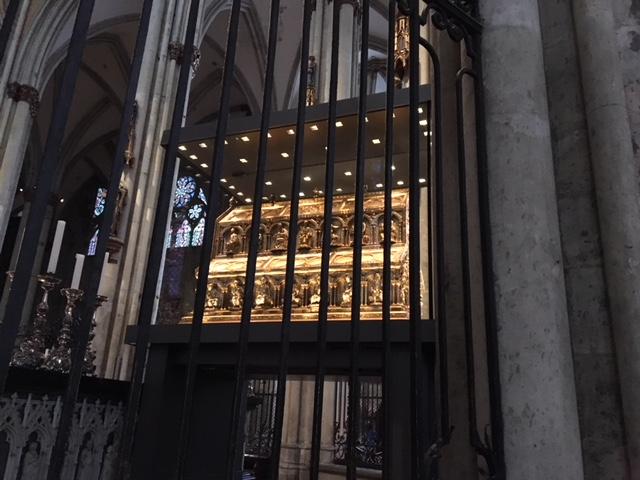
Cologne Cathedral, Reliquary of the Magi (the Three Kings): This gold, crystal and enamel cabinet, one of the most glorious artifacts of the entire Medieval world, took some of the best artisans in Northern Europe more than a generation to create, between the 12th and 13th Centuries.  Nothing less than its intricacy and rare materials would have seemed suitable to honor the relics it contains, traditionally held to be bones of the three Kings who adored the newborn Jesus in the stable in Bethlehem.  The irreducible preciousness of these objects has been an integral part of Cologne’s self-image since the era of the Crusades, and a major part of the reason it has so long retained its status as a place of great importance.  Three crowns, representing the Kings, still appear in the city’s coat of arms.

This vessel definitely does contain human bones, and while it seems unlikely that they could actually be the Magi, their pedigree cannot be dismissed out of hand.  They have a well-documented history, unbroken for more than 1600 years. I don’t know when they first entered the historical record, but Constantine gave them to a church in Byzantium (now Istanbul) in the Fourth century, then they were sent to Milan, in the Seventh.  500 years later, Holy Roman Emperor Frederick Barbarossa took them from Milan and gave them to Cologne in appreciation for its archbishop’s military assistance (to this day, some Milanese lament their loss).  Several decades later, plans were begun to build this current church to house them in reverent resplendence; it has been their home ever since.

Today’s Kolner Dom was designed to be a suitable shrine, as evocative of Heaven itself as possible, for such objects of saving grace.  Cologne became a major site of pilgrimage to venerate them, attracting economic activity that contributed greatly to its long term vibrancy.  Although the cathedral was only finished to its original plans in the late 19th Century (by Prussian kings largely interested in the political advantage they might derive by doing so), the devotion that called it into being was fully Medieval.  Its exuberant, yet solemn aesthetic had been meant to inspire beholders in a quest for Salvation, then assumed to be everyman’s ultimate goal, and deepest desire.

I don’t know a lot of details of the reliquary’s 800-year history, but suppose that it survived the tumult of the Reformation, during which uncountable pieces of ancient Christian religious art were destroyed as idolatrous by iconoclastic Protestants (a major heritage of Western creativity lost forever, owing to one of many violent passions of that time which we may no longer fully comprehend) because Cologne was in a part of Germany that stayed largely Catholic. 

French Revolutionary troops attacked the still incomplete cathedral in 1794 and did damage to the reliquary that was later repaired.  The Nazis extolled it mainly as a specimen of German genius (actually, master artisans from several lands – working when the cultural frame of reference was principally Christendom, not linguistic identity – contributed to its making), and removed it for safekeeping when Cologne became acutely liable to Allied bombing in the early 1940s.  After peace returned, it was restored to its traditional sanctuary behind the main altar. 

It is easy to see how things like this extravagant cabinet and its alleged contents may, to people of the 21st Century, chiefly suggest superstition, and exploitation of the gullible.  And there is some truth in that, in terms of the general ignorance and unsophistication of most Europeans and their society at that time, and of the willingness of some church and secular authorities to profit financially from them. 

But unconsidered disparagement of a past era (to the benefit of one’s own) is an historical snare against which I have cautioned before: Presentism.  That often involves much oversimplification, of people from one age adversely judging an earlier one, without reflecting on why its outlook and resulting choices might in fact have been appropriate – or at least the best feasible option – for its own multifaceted context.  Men who were simply stupid could never have conceived nor executed this sumptuous treasure, let alone devised the spectacular structure that would house it (nor similar ones completed all over Western Europe in the same era).  The nature of their motivations – which were admittedly based on less knowledge of the physical world than our own – is surely more nuanced. 

We in the 21st Century should not view Medievals and their deeds exclusively at a superficial level, simplistically attributing their priorities to wrong-headed ignorance.  Doing so may whiff of un-self awareness, for any sense of our own having neared true enlightenment is belied by the global havoc in the 20th Century by mechanized warfare, for which science was harnessed – as well as ongoing human misdeeds in our own century.  In fact, we really have far less excuse for folly than Medieval people had, yet are making Earth uninhabitable, overtaxing it to feed voracious consumerism.  We are better informed, but not incontestably wiser.

Thus, if one wishes to be accurate (and fair) about where the truth may lie, one must look deeper.  We should consider the sincerity of Medieval efforts to seek greater significance for human life than just prolonging the flesh, or hyper-focus on individual actualization. That is, on defining some significant purpose for it, in which everyone might share and from which everyone might benefit.

As acknowledged before, I certainly wouldn’t have wanted to live when the Dom was first being built, and not just because of the era’s appalling medicine, hygiene, etc.  As one born in the 20th Century, and heir to the Catholic church’s Second Vatican Council’s seismic reconsiderations of religious doctrine and practice, I would have been repelled by the destructive parochial tribalism of Medieval Europeans, their tendency to validate themselves by devalidating others as heretics or infidels, treating other beliefs as loathsome, intolerable affronts. Such attitudes now seem to be misreadings of perceived divine intent, irreconcilable with the idea of God as love. 

But they were not the whole story of that culture.  Most peoples’ lives then were a relentless ordeal by our standards, of discomfort, filth, hunger, sickness, and manifold omnipresent perils.  Many might have committed suicide to escape such unremitting burdens had they assumed they would just be extinguished by the grave anyway.  Instead, their way of contending with those struggles was not wrought just in the masonry of their churches, but by the immaterial wealth they also presented: A faith in Divine affirmation, believed to offset extinction at death.  For this, their individual deeds, and how they faced the adversities of this world (seen as parallels to the sorrows of the Crucifixion, itself endured to pierce the bounds of human frailty) determined merit for the reward of Paradise. 

Such a faith may appear nebulous, or even irrational to us, but it enabled them to withstand hardships of which we might despair. They relied on it, as many now do on science (despite all its unintended consequences) ‘to save us.’  What may seem exaggerated reliance, or superstitious delusion, to one era or person, may be indispensable, sustaining grace to another; hope that makes life worth enduring.

A pilgrim trembling with devotion or ecstasy before the Magis’ relics believed that undertaking a journey to them brought him closer to One through whom Heaven might be opened to him.  Such solace must have softened the jagged edges of his own very hard existence, and proffered some promise – in ways material security alone never could – for being free of want and sorrow, and of evanescence.  

Spurious relics were an open scandal of life in the Middle Ages, used to pry money from trusting souls, and a legitimate grievance of Martin Luther.  Many such objects were mistakenly attributed; others were undoubtedly deliberate fraud.  But in their highest instances – the Kolner Dom’s Magi relics were one such, St. Mark’s in Venice (with the supposed bones of the Evangelist) was another – they were more plausibly what they presented to be. And they brought forth trenchant ingenuity, used to shelter them (like the Dom); then the masses of heartfelt meditations they evoked; and finally the great aura of longings, both awakened and fulfilled, with which they gradually, and almost tangibly, became lustered. 

Such veneration was a part of the aspirations of a civilization in its quest – one that logic, alone, might never still, nor appease – for a fundamental reason for conscious life beyond its grim, visible character as “nasty, brutish, and short.”  To the faithful who came here to ponder the Three Kings – especially to those who were not rich and powerful, nor brilliant and talented, just the common children of God – these objects helped to hallow and illuminate their lives, no matter how miserable, nor ultimately meaningless all rational evidence might suggest they were. 

For at base, they asserted an absolute and universal benevolence for all men and women, everywhere and forever, through Christ’s incarnation. 

And that premise of universal benevolence – now more generally understood to be fundamentally embraced by the righteous of the whole human family, not just a clique of the doctrinally sound – may still shine with accessible simplicity, burning like the dawn through mists of extraneous erudition or dogmatic encrustation, even through instances when its spirit was horrifyingly absent or misapplied, as in the Crusades.  The potential harm caused by religious faith can undoubtedly be massive, but its potential to release, and even to help form, our better Selves may be just as great; and occasionally, greater.

Unlike excesses of fanaticism such as the Inquisition, Cromwell in Ireland, or our own era’s radical Islamic terror, most private successes of faith – lives quietly consummated by the work of the spirit in humility, meditation, charity, and deliberate efforts to make the world a better place out of gratitude for the gift of existence itself– seem too intimate and prosaic to appear in history books. But they were immense forces in the Europe that spawned this church, and satisfied needs that are still woven deeply into the fabric of human consciousness. 

A desire that baffles and eludes the mind may nevertheless be insistent for the heart.  Some of the most pervasive beliefs offer answers we may all share, because they refer to concerns (especially mortality) in which we also all share. The people who conceived the Dom treated the brevity and coarseness of their own lives as motivations to connect with something limitless, imperishable and perfect.

These may not really be the bones of three west Asian savants, but there was nothing false about the good they must often have done for pilgrims who placed, and found, hope in them.  Whether or not they literally made the lame walk or the blind see, they must have wrought marvels just as vitalizing.  They helped to rescue, with consolation and peace, what might, dispassionately, seem to be the pointless lives of undistinguished people who contemplated them – and found soothing succor in the radiant, redeeming Nativity story of which they were part.

The relic-like display of iconic documents such as the original American Declaration of Independence, or the embalmed remains of Lenin and Mao Zedong, suggest that the craving for visualization may appear even in cultures that consider themselves emphatically reason-driven.  Presumably, this is because most of us ordinary folk benefit from seeing tangible emblems of rarified abstractions – talismanic of forces beyond troublesome, everyday reality – which might otherwise be grasped only by a sophisticated elite. 

Thus, in many times, places and cultures, the appeal of objects held to be ‘sacred’ persists, symbiotic with the refracting power of the great lattice of personal perception and reference.  In the case of the Magi relics, that is because what they simply are – old bones – is so far transcended by what they represent: An enduring, shared joy, glittering as the Star of Bethlehem, in the promise of Life, in defiance of the ephemerality of lives.

Entrancing –

CONTEXT: This piece from my visit to Cologne, Germany in 2016 doesn’t deal directly with Christmas. But I post it in honor of that holiday, 2022, to respectfully take issue with the premise – which increasingly pervades our outlook – that worthwhile human progress must come, more or less only, through the exercise of human reason. As noted in my ‘Jewish Bride’ essay recently re-posted, however much I praise and benefit from all the understanding, knowledge, technology etc. of our era, I deeply question if all other attributes of our nature should be disregarded or dismissed in its favor.

To cite an axiom of mine: Reason is not the only thing that makes us Human. To starkly illustrate that, I noted the Nazis’ diligent use of science in that recent post, as an instance of what may be called ‘brute Reason’ (as opposed to brute strength). Another example was Hitler’s T4 program, the covert murder of thousands of Germany’s physically and mentally handicapped people as ‘useless eaters’ who could only drain society’s resources and never contribute to them. Admittedly that was so, but despite euthanasia arguably meeting the standard of ‘logic’ as a basis for T4, it led to an unthinkably abhorrent course of action, repugnantly devoid of empathy – a humane quality whose value I propounded in ‘Jewish Bride.’

The following piece about Cologne cathedral speaks to the task to which Christmas calls us, and the wholly legitimate (in my view) human need for validation which may be found by complying with its summons. A need that should not be delegitimized – particularly by fortunate folk who have, or see, no need for consoling, sustaining hope – nor can be fully appeased with science’s gifts to us of greater comfort, more distraction and longer, better physical life.

Those are all marvels, but this essay suggests that many of us cannot find adequate meaning to life through them. It seeks to remind us of alternatives – generally, not feeling bound to seek exclusively rational answers – that will always be there for us if we need strength and comfort that otherwise elude us. And the humility to admit to such needs – to aspire to something unreachable by intellect alone, nor by other personal gifts – can be a first step in letting extra-rational hope ‘console and sustain’ us.

One need not be religious to be empathic, of course. But religious faith can offer a vantage point from which many of us may be inspired (given a last, vital boost) to act thus, piercing limitations that might otherwise keep us from doing so.

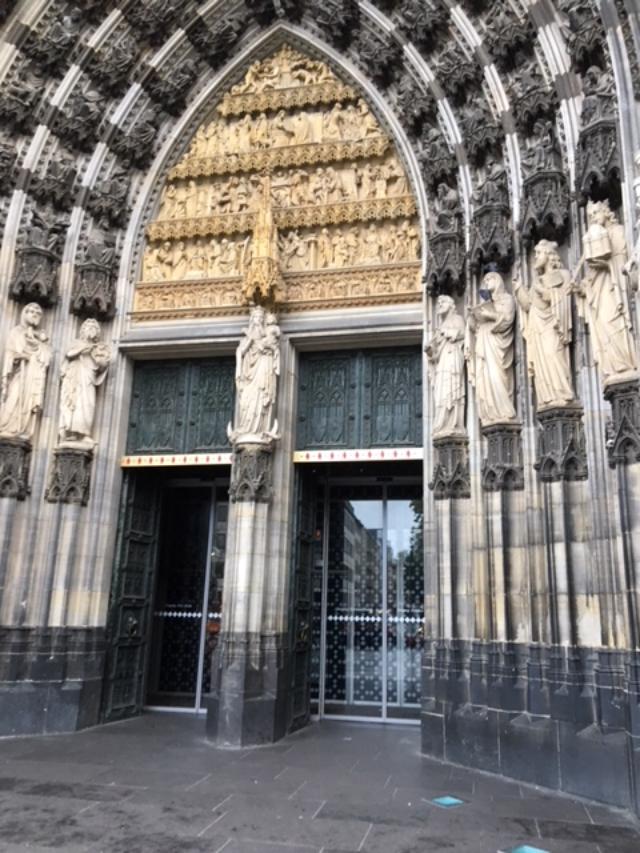
Cathedral Entrance: This is the end of the church with the great towers, unfinished until the 19th Century, when this grand portico was also added between them. The Industrial Age sculptors who executed this did their Medieval forbears proud; their carvings looked like they were cut by men who believed their work here might help admit them to Heaven, as their Gothic era predecessors may have exerted themselves to do.

The imagery above this door (in the space called the tympanum) may have some Biblical iconographic message, as art often did when literacy was scarce, but I didn’t even try to interpret it. Instead, I had long been intrigued by photographs of the Tympanum showing it with an unmistakable golden cast, so I looked closely to see if it was stone, rather than bronze, or some form of gilding. It is indeed stone, but clearly of a type different from that surrounding it, presumably chosen for its distinct color.

In a concession to efficiency, modern technology is used at the Dom to admit its 20,000 daily visitors. Its doors are sensor-driven transparent panels that glide back and forth horizontally (rather than swinging on hinges) with a soft whoosh.

The cathedral’s eventual completion during the Gothic Revival of the 19th Century was a rationalized, near-perfect expression of an extra-rational impulse. The skyscrapers of our era may scrape the sky, but they do not reach for Heaven. They are not meant to; their main goal is maximized economic utility.

Churches like the Kolner Dom, however, were meant to stretch for the celestial, connecting to its presumed benevolence in sharp contrast to a tumultuous world whose difficulties might otherwise be despaired of. They resonated of a hope worth enduring seemingly intractable hardships to attain, and sheltered embers of the West’s vitality until, in later times, ‘hope’ began to mean other (and more often, material) things than when this building was begun.

The great leveler mortality, and the right of every Christian to strive for Paradise, were formidable equalizers in the world of the Middle Ages. Inside a church, a prince, lord or knight might rate a better spot for mass, but otherwise, each person was truly “Everyman.” That is, animate dust, never truly, fully in control of his or her ultimate fate in this life. In this setting, a peasant, rough mason, thatcher or fuller might feel brethren to a king in ways they never would or could, elsewhere.

But they would not have considered sharing this most basic of all concerns as “Democratic” – a term and concept as alien to them as the planet Saturn. It was just an understanding among the faithful that all men were largely powerless, most individual concerns of scant import to the great expanse of time. And since Christ evidently held every person worthy of the offer of salvation to resolve the trials and vagaries of this life, it implied that, in the sight of God, no soul was less precious than any other (a seditious idea that would eventually help undermine the custom that high-born men were most entitled to rule, and reap, this world).

Even a Divine right monarch was Death’s subject, his crown and sway no more consequential than the degree of his lowest serf. It must have been a sharp reminder of actual priorities, in a world in which the rich and mighty were accorded such preeminent status, to realize that luminaries could die just as soon and suddenly as the poor and feeble; or be damned. To Medieval Christians, the presence of a deity presumed to be so saturated with love as to have gratuitously conjured the universe out of nothing, and bestowed the further gift on its only actively conscious beings – us, humanity – the option of of a path to escape the shadow of death was one context in which, assuredly, “All men were created equal.”

Conversely, speaking of inequality, it was just outside this portal that I saw the disturbing sight (mentioned in my original Facebook overview of my trip), of two men who seemed to be beggars, arguing, then forcibly grappling with each other. My German isn’t good enough to understand what they were quarreling about; possibly for the most advantageous spot to accost tourists. Their struggle was over quickly and with no visible harm done, but was a reminder that Cologne – wondrous as it may be to visitors – is not unlike most urban areas: Dense concentrations of people where some inhabitants occasionally feel forced to fight just to stay alive.

I’ve never seen homeless people in combat like that in my hometown, Chicago, but it probably happens anywhere people are reduced to desperation; an especially depressing, though instructive, spectacle when it happens amid First World prosperity like central Cologne or Chicago. And especially at the entrance to a building dedicated to proclaiming some of our loftiest aspirations.

(It would be interesting to know the back story of that fracas. Germany has a robust social safety net, and I learned that the Archdiocese of Cologne – which surely controls the Dom on whose threshold this struggle took place – also offers extensive charitable services for anyone in desperate need. I must wonder why those two men did not, or could not, seek out the different types of aid that are apparently available.)

Upsetting as that image was, I’m glad to have seen such a display of raw life, a jolting reminder, especially in view of my own relative financial stability, of how broken our world is for so many people.

The Kolner Dom is an awe-inspiring edifice, but ideals such as it betokens cannot be fully represented by the temples raised to enshrine them. Those would lift us higher than other creatures, and so can only really assert themselves by inspiring the quest for a world in which people neither need nor desire to fight, from those two men apparently frantic to stay alive, all the way to World Wars.

That seems to me a crucial duty of any great creed: Not only for most religious faiths, but especially for them, as they appeal to forces and inclinations at the upper limits of our nature. Such faiths exist to offer reason for hope, when Reason – used in isolation from the full panoply of the human spirit – may seem to justify, even to demand, jettisoning anything our minds cannot concretely encompass, as a sort of bloodless sacrifice to be performed in exchange for enjoying the practical benefits of the modern era. As if the wholly human dread of reverting to the darkness were some flaw a modern person should simply be able to suppress with machine-like equanimity.

The semi-feral tussle I witnessed – amid a rich, rebuilt city, laid waste to frustrate the infernal Nazi agenda that people should emulate the kill-or-be-killed behavior of wild animals – at the doors of a place meant to invite us to better things, accentuates that we collectively still have many thresholds to fully cross.