‘Oh Come Let Us Reflect Him’

CONTEXT: This is the first piece I will post here in observance of Christmas, 2022. The next two will be re-posts from my 2016 visit to Europe, and later meditations upon it. The second of those will be posted on the Twelfth Day of Christmas – Epiphany – January 6; for which its subject makes it especially appropriate.

I have adjusted the refrain of the carol, ‘Oh Come All Ye Faithful’ by a single word, to re-affirm a core aspect of Christmas which seems increasingly to get obscured: Jesus personified willingness to sacrifice the Self for the Other. Thus any act of loving generosity may be said to ‘reflect’ Him. And I hope anyone who is not Christian will try to accept that striving to act in this way really is supposed to be a defining element of sincerely following Christ.

This, despite the fact that many people who claim to revere Christ often do not act so as to ‘reflect’ a grasp of His intentions, nor apparently recognize any need to do so. Or who may believe lip service is sufficient. This includes any ‘identity/culture warriors’ who assume the Prince of Peace wants them to behave heartlessly in His name.

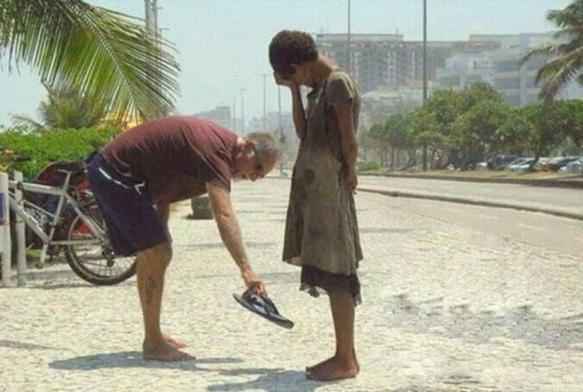
Further, I would assert that, as the accompanying image suggests, it is more important to follow His example, than merely proclaim one’s adherence to it. Thus, while the man giving his sandals to the poor boy may embrace some other religion, or none at all, I sense that Jesus – presumably preferring hallowing acts to hollow words – would rejoice in his compassion anyway.

Here is another expression of my point in changing that single word:

‘Wherever selfless love is shared,
Know that He is present there.’

(All people of goodwill practice decency and kindness; I do not presume to claim those as uniquely Christian values. Only that they are obligations – of which they should never lose sight, and always strive – for those who do call themselves ‘Christian.’ As one who does call myself such, I acknowledge often failing at those, but accept my lifelong duty to keep trying.)

We humans can use our gift of reason to choose to obey our finest impulses, and thereby deliberately summon the best of our humanity. Particularly when doing so goes against our own immediate interests; like giving away one’s footwear to a brother being who needs it more. The mere existence, and exercise, of such empathy nudges our whole world slightly closer to Paradise for everyone; hence, the dirt that will get on this giver’s feet transfigures as the soil of the Garden of Eden.

So whether you regard Christ as a factor in your life or not, may the loving care this image shows inspire you to ‘summon the best of your humanity’ also. It is the simplest thing that many of us can do – regardless of why – to better this Life. 

Which I would venture to believe must gladden Him, also.

Rembrandt’s ‘Jewish Bride,’ Amsterdam

CONTEXT: This was my final post from my 2016 time in Europe. It was the result of much reflection, and so was not finished until mid-2018. The results of the 2016 Presidential election – shortly after my return – seemed (to me) like an alarming quirk of history, in the shadow of which my recent journey to various sites of Fascism should be carefully considered.

‘Journey’ is also the word used in my Introduction to this blog to describe personal meditations posted here, including ones like this derived from my travels. The meandering path from some initiating experience – like the Gestapo cell, the Ann Frank House, and this wondrous example of artistic virtuosity – to what I ultimately write about it is indeed a journey, wandering among the observations that ‘initiating experience’ summons, and seeking the best routes to express them.

And this piece, as noted at the end of my recent post about the Westerkerk, may soften the rather bleak observations made there. Here, I try to draw attention to the broader, yet finer, implications of what Rembrandt achieved in this painting. Encouraged by those, I venture to recall a force in human affairs that might help successfully, and benevolently, redirect them.

This ‘force’ has never been easy to follow – I alluded to a related principle in ‘Marvelous Beasts’ – and here I continue to propose it as a counterweight to presumption that Reason, by itself, can save Mankind from himself. So far it has failed to do so, although Reason can produce conditions (exceeding our mere survival) in which we can save ourselves from ‘our Selves.’ This distinction is addressed in this essay, which tries to show what we might all learn from what Rembrandt rendered in this painting.

After this post, I will re-post two others based on my travels in Europe. Those – appropriate for the holiday season of this writing – are meant to draw attention to a traditional but often overlooked (or spurned as too conventional) source of the ‘solution’ I propose here, to augment the power of Reason; which is simply not our only facility as humans.

I would assert that it cannot be; it Must not be. For if it is, as I try to argue, it may eventually destroy us before the rest of our potential as fully-cohered conscious beings can finally overtake Reason, to fully temper its potential harm, and to amplify its potential benefits to us all. As such, my proposal here is unapologetically idealistic – some might say simplistic or naive – but is supported by how, in my view, hard logic is continually thwarted by human impulses it seeks to circumvent or simply negate. But it never fully can; something other than logic alone is crucial, including (but not limited to) exquisite human hope.

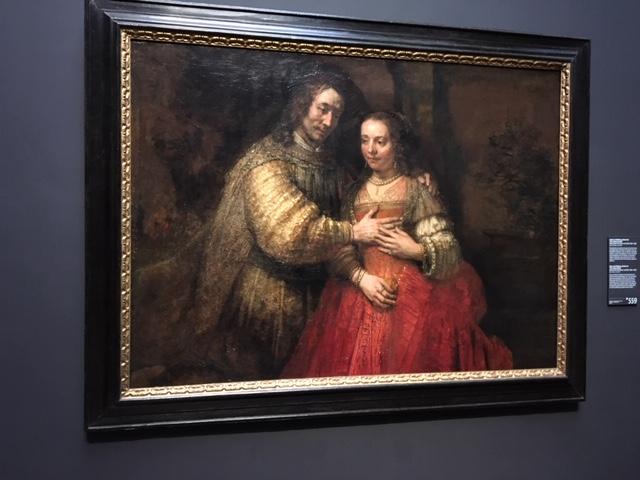
‘The Jewish Bride,’ by Rembrandt, Rijksmuseum: Although I actually saw this exquisite, arresting creation before reaching ‘The Night Watch’ in another gallery, I am putting this image last among my postings for Amsterdam – in fact, for my whole European journey – so as to end them on a more optimistic note than my possibly disheartening perspectives on the Westerkerk.

This is as intimate an image as “The Night Watch” is grand, considered so magisterial an example of pictorial craft that it may seem inadequate, even inappropriate, to try to describe it in words; it “speaks” for itself. However, my observations may at least help readers appreciate it in ways that are meaningful for them personally.

It is a technical marvel of utilizing brushwork and light, but its truest brilliance is in how candidly, delicately, it conveys a physical component of affection as a wondrous thing, to be celebrated, not concealed, as it is so much more than mere lust.

What Rembrandt has captured here – frozen, yet ardent – is purest love. This is likely his most successful rendering of the quiet splendor of relations between men and women, a matter of far greater import than the pinched, prim sensibilities it was once felt to violate.

For even this picture’s subdued, tender representation of many-splendored love – a softly erotic gesture, a man’s hand resting gently on a woman’s breast – was too much for the Victorian era, during which Rembrandt’s popular fame began to spread far beyond art experts and collectors.

Hence its name; at some point, it was given the title “The Jewish Bride,” (Rembrandt painted numerous members of contemporary Amsterdam’s thriving Jewish community, but it is not known with certainty who these subjects actually were) as an effort to camouflage its patent sexual element. That title supported a quaint description I once read of this picture, to the effect that it shows “the bride’s father adorning her with a necklace on her wedding day.”

No, it does not. This man clearly has his hand on the woman’s breast, something one presumes, no father would do to his daughter (and if one did, Rembrandt would not likely have seen fit to record it). And just as clearly, the woman approves, as indicated by the gesture of her hand and her blissful facial expression. The painting’s name likely began as a crude ploy to misrepresent a joyous, tactile aspect of affection, along with its unspoken depth; to prudishly pretend that this lovely picture and sentiment show something that they don’t.

One even wonders if Rembrandt contrived the man’s great, swollen sleeve with such a sensuous sheen to encourage viewers to revel in things with exclusively sensual appeal. Sexual love is another object of such appeal, and he may have used the voluptuous sleeve to visibly suggest its wonders, far beyond mere desire of the flesh.

This was painted some 25 years after “The Night Watch,” and shows the progress Rembrandt had made, technically, emotionally and presumably spiritually. “The Jewish Bride” could scarcely be less like the earlier tour de force; it is intimate in both size and tone, and echoes the artist’s apparent grasp of the transience (and other shortcomings) of fame and wealth as motivating goals. Rembrandt was perhaps Amsterdam’s most sought-after painter around the time of “The Night Watch,” but owing to the mixed reception it got, to personal sorrows, financial reverses, and other aesthetic experimentation, by the time he gave the world this masterwork his fame and fortune had long been waning.

The only true riches Rembrandt still possessed when he made this were his unsurpassed skill and the profoundly sympathetic insights he had gained, through his own troubled life, into the human condition. Many people become embittered by disappointment and the trials of old age, but he seems to have done the opposite, to have had his sensitivity – the core of his being – mature and grow due to the lessons age taught him.

Becoming thus enlarged, rather than shrunken, is surely a mark of a great spirit, and in this case, a peerless artist, able to recognize and convey an abstraction with singular beauty.

For beyond its portrayal of soothing amorous delights, in this picture, Rembrandt – whether he meant to or not – approximates what full harmony between our own selves and Life Itself might look like (rather than perpetual contest with it as Nazism demanded, and as relentless self interest still does): Being at one with creation, in every sense of that term, exulting in communion with something one discerns, and willingly accepts, as being greater than just oneself (in this case, a contenting rapture).

And thus, by illustrating an all-fulfilling tranquility, the underlying import of this image is an encouraging one. It is a counterpoint to my disquisition on the Westerkerk, about how the primacy that personal autonomy and Reason have been given in Western civilization has helped insidiously seduce us to believe that our brains make our deeply compromised race – atom bombs, Auschwitz, gulags, etc. somehow notwithstanding – equal to (the conceptual perfection of) divinity, or a substitute for it.

Felicity like that shown here is not about personal self-involvement, nor is it a reward for careful calculation. It arises from a different place entirely.

Human intelligence could design and build stalwart Dutch ships, and chart the seas for them to sail to the other side of the world and back. It could figure how heavy a load of cinnamon from the East Indies such a ship could safely carry, gross profit it might make on a dock in Rotterdam, exact shares of payment for the partners who paid for the voyage, etc. It could try to predict how long it might take a spice to become a staple of European palates, and a source of continual profit.

But the coin of intellect has more than one side. To give an especially heinous example, it could also be deployed as the Nazis did, to help finance their war by formulating, down to the Pfennig, the economic value that could be harvested from Jews being sent to death camps; the average worth of their personal property, their clothing and shoes, their cash, their gold teeth, etc. – even their hair (possibly including Anne Frank’s), shaved off on arrival at the camps to stuff mattresses.

Some of the best minds in Hitler’s Germany were set, avidly, to the stupendous complexities of managing railroad traffic during wartime, including trains carrying victims – and not just Jews – to Stygian destinations for the good of the Reich.

(And while the Nazis were an extreme historical instance of misusing the mind’s powers, consider the assiduous internet hackers as of this writing, 2018, looking to enrich themselves or just conjure chaos through their immense technical talents.)

That horrifying, but (to me) valid example of the peril of idolizing Reason as, effectively, our only hope causes me to repeat a mantra-like adage I have used in these postings before – which few things display better than the imagery of “The Jewish Bride”:

Reason is not the only thing that makes us Human.

No other living beings have it as we do, but it is absolutely not the only facility we have that matters, or avails. I have known of too many people who were dim yet clearly decent, and others who were brainy yet beast-like to accept that intelligence alone can, does, or should, primarily define what it means to be a ‘person.’ But the degree of pre-eminence our society now bestows on rationality seems to suggest it can, does and should (even though brain acuity is largely a function of random genetics, rather than some earned, onboard virtue).

Used with sage, benevolent intent, Reason can be a marvelous tool; used without it, it can just as easily hypercharge iniquity, as much an unleashing as a releasing. If we exploit it too often in ways that harm the world and each other, we may not deserve to possess it, for it is as much a sacred trust to be honored as an evolutionary advantage to be seized.

Great souls like Rembrandt used mental powers to summon visions with the shimmer of Heaven; the Nazis used theirs to call Hell to Earth. So I would suggest that we humans do not necessarily reach our greatest potential only through the exercise of our minds, however useful or awesome their contributions may often be. Most of us can do so just as much — if not even more so – by using our hearts.

In that view, the golden element for “being fully human”, is not intelligence, but empathy – the disposition to connect, share vulnerabilities, to proximately merge with others – an ability only humans may fully manifest. Other species, with few abilities to spare beyond maintaining their own survival and that of their offspring, cannot fully manage it even if they could apprehend it.

Unlike them, people need not be either atomized competitors, or undifferentiated flocks. Our collective brains (especially in our technology-adept era) can let us ensure our own sustaining stability and surplus, and thus afford to choose to be kind to each other – if we simply will.

Surely, Rembrandt portrayed loving empathy here so marvelously by deploying his own resources of it, as integral a tool of his art as paintbrushes and measuring stick.

To have exceptional raw brain power, one must be born with it, but not so with empathy. It can be recognized, learned and embraced, so it is a practicable goal for far more people than innate intellectual brilliance could ever be. Moreover, every worthwhile experience in life cannot simply be compacted into some reliable, rigid algorithm, and trying to do so would shear a great many of them of the uplifting radiance they offer – a power one admits, rather than grasps.

And thus, there can be no regularized formula for empathy (and the happiness of sharing) but it may be defined as one heart allowing itself to beat in accordance with another, or others; unspoken, unbidden, authentic “fellowship.” And in cases like this painting shows, such a bond may ascend to near adoration.

Of itself, technology (frequently one of the most positive by-products of Reason) is inherently incapable of such an experience or outcome, having neither sensibility nor moral inclination of its own. It can remove obstacles like the need to fight over vital resources (so that survival need not depend on physical prowess as much as it once did) to help us reach shared and sharing harmony – or let us drive madly in the opposite direction. Thus, a knife can slice bread or slit a throat; it is not an invariably positive implement. Empathy however can serve only to make those who practice it better people.

Intellect can provide us with the abundance needed for generosity, and may also let us attain the wisdom to recognize its worthiness. If the savage, anti-Semitic Nazis had destroyed this painting when they occupied Amsterdam, it might have been as much because of the luminously humane underlying message it projects – that giving, rather than taking, can actually augment us – as because the word “Jewish” is in its title. It is a premise diametrically opposed to their mania for hatred-driven power.

Hitler and his true-believers regaled in domination, and raged at empathy as despicable weakness. The mere fact that such luridly depraved, violent individuals loathed it so fiercely might give pause to any righteous persons and spur them to deliberately pursue it to try to restore the balance of our consciousness, which the Nazis had deformed with the crushing weight of their evil.

So in addition to considering all the positive blooming of individual agency that came from the Westerkerk and the shifting mindset it represented, we should also reflect on visions like “The Jewish Bride,” an icon of precious wisdom executed with supreme acumen, for the lessons they can teach.

For any type of love can be illogical bordering on madness, yet it can also be wholly life-affirming and ecstatic; a potent caution against guidance by logic alone. It may be transient, but also transcendent, uniquely bonding us, while it prevails, together in perhaps the nearest vantage we can get in this life to glimpse Paradise. Not the obscene, criminally proud Valhalla that Hitler dreamt of, but the innocent repose of Eden.

If you want to see what it can truly mean to be intrinsically “human,” contemplate this painting, as well as its origins amid Rembrandt’s somber adversity, out of which he brought forth this limpid idealization of existence. Rarely have pictorial expertise and long, sympathetic observation been so gloriously combined as here, to display – again, whether the artist actually meant to, or was, literally, inspired to channel a vision that even he did not fully grasp – a kind of consummation of life we may all seek. It both demonstrates his soaring genius which ennobles us as a species, and makes graphic that true happiness just might, in some attainable form, be accessible to us all – especially if we try to build it together.

Unlike the practical benefits of science, such artistry cannot lengthen our lives; but it can surely deepen them, in ways Reason alone does not, and cannot. Further, it would debase and reduce a visualization like this painting to try to ensnare the power it can have – enigmatic, yet seemingly inexorable – by fully explaining it.

This level of creativity, along with facets of life like the calm passion so gracefully portrayed here, are among the closest things in this world to the magical; or to the miraculous.
Marvelous Beasts:

CONTEXT: The end of my post about Amsterdam’s Westerkerk said my next would be the ‘last for my whole 2016 journey.’ But instead of that one (‘The Jewish Bride,’ to be put here soon), I am posting this piece and (below) the video that inspired it. When I came across that video in late May, 2020 – the pit of the COVID Pandemic – it acted as a zephyr, softly breathing life into the embers of my wavering spirit and faltering sense of hope. I consider its great effect on me to be ‘soft’ evidence of how there are times we should just yield to letting our impulses, instincts and better Angels guide and sustain us – even in the absence of ‘hard’ evidence.

If the video strikes you as maudlin, that quality, perceived instead as beautiful, is just what makes it so potent. It demonstrates how instinct on its own may lead to Edenic behavior. But this presents a special challenge to us humans, for unlike its sweet animal protagonists we can, if we will, deploy our reason to augment, but not replace, the promptings of our ‘better Angels.’

My ‘Jewish Bride’ suggests a goal for which I will try to provide logical supporting arguments. But here, I advocate that a related aim may be reached by yielding to an alluring but elusive energy, ‘Like a breeze gracefully rustling a curtain.’ An aim which also manifests my aphorism that ‘Reason is not the only thing that makes us human.’ And that a milder, suppler aspect of our humanity may serve as a glorious enhancement of it; as I hope these loving, gentle creatures (and my lowly text) may help you to agree.

Marvelous Beasts: The Peace that was Meant to Be: Discovering this video recently was a huge relief to me amid the ongoing pandemic. I had to choke back tears of joy to see that even now, such innocent beauty is still to be found in our world. Perhaps you will, also.

Beyond its straight-to-the-heart impact, this had additional relevance for me. It reflects what I’ve tried to convey in some of my posts, hinting that ‘Eternal Life’ may mean our rejoining the energy of Creation that never ends but is, transiently, obscured from us by our mortality. And that energy’s clearest expression is love.

Which this video radiates like the breath of Eden. The acts of affection, care and trust it shows are awesome due to their essential simplicity, not in spite of it.

Perhaps these animals, spared by their kind owners of the need to kill and eat each other just to stay alive, demonstrate what our world is meant to be, and what human intelligence could procure: A reality in which living beings never have to hunt and devour each other – literally or figuratively. The end result of using our brains for mutually assured sustenance is what we call ‘civilization,’ and despite there being so much privation on Earth, we have the means to share with our whole human family the abundance and security these pets already enjoy.

To take that observation further, perhaps we were given Reason so we could be instrumental – in a way no species lacking it could be – in making universal peace and plenty a reality. Perhaps the mission of our very existence is to be active participants in completing the original, disrupted cycle of Creation, and reopening the gates to Paradise in whatever form, or forms, it takes.

We can all contribute to that mission. Consider the cases of two characters from Mozart’s opera ‘The Magic Flute,’ Papageno, a jolly bird-catcher and Tamino, a courageous truth seeker. Papageno is content just to have enough to eat, work he likes, and a pretty wife who loves him back. Hence, he is condescendingly told that he will never know true enlightenment, as the clever Tamino will.

Cleverness is a fine attribute, but surely, exceptional abilities are not needed to make a human life worth living, if only because not all of us are equipped for such a standard. Brain capacity, of which things like cleverness are fruits, is largely a matter of genetics (as are physical beauty, strength, agility, etc.), and I will not accept that it could be a Natural, let alone Divine, intent that any person’s right to fulfillment or value depends on random advantages, or disadvantages. Ranking in this way is a coarse social construct we use to appraise each other, as higher or lower.

Is it ‘true enlightenment’ or even common decency to imply, more or less, that because he got born with more brains, Tamino is simply ‘better’ than Papageno, whose naïve jolliness of nature may benefit not just him, but all those around him? Such an implication (especially coming from genetically privileged people) looks self-referential, or even self-congratulatory. Anyone of good heart should reject it.

Routes that most of us cannot access cannot be the only ones to life ‘worth living.’ Other valid paths may be simple, and likely benefit others too, like how these placid pets care for each other. And what could be simpler and more accessible than ‘Love thy neighbor,’ as these creatures, unable to reason, display with illuminating clarity? Loving one’s neighbor is simple in the sense of ‘elemental,’ an ability most of us have innately, but it has proven harder for mankind to practice consistently than it has for us to learn the structure of the atom or the universe.

Yet here are animals that are often natural enemies, showing us it can be done. This video may pierce so many of us because it echoes our deepest sense of how life on Earth should actually be. To someone of my background, rapture at such idyllic images suggests the dynamic work of the Holy Spirit. Like a breeze gracefully rustling a curtain, She cannot be seen, yet is apparent, confronting us with realizations of our best impulses. Like tender responses to visions like this.

A world in which such scenes are the rule rather than an exception is not a reality we discover, like laws of physics. It is a reality we may each be inspired to help beget. And making our planet less bitter, and more sweet, surely enriches not only those who receive the sweetening, but also those who proffer it – perhaps as much enlightening, as enlightened.

As you may agree, if you had to ‘choke back tears of joy’ watching this. Again: helping to complete a cycle of Creation, one worthy life at a time.

Westerkerk, Amsterdam:  

CONTEXT: This picture was among my last from my 2016 visit to Europe, as I prepared to return to the US via Amsterdam after seeing Rembrandt’s ‘Night Watch’ there. Before that, I had spent a week in Germany (Berlin, then Cologne). After returning home, I reflected on what I’d seen in the homeland of Nazism, to try to express in both historical and personal terms how the benefits released by individual empowerment (discussed below) played roles in putting us on paths to such outcomes as atomic weapons and Global Warming. Paths that were unforeseen.

But possibly not unforeseeable. The Reformation was surely pivotal in fostering our ideal of the primacy of the individual (and his right to pursue his own best interests), but here I consider whether that did, or could, make us truly ‘better’ – or if it also served, at least partly, to highlight the distinction between human intelligence and actual wisdom. And focusing on Amsterdam, a city whose immense role in creating the world and culture we know today, and which came to exemplify such primacy, led to me to consider – with benefit of hindsight – the implications of developments started, enhanced, or accelerated there. And to what consequences they ultimately led as they played out over time.

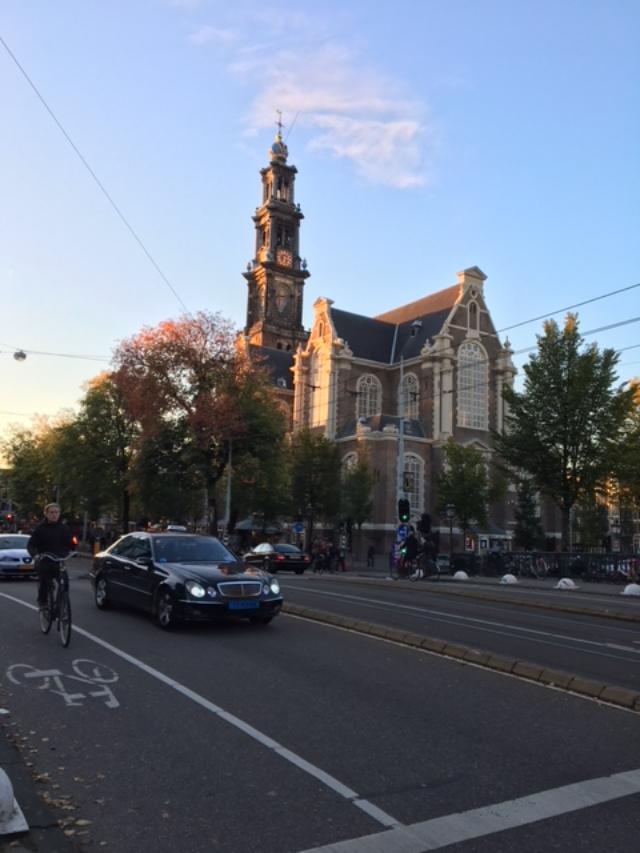
I used this building, the monumental ‘Westerkerk’ (West Church; this text refers to another picture I took of it from its front) and its origins in the Dutch Golden Age to serve as a referent for my observations here, on the questions above.

Also, the other post this one refers to at its end, is one I wrote about Rembrandt’s painting ‘The Jewish Bride.’ When these were first put online, they were, as it says, adjacent. But on this blog, they are separated by one entitled ‘Marvelous Beasts.’ If you wish to read my final post from Europe – offering my reflections on the impact of having visited Germany and its Nazi miasma – please look for ‘The Jewish Bride,’ published on this blog on December 22, 2022.

Westerkerk, Reflections: Here is the Westerkerk, looked at from a different angle from my previous image of it. I photographed this view partly just because it is a handsome structure I wanted to admire further, but also as a metaphor for trying to see more perspectives than the one that most immediately presents itself. And I don’t mean simply looking at it from another physical angle, or saying more about its history than I did with my earlier photo. I mean examining the cultural implications it represents – since its origin, up to our own time – as I did for the Kolner Dom.

As I write on my home computer, in preparation to post descriptions of my travels on the global bulletin board of the internet, I reflect (again) that the possibility of doing such things are just some of a multitude of modern phenomena from which I personally benefit, and am glad for. Others are the ability to travel the whole world, and the need such enormous distances spurred for faster communication. Westerkerk didn’t directly have a thing to do with creating any of those, but it represented the post-Medieval mindset that would drive the courage, incentives and ingenuity (and validate the desire for personal gain) to seek solutions for such travel, communication needs etc., and to fill them.

As noted in earlier Amsterdam posts, such an approach to life, in which Man could actively shape his own destiny, was a seminal leap beyond the constraints of the West’s consciousness in the Middle Ages. Earlier Europeans had simply assumed that life was inherently tenuous, and the world a place so massively mysterious that finite human minds were probably never even meant to fully grasp it. So they had deployed much of their ingenuity and resources into honoring the Christian understanding of eternity; their hope, and possible reward, for enduring the here-and-now, for appreciating the gift of merely existing, for possible redemption from every form of innate human imperfection, including mortality itself.

Amsterdam however, by virtue of its trading advantages and tradition, its primacy in the Protestant Dutch Republic, and by the industry of many of its citizens (who knew they would be applauded, not disapproved for seeking self-improvement), played a bigger role than most cities in creating the world we have today. Its rows of tidy, solid houses were the work of a society willing and able to make this world better, without focusing exclusively on an unseen, unknowable afterlife. Indeed, in the Westerkerk’s and related cultures, material wealth in this life was often assumed to be evidence of divine favor and proof of worthiness for further reward in the next. (Much later, that premise would have a role in Karl Marx’s critique of religion as he devised classical socialism, but that is far beyond the scope of this writing.)

But Westerkerk was a Christian church, and the Amsterdamers were not simply indifferent to dimensions of existence beyond this one; for them, Christ was still the irreplaceable key to Heaven, which remained the ultimate goal. However, their vision of it had far more room for human agency, in which our species had not just the ability and right, but a duty, to use its singular brain power to “tame the Earth and subdue it,” to benefit ourselves. Gradually, Western society has made the here-and-now its main preoccupation, the one sphere we can see, control, and rely upon. Hope of personal validation in some other plane of being has, incrementally, come to be tacitly rejected: A sort of “Paradise, Tossed.”

This leads me back to my “unforeseen costs” remark in my post about “The Night Watch,” as well as a prior reference about how Japan was a part of the Dutch trading network. Japan was never conquered outright as many other European imperial possessions were, but from the Seventeenth to the Nineteenth Centuries, its government permitted the Dutch, alone among Europeans, to trade within their country. (I’m not sure why they were chosen. Perhaps the Japanese feared that Britain was too powerful, and if invited onto their territory, might take over. The Dutch may have seemed less formidable potential foes.)

This arrangement led to a circumstance too tenuous to be considered a cause-and-effect connection, but nevertheless, one that strikes me as a coincidence so unlikely as to justify calling attention to it.

All the striving and inventiveness of the Dutch continued to interconnect and reverberate, augmented by accumulating scientific discovery across Europe, helping to shape the entire modern age. But improved science and technology wielded by unimproved humans – still too often driven by self-interest or aggrandizement – can bring fearsome results. By the time of World War II, the Dutch had long since lost their monopoly on access to Japan. Other western nations were active there, and Japan was the one non-Western society that became truly dynamic, and rose to national power and vigor elsewhere achieved only by Caucasians.

But the Japanese city in which the Dutch had their sole trading post for 200 years – through which they extracted local wares, and through which Japan, long deliberately isolated by its rulers, began to view and imitate the growing order and technology of the West – was Nagasaki. It was also where the second atomic bomb would be dropped, effectively ending World War II.

Far more portentously, it put apocalyptic power in fallible human hands.

No one could have anticipated that the West’s growing ability to manipulate the physical world would lead to the horrifying happenstance of Nagasaki’s fate. It is, I repeat, only a coincidence that the vigor Amsterdam helped, disproportionately, to radiate would eventually lead to the colossal forces that contended in global struggle, and to the stupendous scientific endeavors over the prior 300 years that had catalyzed it.

Still – What a coincidence. It seems to me the most significant of ironies that of all the cities on Earth, one of only two at which Man first brought Doomsday on himself happened to be where the inquiring, increasingly confident rational spirit that also built the Westerkerk had, for 200 years, entered the land upon which the bitterest fruit that grew (along with the sweet) from its tree of knowledge would fall to the ground – poisonous and world-shattering.

To say the least, Japan’s intercourse with the Dutch and their civilization was not ultimately an entirely beneficial encounter. Nor was western man’s rise above passivity (inflicted, during the 19th Century, on much of the non-Western world in the form of exploitative imperialism) accompanied by a fully offsetting increase in grateful, sensible benevolence. We were starting to release, in the interests of not being in the grip of Nature, unprecedented forces we lacked the comprehensive wisdom to wield, and whose full consequences we could not foresee. Seemingly harmless, tentative steps that often warped into something very different much later started, for good or ill, in places with spirits like Amsterdam.

And this tension between measurable gain and unforeseen detriment is still playing out, in less violent, if still dramatic ways. Because much of the Netherlands is at or below sea level, it has centuries of experience at compensating for rising water levels (dikes, polders, windmills, etc.). It is now selling that knowledge, augmented by computer modeling techniques, to other countries whose coasts are suddenly at risk of rising seas due to Global Warming. I applaud the Dutch for sharing that vital expertise, even as I note their (unintended) role in creating a world in which the glorification of the individual – his autonomy, abundance, convenience, amusement, etc. – became such an unstoppable force that efforts to serve it are now disrupting the natural functions of our planet.

Obviously, none of Rembrandt’s contemporaries worshiping in the Westerkerk could have foreseen all that, but it has arguably turned out to be one result of the West’s incremental focusing mostly on trying to make this world and life as near to Paradise as possible. For no amount of individual genius can fundamentally improve “this world and life” if there is no compelling bar to its being used (as Hitler used so much contemporary science) as a platform to serve unreformed forces such as greed and pride, that have so long degraded them. We dare not just accept those factors as intractable, and assume that science will somehow find a way to offset them.

Anne Frank’s terrified refuge, so near this building, might also remind us of that.

Am I glad for all the technology that flowed from the stout Dutch ships and all the science that they and other Europeans devised to enhance their lives, that continue to improve ours? Absolutely. Do I see them as ends, in and of themselves, that consummate and validate the entire human experiment, the peak of our potential accomplishment? No; if they are indeed our best, history suggests that malevolent impulses will likely eventually just outrace them – again.

In my view, scientific advances are a path, not a destination. Any true, full transformation – that is, positive Evolution – we achieve must come from elsewhere. For what would seem to me to be a better goal for us to aim at, collectively and individually, please see my next posting, my last for Amsterdam, and for my whole 2016 journey.

Choosing to Give Thanks.

In 2003 I injured my right knee, causing tissue damage that took several years and surgery to fully heal. It was inconvenient, veered between aggravating and miserable, and was more than slightly frightening, as I felt too young to face permanent mobility impairment. But two invaluable lessons came from that ordeal: I promised myself never to take any fundamental ability like unrestricted freedom of action for granted again. Also, I accepted that my life need not be perfect to be very much worthwhile.

Ever since, I have tried not to lose sight of these realizations. Being without something so essential to autonomy, independence and enjoyment of day-to-day activity as ease of movement is a harsh, but relentless reminder not to lose sight of its value again. But also that even a constrained life may offer contentment, if one lets it in by not wallowing in resentment at misfortune. Both those lessons are proving useful now in the aftermath of COVID.

As that peril recedes, I am making a conscious effort to let something positive – or at least something other than ingrained pessimism – come of it. I’m trying not to revert to complacency about basic, but congenial aspects of life as I too often did (a habit, despite lessons from my knee) before the world around us tightened into a self-protective curl from the virus. Whatever a ‘congenial aspect’ means for each of us; climbing Yosemite, enjoying some long anticipated in-person event, reveling in a gathering of loved ones, or simply drifting along in some unconsciously-cherished routine.

As we have now seen, such things are not ‘granted.’ They can be lost, or at least compromised. However, we may cherish them more when, and if, they return.

For example, Talleyrand, the French aristocrat-politician whose career spanned (and abetted) several upheavals of history, once said ‘No one who did not live before the Revolution (of 1789) can know the true sweetness of living.’ Life was indeed sweet then for nobles like him, though miserable for most other French subjects whose labor and poverty sustained Elysium for a narrow elite.

Still: We might take a lesson from his perspective, belatedly appreciating our blessings as we recover from months of stressful anxiety. Talleyrand’s class privilege was never fully restored after the Revolution, whereas most of us can return to largely the same patterns our days had before COVID. If life was not always ‘sweet’ for us, perhaps neither were we fully attuned to its delights, grand to subtle. And at least it was not ambient dread, disruption and death for most of us, as it became after March, 2020.

Might we now grant such unremarked mellowness as much weight as we previously accorded our lives’ struggles, or mere monotony? Might we now viscerally grasp what a treasure being alive is, just in itself? After having our cocoons of personal freedom and safety ruptured, can we resolve not to return to dashing reflexively from one stimulus to the next as our acquisitive, tech-driven, Self-focused culture cumulatively prods us to do?

(I must note in passing how the Pandemic exposed and worsened many inequities in society. How it cast harsh, accusing light on whom our economy is meant to serve, and whose interests – even lives – are expendable for its benefit. Further, there are ‘elites’ in America today who’d do well to recall Talleyrand’s regrets at what can happen when a privileged few indifferently exploit the many. They may be rich, but are nevertheless fools if they assume such a reality will be tolerated forever. France’s pampered court at Versailles learned that in 1789.)

It may be salutary how COVID forced us all to face insecurities (financial, mortal, etc.) which confront many of our fellowmen constantly. Thus, the more sheltered among us could emerge more fully ‘human’ than mere consuming organisms if we now try to be more conscious of the challenges of others who share our nations and planet. As we revert to familiar pre-Pandemic regimens, we might, mindful of our own recent vulnerability, try to let our world expand to overlap more with the ‘worlds’ of others. Especially of those whose whole existence is chronically precarious, at least by being more sensitized to their daily struggles.

The types of experience which, prior to the great lockdown, bolstered us to carry on (and to which we would now return) are, as noted before, different for each of us. Many people draw peace, strength, contentment, etc. from the embrace of Nature – azure seas, mountains, fantastical tropics – absorbing vitality from the presence of such elemental power and beauty. Less adventurous souls, like me, prefer our man-made world; in my own case, most familiarly, the ‘Golden Mile of Broadway,’ my name for the nearby stretch of the main commercial street of my Chicago neighborhood.

Though very ‘pedestrian’ both literally and architecturally, pre-COVID Broadway was for me simultaneously invigorating and calming, thrumming companionably in a gritty gavotte of commercial and social interaction; my own concrete ‘comfort zone.’ But during lockdown, it became a hollow of its former self, its absence of life echoing a palpable presence of danger. I feared the minor magic of my Golden Mile might never revive fully. If at all.

And if such a throbbing artery could not pulse again, maybe no place could. Between the menace of the virus and the upheaval of social discontent (and reaction) forced to the surface when the dampers that had muffled it got jammed by shredded economic activity, who could be sure we were not falling into some new Dark Age? That didn’t feel implausible; and surely not just to me.

But Broadway has since revived; and seeing it now, changed but flourishing with vivacity, makes me feel finally, unreservedly safe to (metaphorically) let out a breath long held in from a sense of foreboding.

Perhaps withstanding the Pandemic – whether we, or loved ones got sick, or were lost to it – may now help us more consciously appreciate just being alive, rather than gravitate back to some materialist tunnel vision of what we lack. When forced to face an alternative like early death, we sure as Hell didn’t like it. A healthy Epiphany that, even if set in motion by a health calamity?

So now I will invoke memories of my handicapped/restored knee, to focus on all there is to give Thanks for in my life. Our individual worlds may not have been as luxuriant as Talleyrand’s, but COVID (during which we all largely lost ‘unrestricted freedom of action,’ as I did with my knee injury) certainly gave us a taste of just how bitter our spheres could become. Also perhaps reason to consider if our pre-Pandemic discontents were proportionate.

All of us who survived this catastrophe are still mortal, so we will pass away eventually. Humanity has faced worse misfortunes than COVID, but none has snuffed out the illumination of our species’ consciousness, and it will not be extinguished when we too are gone, for we are all part of a Continuity greater than our collective Individuality. The ‘Great Chain of Being’ will continue to unwind fundamentally as it should, even as we each choose to play a positive, or a harmful, part in that process.  

Accepting this requires resignation, but this premise also yields some comfort: We are all sparks of an energy that will not just vanish after us. If acquiescing to this cannot dispel the melancholy of our mortality, it may at least shine a bright corona around the edges of its shadow, as the Sun does behind the Moon during an eclipse: The Light will never actually be gone.

And by making life ‘sweeter’ for anyone – making the world in general less harsh – we shall make it less so for ourselves. (One way of doing so might be accepting that workers in COVID-devastated industries deserve a decent living wage they didn’t always get, paid for in our higher charges for their labor. That is putting money where one’s mouth is, in espousing a kinder, fairer culture and society.)

My city, Chicago, is not widely thought of as a gentle place. Yet a natural reassurance can be sensed in its ambience, the promise of plenty inherent in a patch of Earth where a blue freshwater sea laps at soil so rich the first French explorers here thought they had found the Garden of Eden. Land from which thriving human activity now sprouts, ready to calm any who listen, with a wordless whisper: Don’t fret too much; if all else seems to fail, Nature can provide. And the world will unfold as it should.

If such a whisper may be heard in a place often seen as being lackluster as is Chicago, perhaps you, dear reader, will find that some comparable version may sprout wherever you call home, too.

But experiencing that may be more a matter of yielding than pursuing. Trying to ensnare something as unquantifiable as a tranquil aura may be like trying to seize iridescent mist with your hands; it will just flow through your fingers. Perhaps you must just let its presence steal over you. Although this runs against our culture’s ideal of self-realization, it may be that bliss does not come when bidden, but when it finds us ready for it.

For me, a ‘blissful,’ restorative sensation, which soothes yet strengthens, is present in Scarlatti’s exquisite song, ‘Gia’ il Sole dal Gange,’ ‘The Sun Shines Brightly on the Ganges’ (a glorious performance is provided below), whose imagery also reminds me of glittering Lake Michigan. This music’s comely merriment seems so detached from much of our human domain’s upheaval as to assert resolutely that there is always – if we look – more to our world than ‘upheaval.’

Perhaps listening to it will help you feel the same.

And if you do so, please also ponder this cycle: Sorrow goes and Joy comes – and vice-versa. We should reflexively seek to overcome hardship if possible, but should not be despondent that it even exists. The same power that spawned COVID also offers us means to make surviving it very much worth our struggles to do so, tantalizing us with sparkling images like the Ganges, Lake Michigan, the faces and voices of loved ones, or whatever makes existence brighter – like a passing eclipse – for each one of us.

Such things are every bit as much present on our Earth as are reasons for sorrow and despair. The Pandemic has been a global nightmare, but if we waken from it having learned to be thankful for graces we previously ignored, then our experience may be like a broken joint (as with my injured knee) that may emerge from a daunting trial better than it was before.

‘The Night Watch,’ Amsterdam:

CONTEXT: In my July 17, ‘22 post about visiting the Anne Frank House in Amsterdam at the end of my most recent visit to Europe in 2016, I referred to two extremes in that city as a ‘summit and an abyss of human endeavor.’ The ‘abyss’ was the Nazi Holocaust of Europe’s Jews, which devoured Anne Frank. The ‘summit’ in question was Rembrandt’s remarkable group portrait ‘The Night Watch’, housed at the Rijksmuseum, a mere 12+ minute walk from Anne’s home and hiding place.

Please bear that stark contrast – summit and abyss – in mind as a point of reference about the breadth of what we are capable, if you read the post below, which I wrote about my personal experience of that seminal painting. As it notes, I chose Amsterdam deliberately (instead of Frankfurt, Germany) to depart from Europe, in order to see the ‘Night Watch’ there.

Rembrandt’s conception for the piece both reflected and reinforced a seismic shift, going on during his lifetime, in the perceptions, priorities and purposes of ‘Western’ culture. In my Aug. 28 post about the stuffed Ocelot, also at the Rijksmuseum, I touched on commercial and scientific aspects of that shift, but here, turn my attention to what the art of that era reflected about its time and place; about an outlook that often both fed, and was fed by, those contemporary ‘commercial and scientific’ developments; and to energies those developments released – but also alludes to ones they would eventually ‘unleash.

Later, I will re-post other items I composed about my time in Amsterdam and Cologne, my other destination for meditating on how a society that spawned a specific cultural artifact – in Cologne’s case, its extraordinary cathedral – perceived life, and the visible world it encompassed.

The Night Watch” by Rembrandt van Rijn: One of the most pivotally innovative and visually agitating paintings in history; seeing this was my main reason for coming to Amsterdam. The title (which Rembrandt did not give it) refers to these men, members of a local guild, who, in an era before regular police forces, intermittently patrolled city streets after dark.

It may not be apparent to modern viewers what a vault of imagination this picture was, compared to previous conventions for the genre. Most group portraits at the time were static ranks of figures, all ‘shown’ equally, but ‘portrayed’ little, if at all; monotonous rows of semi-identical faces that most painters lacked the skill or time to fully differentiate. Rembrandt invigorated that template in this large canvas, using a dynamic flourish that invokes the individual personhood of its subjects (and better represents their appearances) with a potion of color and kinetics, chiaroscuro and character.

(We know the identities of all the men shown here because a graphic survives listing their names and locations within the composition. Some of them however grumbled that despite paying equal shares for the work, they had been reduced to blurred ciphers in its execution. True; this arrangement made for a great image, but not for equal shares in its drama. Further, they had not asked for, nor expected such a novel conception. Some art scholars believe that as a result of the mixed reception his daring “Night Watch” got, the career of Rembrandt – at the time, Amsterdam’s most sought-after portraitist – went into a slow, but steady decline.)

People in the 21st Century have seen many action-oriented paintings like this, and so may find it difficult to grasp how novel “The Night Watch” was for its context. But at its time, it was an astonishing leap of creativity, like the music of Beethoven would be later. Both seemed to come from some entirely new dimension; unfamiliar, unexpected, even jarring.

Unfortunately, its vision has been significantly diminished from its full original ingenuity. At one point, this picture had to be moved from the hall it was painted for to a smaller space, and substantial parts of its edges were cut off to make it fit, badly distorting Rembrandt’s original arrangement. So I was thrilled to see a smaller copy beside it that some lesser artist had made of it before it was hacked, showing its intended layout. It did, indeed, sit its space better than as it appears today, but even truncated it is wondrous, a harnessed optical tempest; the Elements masterfully deployed, rather than randomly released.

This work could scarcely be more different from another era-defining masterpiece, da Vinci’s “Mona Lisa.” She is a rendering of cool intellectual rumination, a subject serenely detached from the petty reality of her mortal spectators; floating outside eternity and untouched by it. “The Night Watch” is no such exercise of calm introspection; one can almost feel wisps of breeze set off by the bold advance of the forthright men shown in it. It surges with movement and champing energy, the vitality of its participants fully realized by Rembrandt’s skillful integration of technical effects – as much as by the indefinable, but unmistakable, mystery of true “artistry.”

The subjects themselves, and Rembrandt’s treatment of them, reflect – among other things – the maturing self-image of the Protestant Netherlands regarding the efficacy of human enterprise, to a step beyond its classically-based stirrings in the Renaissance. That is, this picture focuses on actual people, not merely as backdrop in some crucifixion scene, a disport of Greek gods, martial valor, or some other elevated tableau. Rembrandt, in successfully executing a truly compelling group portrait, thereby presents its members’ reality as living, self-directed personages rather than space-filling scenery for some worthier center of attention.

And that was no minor adjustment of emphasis. At the time, Protestant cultures such as the Netherlands generally looked upon most Christian religious graphic art as akin to idolatry (though Rembrandt produced a good deal of it himself), so paintings depicting faith-oriented subjects faced shrinking patronage in Northern Europe. Instead, when members of the expanding Dutch middle class sought pictures on which to spend their growing earnings, they were likelier to prefer domestic scenes or portraits that edified the here and now, rather than evoking a putative, better afterlife.

Rembrandt was one of the very greatest devisers of a new real-life, real-time aesthetic. “The Night Watch” was painted when he and his work were at the height of their contemporary fame and desirability, showing Amsterdamers as they wanted (generally speaking) to see themselves: Masters of their own Fate, through their own vigor and resolve. And this approach produced a self-perpetuating cycle; the more self-assured the commercially-oriented Dutch became, the more Rembrandt and his colleagues were inclined to depict them that way, till a corpus of creativity emerged that insistently exalted such everyday references of relatively “ordinary” people. Imagery and actuality augmented each other.

As I had hoped, savoring this splendid image surely made Amsterdam a far better last memory of this journey for me than Frankfurt could have been. And having now seen ‘The Night Watch’ (marvelous though it is), I find I prefer Rembrandt’s single portraits to a larger work like this. Many of his clients were newly affluent people looking for possessions through which to display their hard-won prosperity, and portraits (previously the province of the high born or truly rich) had great cachet. To me, his portrayals of lone subjects seem to benefit from the fuller attention he could give them, the palpable presence he could elucidate when representing a single personality.

It also bemuses me to think that such peoples’ acute trading instincts might have been thrilled to discover that, in having had Rembrandt paint them, they eventually got unimaginably more than they had bargained for: True immortalization. In many cases we do not know the names of his sitters, but even anonymous and silent, he made their life realities converse with us across infinity.

Look at some of his later portraits, and you may see what I mean. Far from just giving his clients prestigious wall decorations, Rembrandt transfixed their “selves” forever in the gleaming amber of his genius, putting them among the first common people – those without high formal status in their societies – anywhere, to be explicitly monumentalized in paint.

For in that new era, ‘common’ people could not just afford to be portrayed: They were felt worthy – As individuals – of Being portrayed. Such an assertion of a self-generated, rather than divinely bestowed, value of every person (though still far from our more fully-formed 21st Century ideas of individuality) was one of many major changes western Europe underwent at this time, from the mindset that had driven, for example, the inception of Cologne cathedral.

That evolution from quasi-passive acceptance of, to active participation in, Earthly existence has admittedly brought human life immense benefits. But it would also later lead to unforeseen and stupendous costs, as I will discuss in other postings here.

Apropos: In Amsterdam, after fortifying myself by seeing at the Rijks the beauty produced by some of our species’ best spirits, I made the short pilgrimage to Anne Frank’s house to confront what we can do at our worst.

A Vision worthy of reflecting?

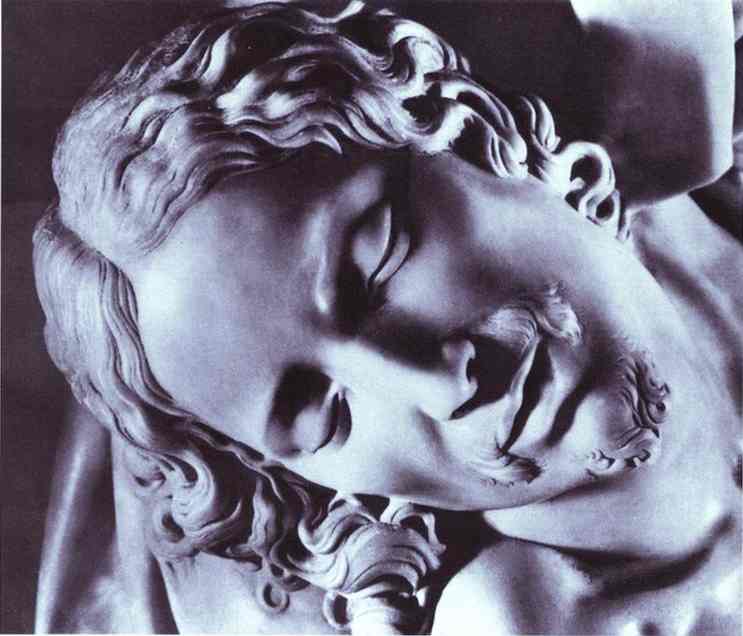
This is the head of Christ of Michelangelo’s Pieta, usually seen from the side rather than in this arresting full-face perspective. In a rendering whose eloquence itself radiates the miraculous, it conveys epic suffering, but also serenity that such has been endured to open Paradise to all the children of God.

Might this image suggest what the ultimate evolved state of humanity could be? Or should be? Capable of Love that, counter-intuitively, actualizes the Self by acting with regard for the Other that is limitless, and thereby – for the ‘Self’ passes away, but there will always be ‘Others’ – merging with eternity and infinity? In my view, that may be the truest possible meaning of Enlightenment.

As we all know, altruism can be dauntingly difficult in practice. But for inspiration, one may reflect on Michelangelo’s depiction here of how a sublime benevolence might appear.

‘By the Grace of God, Elizabeth II’

Queen Elizabeth was likely the most globally famous person, for the longest time, of anyone in history. Thus, she was a constant in the firmament of most people in the world today, including mine, if rarely consciously. Hence her death seems an occasion for some reflection.

No doubt the Queen had many failings, limitations any of us might have, was neither perfect nor saintly. But her privilege and fame should not be held against her, as they probably came at great personal cost, which only those nearest her could be aware of. Also not, in light of how she often put those advantages to use for the common good.

As an American, I have no direct experience of monarchy, but have seen what my society, which routinely sanctifies unrestrained pursuit of personal interest with no tempering presence (like the institution Elizabeth embodied, to try and remind us of values like moderation and ‘honor’) can become. This perspective colors the remarks that follow.

Unlike many people in my circle I am not a fervent fan of theater, but the only New York Broadway show I ever really wanted to see, and did, is relevant for Elizabeth’s passing: ‘The Audience,’ with the marvelous Helen Mirren portraying the Queen. It was a fictionalized version of a weekly meeting (audience) she had with her then-current Prime Minister; 14 of them, from Winston Churchill to Boris Johnson. Those encounters were the Prime Minister’s obligation to keep the sovereign informed about all important matters (presumably including secret ones) the government was undertaking. Those conferences were absolutely confidential; no one else knew what was said during them. So ‘The Audience’ is only thoughtful speculation.

Mirren’s Queen was admirably regal, yet deeply humane. Also pretty savvy, for someone whose position put her above the muck of practical politics, but to whom the highest ranking politician in the land was responsible. Mirren’s age (makeup) changed as the show progressed, from the 25 year-old Elizabeth was at her accession to the throne, to the font of mature, self-reliant wisdom she became.

I believe the play reached an ingenious – and now very pertinent – resolution. In scenes where the Queen was alone speaking to us spectators, and also summarized at the end, she pointed out that her role caused her to cross paths with many of the smartest, toughest, bravest, most talented and generally remarkable people in the world, from Britain and beyond. But she was self-aware enough to recognize that she herself was no prodigy, just an ordinary person whom Fate had thrust into an extraordinary locus of fame and influence which her own modest abilities could never have won for her.

From that realization, Mirren’s Elizabeth offered a great lesson: That all these extraordinary people had, like her, gifts that amounted to random acts of Fate. Like so many of them, she made the most of her position and what skill she had, or learned, to use it. Yet also like them, she could have been just an anonymous citizen but for the intervention of events she could neither foresee nor control. In their cases usually their own favorable genetics, in hers the abdication of her uncle King Edward VIII which led to the unexpected reign of her father George VI, because of which Princess Elizabeth became heir to the throne, then Queen, in 1952.

‘The Audience’ suggested (if I recall) that Elizabeth’s very ‘ordinariness’ qualified her to speak to the Mighty and the prodigies of the world on behalf of us common folk. Including the world-class politicians who became her Prime Ministers, and to whom she (not having to worry about re-election) was shown as often giving good advice.

Perhaps in real life, the actual Queen Elizabeth bore such contingency in mind to try to restrain, or at least reproach – within her limited temporal scope – the most extreme actions of the callous gifted with whom her station brought her face to face (for me, epitomized by Margaret ‘feed-the-weak-to-the-strong’ Thatcher).

The overriding lesson is that we are all on the ‘wheel of Fate’ to some extent, from a hereditary sovereign to those ‘smartest, toughest, bravest, most talented people’ in the world – whether they recognize (or admit) it or not – whom she would never have met but for the circumstance of her birth. In ‘The Audience,’ the Queen adroitly reminded Thatcher that as a person born fortunate and gifted (and I assume, ruthless), she should not regard everyone who had not succeeded financially or professionally as failures, their lives and labor to be exploited by the world’s ‘winners.’ Like Margaret Thatcher.

If the late Queen truly did harbor such attitudes, it surely helps explain why she was as successful – stabilizing, reassuring, beloved – an entity as she was. In this interpretation she could, and did show how a less-gifted person might determine to exemplify grace, probity, continuity, etc., while (because there was no place higher for her to rise) immune to personal ambition. She apparently simply expected of herself what her people expected, and needed, from her.

Elizabeth II helped her monarchy to evolve, survive and in some ways, thrive. No longer holding absolute power as ‘the Lord’s anointed’ as Kings long did, British royalty’s most useful purpose today may be to pull the attention of the Mighty – like it or not – to the interests of those who have less voice in the running of their country than the Westminster cliques, and barely covert, but massive power of the financial City of London.

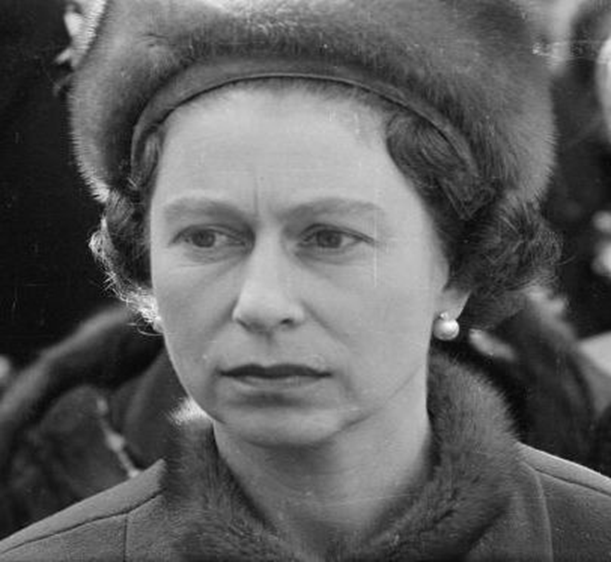
Another aspect of her life that deserves reflection is speculation about her degree of emotional depth. To that end, I offer the accompanying photo of her taken in Aberfan, Wales after a catastrophe there in 1966. A huge pile of spoil from a coal mine collapsed, buried part of the town, including its grade school, killing 144 people, mostly children.

The Queen has periodically been said to lack normal emotions, but look at her facial expression here, from when she visited the site several days after the disaster. This is hardly the face of one unmoved by the sorrow and tragedy she is seeing in a devastated community. The Aberfan avalanche was one of most terrible domestic events during her reign. She didn’t go there immediately after it, but as she confided much later, that was not because she was unsympathetic, let alone unfeeling.

On the contrary: She’d feared that if she went there while they were still dragging out the bodies of dead children, she might dissolve in tears at the spectacle. But that was exactly what this shattered village did not need; confirmation, by one who had not lost a child there, that their calamity was indeed, overwhelming. So she waited till she felt sure she could display supportive empathy, rather than more fuel for the grief by succumbing to it herself.

This was one of very few occasions when she was seen to shed discreet tears in public. In fact, it took much courage and sense of duty to voluntarily walk into a setting of horror most people would shun. Nevertheless, she later confessed that letting a week pass before going to Aberfan was one of her worst regrets as Queen. For Elizabeth, it was that, as personification of ‘the Nation,’ she must share – and be seen to share – in its tribulations, not just its triumphs.

(The people of Aberfan understood her hesitation. Further, they later said they would have been too dazed or absorbed in frantic rescue efforts to register her presence had she visited sooner. Her arrival after the initial shock passed allowed them to benefit from her recognition and support in their unspeakable loss.)

Look at that picture again. Her heart was probably cracking at the ghastly distress around her, but breaking down herself would not have helped her suffering subjects, so she forced herself to be strong for their sake. For that matter, during those Prime Ministerial audiences, she was probably told horrifying state secrets. No one will ever know what dreadful knowledge she had to bear alone, without even the comfort of her husband and children.

To reference the play ‘The Audience’ again, I could well believe that a person as feeling, and empathic, as Helen Mirren portrayed might well display such a facial expression, of being profoundly moved by events around her, even as she knew it was vital to (visibly) maintain her composure.

Bearing such burdens, publicly or privately, for the welfare of her people, is what I call truly ‘princely.’ Am I allowed to use the low term ‘gumption’ about royalty? For the late Queen sure seemed to have it, proving that monarchy and democracy are not invariably incompatible.

Her walkabout in Aberfan, along with many other high-visibility episodes of comfort and soothing, on top of the re-assurance of her consistent presence in the national consciousness shows just how much good a supposedly ‘ordinary’ person can do, if they believe that their duty is to embody and vocalize the better aspects of our Nature.

Elizabeth I was called ‘Good Queen Bess,’ in the golden later part of her 45-year reign, after the defeat of the Armada in 1588. Elizabeth II is surely as deserving of that title, both as a devoted ruler and orienting landmark in the background of so many of her subjects’ lives.

Contemporary considered opinion, including of many Britons, seems to be that sophisticated people look upon monarchy (even Queen Elizabeth) as a quaint anachronism to be indulged at best, but eliminated if possible, as contrary to logic and utility. But our world is not composed of only ‘sophisticated’ people, and does not function solely for their benefit.

More important, nor should it. Less cosmopolitan individuals, everywhere, should have someone who can speak on their behalf to the powerful, and uphold values like the need for some persistent degree of comity and civility, which get routinely violated in daily life. Queen Elizabeth, at the summit of her society, had both the visibility and inclination to do so. Surely there is some middle way between Pollyannaish optimism, and well-informed nihilism.

And the Queen seemed to try to navigate that indistinct line, affirming that all traditional values are not outdated or toxic. For her countrymen who deeply revered her and her title, despite her lack of power or Britain’s isolation among major nations in retaining a crown – indeed, for less jaded citizens for whom the complexity of the modern world seems overpowering – some sort of boosting inspiration may be essential. Perhaps including respect for largely benign traditions, upheld by a gracious, and caring sovereign – herself a ‘benign tradition.’

Moreover, it is ill-judged to dismiss or disparage the sheer, centering power of familiarity. Watching and listening to her address to her Realm during the worst days of COVID, surely gave great solace to millions of her people who feared the world as they knew it might be coming to an end – no doubt, even to many sophisticated (otherwise) anti-Monarchists. Just as she intended it to.

Forgive me now, for getting somewhat political: I am confident my readers are informed enough to know that a British sovereign has little real power (as I have noted in here), though not none. But far from being a ‘quaint anachronism’ or vehicle of tourism-generating spectacle, I hope that, as King, Charles III might be able to use his position as skillfully as his mother did, to temper (within his constitutional boundaries), how Britain since Thatcher has reverted to red-fanged Capitalism. Its economy now looks, in large part, like a Lucretocracy mainly conforming to the interests of the Square Mile (the district around the Bank of England, one of the dominant financial centers of the world; sometimes called ‘The Second British Empire’).

These financiers’ laser-focused, limitless appetite for profit has led them, for example, to suck in the blood money of villains from around the globe, making a laughingstock of the vaunted British self-image of ‘fair play,’ to say nothing of worldwide tax evasion and resource despoliation. They also treat most of the United Kingdom as a negligible, disrespected backwater, existing mainly to support the needs of greater London as a playground for plutocrats. Or for a small stratum of unreformed British aristocrats who haven’t gotten the memo about the perils of excess inequality amid the rightful expectations of a functional democracy.

(This attitude probably had a lot to do with why so much of England beyond London voted for Brexit. To the shock of the home counties’ ‘Elites,’ whom such voters felt routinely ignored them, their values and their well-being. That pushback must come should have been obvious.)

So may King Charles rise to challenges as great as his title is grand, to be as much a stabilizing gravity, and wise counselor as his mother strove to be, in a society evolving so spasmodically that it could fly apart with no sturdy hub – like a crown? – around which to revolve as a common point of cultural reference. As the ultimate ‘elite’ institution, the monarchy dare not be a focus for resisting change, where change is needed for the sake of fairness and civil stability. On the other hand, out-of-control deformation can lead to centrifugal forces that could cause said society to come undone.

A wise King may still dampen or discreetly channel such energies, for an institution that may be an encumbering obstacle in some situations may be a saving anchor in others. Like the address by the Queen and other Royals during COVID, when the British people badly needed encouragement that they could resist and defeat the menace. As the Queen’s father, George VI did during Hitler’s Blitz.

For Charles to reign successfully thus would be to continue his mother’s devotion to all the people of Britain. No statue or other monument could be a greater testament, or tribute, to her memory.

Returning to ‘familiarity,’ if I may close by presuming to speak for hundreds of millions of other people worldwide who, like me, are not from her Kingdom or her Commonwealth: Elizabeth was, in a very real sense, ‘the World’s Queen.’ She was more peripheral to us than to them of course, but nevertheless, a familiar, and reassuring part of our ‘firmament.’ Her COVID address helped calm me that there was still sanity, resolution and empathy in the World (especially in contrast to America’s own Head of state during the crisis).

For all like-minded people everywhere, may I say, Thank you, Your Majesty – Elizabeth II, by the Grace of God – for showing, and upholding, what nearly divine Grace looks like.

Amsterdam; Preserved Creature from Tropical Dutch Territory:

CONTEXT: My 2016 journey through Europe began in Paris, but ended with less than a full day in Amsterdam. I selected that city as a departure point because I wanted to see Rembrandt’s masterpiece, ‘The Night Watch’ there (which I’ve written on extensively, items I may re-post here). Writing about that quick visit later brought out my inner historian, in my observations below about the Netherlands, especially in the mid-17th – mid-18th centuries when it was a principal world power.

Before Amsterdam, I had spent several days in Cologne, Germany inspecting and pondering its cathedral (the ‘Kolnerdom’, shown earlier in this blog, lit by the setting sun). In this piece, I graze upon the differences in the two worlds represented by Cologne’s great church, and the very different world nurtured in, and by post-Reformation Amsterdam (noting its most famous church, the Westerkerk, tellingly modest compared to the Kolnerdom).

The ‘Rijksmuseum,’ or ‘State Museum,’ houses many of the greatest works from the Dutch Golden Age of painting, including Rembrandt’s ‘Night Watch,” but it is not only an art collection. It displays items that show many aspects of the nation’s history and contributions, including the outsized role the little Dutch Republic played in the Seventeenth and Eighteenth centuries’ great burst of exploration of the wider world by Europeans.

I had hastened from lunch to see ‘The Night Watch’ before the museum closed. After paying that homage, I spent the remaining 40 minutes examining the rest of the paintings there (all of them Dutch, I think, as a place dedicated to telling only the homeland’s story, not of world culture in general).

So there was really no time for me to do more than pass through other galleries of artifacts of the nation’s scientific, commercial and maritime, etc., heritage, nor the many displays from Dutch colonial territories around the world. Their empire later ebbed in size, much of it taken over by the British, including their North American and South African possessions. The Dutch East Indies, modern Indonesia, remained their largest foreign colony until after World War II, when it became independent.

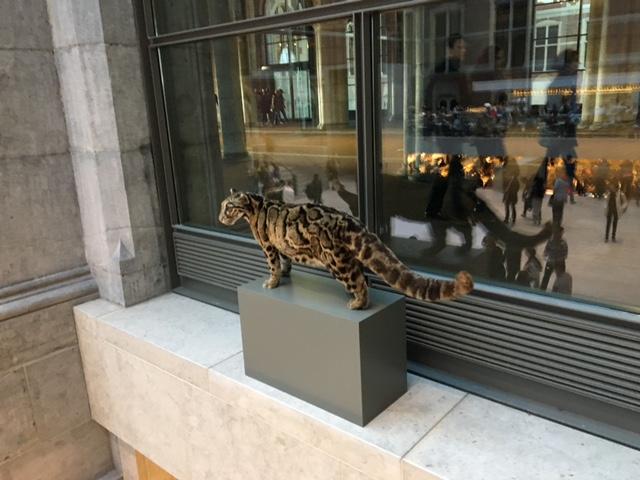
But this beastie in the Rijksmuseum caught my eye; there was no explanatory panel, but I think it is a stuffed ocelot. It was probably from some tropical colony of the Netherlands, brought (alive or dead) back to the homeland as trophy or curiosity. Presumably, elsewhere in the museum were also relics of the spice trade in the Far East, the greatest single source of wealth from Dutch overseas domains, and perhaps specimens of the plants on which the precious herbs grew.

Such items (likely privately acquired and eventually chosen for the Rijks) showed the people back home how wide and varied the world really was, very different from the flat Earth Medieval view that had preceded it. What Medieval Europeans knew (or thought they knew) about other parts of the world was mostly via convoluted and often inaccurate legends, but here were genuine articles brought from distant places previous Europeans had not even known existed, let alone seen.

Such questing and curiosity were consonant with the incipient Renaissance-Reformation mindset that human beings can control their fates and environments; very different from the other-worldly preoccupations of Cologne cathedral. However, looking back on how exploration, colonial exploitation and subsequent developments harmed other parts of the human and natural world – in some ways that still continue into the 21st Century – whether that new quest for control, propelled by still-imperfect men and their desires, was an unreservedly good development is not entirely clear.

Amsterdam was one of the places where the practical effect of Protestantism leading to greater individual self-actualization began to manifest itself most visibly and extensively. In that outlook, men did not have to believe that they were, more or less, essentially at the behest and mercy of divine manipulation and intervention.

That certainly is not, of itself, a bad thing, as I, steeped in the American culture of self-determination, will vigorously agree. It is splendid that we can better understand and manage the planet we inhabit, and human life today is unquestionably better in innumerable aspects than when either the Kolner Dom or Amsterdam’s (much later) Westerkerk were begun.

Yet, our world today – now, so much the product of human reason and individual autonomy – is still hardly Utopian. That is a realization that merits reflection.

Christmas Holiday, 2019:

Please find peace, hope and joy wherever you seek them, in this customary season of gladness. The ability to reason is part of being human, but every bit as much so are impulses to rejoice and to hope. So though logic may suggest life is inherently sad and futile because it ends, our reflexive reluctance to accept that bleak conclusion leads us, rightly, to use faculties other than logic alone. Hope is just as vital and elemental. And ‘Accuracy’ is not necessarily the same as ‘Truth.’

Few of us can be so monolithically rational as to easily embrace a self-annihilating interpretation; nor should we be. If logic demands we do so, then it – used exclusively – may be thwarting us as much, or more, than it empowers us. Reason itself, arguably, makes it implausible that the marvel of existence could be pointless, however obscure its intent may seem from our finite perspective.

Western culture developed to hold that the cosmos isn’t just an indifferent, devouring void. Anything so amazing, if mysterious, could not be mere happenstance; it had to arise from an act of loving Creation. That led to faith that each human life, by virtue of our consciousness enabling us to ponder our origins and purpose, parallels the mechanism of Creation, and is thus a precious sprig of it. And the Christmas story (in which I personally find deep comfort and lofty joy) proclaims that every such sprig is worthy of love, validation and, if needed, saving, despite what it has done or failed to do.

Whatever you believe, celebrate every aspect of your personhood, and savor hope and joy wherever you find them, or where they find you. To do so is to defy that supposed ‘indifferent, devouring void’; or to negate its power. Your spirit – our spirit – may be stronger than it could be. Besides, you are a member of the human family, and realizing that one is part of a family should always be cause for happiness and belonging.

And for Peace on Earth.