CONTEXT: I am currently nurturing some large writing projects, including an ambitious one for this blog. But rather than cease posting here till that is ready, I am going to re-post a few more items from my 2016 trip to Europe, starting with this one from Amsterdam. These will be relatively short, dealing mostly with substantial, not largely abstract themes. They are chosen in hopes they may provide context about places or events that inquisitive people might savor.
‘Exotic’ is a relative, subjective term. I live in Chicago, which seems comfortably familiar to me, but to someone from London, Moscow, Tokyo, Lima, Lagos, etc., my hometown may well seem ‘exotic’ – just as theirs would to me. For example, I was delighted when a group of visiting Parisians once told me they found Chicago – with its parapet of Skyscrapers and much of the best modern architecture anywhere sitting on the shore of glittering, opalescent Lake Michigan – ‘spectaculaire.’ They knew of nowhere in Europe where such stupendous works of Man abut such an auspicious natural setting.
I am very fond of my city and while I never considered it prosaic, it was a revelation to hear the impression it can make on people seeing it for the first time. So please consider: Might that also be true of wherever you live? Could there be things there you take for granted that would delight, even amaze, a newcomer? Paris’ inhabitants have appeared to me to be almost indifferent to their surroundings, even though those include some of the most elegant streets and structures in the world.
So while familiarity may breed indifference, never forget that our Earth is full of wonders and marvels, human and natural – or maybe denying easy categorization. Not all of them are ‘show-stoppers’ like Chicago’s rampart of cloudbusters, but many of them may be ‘breath takers’ anyway. And some of them may be in your life every day. So be attentive to the possibility of ‘wonders and marvels’ around you.
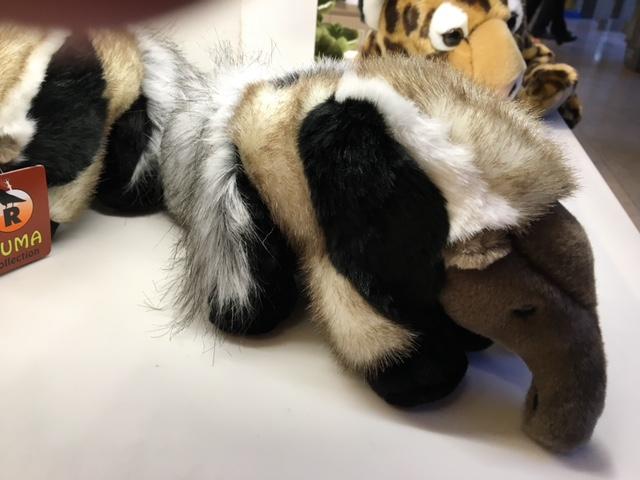
To start this interim series, something very cute from a museum in Amsterdam. By the way; ‘Brazilie’ is the Dutch name for ‘Brazil,’ where they once had colonies.
Amsterdam’s Rijksmuseum, in addition to artworks at the level of Rembrandt’s ‘Night Watch,’ was full of varied, whimsical items gathered globally, to remind the Dutch of the giant shadow their little land cast in its era of outsized, multifaceted achievement in the late 17th – early 18th centuries, when their ancestors sailed forth to explore, and exploit, vast reaches of the world. Its collection echoes a culture of openness to outside influence, upon which their culture apparently continues to evolve. This stuffed toy looked like an anteater, though I’m not sure (the Museum was closing as I dashed through its store, where this was displayed; no time to investigate). Such things don’t usually attract me, but now I wish I had bought this. It was a real novelty, and as you may agree, very cute.
Today’s Dutch people are reputed to be irreverent, resistant to pomposity and rote convention; very different from the severe character of their thrifty, Bible-guided forebears in their Golden Age – and possibly a logical development of their society’s drift away from rigid, approved behavioral codes. This is also reflected in their moral flexibility and live-and-let-live attitudes, demonstrated by the adult pleasures on show in Amsterdam.
It is also reflected in their attitude towards the Rijksmuseum itself. Although it contains some of the greatest creative treasures in the world, it did not seem like some set-apart temple of high culture, revered as a semi-sacred space and treated with hushed decorum. Instead, the Rijks felt more like an active part of contemporary Dutch identity. In fact, it is literally implanted in the everyday experience of Amsterdam, because a heavily used bike lane runs at street level between its wings. Such a synergy may say as much about the Netherlands of today as the displays inside the museum say about its Golden past.
It seems good the Rijks is part of dynamic communal life rather than an inviolate temple to be venerated at a worshipful remove. Great art requires concentration to create, or fully appreciate; but not necessarily humble reverence, for its energy to spread and affect a broader community. And that is surely true for sensations from the natural world around us, too.

 All Things Gaul