‘By the Grace of God, Elizabeth II’
Queen Elizabeth was likely the most globally famous person, for the longest time, of anyone in history. Thus, she was a constant in the firmament of most people in the world today, including mine, if rarely consciously. Hence her death seems an occasion for some reflection.
No doubt the Queen had many failings, limitations any of us might have, was neither perfect nor saintly. But her privilege and fame should not be held against her, as they probably came at great personal cost, which only those nearest her could be aware of. Also not, in light of how she often put those advantages to use for the common good.
As an American, I have no direct experience of monarchy, but have seen what my society, which routinely sanctifies unrestrained pursuit of personal interest with no tempering presence (like the institution Elizabeth embodied, to try and remind us of values like moderation and ‘honor’) can become. This perspective colors the remarks that follow.
Unlike many people in my circle I am not a fervent fan of theater, but the only New York Broadway show I ever really wanted to see, and did, is relevant for Elizabeth’s passing: ‘The Audience,’ with the marvelous Helen Mirren portraying the Queen. It was a fictionalized version of a weekly meeting (audience) she had with her then-current Prime Minister; 14 of them, from Winston Churchill to Boris Johnson. Those encounters were the Prime Minister’s obligation to keep the sovereign informed about all important matters (presumably including secret ones) the government was undertaking. Those conferences were absolutely confidential; no one else knew what was said during them. So ‘The Audience’ is only thoughtful speculation.
Mirren’s Queen was admirably regal, yet deeply humane. Also pretty savvy, for someone whose position put her above the muck of practical politics, but to whom the highest ranking politician in the land was responsible. Mirren’s age (makeup) changed as the show progressed, from the 25 year-old Elizabeth was at her accession to the throne, to the font of mature, self-reliant wisdom she became.
I believe the play reached an ingenious – and now very pertinent – resolution. In scenes where the Queen was alone speaking to us spectators, and also summarized at the end, she pointed out that her role caused her to cross paths with many of the smartest, toughest, bravest, most talented and generally remarkable people in the world, from Britain and beyond. But she was self-aware enough to recognize that she herself was no prodigy, just an ordinary person whom Fate had thrust into an extraordinary locus of fame and influence which her own modest abilities could never have won for her.
From that realization, Mirren’s Elizabeth offered a great lesson: That all these extraordinary people had, like her, gifts that amounted to random acts of Fate. Like so many of them, she made the most of her position and what skill she had, or learned, to use it. Yet also like them, she could have been just an anonymous citizen but for the intervention of events she could neither foresee nor control. In their cases usually their own favorable genetics, in hers the abdication of her uncle King Edward VIII which led to the unexpected reign of her father George VI, because of which Princess Elizabeth became heir to the throne, then Queen, in 1952.
‘The Audience’ suggested (if I recall) that Elizabeth’s very ‘ordinariness’ qualified her to speak to the Mighty and the prodigies of the world on behalf of us common folk. Including the world-class politicians who became her Prime Ministers, and to whom she (not having to worry about re-election) was shown as often giving good advice.
Perhaps in real life, the actual Queen Elizabeth bore such contingency in mind to try to restrain, or at least reproach – within her limited temporal scope – the most extreme actions of the callous gifted with whom her station brought her face to face (for me, epitomized by Margaret ‘feed-the-weak-to-the-strong’ Thatcher).
The overriding lesson is that we are all on the ‘wheel of Fate’ to some extent, from a hereditary sovereign to those ‘smartest, toughest, bravest, most talented people’ in the world – whether they recognize (or admit) it or not – whom she would never have met but for the circumstance of her birth. In ‘The Audience,’ the Queen adroitly reminded Thatcher that as a person born fortunate and gifted (and I assume, ruthless), she should not regard everyone who had not succeeded financially or professionally as failures, their lives and labor to be exploited by the world’s ‘winners.’ Like Margaret Thatcher.
If the late Queen truly did harbor such attitudes, it surely helps explain why she was as successful – stabilizing, reassuring, beloved – an entity as she was. In this interpretation she could, and did show how a less-gifted person might determine to exemplify grace, probity, continuity, etc., while (because there was no place higher for her to rise) immune to personal ambition. She apparently simply expected of herself what her people expected, and needed, from her.
Elizabeth II helped her monarchy to evolve, survive and in some ways, thrive. No longer holding absolute power as ‘the Lord’s anointed’ as Kings long did, British royalty’s most useful purpose today may be to pull the attention of the Mighty – like it or not – to the interests of those who have less voice in the running of their country than the Westminster cliques, and barely covert, but massive power of the financial City of London.
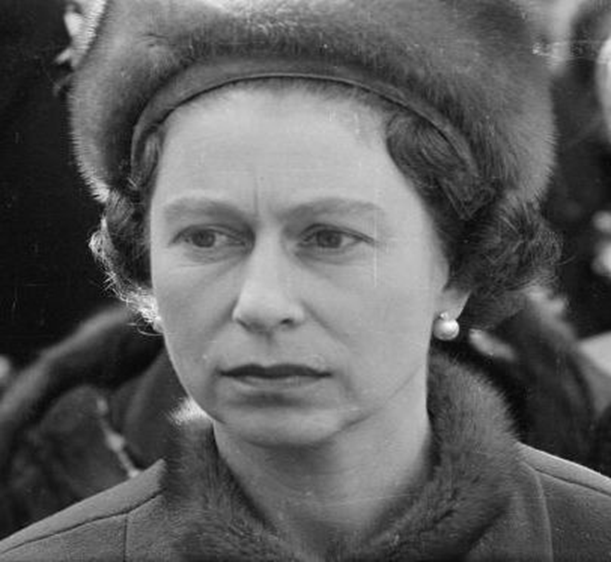
Another aspect of her life that deserves reflection is speculation about her degree of emotional depth. To that end, I offer the accompanying photo of her taken in Aberfan, Wales after a catastrophe there in 1966. A huge pile of spoil from a coal mine collapsed, buried part of the town, including its grade school, killing 144 people, mostly children.
The Queen has periodically been said to lack normal emotions, but look at her facial expression here, from when she visited the site several days after the disaster. This is hardly the face of one unmoved by the sorrow and tragedy she is seeing in a devastated community. The Aberfan avalanche was one of most terrible domestic events during her reign. She didn’t go there immediately after it, but as she confided much later, that was not because she was unsympathetic, let alone unfeeling.
On the contrary: She’d feared that if she went there while they were still dragging out the bodies of dead children, she might dissolve in tears at the spectacle. But that was exactly what this shattered village did not need; confirmation, by one who had not lost a child there, that their calamity was indeed, overwhelming. So she waited till she felt sure she could display supportive empathy, rather than more fuel for the grief by succumbing to it herself.
This was one of very few occasions when she was seen to shed discreet tears in public. In fact, it took much courage and sense of duty to voluntarily walk into a setting of horror most people would shun. Nevertheless, she later confessed that letting a week pass before going to Aberfan was one of her worst regrets as Queen. For Elizabeth, it was that, as personification of ‘the Nation,’ she must share – and be seen to share – in its tribulations, not just its triumphs.
(The people of Aberfan understood her hesitation. Further, they later said they would have been too dazed or absorbed in frantic rescue efforts to register her presence had she visited sooner. Her arrival after the initial shock passed allowed them to benefit from her recognition and support in their unspeakable loss.)
Look at that picture again. Her heart was probably cracking at the ghastly distress around her, but breaking down herself would not have helped her suffering subjects, so she forced herself to be strong for their sake. For that matter, during those Prime Ministerial audiences, she was probably told horrifying state secrets. No one will ever know what dreadful knowledge she had to bear alone, without even the comfort of her husband and children.
To reference the play ‘The Audience’ again, I could well believe that a person as feeling, and empathic, as Helen Mirren portrayed might well display such a facial expression, of being profoundly moved by events around her, even as she knew it was vital to (visibly) maintain her composure.
Bearing such burdens, publicly or privately, for the welfare of her people, is what I call truly ‘princely.’ Am I allowed to use the low term ‘gumption’ about royalty? For the late Queen sure seemed to have it, proving that monarchy and democracy are not invariably incompatible.
Her walkabout in Aberfan, along with many other high-visibility episodes of comfort and soothing, on top of the re-assurance of her consistent presence in the national consciousness shows just how much good a supposedly ‘ordinary’ person can do, if they believe that their duty is to embody and vocalize the better aspects of our Nature.
Elizabeth I was called ‘Good Queen Bess,’ in the golden later part of her 45-year reign, after the defeat of the Armada in 1588. Elizabeth II is surely as deserving of that title, both as a devoted ruler and orienting landmark in the background of so many of her subjects’ lives.
Contemporary considered opinion, including of many Britons, seems to be that sophisticated people look upon monarchy (even Queen Elizabeth) as a quaint anachronism to be indulged at best, but eliminated if possible, as contrary to logic and utility. But our world is not composed of only ‘sophisticated’ people, and does not function solely for their benefit.
More important, nor should it. Less cosmopolitan individuals, everywhere, should have someone who can speak on their behalf to the powerful, and uphold values like the need for some persistent degree of comity and civility, which get routinely violated in daily life. Queen Elizabeth, at the summit of her society, had both the visibility and inclination to do so. Surely there is some middle way between Pollyannaish optimism, and well-informed nihilism.
And the Queen seemed to try to navigate that indistinct line, affirming that all traditional values are not outdated or toxic. For her countrymen who deeply revered her and her title, despite her lack of power or Britain’s isolation among major nations in retaining a crown – indeed, for less jaded citizens for whom the complexity of the modern world seems overpowering – some sort of boosting inspiration may be essential. Perhaps including respect for largely benign traditions, upheld by a gracious, and caring sovereign – herself a ‘benign tradition.’
Moreover, it is ill-judged to dismiss or disparage the sheer, centering power of familiarity. Watching and listening to her address to her Realm during the worst days of COVID, surely gave great solace to millions of her people who feared the world as they knew it might be coming to an end – no doubt, even to many sophisticated (otherwise) anti-Monarchists. Just as she intended it to.
Forgive me now, for getting somewhat political: I am confident my readers are informed enough to know that a British sovereign has little real power (as I have noted in here), though not none. But far from being a ‘quaint anachronism’ or vehicle of tourism-generating spectacle, I hope that, as King, Charles III might be able to use his position as skillfully as his mother did, to temper (within his constitutional boundaries), how Britain since Thatcher has reverted to red-fanged Capitalism. Its economy now looks, in large part, like a Lucretocracy mainly conforming to the interests of the Square Mile (the district around the Bank of England, one of the dominant financial centers of the world; sometimes called ‘The Second British Empire’).
These financiers’ laser-focused, limitless appetite for profit has led them, for example, to suck in the blood money of villains from around the globe, making a laughingstock of the vaunted British self-image of ‘fair play,’ to say nothing of worldwide tax evasion and resource despoliation. They also treat most of the United Kingdom as a negligible, disrespected backwater, existing mainly to support the needs of greater London as a playground for plutocrats. Or for a small stratum of unreformed British aristocrats who haven’t gotten the memo about the perils of excess inequality amid the rightful expectations of a functional democracy.
(This attitude probably had a lot to do with why so much of England beyond London voted for Brexit. To the shock of the home counties’ ‘Elites,’ whom such voters felt routinely ignored them, their values and their well-being. That pushback must come should have been obvious.)
So may King Charles rise to challenges as great as his title is grand, to be as much a stabilizing gravity, and wise counselor as his mother strove to be, in a society evolving so spasmodically that it could fly apart with no sturdy hub – like a crown? – around which to revolve as a common point of cultural reference. As the ultimate ‘elite’ institution, the monarchy dare not be a focus for resisting change, where change is needed for the sake of fairness and civil stability. On the other hand, out-of-control deformation can lead to centrifugal forces that could cause said society to come undone.
A wise King may still dampen or discreetly channel such energies, for an institution that may be an encumbering obstacle in some situations may be a saving anchor in others. Like the address by the Queen and other Royals during COVID, when the British people badly needed encouragement that they could resist and defeat the menace. As the Queen’s father, George VI did during Hitler’s Blitz.
For Charles to reign successfully thus would be to continue his mother’s devotion to all the people of Britain. No statue or other monument could be a greater testament, or tribute, to her memory.
Returning to ‘familiarity,’ if I may close by presuming to speak for hundreds of millions of other people worldwide who, like me, are not from her Kingdom or her Commonwealth: Elizabeth was, in a very real sense, ‘the World’s Queen.’ She was more peripheral to us than to them of course, but nevertheless, a familiar, and reassuring part of our ‘firmament.’ Her COVID address helped calm me that there was still sanity, resolution and empathy in the World (especially in contrast to America’s own Head of state during the crisis).
For all like-minded people everywhere, may I say, Thank you, Your Majesty – Elizabeth II, by the Grace of God – for showing, and upholding, what nearly divine Grace looks like.
 All Things Gaul
Brilliant title!
LikeLike