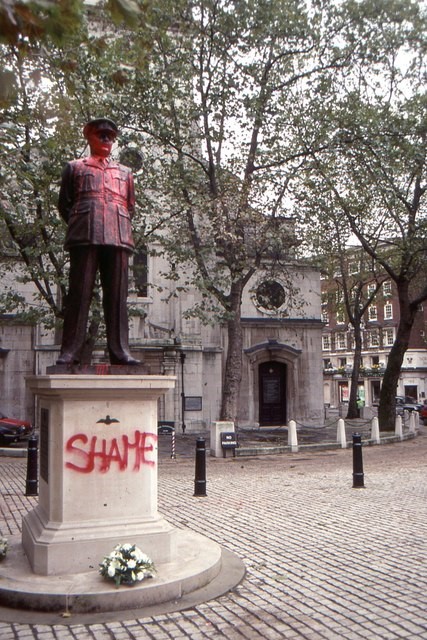
This image shows the defaced statue of Sir Arthur ‘Bomber’ Harris, Air Marshall of the Royal Air Force (RAF) during World War 2, outside London’s church of Saint Clement Danes. An ironic name for the location of such a monument, as will be noted below.
In 1942, Harris was appointed head of RAF Bomber Command, from which position he helped devise and implement ‘Area Bombing,’ the targeting of general vicinities of industrial and military significance in Nazi Germany. This strategy replaced ‘Precision Bombing,’ which was highly risky and relatively ineffective, given the coarse aiming technology of the time.
But Area Bombing also killed a horrendous toll of German civilians, which Harris more or less admitted was at least part of its intention. In addition to attempting to destroy legitimate targets like materiel depots, airfields, rails, munitions plants etc., this tactic kept ordinary citizens of German cities in a semi-permanent state of disrupting fear. It also meant to keep the Nazi regime concerned about domestic unrest, and obliged to devote resources to detecting and suppressing it.
Harris was forthright about his wish to inflict terror on the German masses to keep them as unproductive and discontented as possible so as to shorten the war. For example, RAF archives hold horrifying (in my view) maps and tables showing the composition of major German towns in terms of how flammable their building stock was. That is, how well it would burn, for at the time a great deal of urban Germany still consisted largely of wood-framed/roofed structures from the Renaissance and earlier. Harris explicitly directed high-explosives and incendiaries to be dropped on such pyres-in-waiting to consume them, any people inside them at the moment, and as much as possible, any sense of order and personal security among survivors.
Yet German civilian morale never substantially cracked, and military historians – which I am not – have argued about whether the impact of Area Bombing on Hitler’s ability to continue the war was worth discarding Britain’s cherished, integral self-image of decency and fair play, given its appalling cost in non-combatant lives. Compared to about 40,000 Britons who died in the Blitz (although far more throughout conquered Europe), some 500,000 German civilians were killed by Allied airstrikes. Many of those ‘Huns’ surely just wanted to live unmolested, but were trapped between the fear of the bombs, and the terror of their own government’s Gestapo and other security services.
The Nazis got very good at compensating for such attacks by dispersing their war production facilities to multiple smaller, hard to target locations, and other measures. So it is not clear that the practical damage inflicted by Area Bombing was worth the enormous loss of non-military lives; to say nothing of grievously compromising the Western Democracies’ claim to any moral high ground. Also, I have heard expert opinion that the biggest effect of Harris’ campaign – though it was admittedly an immense one – was only indirect. That is, it forced the Nazis to keep anti-aircraft guns in Germany to protect the homeland, instead of sending them to the Eastern Front for use against the Soviet Air Force during combat operations.
This gave the Russians vastly greater freedom to deploy their bombers and fighters as part of ground battles against Hitler’s armies, which they did with devastating effect. That being the case, if Harris had used an approach that did not implicitly victimize the German populace, it might have been just as effective in keeping many anti-aircraft weapons away from the war in the East. But again, I leave it to specialists to settle the practical efficacy of Area Bombing.
Ever since the war (and even during it), there has been debate, especially in Britain, whether Harris’ strategy – of which the joint Anglo-American attack on Dresden may be the ultimate instance – itself amounted to a war crime. After all, his method had similar effects to Nazi air attacks on cities such as Warsaw, Rotterdam, Stalingrad, etc., and to London and other targets in Britain during the Blitz. This fervent controversy led to this splashing of blood-red paint, and writing SHAME on this statue dedicated to his leadership.
Surely conscience should demand that good-hearted people not just shrug and say, ‘War is hell, and Hitler started the savagery.’ While that is true, put another way, it is not (inherently somehow) ‘’different’’ when We do it.
(That ‘We’ must include America, which also helped bomb Germany. Moreover, the U.S. had an analogue to Harris in USAF General Curtis LeMay, a ferocious aggressor who designed techniques to be used against Japan. Those sacrificed even more civilian lives than the air war in Europe, including 100,000 in a single incendiary raid on Tokyo – more than the nuclear strike on Hiroshima.)
On the other hand: Abstract ideals must be weighed against the concrete, paramount need to vanquish an evil like Nazism. At the time of Harris’ campaign, it was not at all clear, or certain, that Hitler would lose, however apparent that may look in hindsight. Given the stakes of this dilemma, I would propose that Harris’ collateral targeting of civilians – unspeakable as it was – might not be radically more shameful than many other deeds committed in wartime for the sake of defeating a ruthless foe.
So perhaps the real disgrace is how the British state saw fit to lionize Harris in this statue, seeming to brush aside all pretense of restraint or mercy (i.e., clemency; hence the indecorous irony of such a memorial being outside St. Clement Danes; there was nothing ‘clement’ about the deeds for which this man is being celebrated). Tactics like Area Bombing may be necessary to national survival, but even so, should they not be limited to acceptance as dreadful necessity? Instead of appearing to honor them as deeds whose memory should be revered?
In this context, one must draw a distinction between ‘honor’ and ‘gratitude.’ That is, I personally am thankful to all men and women, anywhere, who took harsh steps to ensure that Hitler ultimately lost. But I cannot ‘honor’ – without reflection – all of their actions, more than I lament the human failings that made them necessary.
Applauding carnage unreservedly is something Hitler would assuredly have done. And as is often the case, Hitler can serve as a model for all we should Not want to do, or to be. Can’t he? No qualms of conscience for him, ever: Nor for anyone who values absolutely nothing but winning.
Moreover, here is another perspective to consider: Besides the paint and ‘SHAME’ graffito, please also reflect on the fresh flowers at the base of the statue, presumably left after its defacement; maybe even in reaction to it. Those may have been put there by somebody who lost a loved one in the devastation of Coventry, or one whose mother’s sanity had been about to snap, or innumerable other deep personal concerns. The flowers may be a tribute to Harris’ presumed contributions to halting the Luftwaffe attacks on Britain. And yes, also possible gloating, out of fear or fury.
So is it too facile for those of us living long after the war was over, to whom its terrors are just ‘history,’ to claim that the sentiments of the flower-giver should be disregarded? Does anyone speaking retrospectively – in a world made safe, at incalculable cost, from Nazism – truly have the standing to decry the reactions of those forced to live through the fear, horror, suffering and sorrow it inflicted? Or with tragic family legends of those? The expression ‘Easy for you to say,’ comes to mind; ‘Your flesh and blood weren’t in the line of fire.’
If you had reason to believe that Harris’ bombing had saved you and all that you loved from Hitler’s wrath, would your priority still be a theoretical sense of benevolent equity? I am not in the least sure that mine would. We in the 21st Century view these events from a distance that affords us perspective, but deprives us of immediacy. Do we, today, have the right to dismiss the feelings of all those who actually faced the multi-pronged Nazi onslaught as irrelevant?
Only after saying all of that can I assert that although these may be unanswerable questions, it reflects an underlying humane decency even to be asking them, as British society has, when acting in its best spirit. One can be quite sure that no Totalitarian government, like the Nazis’, would even comprehend, let alone tolerate, consideration and discussion of such issues. Inquiries like these are marks of a society that is not only free, but that may be trying to attain a higher level of Human Evolution; even of Human Nature. The responses this statue has provoked give a stark example of the ongoing conflict between our reactions as organisms, and our aspirations to transcend those. Though of course, it is very far from the only example.
Perhaps the pitilessness of men like ‘Bomber’ Harris – or for that matter of Churchill himself, who could be as nasty in pursuit of triumph as his ancestor, Marlborough – was a terrible, but inescapable necessity to prevent the far worse outcome of Hitler successfully dominating our planet. Feasible moderate alternatives for preventing such a nightmare are not readily apparent; like a mad dog, there was really no way to reason with a biped beast like him. Although in a global war, the mad dog was not the only one that had to die, to eliminate the danger. I understand the need for military force, even if with regret, by nations that would at least try to pursue traditional ‘righteousness’ in a world in which the wicked may gain power and – because they don’t Care who gets hurt – wield it mercilessly.
But bronze effigies glorifying such hideous expedience seem several steps too far. Determination not to be conquered by Hitler was justifiable and understandable, but having sanctioned tactics like Harris’, Britain cannot just revert to a self-perception of virtuous temperance. That soothing image has been marred like this statue; possibly forever.
We can be glad people like Harris did what they did so that Fascism got destroyed. But we should also mourn that it was necessary for them to do so; that the human race can secrete an incubus like Adolf Hitler, even if it can also generate the will, genius and valor to thwart him. In an ideal world, someone like him would not even exist, let alone become leader of a great nation. But he did. So this stern, repulsive reality must be factored into our perceptions and actions.
Perhaps we should move such statues, as memorials to military prowess – particularly in countries truly striving for a better world, and in cases that reflect excessive brutality – to military installations, settings where defending a nation is a right, proper priority. This statue, for example, might be relocated to RAF Base Northolt, near London. Then, such public totems of ‘dreadful necessity’ might be replaced with something else, to remind us of the absence of war, and the contrasting value of peace. Any suggestions?
In these posts, I usually try to reach some conclusion about my topic, but in this case I would not feel comfortable doing so. Not only can I not agree that there is an easy answer to this quandary of honor vs. abhorrence, but I would distrust any claim that only one conclusion is possible, or valid. The dispute over this statue symbolizes a tension between our most compassionate inclinations, and our equally valid, innate desire for self-preservation. Such tension can never be fully released, and I would suggest that it should not be.
For that tension is the ‘Defining Dilemma’ of my title; a tug to, at least, try to be better than our basest nature.
Presumably we will never lose the reflex to defend our Selves, even if it requires destroying other ‘Selves.’ But neither should we forsake the stalwart ethical impulses whose very existence marks us as so different from other living beings. We must aspire, in the aggregate at least, to be better than creatures whose only involuntary purpose is to cling to life. For us also, that instinct is necessary; but as I have said in other posts and contexts, it absolutely cannot – must not – be sufficient for us.
The most appropriate shade to tint Harris may lie somewhere between the intrinsic darkness of his deeds – the deadly Nazi menace notwithstanding – and the white of those blossoms left at the base of his statue; lovely, delicate and fragrant. Everything that war is not.
 All Things Gaul