(It is recommended to read/view the adjoining post/video, ‘Lessons from September 11, Beyond ‘Living Memory’ After this one.)
The attached video exemplifies one lesson noted in my other post today, ‘Lessons from September 11, Beyond ‘Living Memory.’
It offers a poignant example of the resilient vitality of the human heart and spirit, which can be as lucid as the malevolence they showed that day was dark. This woman’s story was surely offered to encourage us all.
And it should; an alternative to despondent resignation.
(It is recommended to read/view the adjoining post/video, ‘Inspiration from September 11: Tragedy and Triumph,’ Before this one.)
I composed the post below, ‘An Essential Sorrow on September 11’ for 2023, as part of my ongoing effort to process the crushing enormity of September 11, 2001. That atrocity still scars our world, and I re-post it for this anniversary, while realizing any words must be inadequate to such overwhelming sorrow.
But my need to defy despair bids me try; and Mozart’s accompanying music may come closer to expressing the unimaginable.
The New York Times recently had an article about murals painted around the city soon after the catastrophe, to bear witness to it. Those catharses of grief and invocations of hope used varied imagery, but carried a common, still vital, message: Never Forget.
The piece described how many of them have deteriorated, been painted over, merged into their background, etc. Thus, they are metaphors for how that grisly date must eventually slip from living memory, as the Holocaust is doing, as its last survivors die.
Those who were alive at the time of such tragedies may, understandably, not want to re-live them forever. But the sentiments those fading murals strove to express must indeed never be forgotten. The import of such hideous crimes must be passed along to those too young at the time, or born later. They didn’t experience these traumas, yet must live in a world shaped by them.
Everyone, now or in posterity, should stay peripherally mindful of that terrible, beautiful Summer day’s lessons. One such is that no good ever has, or can, come of dragging others through Hell, by trying to impose Heaven on Earth.
The World is never improved by the impulse to purify it by destroying those who do not share any fanaticism that exhorts us to sacrifice the blood and lives of others along with (or instead of) our own.
Fanaticism – murderous Self-importance – such as deluded the 9-11 terrorists to believe they might be doing the work of the Divine, rather than of the Devil. I am a person of faith myself, but (seeking only to witness ‘Good News’) feel no need whatsoever to coerce; let alone, to kill.
But another priceless lesson of that day is, perhaps, the only good that appeared during it: Whereas the evil then was carefully planned, the heroism of Emergency Personnel, civilians, the passengers of United 93, etc. was entirely spontaneous. Many people suddenly thrust into desperate situations, rose – sometimes, magnificently – to the occasion.
Never forget that such too, can be part of the heritage of our species. If we take nothing else from that daylight nightmare, let us note that while it displayed humanity at its worst, it also, sporadically, summoned our best. And if we cannot be heroic, let us at least resolve not to become desensitized to the mostly lesser evils around us.
Perhaps, listen to Mozart’s ‘Lacrimosa’ – especially its end – in the re-post, while reflecting on these very different, but equally valid, ‘lessons.’
—————————————————————————–
An Essential Sorrow on September 11
This music, the ‘Lacrimosa’ (Tearful) movement from Mozart’s Requiem, is posted in honor of all the victims – heroic, helpless, or taken completely unaware – who died in the terrorism of September 11, 2001. Their lives were ferociously cut short, so all memory of their existence should not just be allowed to vaporize as well. Besides, by not forgetting about their loss, we may give a sliver of solace to their still-grieving families.
In this piece, Mozart sustains a mournful musical experience until the final measures, which resolve to a Major key, suggesting hope. Hope with no basis, in this case perhaps, other than that the spirit craves soothing from the impact of the savage impulses with which the wicked may afflict others.
But they thus darken the World for themselves too, as for all the rest of us. So we do well to guard our hearts (and minds) against such impulses – especially if we feel some duty to strive for a World better than that from which some 3000 souls were suddenly, wantonly torn that day.
France recently made a choice that re-affirmed what she reveres and encourages. It arguably offers inspiration for everyone, so is worthy of special note today, Bastille Day.
For over 200 years, France has honored her very greatest citizens at the Panthéon, a grand temple-like structure in Paris. Only a very select cohort get commemorated there, those who excelled in service to the nation, or to literature and science of global stature. For comparison, the ashes of Voltaire, the greatest philosopher of France or almost anywhere, are enshrined within. Many others were Napoleonic officials largely unknown today, reflecting evolving political and cultural priorities.
But this year, French President Macron directed that, for the first time, an historian, Marc Bloch, be ‘Panthéonisé,’ have a monument within its walls. The attached video shows part of the formal ceremony of his induction into this Gallic Valhalla (Gal-halla?). This reflects not only gratitude, but inspiration – even appropriate awe – at his glorious example.
This exalted privilege was bestowed on Bloch partly for his immense contributions to global study of history, but also for selflessly risking his life opposing France’s Nazi occupiers, who eventually martyred him.
His scholarly deeds alone might qualify him for this elevation, but his extraordinary bravery absolutely must. Other great minds (Zola, Marie Curie, Victor Hugo etc.), and gallant citizens (Jean Moulin, another patriot martyr) are lionized there, but few, if any, others so exemplify both the ‘Light and Fire’ – the mind and the spirit – referenced by this post’s title.
Fittingly, the Panthéon is not far from the Sorbonne, France’s elite university and venerable epicenter of academic excellence. Bloch taught there during the 1930s, contributing substantially to its heritage.
Born in Lyon in 1886, he was ardently patriotic, out of unforced love for his homeland, and her Revolutionary pillars, Liberty, Equality and Fraternity. He fought valiantly for France in World War I, was wounded twice, receiving two of his nation’s highest awards, the Croix de Guerre medal, and induction into her Legion of Honor. A secular Jew, Bloch likely felt spurred to demonstrate his loyalty in response to the Dreyfus Affair, when a Jewish army officer was falsely accused of espionage. It had convulsed the country during his childhood, and its anti-Semitic tremors lingered long.
After the Great War, he resumed his studies, devising (with colleague Lucien Lefebvre) the Annales School of history. That method examined the impact of ordinary people, not the famous and powerful, on historical events. Since there are few records, for example, of lives of serfs (topic of Bloch’s magnum opus ‘Feudal Society’), ‘Annales’ inquiry required cross-disciplinary extrapolation from long-disregarded sources to study them.
This approach implicitly bypassed ‘Great Man’ history, focused on Caesar, Charlemagne, Napoleon, Churchill, etc. Ironic, as Bloch will now be remembered in a temple officially dedicated to the nation’s ‘Great Men.’
When France declared war on Nazi Germany in 1939, Bloch, by then a 53 year-old professor, re-enlisted in the Army as a logistician. It was patriotic, but probably also from fierce desire to obstruct Hitler, embodiment of all that Bloch, elite scholar and individualist citizen, must detest. The feeling would be mutual; Jew-hating Hitler was also violently anti-intellectual.
The Germans, having converted their country into a war-making machine, swiftly defeated France, then occupied the northwestern half of its territory, leaving the southeast nominally ‘free.’ Its improvised capital was at a Spa town now synonymous with national dishonor: Vichy.
Expelled from teaching at the Sorbonne by Nazi bans on Jewish educators, Bloch moved to the free Zone, where he taught again, and eventually joined the Resistance, ‘Partisans’ combating the German occupiers. This was an act of almost insane courage, due to his age, relative notoriety, and being, as a Jew, already a prime target of Nazism.
It is breathtaking to ponder the terrible dangers to which he knowingly exposed his flesh and blood for abstract principles he considered more precious than his own life. He was given vital noncombat work, such as translation, coordination, and composing Resistance propaganda.
Examine Bloch’s picture in the video; he is late middle-aged, not some naïve, reckless youth. He knew the lurking horrors of the world, and surely realized what risks he faced among the Partisans. He faced them anyway, entering a lion’s den like the Old Testament Prophet Daniel, but unlike him, paid with terrible suffering when the beasts devoured him.
In 1943 in Lyon, Bloch was betrayed into the grip of the Gestapo, and interrogated under torture for months, supposedly revealing nothing. He was executed June 16, 1944, along with other Partisans, partly as a precaution, after the D-Day Invasion. A witness said Bloch’s last act was comforting a terrified adolescent prisoner, also about to be shot.
Facing imminent death himself, surely in pain from torture, yet still kind enough to soothe a distraught comrade. What humanity, both profound and soaring! And like Daniel, the articles of faith he treasured – France and her Republican virtues – lived on after him. Perhaps even partly because of him: An historian who, himself, contributed to history by hastening the liberation of his beloved country.
I once wrote a meditation about a holding cell I saw in the ruins of Gestapo headquarters in Berlin. Bloch’s Self sacrifice recalls that I said that if that site ‘saw mainly cruelty and horror, it must also have seen Olympian courage and nobility.’ He unquestionably showed those qualities, struggling against Fascism.
Few of us have the brainpower to attain his scholarly stratum, but theoretically, more people may be capable of heroism. Yet very few of us actually are, so his bravery may be even more astounding than his brilliance.
Now his nation is according him recognition commensurate with his splendid feats. Part of Macron’s decision was likely a wish to address a deeply sensitive chapter of French history. Her Occupation by the Nazis is still an infamous memory, because many Frenchmen aided Hitler not out of expediency – shameful enough – but conviction, seeing him as Europe’s bulwark against Bolshevism. They became his avid accomplices, persecuting their countrymen, especially Jewish ones.
The Great War hero Pétain, who resolutely preferred Hitlerism to Stalinism, became Vichy’s Premier. He set up a regime with like-minded reactionaries who hated many fellow Frenchmen – Liberals, Jews, Communists – more than the conquering Germans. Vichy connived with the Nazis in various ways, most ghastly, deporting multitudes of Jews to death camps from France, where some 80,000 perished.
For decades after, while many who cooperated with the Occupiers were still alive (and some in public office), France avoided confronting the scope of its societal culpability. Now that the War Generation is mostly dead, Macron likely intends Bloch’s commemoration at this most hallowed venue of French greatness, to suggest how the squalid implications of Vichy’s collaboration should be countered.
For Bloch’s spectacular gallantry, even Panthéonisation, a pinnacle rite of national reverence, may seem inadequate. He said of his death-daring decision to resist, ‘There can be no salvation where there is no sacrifice.’
I have no better descriptor for such magnificent nobility than the one I used before: ‘Olympian.’ Or possibly, in deference to his background, ‘Samsonian.’
In recognizing Bloch thus, France pays a debt – atonement? – not only to a patriotic hero, but to one who, by his scholarship, indirectly promoted values for which he ultimately died: the worth and sanctity of the ordinary individual. One whose view of history was that it is not moved only by men on thrones or horseback, but also by ‘ordinary individuals,’ he supported that view by defying bestial oppressors. Not with swords or guns, but words and ideas.
The disgrace of Vichy may always stain France, as tolerating the thwarting of Reconstruction may forever mark America. Societies that cannot acknowledge past error cannot improve, because they deny experience. By celebrating Bloch thus, Macron has decided France needs to face this shame, but also to learn from, and move beyond it.
Bloch’s life offers a luminous ember that France – indeed, the world – can use to kindle determination to resist the darkness to which any quasi-wolves like Hitler would make humanity revert. Republican France was Hitler’s nemesis militarily, but also philosophically, for the hopes of her Revolution were – and are – mutually exclusive with those of Fascism.
If any life could help inspire such determination, Marc Bloch’s could. By honoring him, his nation shines light on a detestable corner of her national story, but also re-asserts her vibrant desire to promote human progress.
Such progress may take place in libraries and classrooms, or cells and torture chambers, sometimes as much as in armed battle.
As against the ramparts of the Bastille, on July 14, 1789.
True patriotism is not reflex, flag-waving, Jingoist Chauvinism. True love of one’s country means neither hyperfocus on its imperfections, nor just ignoring them. As in loving another person, authentic affection doesn’t require pretense of perfection, but appreciating the beloved’s full potential, beyond any undeniable flaws.
So for me, America’s 250th Anniversary elicits reflection blended with some pride; and cautious optimism. As my title tries to suggest, she may still offer much to the world, if she can surpass forces that tainted her founding promise.
I thought of this during a walk in my vibrant Chicago neighborhood recently. The sense of freedom and security I felt seem valid reasons for thanks, as well as hope for, my country. My area reflects a society with good social ‘bones,’ not inherent, ambient chaos. And recognizing such seems a better way to appreciate America than any parade or statue.
But even those whose well-being our society long prioritized take such privileges for granted at their peril; personal freedom and security are not defaults in this world. Nationalist songs like ‘America the Beautiful’ may exaggerate positivity, with lyrics like ‘thine alabaster cities gleam,’ but such words stretch imagery to absurdity. Neither Chicago, nor any other American city is literally alabaster, white, pure, flawless stone.
To say the least, our heritage is not pure and flawless either. And it may have too long been presumed to be ‘White,’ which – ironically – has stained it.
While my neighborhood is relatively safe, clean and attractive, it still shows signs of the instability of any society where prosperity is protected to the detriment of those who lack equal access to it by legal, economic and cultural barriers. This should be an intolerable mismatch for any land that reveres equality.
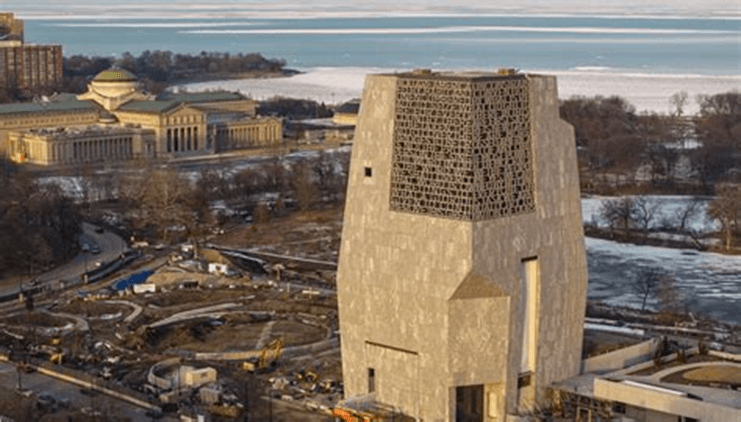
The new Obama Center pictured here is granite, yet reflects genuine hope for ideals, for which allusions to alabaster cities get brandished, rather than face the reality of failing to uphold them. Its design, so unlike other public institutions of its type – the classical Museum of Science and Industry appears behind it – suggests how diverse visions can be stimulating and beneficial.
The vision released on July 4, 1776 would diverge far beyond anything those prosperous White men, seeking redress against the authority of their lawful King, foresaw or imagined. They simply meant to adjust the power structure to benefit those they (presuming to define who was worthy – and ‘normal’), considered more fit and entitled to rule than any hereditary monarch: Themselves.
But the grand ideas they declared that day took on a life of their own, for if such mere mortal men need not submit to alleged natural rulers – princes and lords – why did anyone else? Those men opened a door to individual worth and autonomy that could not apply, indefinitely, only to those like themselves.
In time, their ‘adjustment’ swelled to an avalanche, gathering all people suppressed by traditional hierarchy, demanding control over their own lives. They never foresaw full citizenship for women, let alone ‘Negroes’ which would likely have horrified them. Progress has been slow and uneven, but it seems willful to deny that such counter-traditional leaps towards general personal liberty are not genuine evolution toward equality, based on one’s humanity alone. One should not expect perfection, or nothing; human affairs rarely work that way.
Consider: there was a built-in crossed-purpose – almost a ‘curse’ – for our professed ideals, which has deflected them ever since. A priority for many Americans was exploiting the wilderness of the continent, portrayed as a quasi-sacred duty, in which worldly success was divinely sanctioned.
But the sort of folk willing to endure hardship, ocean voyages in primitive ships, risk life and limb to develop this enormous land, were more likely driven by self-interest – including a great many who came in the later 19th Century – than abstract principle; including concern for native peoples who already lived here (to say nothing of slavery). And that’s fair; those willing to exert themselves beyond what is easy should get greater rewards. To a reasonable degree.
But American popular culture now endorses rewards to ‘unreasonable’ degrees. Thus, our economy recently spawned history’s first dollar Trillionaire (a South African immigrant who, unsurprisingly given racial presumptions amid which he grew up, rejects empathy as a value).
The obvious benefit of that self-interested vigor, first released to tame a wild continent, still curses many of us to consider wealth a virtue, no matter how unethically it is obtained, or how much harm (active or passive) it causes. Such frenetic dynamism may have been necessary to develop needed natural riches, but has largely outlived its usefulness, and made our nation the place where a phenomenon as unequal as one person having more money than there are stars in the heavens was apt to appear first. America too often encourages, facilitates – demi-deifies – such financial overkill, rather than treat it as a gross failure of proportion, self-awareness and modesty in a world of Want.
Is it hugely surprising that a society that largely approves such excess might also lack moderation in its politics? The validation of the Self effectively implied by the Declaration of Independence has, in many ways, decayed into indifference to the Other. That engine of greed collides repeatedly with the aspirations of the Declaration; historically, greed almost always wins.
Almost.
Events generally get driven by people with abundant energy, if often short on scruples. Actions speak louder than words however grand, and our true priorities gradually slid from the sublime to the avaricious.
Further, while the ‘equality’ the Founding Fatcats of ’76 sought chiefly rejected hereditary governance by asserting the inherent sovereignty of all (men), today, many Americans – especially, unremarkable white men – do not want to be ‘equal.’
They want to be ‘supreme,’ and thus many without distinguishing deeds or gifts cling fiercely to the unwarranted ruling class privilege our society has long accorded them. They would stand atop others to keep themselves raised, but such (violence-bacKKKed) egotism in fact proves them unworthy of rarified status. They don’t deserve it, have just been too long indulged to believe they are entitled to it.
To return to my ‘almost’ caveat about self-interest versus principle: ideals like those America asserted as its foundation are organic, self-sustaining, and cannot be put back in a box. They still win over ‘rugged individualism’ often enough to display their power, and thus remain worth striving to advance, rather than abandon as unrealistic.
And there are still prominent American voices advocating aspirations higher than Plutocracy, if we listen to them.
Hope is often unrealistic, but ideals are conceived to oppose intolerable (apparent) realities. Refusal to accept things as they are – belief that something better is possible – is an indispensable well-spring of much human progress. It’s what the Philadelphia Patriarchs intended. They knew their undertaking had historic implications; they just didn’t realize how much.
It is easy to focus on all the ways America has deviated, obstructed, or failed in its lofty pretensions. But it is worse than useless to give it up as a lost cause, and not still try to absorb those pretensions, mutated but improved, from those envisaged by those Patriarchs. Passivity concedes the public realm to the scruple-free.
The nation we can realize by seeing ‘Patriotism’ as combining personal autonomy with using it to contribute to our broader community, can genuinely nurture our experiment in freedom. Maybe observed as ‘Inter-Dependence Day?’
Whereas imagery like ‘alabaster cities’ is so far from reality as to seem like an admission that, since we cannot really be good citizens, we may as well aim for impossible perfection. But we do not need alabaster cities, we need faith that what got set loose 7/4/1776 deserves our best efforts to keep alive and evolving.
In addition, we should ditch our widespread knee-jerk near worship of wealth, as a worse-than-useless relic of a grasping frontier mentality. If we don’t start to reject baser impulses like hyper-Egoism, we will never attain, nor deserve, the higher state the founders offered us all; however unintentionally.
We may pray, as the song says, of America, that Providence may ‘Mend thine every flaw.’ But it is also said that Heaven helps those who help themselves, so we should actively pursue benevolent – and meaningful – contributions to life as individuals and collectively. Not just for our nation but humanity in general.
What may be accomplished, by free people with material sufficiency, focused on values immeasurably greater than rampaging rapacity? Reaching for and spreading such values may be more powerful than the self-interest of those who initially set them in motion – and possibly, worth more than all the ‘stars in the heavens.’
At a time when too many Americans increasingly struggle to maintain their current standards of living, facing swelling basic expenses:
When the world’s wealthiest people reflexively dodge their responsibility to pay taxes to sustain the societies on which they prey:
DT proposes to build an exorbitant offshoot of Versailles next to the White House. This thing was initially expected to cost $200 million (contributed by private parties, who would no doubt expect ‘access’ in return). It is now projected for $1 billion, and taxpayer funded. How’s that for brazen bait-and-switch? And for tin-eared cluelessness about life’s harsh realities – especially for many of his own voters?
What must happen before DT, and others of stratospheric wealth, grasp that they are blithely drilling into the lava dome of a volcano of anger, seething at galloping, indefensible economic disparity? They act as if they presume the ‘volcano’ is a dumb beast that either won’t notice, or can be easily diverted. But eventually they will drill too deep, cross some hyper-sensitive threshold, and all that enormous power will burst forth like the (stupidly disregarded) force of Nature it is.
Then, like the regime of Pre-Revolutionary France, the heedless, hyper-privileged caste will learn that in refusing to give a little, they are apt to lose all. It is coarse, short-sighted hubris, by people who imagine themselves to be hyper-sophisticated. If they won’t pay to help keep civilization functioning, they may have to taste more deeply than most of what happens if it stops doing so. As the courtiers at Versailles did when the Revolution came to (and for) them.
Unfortunately, such upheaval will impact more people than just themselves. But then, since when have most Plutocrats ever cared about anyone else? Just aspiring to, let alone ruthlessly achieving, unnecessary, excessive wealth suggests pathologically – and quite possibly, self-destructively – unrestrained self-involvement.
My focus here is DT’s ballroom. But it reflects a problem – accelerating use of Reason to overfeed sub-human appetites, instead of nurturing genuinely (evolved) human attributes, like Empathy – that is global in scope. It’s just appearing so floridly in America because material success has for so long been our quasi-State Religion.
Remember Man, that thou art dust, and unto dust shalt thou return.
These words are the traditional Catholic formula for the ‘imposition’ of ashes on the foreheads of the faithful on Ash Wednesday (today, 2026), the commencement of Lent.
But they have a broader, non-religious interpretation too: Eternity cares nothing for fame, wealth, power, beauty, or any other glittering prize which some will debase themselves to pursue and possess.
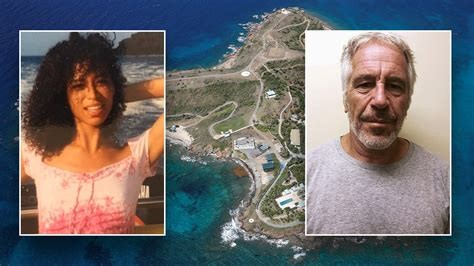
Revelations of how many of the most fortunate, privileged, exalted people on Earth behaved on Jeffrey Epstein’s isle of excess, when they assumed the public would never know, are convulsing the world. So I would hope that anyone who disapproves of what happened there, and in his other havens of unimpeded sybarism, will understand why it seems fitting to state the title, and first line of this post today.
The ancient significance of Ash Wednesday – broadly defined as ‘death to Self’ – may be a reminder of many things. Including of what one may become, in limitless pursuit of sensual appetites. Especially when others who are vulnerable are harmed in that ‘hunt.’
I may have more to write about this phenomenon later, but today seems to offer both a valuable counter-example, and a particularly suitable context for such observations.
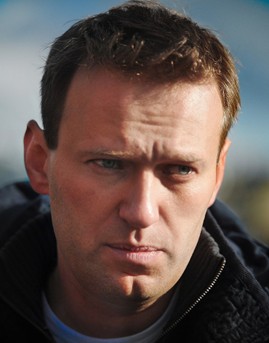
Alexei Navalny died February 16, 2024. An international scientific panel working with samples of his tissue, has concluded he was poisoned with a toxin that only vast resources could have created. Resources such as the Russian government had. Whether Navalny’s Nemesis Putin explicitly ordered his murder or not, he was ultimately responsible for it.
The War in Ukraine – Putin’s most far-reaching outrage, which Navalny challenged vocally – suggests how Alexei can be seen as, forever, as good an example of what people should aspire to be, as Putin can be seen as a specimen of what we should strive to transcend.
The war is the act of vicious, venal, cynical men understanding nothing but self-interest and blunt force. Equally contemptuous and bewildered by anyone who doesn’t see the world the same way, instead, looking through a filter of human morality.
As Navalny did.
Perversely, Putin may end up presiding over the breakup of Russia, the opposite of his megalomaniac dreams for his homeland, a backfire of near cosmic scope. In addition to his delusional overreach, he will accomplish this by treating his people, as Stalin did, as ‘little cogs’ to be deployed at the whim of an utterly callous ruler. And to be sacrificed, as we are seeing in Ukraine.
Incapable of winning by civilized rules, men like him act in accord with jungle reflex. They can do nothing else, actual human reason being seemingly beyond their abilities. Crude compulsion is the only tool they’ve got, or at least clearly their preferred one.
Such a mindset cannot suffice for the 21st Century, cannot meet the needs of economies and societies that depend on order, technology, complex social interactions, etc. Russia’s inability to shake her Medieval Mongol worldview would be just her own domestic problem, but that she is vast enough to disrupt the whole world with it. Thus, her anachronistic, kleptocratic Oligarchy is not a local concern; like gravity, it can influence almost anything, almost anywhere.
The complex poison used to kill Navalny is a testament to human sophistication put at the service of primal instinct: here, a ruler’s lust for domination. The Russian state’s ability and inclination to do such must not be mistaken for ‘modernity.’ No more than assassination as a legitimate tactic at the court of the Borgias.
It may be too late for Russia to escape the destruction that Navalny, and other noble souls like him, have tried to rescue her from. But it is not too late for the rest of us to be inspired by his example. And further, to ponder what can happen when we suffer events to be controlled by brutes in suits.
Wherever they are. Their legacy will be shame, disgrace, and serving as eternal examples of how Not to lead.
Whereas Navalny, whose physical life was cut short, can live on, perhaps forever, as an emblem of where we, as a species, should try to go.
A far better, grander legacy than that his Nemesis is likely to face.
Every year, I post a version of ‘Oh Come, Oh Come, Emmanuel,’ perhaps the most venerable song of Christmas. With Medieval roots, allusions to the Old Testament, its lyrics originally in Latin as ‘Veni, Veni Emmanuel,’ it is often performed with grand solemnity. Or when sung in English, in a tone of quasi-theatrical religious effusion.
But I feel its innermost nature, rather than solemn or theatrical, is awed reverence, hushed as the light of twinkling stars and evoking a limitless force that sustains them. So this year I have chosen an unadorned piano solo, displaying a common English translation. Those words will be my focus here, for when not inscrutably cloaked in Latin, they are as meaningful and compelling as the austere, ageless melody.
Especially consider ‘ransom captive Israel.’ It could be a reference to the Babylonian Captivity, or Roman oppression of the Jewish people. But there may be a broader interpretation: ‘captive Israel,’ refers not just to the Chosen people but to all children of God, everywhere and always, in lonely exile outside the Gates of Paradise since the fall of Adam.
Without speaking stridently, this song echoes ancient inspiration that can brighten our entire condition, conveying melancholy at human woe, yet encouraging us in hope for ‘power o’er the grave.’ And it poignantly addresses our desire, unspoken or unrecognized, for relief from the disappointing, browbeating world most of us experience, relief that may materialize ‘in cloud and majesty and awe.’
Jesus, these words cumulatively intimate, offers rescue from the sense of exile from the Edenic world that was, and is, supposed to be. And they subtly, but insistently affirm faith that, in the hands of Providence, all will be well. If only in an ultimate dimension, which we can never fully perceive.
Most people, at some time in their lives, will feel the sting of events beyond their control, no matter how autonomous or gifted they are. Our culture nudges us to focus (ever so profitably) on our individual selves, but ‘We’ are more marvelous together, than any of us alone can ever be.
So to perceive our value only in terms of the Self is to reject a sense in which we might, effectively, attain eternal life. That is, by living so as to contribute to the welfare of humanity after us, so that they will benefit from any benevolence we contributed or sustained. As opposed to living for ourselves alone, and thus simply vanishing when our bodies die.
‘Death’s dark shadows put to flight.’ The premise, on reflection, is not necessarily that our physical lives can be eternal; it is that our presence in this life need never disappear entirely. Jesus incarnated faith that we are worth far more than just our imperfect Selves, and pledges that faith to us, forever. This carol’s tone bespeaks grievous discouragement, but also hope that its longed-for remedy appears at Christmas.
The coming of Christ, who overcame the Self to redeem all Others, may offer solace to anyone who hopes there must be more to us, and our existence, than the intellect alone may ever compass.
As events, fate or passage of time diminish our individual deeds, unique qualities, advantages or burdens, all that remains to each of us, for better or worse, is the substance of our own humanity. And it is for refuge in that substance to which these words allude, by overwhelming grace that may ‘close the path to misery.’
One cannot, in any sense, truly grasp infinity, but one may yield to and merge with it, as this music pleads by proxy. Christ’s coming, mission and vertiginous love assert our fundamental value, merely by the exercise of the trait that distinguishes us from other life forms; the ability to reason – empathically.
It is less important that the existence of love like that can be factually proven, than that we act as though we are moved by its example. For that is the promise Jesus represents for all who grasp it, and reciprocate it, with lives that perpetuate the cycle of giving, joyously, that propelled Creation itself.
This timeless melody inspires awe, but its words of both jubilation and serenity also reward contemplation. Always, but especially in this season of Emmanuel, ‘God with us.’
On a recent visit to Europe, a friend and I went from Paris to Sarlat (a lovely Medieval vestige in France’s Dordogne, itself a marvel of nature and history) then Munich, and finally Vienna. It was all rather wondrous.
I hope to post reflections on some pictures I took, as after my 2016 travels. But I am currently focused on a large writing project, so may compose only a few essays, about photos I deem especially significant.
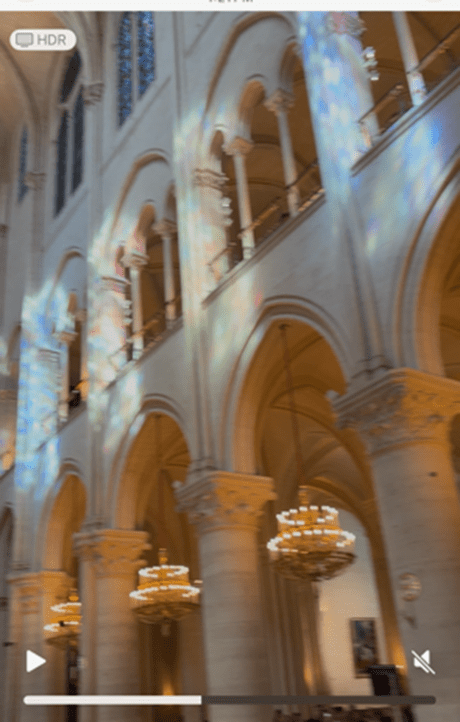
This image initiates that effort. It shows a spectacle not seen in centuries at gloriously rebuilt Notre Dame de Paris. The entire restoration from the fire of 2019 was magnificent, but encountering this long-gone ‘rainbow’ was enrapturing. Without the fire, this vista might have stayed lost forever.
After that inferno, the church’s walls were scrubbed of ages of candle smoke, incense, etc., and its stained glass consummately cleaned. Consequently, this cloud of limpid color, long obscured in the gloom, is now cast onto the stone-work overhead. The restorers likely anticipated its return, but I certainly had not, so discovering it astonished me.
Where I stood filming had been saturated with lead dust, ash from burned roof beams, rubble, all still in peril of structural collapse after the fire. That Notre Dame was not just restored, but is better than before, is evidence of determined, diligent, ingeniously potent human agency.
However: In Medieval Christian theology, God was light, which this revived iridescent glow assuredly suggests. Thus, this image may be pondered as divine approval, or affectionate reward, for how we deployed our collective gifts to rescue this venerable shrine, sacred to abstract aspiration.
I especially hope to write posts for three other photos from my journey. One is consonant with the majesty of human endeavor suggested here; the other two contrast with it.
I photographed Munich’s courthouse, where another intimation of our best Nature appeared. There, in 1943, members of the White Rose, a legendary anti-Nazi network, were tried and condemned to death for their ‘noble treason.’ Supposedly, they even dared scold their judge for moral dissolution and complicity with Hitler – a deed of defiant courage I find as awesome, in its context, as this compelling phenomenon in Notre Dame.
In contrast to that summit, two pictures I took at Dachau, suburban Munich site of Nazism’s prototype Concentration Camp, witness a chasm. One shows a statue of an anonymous inmate, inscribed ‘Honor to the Dead. Warning to the Living.’ The other is a photo of inmates taken by a guard, carefully conceived and crafted to sate Nazi mania to degrade and dominate the ‘other.’
Both these images feel ominously relevant to the political climate in America today, 2025.
The fact that so many people seem not to have learned the grim lessons places like Dachau symbolize makes me fear our species may have reached a pivot point. A point beyond which our Reason, spawning technology to serve the primally self-interested, may be as liable to degrade or destroy us, as to advance us.
Thus, until if and when I write about those three, the image here must serve to assert a proposition I ardently feel worth advocating: belief in the ultimate positivity, underlying and overarching, of our mortal existence. What these apparently unrelated things – this recovered spectacle at Notre Dame and the White Rose’s nobility – have in common, is that the instinctive admiration most of us feel for such marvels may suggest that simple goodness is the default of our nature, and wickedness a baser aberration. And they may help us keep faith in that default, despite all counter-evidence.
Scripture says that after the Great Flood, God set a rainbow in the Heavens in token of a promise never again to chastise humanity for its failings. The rainbow shown here may be mere optical happenstance, but such apparently random coincidences may act as mechanisms to move us to hope, may offset dispiriting, life-negating evidence, inspiring us to reckon that an elementally better world is possible; even necessary. A world more worthy of this sensational vision, and of the soaring honor of the White Rose martyrs, than of demonic Dachau.
In terms of attaining the highest level of being we can, reaching beyond the Self alone – love – may prevail, where logic fails. So I invite readers to consider this image as evocative of tender, reassuring encouragement to such ‘reaching.’
Most humans’ spirits are not data driven, so physical experimentation, mathematical proofs, etc. are not tools for such undertakings, which are outside the realm of reason, alone. We must generate and embrace such Hope within our Selves. And it must subdue animal urges such as Nazism invoked, or we are lost.
Hope need never die, unless we let it expire. At grievously wounded Notre Dame, we did not, and as a result, got back this breath-taking apparition.
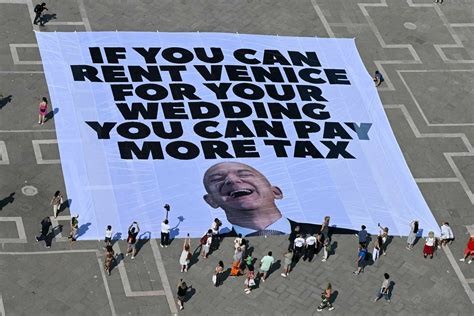
The recent Bezos Matri-Money in Venice reminds me of an episode from the French Revolution. We tend to think of the Fall of the Bastille, July 14, 1789 as the start of that grand historical process. It was pivotal, the most violent defiance of King Louis XVI’s authority to date, but was soon followed by an incident more pertinent today. We are not at a tipping point like that event turned out to be, yet it feels increasingly relevant.
On October 1, 1789 the Flanders Regiment reached Versailles to take over duties of a unit that defected at the Bastille uprising. At the same time, a bad harvest was making bread, staple of most French diets, costlier in Paris.
The King’s bodyguard threw a sumptuous banquet to welcome the Flandriens. As if luxuriant food as commoners faced starvation weren’t insensitive enough, the newcomers also displayed inordinate gestures of loyalty to Louis. The callousness of extravagant dining and obliviousness to broad frustration with a feckless King were dangerously at odds with the mood beyond the royal Court.
News of those antics got soon back to Paris, and as a result, a mass of irate women marched out to Versailles to remonstrate with Louis about the cost of bread. They breached the palace, and coerced the royal family to return to Paris, where they could be more easily controlled, guarded and menaced.
In 2025, there are no Divine-Right Kings on whom national publics can focus frustration. But we have our own focus: behavior like that extravaganza in Venice by those who, like Louis’ courtiers, evidently see themselves as above the concerns of (other) mortals.
It is a fair, if inexact, parallel to reaction to that Flandrien feast that today, beleaguered folk observing modesty’s ‘Dearth in Venice’ resent the ultra-rich absorbing ever more of Global wealth. Often by redirecting it from previously comfortable middle classes.
Even more reckless, today’s plutocrats try various ploys to pull up the socio-economic ladder, to make their privilege and power inassailable. (‘Ploys’ like rendering healthcare less accessible, reducing life expectancies; hence my citation of ‘Fratricide.’)
Was the unseemly profligacy of the wedding of merchant martinet Bezos due to delusion? Arrogance? Both?
Did its guests not realize the resentment their hyper-indulgence causes fellow citizens? Citizens watching as historically unique widespread financial and personal security –- which they consider the bedrock of any ‘just’ society – gets deliberately eroded?
Especially when many of those guests avoid taxes (as the accompanying image suggests) with the same vigor they siphon profit to themselves. Often, using techniques they – the groom first among them – devised or control.
(Sidebar: Is facilitating techno-charged rapacity ‘Evolutionary progress?’ Surely, this is not the highest state of development to which we can aspire!)
Can they actually believe their efforts to revive a Gilded Age – a glittering membrane over a dark reality of struggle for survival for most – will pass unnoticed, and unresisted, by ‘most?’
All this is an insufferable offense against simple fairness, so any popular wrath it ignites should come as no surprise. How can allegedly smart (rich) people be so blinkered they can’t see this is both intolerable, and untenable?
There is a huge difference between most people today, and French commoners in 1789. They were accustomed to hardship, hoping mainly that survival be as little difficult as possible, whereas most of us experienced ‘widespread financial and personal security’ not long ago.
We know life Can be better, and should not accept its being degraded so kleptocrats can outdo each other with grander yachts.
Why should so many give up so much, to pamper so few?
Or is it arrogance? Do members of the ‘élite’ simply not care what the common herd thinks? Or presume it can be reliably manipulated? But today’s ‘herd’ is educated enough to sustain a modern economy, so its members are aware life was not, and need/should not be, constant struggle for survival.
In honor of Bastille (Bez-steal?) Day, the subtitle of this post is a satire on three pillars Republican France has espoused since her tumultuous birth: ‘Liberté, égalité, fraternité’ ‘Liberty, equality, fraternity.’
Ideals that any libertines, egomaniacs or enablers of fratricide who made it onto the Venice guest list likely not just ignore, but consciously mock. Most especially égalité/equality. Their personal ‘ideals’ are obviously irreconcilable with France’s Secular Trinity and its promise of a better human condition.
To return to that women’s march: legendarily as they neared Versailles, palace staff tried to close its gates. But they hadn’t been shut in decades, and were rusted immovably in place. Heedless gentry had just presumed civilization would prevail to sustain (and be exploited by) them. Their presumption that their privilege was indestructible proved false, so when a reckoning came, it left them unable to shield themselves.
It wasn’t barbarians at those gates. It was wives and mothers fed up with being ‘subjects’ of those whose selfishness proved they did not merit their prerogatives.
Those rusted gates may prove a metaphor for glitterati who attended Bezos’ rites, then ignore justified anger from beyond their velvet cords and gated residences. Who assume civilization is there to protect them, even as they (‘Carnivores in Venice?’) prey on most of its members.
If Venice’s spectacle is 2025’s equivalent to the cluelessness of the banquet for the Flandriens, the equivalent to their tin-eared praise for Louis XVI may be our plutocrats’ shameless tax avoidance, a childish mindset that one may limitlessly ‘take,’ but need never ‘give.’
History may see capers like the flaunted opulence in Venice as what led a critical mass of people to conclude the economic structure benefits only a veneer of the powerful.
In another essay, I will speculate on cynical ways plutocracy may be trying to distract us commoners from noticing how we are being despoiled. Like Versailles’ gates, such gambits are liable to eventual failure, when snarled with the accumulated rust of popular rage.