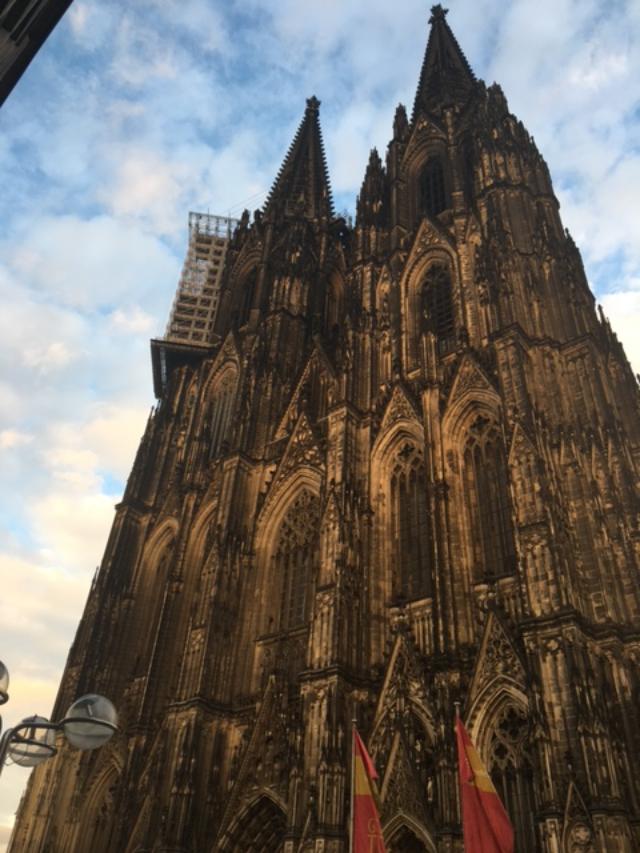
These colossal spires, more than 500 feet tall, were in the original plans for the cathedral. As noted in prior reposts, part of those were rediscovered some 300 years after construction had been halted, leaving the church obviously, and clumsily, curtailed.
Whether it is a trick of the light or a variation in the type of stone, the towers almost seem luminescent in this picture, with the same evocative glow that appeared in my previous repost (July 16, 2022) of a sunset image of this building from the side. To me, here they suggest natural rock formations, rather than purely human labor. This sheen makes them look as much a part of the Earth – not merely on it – as sandstone pinnacles in America’s western deserts. There is an elevator leading to the roof of the Dom, but I didn’t use it, preferring to experience it at ground level, as it was principally meant to be seen; like this view.
The cathedral is, overall, resolutely Gothic, whereas buildings begun as long ago as it was often accrue embellishments from various eras through which they exist. Thus the great delay in completing the Kolner Dom likely ensured its final stylistic uniformity. Unlike many cathedrals completed in the same era they were begun, this one was spared much of the adulteration inflicted on fully Medieval ones, with Renaissance, Baroque or Rococo decor getting slapped over the original fabric. When Cologne cathedral was being finished in the mid-19th Century, no one wanted it to look anything but Gothic; and so it does, with very few exceptions.
The Dom is now the most heavily tourist-visited site in Germany; most people entering it now probably do so mainly as just another place of historic-artistic interest. And it certainly is that, but its formidable physical and extra-physical presences still present a setting in which contemplation may flourish, a sort of gravitational pull to which many so-disposed visitors surely find themselves responding.
Even in its long unfinished and ungainly state, the Dom was for generations a site of continental pilgrimage, owing to the supposed presence within it of the bones of the Three Kings, the Magi, men who attended the infancy of Christ. So each time I entered it, I reflected upon what Medieval folk – who never saw it complete, could only imagine its full, intended magnificence – might have hoped their journey here might grant them. And on what its tacit evocation of the tension between Eternity and human mortality may still offer us today; it was meant to summon and facilitate such meditation, and can continue to do so.
It is no coincidence that the English words ‘respire’ (breathe), ‘inspire’ and ‘aspire’ share the common root of the Latin, ‘spiritus,’ or spirit. In each case – including the process of breathing in and out – the very force of life itself is implied. ‘Respire’ means the constant cycling of that spirit, ‘inspire’ is the height and depth of expression it may generate, and ‘aspire’ refers to its fondest goals. So an inrush of breath elicited in a place like the Kolner Dom may also hearken to inspiration and aspiration.
Like all man-made spaces emblematic of faith that there is something to our ‘Being’ beyond the chaotic vale of tears we observe daily – even amid the assuaging technology of the 21st century – this church faces the issue of whether human life is irrelevant to an impassive cosmos, or has true and vital purpose. The Dom, like the ideals that brought it forth – joyously as the Three Kings kneeling at the manger – both proposes, and evinces, that it can.
That question takes different forms in different cultures, but its widespread preoccupation suggests it is an entirely natural human inclination, which we rightly use our Reason – as well as the other faculties that make us human – to explore. Animals fear danger and pain, but presumably do not contemplate mortality; our ability to do so may, of itself, alter our relationship to it. There may be some aspect of each of us as eternal as those great sandstone pinnacles in the desert; but unlike them, we can – should? – muse upon that possibility.
 All Things Gaul