This is film of the funeral of the author Leo Tolstoy in 1910, posted as relevant to a grotesque tussle over the remains of Aleksei Navalny, implacable, leonine foe of Vladimir Putin. Russian authorities, not wanting a high-visibility ceremony for their greatest enemy (nor to expose evidence of what they did to him) demanded his mother agree to a private funeral before releasing his body. But Navalnaya stood her ground, refused this blackmail, and the Kremlin relented, discharging Aleksei to her.
Tolstoy’s funeral is partly parallel to this, for he too was a passionate, peerless voice against the evils that the regime of his day, Czarism, visited on the ordinary Russians it trod down. As this shows, his passing led to an outpouring of grief and love by common people for one who, implicitly, steadfastly spoke truth to power for their sake.
Note how mourners kneel as one, in gratitude and honor, when Tolstoy’s coffin appears. Masses of peasants – many of whom had not read his works (or were illiterate, still then common in Russia) realized that Count Leo, despite being an aristocrat, wrote on their behalf, often depicting their suffering under the injustices of the Imperial system.
Tolstoy was a Pacifist social critic, whereas Navalny was a fearlessly assertive agent of change, but the mass affection for a champion against oppression shown here is just the sort of spectacle (potential spark?) Putin most fears. And rightly, for while Tolstoy’s passing did not galvanize an uprising, a grand funeral for Navalny conceivably might. Or at least inspire Russians not to just let his dreams be buried with him.
Nicholas II didn’t send troops to quell this shadow rebuke to his rule but Putin, lacking an Emperor’s legitimacy, might not forbear from violent response to a populist funeral for Navalny. What latter-day ‘Cossacks’ might he call out to put down scenes like this, reproving his regime?
The whole world will be watching; or should be. And in 2024, the record won’t be just a single piece of black and white silent film.
Various personal distractions have kept me from focusing on the followup post I mentioned at the end of my last one, ‘Promoting Freedom by Protecting Memory,’ about the 1905 Winter Palace Massacre in Czarist Russia. But to paraphrase Samuel Johnson, death ‘concentrates the mind wonderfully.’
And the death of Aleksei Navalny, all but certainly due, directly or indirectly, to Vladimir Putin, has concentrated my mind furiously, catalyzing that promised sequel, here. It will not take the form I originally envisioned, will serve largely as a partial vent for my current writhing wrath at Putin. Although that feels inexhaustible.
Dedicated to Navalny, this post proposes suggestions of how to perceive, and what to do in response to, his death. I will not advocate for revenge; vengeance is the province of spiteful men like Putin (and Hitler, who literally spoke of a ‘goddess of revenge’). Instead, justice is what we should rightly seek, and that can best take the form of punishing Putin by helping to thwart his mania to conquer and subjugate Ukraine, an enterprise whose criminality, cruelty and reckless stupidity Navalny condemned relentlessly.
Even if Navalny’s eventual Fate was not a real surprise to those following his opposition to Kremlin tyranny and corruption, it was still a shock. He may be credibly said to have represented what is good, noble, hopeful – and truly evolved – in us, as surely as Vladimir Putin personifies all that is not. No doubt he was flawed like everyone, but also exemplified attributes we properly admire, but rarely attain, such as granite-hard determination. One needn’t be angelic to offer a stark contrast to Putin, but Lion-hearted Navalny was a more extreme opposite than most of us could ever be.
The likes of Putin, who incarnate dark forces of human nature and history, are desperate to quell such noble impulses which they regard with cynicism and bewilderment, as obstacles to ‘realism’ in politics. But they are desperate fools if they imagine they can dissipate the loftiest acts and aspirations of Mankind with the odd well-placed assassination. Granted, the relative passivity and credulity up to now of the bulk of the Russian public to Putin’s criminal aggression against Ukraine has likely encouraged him to persevere with it. But his incomprehension of ‘principle’ makes it impossible for him to recognize that he cannot eliminate massive, rightful and reparable discontent by ‘well-placed assassination.’ Eventually, the underlying grievances will burst like a volcano’s lava dome, not manifest only in epic characters like Navalny.
Predictably, men as heartless and crude as Putin regard valor as folly, and likely felt Navalny was a fool for returning to Russia from Berlin, where he received medical treatment for a near-fatal poisoning (that was surely Putin’s doing). But authentic heroism is very different from folly.
Someone like Navalny – as he showed in deeds, as did the journalist Anna Politkovskaya – grasps a truth invisible to anyone like Putin: To a soaring soul, there can be values more precious than his own interests, or even his very life. And for Aleksei, the happiness of his country and her people was one such value. The Putins of this world – wherever they are – are blind to such concepts, cannot comprehend flights of the human spirit or seemingly anything but the coarse, transient rewards of ‘What’s in it for me?’ (As an American admirer of Putin once mocked American soldiers – who had died for their country in World War I France – buried ‘over there.’) Any ethical vision they may have ever possessed is occluded by the moral muck of unabashed self-dealing and indifference to collateral harm which they inhabit.
If you also are outraged by Navalny’s suspicious death, there can be no better response to it than to justify his courage by calling for immediate, greatly enhanced Western support for arming and aiding Ukraine against Putin’s militarist fantasies there. And by furthering – in any way you can imagine – Putin’s worst nightmare (and partial reason for his terror at the westernization of Ukraine): Creation of true, irreversible civil society, and the valuing of individuals, in Russia herself.
Because the inertia and indifference of Western public opinion are as vital as oxygen to Putin. His invasion assumed the Democracies, in their affluence and security, would do nothing meaningful in response to it, and let him go on heedlessly spending Russian and Ukrainian lives in pursuit of his delusional 19th Century style Chauvinism.
But using Navalny’s demise as a spur to frustrate the dark powers he struggled against is surely as effective a memorial, to his life and his death, as there could be. If I could somehow speak to the Russian nation, I would assure them that there are foreigners who hail their forefathers’ bravery in their country’s defense. I might then point out that Navalny faced huge, avoidable, risks for their sake, and in gratitude and inspiration, they might be willing to face lesser ones to validate his sacrifice.
The Russian people have never been more formidable than when their patriotism was inflamed, as Napoleon and Hitler learned; for their Motherland, they can, and will, fight like dragons. Given the extraordinary deeds that the great-grandparents of today’s Russians performed – rolling back Hitler’s barbarous rampage in their land all the way to his lair beneath Berlin – perhaps an appeal to their love for their country (rather than loyalty to its despicable leadership) and to their own dormant lion-hearted courage, is the best way to lead to the final destruction of autocracy in their midst:
For Autocracy continues to hold back their already splendid nation from attaining its full greatness which is to be found in its vast contributions to the arts and sciences; not in Mongol-style territorial expansion.
The World’s Democracies’ stalwart devotion to (and enlightened self-interest in) helping to sustain Ukraine may stoke the slumbering patriotism of the Russians by confronting them with just how utterly indifferent their current Czar is to the lives of their sons, husbands and brothers he will continue to waste in Ukraine; how totally focused he is on realizing his own fantasies of glory, and his horrifying concept of national honor.
I realize all of that is easy for me to say, far from Putin’s fierce police, tear gas, stun guns, and rubber batons. But Russians will face such forever if they don’t liberate themselves; as they did in 1917.
Speaking of 1917, there may be a grim but intriguing irony developing here. The rule of the last Czar, Nicholas II, was corrupt, incompetent and unsuited to modernity, but Nicholas was ultimately brought down by continuing to fight a conflict he had rashly helped provoke, but could not win – World War I – whose grave sufferings for his people he was too stubborn, prideful and oblivious to take seriously. In 1917, those people had finally had enough of him, his war, the feckless social order he represented, and they ousted him and his whole rotten misrule.
Perhaps Navalny’s murder will ultimately put a similar flame in today’s Russians, suffering due to a war Putin is too proud and indifferent to his people’s wishes and welfare, to recognize as utterly not worth the cost. Perhaps they will echo 1917, accept that they must take their destiny into their own hands, and repeat history by overthrowing him and his kleptocracy. Putin, as I have noted in other posts, suppressed official observance of the 2017 centennial of the fall of the Romanov dynasty, so it would be tragicomic if he comes to share their Fate due to his own myopic megalomania. In stifling public memories of 1917’s regime change, he himself may have lost sight of its crucial lesson: Rulers dare not take their subjects’ patience, obedience and timidity for granted.
Thus, he might provoke the very sort of popular uprising he wanted his subjugated public to forget, because he himself neglected its warning, and overestimated the feasibility of eternal repression. And his own eventual Fate might prove messier than the Romanovs’, who got gunned down in a Siberian cellar.
If so, let him face the dreadful destiny of Nicholas II to which his own cruelty consigns him, of obstinately clinging to a path that is as obviously unwise as it is repugnant (and in this, I don’t just mean the invasion of Ukraine, but his whole corruption-protecting police state apparatus), until his own people tear him from power. Or worse.
It will serve Putin right (and be a valuable warning for other tyrants) if he is devoured by the very forces that he has been arrogant, brutish and obtuse enough to disregard, or hubristically suppose he can control forever.
An intriguing premise, that: a self-isolating despot’s inability to recognize that he has slipped into a ‘reality’ at odds with the actual one, leading to the downfall of which he is no doubt petrified. Such self-destruction would prove there can be justice in this world.
And to my fellow Americans, I would warn that we must recognize the peril of letting someone like Putin, insensate of his people’s blood and sorrow, outlast our resolve to stop his current, terrible enterprise. Thus, we should demand more vigorous U.S. aid to frustrate his faith in brute force, and contempt for any moderate exercise of power.
But even more important, Americans must think Very carefully about abandoning our image – to ourselves, and to the world – as friends and defenders of human liberty and progress (the accompanying image was chosen as a reminder of exactly that) by supporting any U.S. movement or politician that considers Vladimir Putin’s savagery ‘irrelevant’ to American interests. Or worse, admirable in itself.
Or supporting any person or party that doesn’t issue a full-throated, unreserved condemnation of the murder of Navalny, as well as all other Kremlin efforts to cradle-strangle individual freedom. Remember: Silence Gives Consent.
(Admittedly, America has its own ‘lava domes’ of justice denied, but they do not include overtly larcenous looting of the national economy, nor domestic political assassination as statecraft. And they are subjects for another time.)
May Navalny’s example flourish in death, even as Putin’s putrefies while he is still alive. To close with a sentiment that could well have inspired Navalny himself, ‘Blessed are they that hunger and thirst for righteousness, for they shall be satisfied.’
It is a rare privilege to witness souls as great as his, who hunger and thirst thus; especially when their goals seem futile. Surely, it behooves us, thus privileged, to help if we can, to ensure his quest was not ‘futile.’
2017 should have been a proud year for the people of Russia, the 100th Anniversary of their forebears’ epic overthrow of Czar Nicholas II, his Romanov dynasty, and their nation’s longstanding Imperial system in 1917. It was a liberation movement with the potential for progress like the French Revolution of 1789.
But in Russia in 2017, the Revolution’s centennial passed with almost no official observation. This was no oversight; it was a bitter irony, because in 2017 – as in 1917 – the nation was being ruled by a coarse, hardhearted mentality, indifferent, even hostile, to the welfare and wishes of its common people. And that regime didn’t want those ‘common people’ to be reminded that Revolutions can be good, even splendid, things, dislodging seemingly immovable injustices that benefit those in power. So they strove to erase this episode from the national consciousness.
The rulers of Russia today, saturated in Soviet cynicism, used the typical USSR tactic of meddling with the historical record by choosing to downplay a truly ‘Glorious Revolution,’ one of the most thrilling mass liberations ever, the end of the most oppressive and hidebound monarchy in Europe. They did so lest honoring that event raise thoughts among the masses of overthrowing their contemporary tyranny.
But to paraphrase John F. Kennedy, ‘Those who make peaceful reformation impossible may make violent revolution inevitable.’
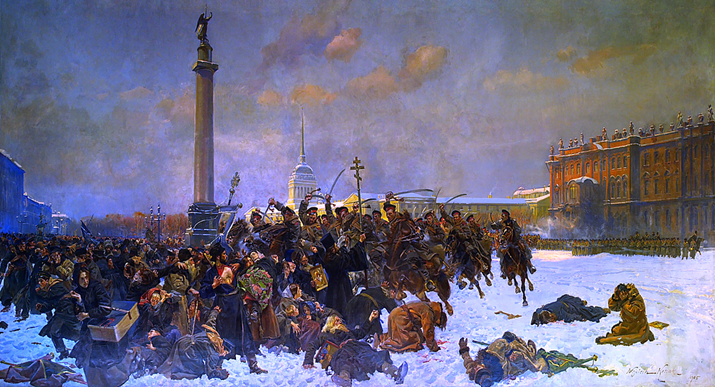
To try to demonstrate this and to redress concealment of 1917’s marvelous gust of deliverance, here, I draw attention to another major, but infamous, date in Russian history: January 22, 2024 (Gregorian calendar), is the 119th Anniversary of ‘Bloody Sunday,’ or the ‘Winter Palace Massacre.’ On that date in 1905, throngs of Czar Nicholas’ loyal, loving subjects, suffering privations in the aftermath of Russia’s recent disastrous defeat in the war with Japan – largely the result of military fecklessness and endemic official mismanagement – approached the Palace (at the right of this image, with troops with smoking guns before it; now the Hermitage Museum). They wished to present a petition to the Czar, asking him as their supreme ruler and ‘Little Father’, to redress the many grievances of their condition, and trusting him to do so.
(In fact by this time, the Imperial family did not actually reside in the Winter Palace in the then-capital, Saint Petersburg. They lived at a huge villa on the outskirts of the city, and so were not in the Palace that day. But the general public was unaware of this.)
The crowd of petitioners entered the vast open space in front of the Palace, singing ‘God Save the Czar,’ and carrying Holy Orthodox Icons, to affirm that they were not rebels, but loyal subjects with faith that their Emperor would help them if only he knew the depths of their suffering.
Instead, through a baleful brew of ineptitude, miscommunication, panic and a default to over-reactive repression, Imperial troops in front of the Palace opened fire on the peaceful crowd, followed by the charge of sabre-wielding Cossacks shown here. The number of ‘loyal subjects’ killed – shot, hacked, or trampled to death by the horses or terrified people – has never been definitively established. But it was surely in the dozens, possibly the hundreds.
So this date in 2025 will mark 120 years since ‘Bloody Sunday,’ a pivotal catalyst for setting off the abortive 1905 Revolution in Russia, born of seething discontent from the recent military humiliation, and causing many other long-stifled resentments to finally boil over. This recourse – seemingly by reflex – to hideous violence more compatible with Asian Despotism than European governance, showed how the Czarist system was unable, or unwilling, to redress even respectfully presented wrongs. The shock and terror those patriotic petitioners must have felt as their adored Emperor’s henchmen set upon them fearsomely as they came, singing for God to protect him and meekly seeking his help, must have been unimaginable.
One might never recover from such disillusionment; indeed, a whole nation might not. Bloody Sunday was by no means the first, or only time the Czarist government had used excessive force, but this showed unmistakably what it was capable of. The unique savagery of this bloodbath helped rend any semblance of a social contract between ruled and rulers forever; ever after, it had to be assumed that the state’s potential reaction to voicing ‘wrongs,’ even glaring ones, might well be ghastly, murderous brutality.
The Imperial regime deserved no benefit of the doubt that it regarded, dismissively, the ruled as slaves in need of iron discipline. This realization festered, thereafter, in the national consciousness. The upheavals of 1905 didn’t bring down the Romanovs – it would take a later, far greater war to accomplish that. And outrage then forced some grudging, semi-effectual political reforms. But the masses’ recognition that their Emperor and his government had contempt for their best interests which it was willing to express in blood, though slow to grow, was irreversible. Is it really any surprise that an abominable deed like the Winter Palace Massacre might ultimately help lead to regime-changing rebellion?
However much the current ‘regime’ tries to downplay such scenarios? So, because the rulers of Russia in 2017 (and today) tried to hide the implications of 1917 from a public that would have benefited from the freedom it should have led to, I point out Bloody Sunday, 12 years earlier, one of the principle atrocities that made the downfall of the monarchy all but inevitable by 1917 (amid its irresponsible provocation and horrendous conduct of the Great War, World War I, then raging). Revolutions are never desirable, if only for the injustices that usually provoke them; but sometimes, they are necessary, when deep-rooted societal problems can be rectified no other way. Vested interests rarely compliantly move aside; they must usually be thrust aside.
The ‘bitter irony’ mentioned near the beginning is that the Putin Regime’s official silence about 1917 was a reverberation of the event several months after Nicholas’ downfall, the Communist Coup d’etat that seized power from the ineffectual interim government of Alexander Kerensky. For whereas the Fall of the Bastille to the workers of Paris is 1789 ultimately led to the right of common people in France and other Western societies to personal autonomy and a high degree of individual liberty, the Capture of the Winter Palace, serving as a headquarters for Kerensky, in Autumn 1917 (despite its heroic portrayal in later Soviet propaganda) effectively saw a Medieval expression of inflexible Autocratic monarchy rematerialize as an updated expression of the same forces.
Marxism, imposed by the Bolsheviks after 1917, was presented as a rational, deliberate redesign of society, following scientific principles. But as the development of the Soviet Union would show, especially at the nadir of Stalinist paranoia, inflexible devotees of Marxism could not accept that its many obvious failings could happen except due to sabotage or other malicious intent. Such had to be ruthlessly annihilated, so that the one, true doctrine of Worldwide Communist Revolution could triumph.
(Beware of anyone willing to drag humanity through Hell to supposedly bring it to Heaven, as Soviet Communism, with its patron Anti-Christ Stalin, postured. Validating their own fanaticism will usually be their actual priority, whether they realize it or not. )
I have elided a good deal of nuance and detail here for relative brevity’s sake (such as the rumored presence of Marxist provocateurs in the crowd in 1905 at the Winter Palace), but do not want to portray this hugely complex dynamic as some black and white assertion of the inherent malevolence or inferiority of Russian culture. That would be simplistic, and besides: There is far too much counter-evidence of what the Russian people can do at their best, and what they fully deserve (as my previous posts have asserted).
Like the Tienanmmen Square Massacre in China in 1989, regime crimes of the magnitude of Bloody Sunday simply do not – Cannot – happen in places where government is assumed to exist as the public’s servant and protector, not its enemy and exploiter, willing to use its legal monopoly on lethal force to protect its own interests and survival, as well as those of some ruling class. Repression of this scale and savagery could only happen in states that ‘make peaceful reformation impossible,’ like ‘Communist’ China, theocratic Iran, Crime-Family run North Korea, etc.
And possibly including Vladimir Putin’s Russia too, trying to destroy memory and opposition. Nicholas II was not personally guilty of the Massacre, but he personified a sclerotic regime that had no mechanism for peaceful redress or transition. Any regime that had such would never have implemented, even by incompetent happenstance, a Bloody Sunday; or needed to. Such a tragedy – outside the very gates of a locus of national pride, values and dignity – was only going to happen where the will of the governed is considered an impudent nuisance by a hostile authority, whose main objective is self-preservation.
In a followup essay, I will explain why this anniversary is not just a gruesome curiosity, but how the cultural forces it represented – including the suppression of the memory of the full 1917 Revolution it precursed – still reverberate today, but now may play a far greater role in the peace and security of the world. A role that reflective people should be aware of – with considerable alarm.
The Soviet Union, and Soviet outlook of most of Russia’s current rulers is not dignified with the jeweled regalia, Court apparatus or semi-divine status of the Czars. However, their lethargy in the public welfare, primacy of self-interest, tolerance for corruption in exchange for loyalty, and bull-ox-like reaction to unwelcome stimuli (attributes that Hitler said proved Russians were ‘subhuman; on that basis alone, one might assume Russians would avoid such behavior) seems to still be stubbornly present.
A recent New York Times article about Russian politics said that in the past, when life in their environment of frozen steppes was so hard, rights for individuals were viewed negatively, as possibly coming at the expense of collective security. That may have been appropriate when there were literally wolves at the gates, needing surveillance taken in turn, but today, this vast nation will never be ‘modern’ till it grasps that this outlook has long outlived its usefulness.
And so has the premise that a good ruler must be ruthless enough to crush any obstacle or opposition; and that any ruler who does so is, by definition, ‘good.’ No regime that treats its people like this will, in the long run, survive, or deserve to do so.
So let the countdown begin, January 22, 2025 will be 120 years since Bloody Sunday, but its spirits continue to lurk, unrepentant and aggressive, in the Kremlin. Mr. Putin might shy away from the visuals of using sabre-wielding Cossacks and Army rifles to attack peaceful protestors against the war in Ukraine, but he has certainly shown willingness to use force against any brave souls who have demonstrated, rather than allowing them to do so peacefully. And there is little doubt he’d be willing, if he felt trapped, to kill such protestors just as he has tried to murder the memory of the Glorious Revolution of 1917. But his power – unlike the Czars’ – makes his mindset a potential menace for the whole planet, not just for his own people.
This is dedicated to my best friend, Joe Piszczor, who died November 21, 2023. Physician and musician, his kindness, humor and wisdom ‘disbursed the gloomy clouds of night’ for me, more than once.
Please bear with me, as I labor to elicit in words inferences that are beyond facile verbal expression:
I try to accompany my posts for Christmas with music; generally something composed for the Season. But this time, I hope to address the jubilant premise of the event – benevolent Divinity coming into the world as love and hope incarnate – with music not written for the occasion, but whose ineffable beauty is parallel, in scope, to that premise.
Below is a performance of Bach’s crystalline Gavotte en Rondeau – a dance rhythm – from his Third Violin Partita, which I perceive as a melodic complement to the spirit of Christmas as respite against the sorrows and troubles of life as we so often experience it. Those can engulf hope like a chasm from whose dark clutches not even light can escape, but opposing such a suffocating vision, the Gavotte’s delight, merry yet arresting, conveys resurgent joy as did the promise of Christ’s coming. This music erupts with grace which we may reflect back, to illuminate the dark recesses we must face.
Including whatever hardship, or cross, each of us bears in their own lives, for Bach’s genius here shows how there is light beyond any darkness. Like the outlandish presentation of Jesus as hope beyond hope and joy beyond joy, the Gavotte offers something to displace the transient fray of our mortal spans: Impossible beauty. ‘Impossible,’ yet there it is, an echo of Paradise, beckoning us to yield to its intimations.
The hardest thing to believe about Christmas may be its aspect that squares least with our lived reality: Too often, compelling evidence is that Life is a blind, callous juggernaut in which savage beings and indifferent Nature prey on vulnerable flesh, and for many if not most of us, the best we can plausibly hope for is to avoid too much suffering before it ends in our being obliterated; each and all.
On the contrary, Christmas asserts, in the same way Bach’s ecstatic Gavotte does, that there is such positivity – grace – to be found in our world as to offset all the evil, sorrow and misfortune that confront us daily and perpetually. That the world and Existence itself are fundamentally ‘good’ phenomena, wherein the value and justification of the Self, as part of a splendid and greater Whole, may be found and fully revealed.
For most of us, that proposition seems even more personally counterfactual than the Christmas story’s deviations from our world’s ordinary processes. We may focus too much on its unlikely dogma and details; divine incarnation, virgin birth, debatable timeline, etc., rather than on its radically extra-intuitive aspect. The import of that story should be taken deeply seriously, but not necessarily literally.
For it is not invariably necessary to believe that something is literally, factually true, in every detail, in order to place faith in it. Such an assertion cannot cure cancer, find us a life partner, secure us a career, etc. But ‘faith’ and hope in the presence and power of things forever beyond our grasp can center us, giving us space to believe that our time on this Earth is not at the mercy of that fearsome ‘juggernaut’ alone, and that our lives have intrinsic meaning and value that are otherwise not apparent. They are parts of the on-going, wondrous dynamic of an interconnected, interdependent Creation, vibrant with the Gavotte’s irrepressible energy.
Opening ourselves to such reflections can help us endure when the struggles of life seem unendurable. Bach was a devout Christian, but though he presumably didn’t compose this piece with any specific religious intent, I invoke it now because it conveys a vaulting sensation brimming with the same ardent bliss as the promise of love being born, personified, into the human realm. That – like this lucent, infectious melody – offers us a means to outrace shadows which seemingly must overtake us all eventually.
This was surely not Bach’s intention for the exquisite Gavotte, but he might have approved my depiction of his inspiration this way. It is three minutes of all-encompassing loveliness which, structured as theme and variations, allegorizes Eternity: An enduring essence, endless change, yet unfailing renewal. This compact marvel supports my notion that the hardest thing for us to accept about the story of Jesus’ birth may not be its factual unlikeliness, but its underlying murmur: life is essentially good, a medium for contentment and happiness, just as valid as the dispiriting, omnipresent evidence of its sorrow and misfortunes.
One of my routine objections to an exclusively rational perception of life is that its mechanisms are not its actual meaning. They explain how life happens and continues, but not what it is for. Its ‘meaning’ must be something grander than our transient ‘Selves’ – though not grander than ‘Ourselves’ – in which we can place hope, and extract gladness. We tend to give the mechanisms preponderance because they are things our minds can grasp to the point of quantification; hugely useful – but must they be the entire reality? Why must we infer that such transcendent loveliness as the Gavotte can be nothing but the result of pulsating brain tissue and firing nerve endings? If it can, then it is not so much splendid, dynamic ‘Life’ as a mere haphazard, meaningless alchemy of anatomical gadgetry.
Arguably more important, even if that mechanistic interpretation were accurate, how wise would it be for us to embrace such an outlook, exclusively? Through this music, we can be revealed, to ourselves, to be far more than mere devices for Self-preservation; we can resonate to an energy that can deliver our own existences from the apparent pointlessness that mortality intones.
As Jesus did, by Christian doctrine, in the eventual consummation of Easter: Love made flesh, love of the Other that may transcend Death itself. I realize this observation may seem insensitive, even ludicrous to those whose lives have been laden with true hardship or riven with real tragedy. But artistry like Bach’s may enable human constraints – even human suffering – to dissolve and merge with splendor that is usually inaccessible, a summit that, theoretically, should be beyond our vision, let alone, our reach.
Yet here it is, manifest through the near-miraculous ingenuity of a supremely great artist. Listen to this music again, let it suffuse you and reflect on whether ‘Divinity,’ however defined, can only be an irrelevant anachronism, as suggested by the barren seductions of rational comprehension alone. It intimates, at the very least, some superhuman presence and intent. Let it flow through you, and you too may feel that humanity is worth saving; even suffering for. If we are all indirectly stained by evil, like Stalin’s, can we not also be indirectly validated by the glories summoned by Bach?
All credit to Bach as the diligent instrument, but such expressiveness is only possible by surpassing ordinary human constraints. Personal talent and industry alone can hardly explain grandeur at this level; it is a reflection – an exposure – of the force of Creation itself. Personally I cannot hear this multi-faceted effusion of shimmering loveliness and exclude the possibility of a tender deity, hinting to us of its presence (if not its consistent intervention), only because it doesn’t seem to comport with the rest of perceptible, measurable, predictable reality.
It may not be proof, but surely, it is credible evidence.
The premise of Christmas is not proof either, yet we should let ourselves wonder if a plain of being in which such sublimity could be generated and contained could be, in the final analysis, merely a venue of ugliness and misery. Utmost creativity, like Bach’s, are sparkling, standalone expressions of the glory – expressed here as artistry, but for all of us, accessible as love for the Other – that may manifest when the potential of the human spirit is fully invoked, and then exceeded. It reminds us, with galvanic iridescence, how our Nature may have heights we so rarely get to sense that we may understandably despair of their even existing. Like thin air at high altitudes, where we cannot function as we ordinarily do.
Protecting and enhancing our physical well-being is one of our intellect’s main tasks, but it is a false sense of empowerment to believe intellect can have no worthy purpose but to untangle the operations of the world around us. This music conveys the resurgent joy I allow myself to feel (with no endorphin frisson) – not to ‘understand’ but to feel – that there is a positive Creative Force with affection and purpose for me, as for every one of us. A Force replete enough with Agapé to summon the Universe from a meaningless vacuum, and even to cyclically rescue its only conscious beings – us – from ourselves.
The very existence of art like this suggests that premise cannot be dismissed out of hand. To me, the Gavotte echoes that sense, lifting me out of my self-regard and into a dimension immaculate of the concerns of this one. Granted, such a sense cannot be defined by logic, but perhaps that suggests that not all in Life that is valuable to discover and experience can be ‘defined by logic.’ Perhaps so many of us respond to this work because it satisfies a void within us we may not even have been conscious or mindful of, till we feel it being filled by some burst of joy. Of which Bach’s inspiration is but one awesome example.
The random scattering of talents, even at the level of Bach’s, among us – just as genetic burdens are also randomly scattered – implies, to me, that our promise as a species lies as much in our each being parts of the great human enterprise, as in our individuality. It is only ‘we,’ not ‘I,’ who may plausibly go on forever, and there may be comfort in accepting such continuity. Most of us will not leave expressions like Bach’s – or like any other epic personality – to mark our lives for posterity to recall; but any of us may be able to contribute to the life-giving love that Jesus embodied, that unfolding, elemental ‘force of Creation itself.’
Thus, if you ever need hope beyond what it is rational to believe, this dance of exultation will be there for you, inviting you to join it, bounding over the sordidness of life around you. Or of super-rational hope, like the premise that Love may, in the ways that matter most to us all, ‘overcome’ Death by furthering the positive energy of the Universe – that is, the presence of love within it – an energy we may recognize as more powerful and actualizing than the presumed finality of non-being.
The opportunistic Russian invasion of Ukraine offers many reasons for pessimism about human affairs, but I would note the hopeful implications of how the tyrants’ main tools – cruelty, ruthlessness and repression, so long and often the ultimate deciders of ‘human affairs’ – are failing to win that struggle.
Russia’s attack might not have gone disastrously had capable managers executed it, but Putin’s regime regularly precludes ‘capable managers,’ as rulers like him dare not empower anyone clearly able to take over from them (this applies especially to military personnel, but Putin also pads upper ranks of the civilian administration with those dependent on his favor). So his dilemma is that what he demands most from subordinates is loyalty, but what he needs most to conquer valiant, resourceful Ukraine is competence. Faced with this choice, Putin has prioritized loyalty, and a ghastly battlefield impasse is the result.
However: The Russians’ bungling may have greater repercussions than just thwarting their own criminal assault (vital though its failure is). Might Putin’s shambolic conduct of his aggression manifest that modernity – increasingly reliant on subtle comprehension, planning, regulation, etc. – has passed a ‘point of no regression’? A threshold beyond which even a semblance of a modern state (like Putin’s kleptocracy) can no longer be kept functional with primordial methods like ‘cruelty, ruthlessness and repression?’
The uniformed bandits Putin entrusted with his ‘Special Military Operation’ are evidently deficient in the temperament and brains to handle the intricacies of 21st century warfare strategy, logistics, etc. Many of them presumably rose in rank due to willingness to implement his orders fiercely and without question, in return for being allowed to commit near-limitless thievery.
So is it really a surprise that tragicomic failure results from a culture in which loyalty precedes ability, corruption starts at the top, cascades down from the extravagant Black Sea villa ‘Putin-hof’, past layers of larcenous Apparatchiki, to ordinary soldiers (for example) rendering military vehicles useless by stripping out their copper wire to buy vodka with the proceeds of reselling it? Is it a shock that such a culture cannot just roll over well-organized, adept patriots like the resolute (NATO armed/trained) Ukrainians?
Thus, this bully-writ-large undertaking may have a positive side, if it exposes that despotism does not – cannot – deliver effective governance in the modern world. That a mentality of rule that comes from the Dark Ages cannot ‘keep the lights on’; that what worked for Ivan the Terrible does not succeed in the era of the Terabyte.
Of course, pitiless use of force was the habitual standard for rule everywhere, including in the West, till the mid-18th Century (for example, the Battle of Culloden, and subsequent repression in Scotland). But whereas much of the developed (modern, functional) world has long since progressed beyond such preliterate impulses, the Russians – acting as if the savagery of their barbaric medieval occupation by the Mongols is still a proper standard for behavior and leadership – evidently have not. Or at least, not nearly enough.
But such cannot remain the standard. Life’s complexity is getting deeper, the Kremlin dinosaurs are in way over their heads, and are lashing out in bewildered frustration at a world in which moderation, not their reflex primal resort to raw power, is likelier to avail. So the ludicrous course of the invasion may represent a little-remarked, but vital evolutionary step for humanity beyond the domination of those (like Vlad the Impeder) who would keep us unevolved and pliable forever.
If they can; and if the rest of us let them. Please bear this perspective in mind in terms of the interests of the civilized world in providing aid to Ukraine till it vanquishes Putin and the Jungle Law he personifies. This would be truly elemental progress, and we need to keep up its momentum.
Ukrainian victory is still far from certain, but their survival for this long in the face of a vastly larger and remorselessly cruel foe, suggests that the Putins of the world have not got (and cannot grasp) what it takes to operate a nation state that meets 21st century expectations. If their main goal is regime survival and blunt force is their go-to tactic to ensure it, its failure to prevail in Ukraine, and the resulting domestic disruption, may prove that such an approach will never again be a reliable means to run a country (especially one with grandiose ambitions) in today’s world.
Russian Goliath still has a club, but Ukrainian David has ditched his sling for a mace-spewing drone. Not that advanced warfare methodology can’t be used for offense as well as defense, but one may hope that the primal instinct that the strong can, and therefore should, tyrannize the less strong may start to wither, along with the efficacy of cruder means of doing so. ‘Evolutionary,’ in that both that instinct and means are more suitable for beasts than for an advancing Mankind.
By contrast to the mindset of Kremlin creatures, perhaps those ‘elites’ in the (especially, and mostly Western) business world who can truly command 21st Century technology and organization will eventually prove to the rest of us that they are sophisticated enough to recognize that the finest use of their talents would be to transcend the immemorial Alpha wolves of the world. That they may show wisdom – even greatness? – by realizing the worthiest rewards must come from using their gifts to benefit Mankind, as much as themselves; or more.
Will they? Time will tell; but the palisade of slender ultra-luxury ‘Money-Liths,’ residential towers on New York’s Billionaires’ Row – visible from areas of seething poverty further north – suggests this group has not yet grasped, or cares, that they may have it in their power to substantially improve the material human condition as few people have ever had. Especially if they decide to rise above the coarser reflex to pamper and exalt themselves as indulgently as gods; a deed higher than any super-tall skyscraper, that.
We may hope they will recognize and act on that realization, but in the meantime, at least the Putin-derthals are revealing their own possible obsolescence. And such – that is, great physical (especially, male upper-body) strength and savagery no longer translating to keys to overall dominance – would not be mere transition, but true transformation.
As to Putin’s invasion, I pray Ukraine stays free, but even if it doesn’t, the world has seen how the ferocity he and his accomplices assumed would quickly overwhelm its supposed decadent Westernizing weakness did so only at enormous costs, with humiliating setbacks and irreversible damage to Russia’s economy. The latter includes eviscerating her fossil fuel market, and driving out legions of citizens with the skills most needed by a modern society (including those smart enough not to want to be cannon-fodder for megalomaniac Kleptocrats).
Far better that Russian military might and barbarity fail conclusively and comprehensively, but the fact that these have been so much less effective than initially assumed may reflect a fundamental shift, in which the needs of modernity – on which those financial and technology elites of Billionaires Row and beyond depend for their comfort and plutocratic sway – are irreconcilable with the primeval supremacy of brute force. If no other good comes from all the barbarous tactics of this invasion, perhaps at least their patent ineffectiveness will contribute to their gradual invalidation and eventual disappearance.
Finally, lest anyone suspect that I am simply anti-Russia, let me show my respect and admiration for her common folk by offering the accompanying video of a Saint Petersburg ballerina performing exquisitely, as evidence of what Russians are capable of, rather than being the biped cattle the Nazis considered them (and as Putin still treats them).
The story behind the video strikes me as characteristically Russian; this artist is dancing, en pointe, on a frozen lake at 5 degrees F, as an ecological protest (as explained in the narration; I don’t know if she succeeded, but hope so). It may not be ‘heroic’ per se, and few Russians could or would do this, but this spectacle nevertheless seems like something that would rarely, if ever, happen anyplace else.
And if a people among whom such talent, grace and strength – seemingly as elemental as their overlords’ cynicism – are to be found, finally realize they don’t have to let their leaders treat them like disposable beasts of burden (the fault line between modern ‘citizens’ and feudal ‘subjects’) forever, they might enact extreme retribution on Putin. Perhaps involving his bodily orifices and Stalin’s disinterred bones, wielded by mothers of Russian soldiers lost to his dictatorial delusions.
Such would be vicious behavior, but a cathartic response to ages of equally vicious oppression. Putin is this great, though tragic, land’s latest protagonist of that kind of rule, but perhaps he will be its last. If ordinary Russians finally reject and destroy the foul apparatus he wields, they would prove they possess tough nobility and truly inherent splendor, as this video suggests.
Ironically, the opposite of the chauvinist ‘glory’ Putin envisages for their Motherland.
Not long ago, a man was shot to death late at night on a street not far from my home. It was evidently a random drive-by attack, and the killer did not know his victim (neither did I). It was an outrage and a tragedy, a grim undercurrent to the usual vibrancy and livability of my thriving urban neighborhood.
But a deed came of it which struck me, at least, as of surpassing beauty.
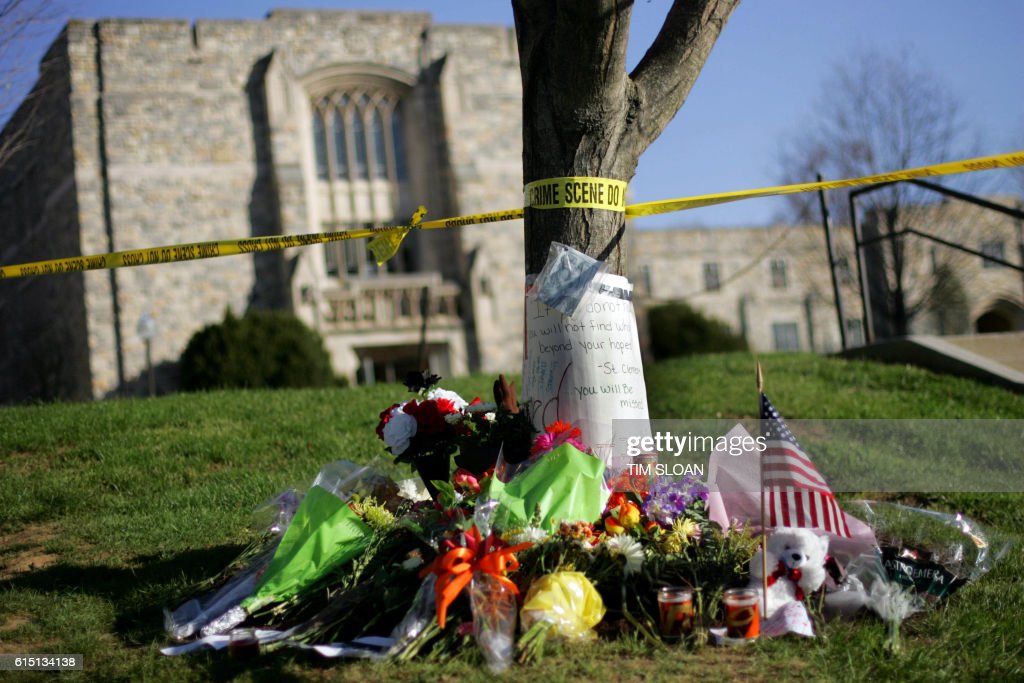
A couple days after this happened, I walked by the crime site. A spontaneous memorial had gone up, flowers from friends of the dead man, or empathic strangers aghast at his horrific fate. That seemed a very decent, proper response to the taking of the life of a relatively young person.
Next to the memorial, the victim’s brother had taped a note on the sidewalk thanking all who left expressions of sympathy, assuring how deeply these were appreciated, and that any flowers would be donated to a local nursing home in the dead man’s memory. It was eloquent in its succinct simplicity.
But to me, that lowly sheet of paper seemed a towering testament to nobility of heart. When first reading it, I could barely believe my eyes, for it amazed me that, in the depths of sorrow that brother was presumably enduring, he thought of decorum and gratitude. Many of us would have been immobilized with rage at such heartbreaking loss, such an unexpected mutilation of our lives. Yet here was this grieving man, acting out worthy attributes, prompted by despicable heartlessness.
‘Astounding grace’ indeed.
His words were moving, in more than one sense, for they can help drive away resignation to the brutality of this world, serving as evidence that ‘Humanity’ is not just a breeding swamp for callous cruelty. It can encompass gestures like that note, affirming we have it in us to be more than biped beasts. Some of us, even in extremity, can summon dignity – grace – as this brother did, when it may seem unimaginable to do so. It may be argued that he validated Humanity as much as the killer profaned it.
Respecting the mourning family’s privacy, I post the accompanying photo (instead of the actual site) of another memorial to victims of U.S. gun violence. There were quite a few online from which to choose, which itself is a depressing commentary on our culture. Many might see that as another reason to yield to cynicism, to protect one’s life from danger. And one’s heart from disappointment.
But I counter that this brother’s exquisite dignity and moderation under potentially engulfing distress are grounds to cling to faith that our better angels, rather than our falling ones, may ultimately prevail. Even if ‘ultimately prevail’ just means realizing that reflexive despair shuts out a force – Hope – that can make life worthwhile and sustainable, as much as breathing does.
Cynicism, presupposing the worst so as to avoid disappointment, is sometimes presented as mature realism. But cynicism is a suit of armor apt to eventually crush the soul of whoever chooses to wear it. Resisting it, and its cousin despair, is – like writing and taping that gentle memorandum onto the very concrete that may have been spattered with his brother’s blood – an act of will; a choice.
I grieve for these strangers, and hope the Police solve this crime, even while heartened it evoked such a stately response. It was a modest deed with vast implications, for if there is condemnation of our species in that killer’s crime, may there not also be affirmation for us in that brother’s decorous words? This dichotomy reflects the scope of the human spirit: within a single Being, we can be selfish, indifferent, profound and soaring. Such is our species; and often, if we look closely, perhaps our selves, also.
We are at our best when we can, and do, summon whatever resources we may need to rise above our lowest impulses. So I propose there may be ‘hope’ for us all, in that even one of us can respond as this brother did.
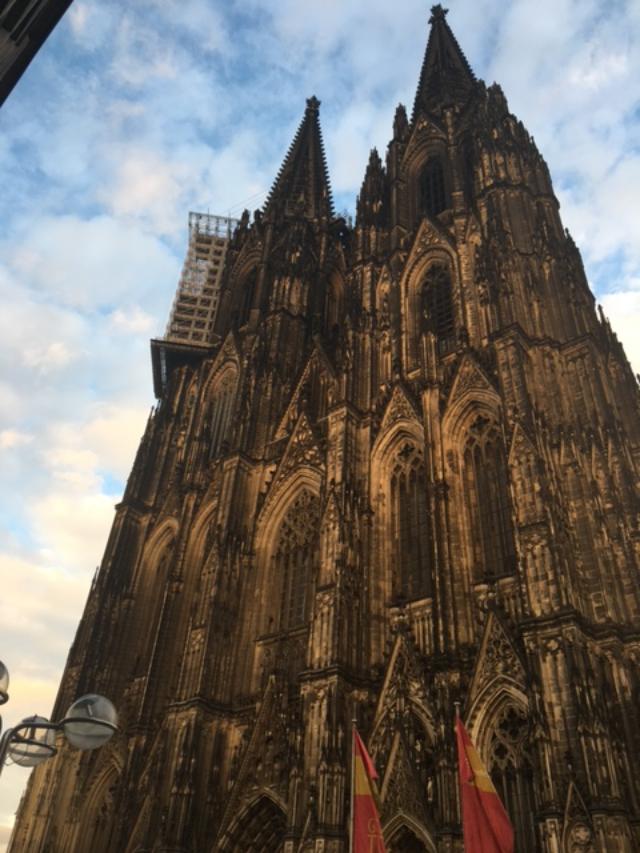
These colossal spires, more than 500 feet tall, were in the original plans for the cathedral. As noted in prior reposts, part of those were rediscovered some 300 years after construction had been halted, leaving the church obviously, and clumsily, curtailed.
Whether it is a trick of the light or a variation in the type of stone, the towers almost seem luminescent in this picture, with the same evocative glow that appeared in my previous repost (July 16, 2022) of a sunset image of this building from the side. To me, here they suggest natural rock formations, rather than purely human labor. This sheen makes them look as much a part of the Earth – not merely on it – as sandstone pinnacles in America’s western deserts. There is an elevator leading to the roof of the Dom, but I didn’t use it, preferring to experience it at ground level, as it was principally meant to be seen; like this view.
The cathedral is, overall, resolutely Gothic, whereas buildings begun as long ago as it was often accrue embellishments from various eras through which they exist. Thus the great delay in completing the Kolner Dom likely ensured its final stylistic uniformity. Unlike many cathedrals completed in the same era they were begun, this one was spared much of the adulteration inflicted on fully Medieval ones, with Renaissance, Baroque or Rococo decor getting slapped over the original fabric. When Cologne cathedral was being finished in the mid-19th Century, no one wanted it to look anything but Gothic; and so it does, with very few exceptions.
The Dom is now the most heavily tourist-visited site in Germany; most people entering it now probably do so mainly as just another place of historic-artistic interest. And it certainly is that, but its formidable physical and extra-physical presences still present a setting in which contemplation may flourish, a sort of gravitational pull to which many so-disposed visitors surely find themselves responding.
Even in its long unfinished and ungainly state, the Dom was for generations a site of continental pilgrimage, owing to the supposed presence within it of the bones of the Three Kings, the Magi, men who attended the infancy of Christ. So each time I entered it, I reflected upon what Medieval folk – who never saw it complete, could only imagine its full, intended magnificence – might have hoped their journey here might grant them. And on what its tacit evocation of the tension between Eternity and human mortality may still offer us today; it was meant to summon and facilitate such meditation, and can continue to do so.
It is no coincidence that the English words ‘respire’ (breathe), ‘inspire’ and ‘aspire’ share the common root of the Latin, ‘spiritus,’ or spirit. In each case – including the process of breathing in and out – the very force of life itself is implied. ‘Respire’ means the constant cycling of that spirit, ‘inspire’ is the height and depth of expression it may generate, and ‘aspire’ refers to its fondest goals. So an inrush of breath elicited in a place like the Kolner Dom may also hearken to inspiration and aspiration.
Like all man-made spaces emblematic of faith that there is something to our ‘Being’ beyond the chaotic vale of tears we observe daily – even amid the assuaging technology of the 21st century – this church faces the issue of whether human life is irrelevant to an impassive cosmos, or has true and vital purpose. The Dom, like the ideals that brought it forth – joyously as the Three Kings kneeling at the manger – both proposes, and evinces, that it can.
That question takes different forms in different cultures, but its widespread preoccupation suggests it is an entirely natural human inclination, which we rightly use our Reason – as well as the other faculties that make us human – to explore. Animals fear danger and pain, but presumably do not contemplate mortality; our ability to do so may, of itself, alter our relationship to it. There may be some aspect of each of us as eternal as those great sandstone pinnacles in the desert; but unlike them, we can – should? – muse upon that possibility.
A RELEVANT DIGRESSION: Before discussing this image, a restatement about my priorities:
As a self-identified historian, I am attracted to ‘grand’ themes, which often animate my posts for this blog. I fear this may sometimes seem pretentious (or grandiloquent), but please bear in mind the scope and gravity of some of my topics.
For example, many of my posts target Nazism, not just for its abominable crimes, but in shuddering revulsion at one of its root philosophies: It avidly asserted that human beings should adopt the kill-or-be-killed behavior of wild animals, claiming that Nature teaches that only the strong survive and that they have the right to prey on the weak – and Aryan Germans, of course, were ‘strong.’ This premise was not just the private fantasy of Nazi fanatics; it became state doctrine, part of schools’ curricula, and was promoted in official propaganda.
Far from encouraging rising above our bestial impulses as Western civilization had long done, Nazism treated imperatives, embedded in both Judeo-Christian ethics and Humanism, for compassion, empathy, moderation etc., as foul weaknesses to be replaced with nobler qualities; like lethal vainglory, utter ferocity and ruthless self-interest. The Law of the Jungle, Enthroned.
My tirades – jeremiads – about Hitler et al are not pretentious, in that my outrage is no pretense; I am deadly serious about the peril that he and his message of Satanic intemperance were, and still are. So I try to write urgent, bitter lessons of how monstrous phenomena like his worldview can seize control of human affairs.
If my words sometimes seem overheated, it is because I feel Hitlerism (or any win-no-matter-how mindset) remains a danger, and demands exposure as extreme as its potential harm and inherent depravity. And if believing we should follow the example of vicious, mindless animals isn’t depraved, I dare not imagine what is.
I understand most people are absorbed in the challenges of their own lives and cannot dwell on abstract menaces beyond them. But reminding, and warning about these, then become the tasks of people like me, who seem more inclined to brood upon ‘abstract menaces.’
For we should not assume that Hitlerism, or anything akin to it, could never ‘seize control of human affairs’ again. In my view, every time anyone today doesn’t recognize (or care about) the dangers of glorifying triumph, criminal pride and callousness, if those serve their personal interests, they are blowing life onto the smoldering embers of the Nazi enterprise: Exalting in aggression more fit for brutes than for men and women.
And thus, they help keep that mindset abroad, like an evil spirit.Anyone – not just mad tyrants, but Wall Street wolves, law-scorning managers, salesmen pushing unsafe used cars for commissions, etc. – who believes it is a winner’s virtue to ignore all rules in order to win (or to not lose) is effectively a spiritual heir to Adolf Hitler. Whether they recognize/admit it, or not; if not his willing accomplices, his negligent accessories.
(I exclude those who bend rules in desperation just to survive, while regretting they must do so. I condemn only those who do so to flourish, perversely proud of their lack of conscience.Nor do I suggest that every instance, from mad tyrant to shifty used-car salesman, is equivalent. Some obviously cause far more damage than others, but no such deed is ‘harmless,’ because it helps perpetuate a loathsome attitude.)
So while some of my fellow Americans might be aghast if I claim there is similarity between the ravings of a psychotic dictator and our culture’s near deification of business success, to me, ‘Sieg, Heil’ (Victory, Hail) and our football motto, ‘Winning isn’t everything; it’s the Only thing,’ feel far too close for comfort, in spirit. It is not a huge stretch from that motto, writ large, to the Nazi belief that nothing matters but prevailing, by any means whatsoever. And thus, there are revered predators all over our economy: ‘Victory, Hail!’
The sentiment beneath, ‘Winning – is the only thing’ may not be a roaring fire, but it whiffs of those ‘smoldering embers.’ It would be better if those were smothered once and for all, rather than being revived/recycled by every soulless lout who can conceive of no reason to care about any welfare but his own. And who may even expect to be honored for doing so.
I don’t imagine that self-interest will miraculously vanish, nor should it. Properly used, it is natural, rightful, and a force for improvement; and certainly, I have my own. But if it gets glorified as the highest possible aspiration, Nazism grimly demonstrated where it may lead.
I hope this helps explain why I keep harping on Nazism; I fear the spark of its outlook is still far from extinguished. I sometimes write and advocate about other matters, but never with such unapologetic fervor as for this one.
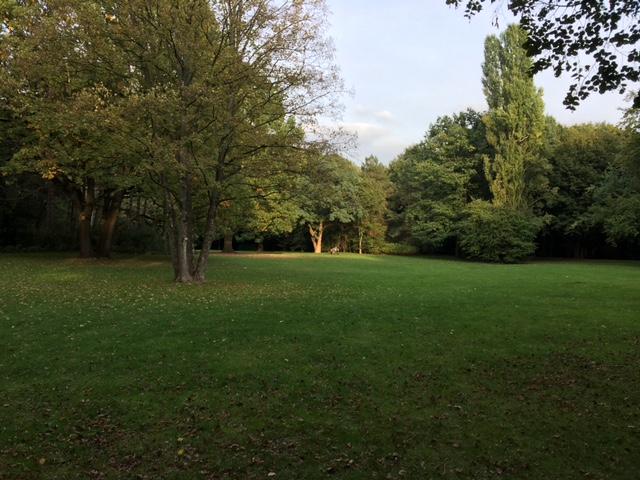
And now for this image of the Tiergarten park in Berlin, depicting a truly ‘grand theme’; the Edenic enfolding of Nature, offering better lessons about peace, vitality and continuity than any words of mine ever could.
Berlin’s main central green space is called the ‘Tiergarten,’ literally the ‘Beast Garden’ – also a commonly-used German word for a ‘Zoo.’ As often happens in cities that originated in eras that had formal ruling classes, this park was once a wooded hunting preserve of those rulers (here, the Electors of Brandenburg). They hunted “beasts” like stag, boar, etc., in this space, which still appears to be densely wooded, along with retaining its traditional name. We roamed around in the park, and I was surprised at how extensive the tree cover was. Unlike, say, carefully designed Central Park in Manhattan, other than the paved foot paths, the part of the Tiergarten we saw felt a great deal like untouched woodland. And that is probably deliberate; Germans still have an exceptional affinity to Nature, from their ancient heritage as a forest people. Thus, it must have felt appropriate to leave a great patch of woods in as close to their primal condition as possible, in the center of a vast urban mass like Berlin.
Many, if not all, of the trees shown here must be replants; most of the ones in this space previously were ruined or cut down, splintered when the Russians fought their way into town in 1945, or burned as fuel by Berliners during and after World War 2, when normal power service got bombed to a standstill.
Parks are meant to be places of tranquility and self-restoration – ‘re-creation’ – and the Tiergarten seemed to serve that purpose admirably. It has been replanted and revived as a soothing environment; somehow poignant, given the man-made calamities that once churned through it. Now the madness of men is displaced here by the reassuring constancy and resilience of Nature displaying its benevolence – which the Nazis disregarded in favor of their kill joyously-or-be killed interpretation of it, and which they sought to impose on humanity – reversing our evolutionary ascent to become masters of our passions. Rather than their slaves.
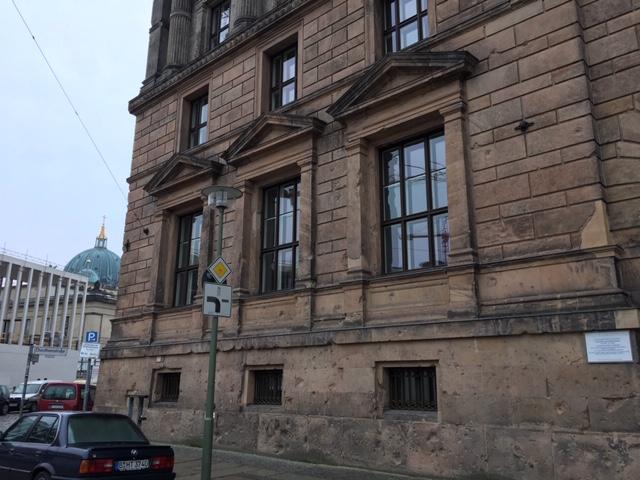
CONTEXT: The mass of blasted ruins in Berlin has long since been cleared away, but unsettling reminders of the city’s near annihilation in 1945still skulk on some of the few remaining pre-War buildings. This one, unmistakably marred with the scars of bombing and street warfare, was across the river from the Museum Island, where so many cultural treasures are located. The dome visible here is Berlin’s immense Protestant Cathedral, also on that island.
I photographed this image because its paradox seemed vividly compelling: evidence of human ferocity literally within sight of the fruit of human creativity: The assemblies of our collective genius on the Museum Island. Seeing the proximity of such glories to the ghastliness betokened by these wounded walls would later summon the verse below, ‘We Stones,’ out of me.
The very fact that we, as a species, are capable of such extreme opposites of behavior deserves – demands? – that we reflect on it, lest it ever take us unaware, again. As my verse asks – however clumsily – of us ‘men,’ and our recurrent appetite for raw dominance, ‘Can they not help but be so?’
When preparing to re-post this piece from my 2016 visit to Europe here, I discovered a revelatory irony: I didn’t know what this scarred building was when taking this photo. But when examining a satellite image of the vicinity to confirm the dome is the cathedral, I realized that this wall is near the Deutsches Historisches Musueum – the National Museum of German History (this structure itself seems to be part of the Haus Bastian, a Center for Cultural Education). So it may have been deliberately decided to leave this lacerated stonework ‘intact’ as very much a part of, and testament to, the gruesome chapter of Nazism (perhaps that’s what the sign on the wall at the right says, I didn’t notice). This would not only be consistent with the nearby Museum’s mission, but possibly a more instructive exhibition about ‘German History’ than any of the tidy displays within it.
One hopes that the adamant lesson about the horrendous potential peril of a feverish drive for ‘Mastery’ registers with Germans who happen to see these stones. In fact, with all who see them, wherever they come from.
And at an individual level, not just a nationality one.
We Stones –
Formed of magma in crushing heat, cooled over ages, our mother Earth slowly pushed us to her surface. For millennia, we formed her mantle and her mountainsides, only rarely reminded of the violence of our birth by earthquake, flood and lightning strike.
Then men shaped us with their clever tools, and bonded us together as shelter against the hostile Nature that made us all. For men, we resisted wind, cold, heat, rain, snow and storms, sheltering all within us in small worlds of survival.
But then men brought the violence of our birth back around us. Great, blasting flames fell day and night from the sky, till finally, humans making their own fire to destroy each other, surrounded, then reshaped us – once again.
Quiet returned, and with it our repose and inert witness. How can Men be so clever, yet also like the fierce, mindless Nature that formed us?
CONTEXT: I first put this piece online in late October 2022, prompted by dark Kremlin hints then of using nuclear weapons pre-emptively before Ukrainian ‘terrorists’ did so first. Now threats of escalation are coming from that quarter again, on the pretext that Russia – waxing indignant that what it routinely does to the neighbor it invaded might now be done to it – is being attacked by (alleged) Ukrainian drones. So far, this has been on a minuscule scale, compared to the Russian V2-like weapons unleashed on non-military targets in Kyiv, etc.
The sacrifice of many thousands of Russian troops so far in Putin’s Special Military Operation (which he assumed would be easy – as Hitler did, of his invasion of the USSR) should prove that he sees his own people as mere tools, expendable for greater goals. Like the goal of appeasing his own gross pride at the loss of lands and peoples from Russian control at the fall of the USSR. So it wouldn’t be a surprise if he was behind bombings in 1999 which killed mere dozens. Nor would it be implausible if the current drone strikes are actually engineered by his regime now, as an excuse to unleash more and greater violence on its innocent neighbor-victim.
However: a wise friend suggested that instead of focusing my fury on Putin (as I have elsewhere), I take the broader perspective of Prince Andrei in ‘War and Peace’: That is, we suppose Great Men, like Napoleon, ‘lead’ history, but in fact they really follow it, by embodying the spirit of their times. A fair observation; Putin is likely merely the point of a spear of pre-modernRussian culture, which continues to allow him and kindred scoundrels to slash their way to the top of society. A culture that assumes brute force and brutish self-interest will always prevail in the human world.
But Ukraine is frustrating that assumption. Its valor, combined with the efficiency of NATO military hardware, organizational advice, intelligence – that is, every advantage of societies whose people are free to reach and harness their full potential, not be mindless slaves of the ruthless and powerful – are helping to show that Dark Age attitudes like those of Russia’s past and present rulers are not apt to ‘prevail’ in modernity (again, as Hitler also learned).
A hidebound cynic like Putin can neither accept nor grasp that, so the Free World needs to keep demonstrating it till this Mongol-inspired Muscovy mindset is conclusively bested by humane, righteous rationality. If not stopped, Putin and the whole awful ‘spirit’ he currently personifies, may inflict, on their own Motherland, the very destruction they insist the West is trying to achieve. That is, cause the dissolution of the Russian nation. And that, given how many times Russians have shownsuch great gifts as a people – when allowed to – would be a tragedy not just for them, but for the world.
A chilling reminder of some grim history, possibly relevant again: Vladimir Putin eventually achieved absolute power in Russia, arising directly from the terror bombing of several apartment buildings in Moscow (shown in the picture above, with a separate, explanatory article) and other Russian cities in 1999. Those crimes were cast as the work of Chechen terrorists, during a combat lull between Russia and its rebellious breakaway Muslim province, Chechnya.
But this ghastly episode may echo today, in 2022, in Russian hints that Ukrainians are planning nuclear terrorism.
Putin, having back then been recently named successor to the tragicomic Russian President and buffoon-in-chief Boris Yeltsin, used those bombings – which collapsed mid-rise civilian residential buildings at night, killing scores of sleeping innocents – as a pretext to restart the war against Chechnya. That led to an orgy of atrocities on both sides, with a bloody, poisoned ‘peace’ eventually won by Moscow.
But it has long been suspected – almost assumed – that those bombings were carried out by the secret police with Putin’s permission, if not his outright instigation, intending to blame the Chechens. That would serve as a motive to reignite the war against them, while also showing Russians they needed a strong leader like him to protect them. And given how he then pulverized the slumbering Chechen insurgency, it seems the worldview of those who gain power in Russia cannot tolerate not crushing any foe to dust.
(And there goes that Russian rulers’ ‘tick’ again, of being just fine with sacrificing the lives of their common people – ‘little cogs,’ as Stalin called them – for a supposedly greater good; like their gaining, or staying in power.)
I don’t speak Russian, but almost wonder if the language even has a word for ‘credibility,’ the idea that one’s past actions entitle one to be believed or trusted – or not – or if that idea even exists in a Russian context. Because the official story of Chechen culpability for the 1999 bombings may be just one of a long, sordid history of barely plausible lies told by rulers at the Center of Russian power, the Kremlin. For example, in 1946, they asserted that, after the Red Army drove the Nazis out of Eastern European nations the Germans had overrun, those nations pleaded for the Soviets to stay – ‘to defend us from Capitalism.’ They were supposedly happy to go from German to Russian slavery; that’s about probable as it sounds.
Either the Kremlinites are so contemptuous of common folk (and not just in Russia) that they assume such drudges will believe whatever Authority tells them, no matter how transparently unlikely it seems – like Chechens supposedly believing wholesale massacre of innocent civilians might help win their freedom – or so cynical they don’t care whether their fabrications are convincing or not.
(The Nazis contrived a ‘false flag’ operation as a rationale for invading Poland in 1939, ‘Operation Canned Goods.’ They took some habitual criminals from German prisons, dressed them in Polish army uniforms, shot them, then left their bodies near a border radio transmitter as ‘proof’ of a Polish incursion into Germany – justifying the huge, long-planned Nazi attack on Poland a few hours later. Hitler had told his generals ‘I will provide a pretext for war; never mind if it is plausible or not.’ And so very possibly Putin too, with the Moscow bombings, then Chechen bloodbath; Vultures of a feather flock together, it seems.)
I raise this ancient history now because of the ominous news that the Russians – who are the ones acting like rampaging, school/mall/hospital/infrastructure-targeting Nazis, not the phantom Fascists whom Putin tells his credulous base he is attacking their peaceful neighbor to destroy – say Ukraine is preparing a dirty nuclear bomb to spew radioactivity on Russian troops; or to sabotage a vast nuclear plant on occupied Ukrainian land. So now if such things happen, he’ll blame them on Kyiv as an excuse for committing worse war crimes than he has already.
Putin appears to have drifted into a surreal state of detachment from reality, a delusional brew of irresponsible indifference to potential calamity. Apparently, in his megalomania, nothing matters more than that his criminally conceived, ill-planned, and ludicrously executed aggression should not fail miserably. And he may stop at nothing to avoid that humiliating outcome. Or at least make the world pay for his frustration.
This is the sort of outlook and behavior alluded to in my March, 2022 FB post, ‘A Sustaining Folly,’ which was partly about how I feel the Russian people deserve far better rulers than they have historically gotten. But it takes epic personal courage to defy vicious, officially-empowered criminals like Putin and his ilk, prone to over-react to any resistance like the savages they are.
As to the echo of the ’99 residential bombings in terms of use of nuclear arms, rarely in my life have I hoped more fervently to be wrong. But if Putin suddenly asserts that ‘The Ukrainians plan to commit Nuclear Terrorism,’ – so Moscow can respond in kind, or worse – please recall those bombed Muscovites, slaughtered in their sleep.
You heard it here first: Putin may replay a trick that worked for him before, assuming no one remembers or cares. But some of us do, and indeed, must.
To conclude, this situation reminds me of an observation I’ve long held about the difference between human intelligence and actual wisdom: A species with the wisdom to wield nuclear weapons would have had the wisdom never to have created them. So God help All of us, that such power – and I don’t just mean atomic weapons – has found its way into the hands of a man like Putin.


 All Things Gaul