For Easter Monday: Echoes of Resurrection

(This post was conceived, and largely composed, before the death of Pope Francis. Now I dedicate it to his memory, and to hopes his joyous proclamation of Christ’s meaning for Humanity may continue to ‘go forth and multiply.’)

This image shows Pope Francis kissing a man with a ghastly skin disease. I don’t know if this encounter was prearranged, or if Francis just spotted this poor soul in a crowd. Either way, he responded as Christ did with lepers, who were then shunned for fear of contagion, and prejudice that they were spiritually ‘unclean.’

Francis’ parallel act of surpassing kindness reverberates as an unaffected demonstration of what love beyond one’s Self may enable us to do. As here, when it likely required overcoming reflexive revulsion, and fear of possible contagion, to comfort a child of God who has likely often been ‘shunned.’

Our best deeds are often not our most rational ones, but a response like this to suffering is fitting for anyone who thinks it worthy to emulate Jesus. Especially for a successor to Saint Peter.

If this meeting was spontaneous, the Pope had to trust the man’s (presumable) assurance that his condition was not highly communicable. But in his role as ‘Vicar of Christ,’ he may have felt obliged – in fact, inspired – to follow Jesus’ example with outcasts. This is a breathtaking illustration of how care for the misery of a brother being – here, one who has surely endured much isolation – may enable us to set aside our sensibilities, and even our own safety.

Caring for another as oneself may be a joyful gift to give, simultaneously a denial of Self, and yet the Self’s finest affirmation. Here, we witness someone heavy laden, being reminded that he need not carry the cross he has been given to bear, alone.

In basic Christian belief, love enabled Jesus, the Christ, to physically transcend death itself. We ourselves cannot do that, but here we behold the transcending power of love in action. I cannot know if Jesus’ bodily Resurrection literally happened, but can have faith that its implications can change the World. That is a reality we may create, and by which we may be re-created; that is, made anew.

Francis could not miraculously cure this man, as Scripture asserts Jesus did on numerous occasions. But short of that, what might Jesus do in such a situation?

Surely, something like the gesture in this picture.

Music for Good Friday: ‘Sweet Cross’

Here is music from Bach’s ‘Saint Matthew Passion,’ his incandescent depiction of Christ’s somber death: ‘Komm Susses Kreuz’ – ‘Come, Sweet Cross.’

Its title may puzzle; how could a cross, an object of abysmal cruelty, be ‘sweet?’ But in Bach’s milieu, it also symbolized comfort, consolation and deliverance: For as Jesus endured His cross, He will help us withstand ours. Thus assisted, we may tremble less, to face our own tribulations.

Such seeming passivity may affront our inclination to problem-solve, rather than to withstand. But while human efforts have hugely improved life, none of us gets through it avoiding all fear, pain, sorrow etc. But that does not make life inherently futile, for as Bach intimates here, when we face adversity our own efforts cannot redress or soothe – yet facing such feels unbearable – we may avail ourselves of hope that resigned anguish need not be our only response to it.

Hope that Christ enrobes us with unfathomable love of which we are rarely conscious. It should be no disgrace to need help beyond what we (or the full genius of our species) are capable of, for the premise that all we really are is bustling sparks of carbon is more than most of us might want to accept with equanimity. Faith is willingness to grasp comfort, strength and hope in things than are not rational. Things like ‘unfathomable love.’

The aria’s lyrics ask of Jesus, ‘give your cross to me,’ offering to carry it for Him. This also suggests how ministering to others enriches us by transcending the limits of the Self. We often see evil in the world, but rarely unimaginable goodness, like Jesus’ sacrifice of Self, in every sense. How to respond to such? Bewilderment? Dismissive incredulity? Awed that it is even conceivable, and inspired to follow its example?

I chose this performance by Thomas Quasthof, who was deformed at birth by Thalidomide. As if in rare compensation, he was bestowed a fabulous voice which, as here, can do justice to Bach’s art. Still, if Quasthof curses God every day for his afflictions, I couldn’t blame him.

But in such resentment, as in his gift, he would personify an extreme example of the sorrows and joys, challenges and rewards, defects and wonders of being human. Quasthoff’s very existence implies how, because we are all imperfect, we would be wiser to help bear each other’s burdens, as well as share in each other’s gifts.

Enabling us to enter Paradise was Jesus’ mission on this day. And unless our own malign actions prevent it, we may also rejoin the essence of Creation: That unfathomable love, which is ‘sweet’ indeed.

And the mournful, yet ecstatic tones which Bach deploys here, may ease us into embracing that transforming grace. 

‘Oh Come Let Us Reflect Him’ (Redux)

Below is my Christmas post from 2022. It seems appropriate again this year, as it was partially meant to rebuke a current pretense calling itself ‘Christian Identity,’ which is in reality an indignation-driven Reactionary political movement.

The raucousness of this imposture’s proponents continues to twist and corrode the word ‘Christian,’ causing it to seem, in much of the public mind, synonymous with ‘cruel, ignorant hypocrite.’ Worse, political developments have emboldened those proponents to seek, and perhaps obtain, greater influence in American society.

Personally, striving (if often failing) to act as Jesus’ examples and words seem to bid, I find this phenomenon heartbreaking. Many such ‘Christian Identity’ people would likely entirely miss the point of my ‘Oh Come Let Us Reflect Him’ – how actions speak louder than words (or bellows) – or consider it irrelevant.

I try to understand the plight of such folk, pummeled by our popular culture, which reveres fame, wealth, dominance – things beyond their reach, though which Christ generally condemned – even as they try to validate themselves, mostly, it seems, by striving to ‘devalidate’ the worth (and welfare) of others. Their outlook is not a lie if they truly believe it. But they are deeply mistaken and self-serving if they do, fouling a sacred ideal.

And I can no longer let their questionable self-image pass uncontested, so may write a post that will try to refute this movement, as much as possible, as being, in any sense, Christian. Again, I can forgive its adherents’ rage for self-value – ‘forgiveness,’ like humility, being duties of which so many of them seem unaware, of trying to follow Jesus – and in a free country, they can believe what they like.

But people spurred to malice by outrage at reduced cultural/economic status-privilege should not be allowed to present, or see, themselves, unchallenged, as disciples of a Prince of Peace. They degrade a holy name, saving truths, and a real path (abnegation of Self) to personal actualization. Perhaps I can persuade others, looking on aghast at ‘cruel, ignorant hypocrites’ against taking them at their word about an identity they claim, yet deeply dishonor, and a faith whose moral standing they are mutilating. Whether they realize it – or even care – or not.

My continued silence would imply indifference or assent to this pretense. But I am Not indifferent, and I Do Not Assent.

I have adjusted the refrain of the carol, ‘Oh Come All Ye Faithful’ by a single word, to re-affirm a core aspect of Christmas which seems increasingly to get obscured: Jesus personified willingness to sacrifice the Self for the Other. Thus any act of loving generosity may be said to ‘reflect’ Him. And I hope anyone who is not Christian will try to accept that striving to act in this way really is supposed to be a defining element of sincerely following Christ.

This, despite the fact that many people who claim to revere Christ often do not act so as to ‘reflect’ a grasp of His intentions, nor apparently recognize any need to do so. Or who may believe lip service is sufficient. This includes any ‘identity/culture warriors’ who assume the Prince of Peace wants them to behave heartlessly in His name.

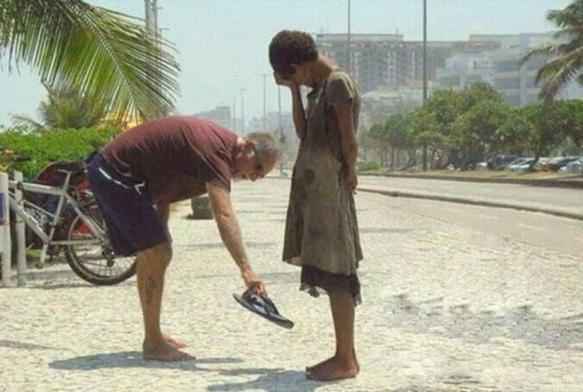
Further, I would assert that, as the accompanying image suggests, it is more important to follow His example, than merely proclaim one’s adherence to it. Thus, while the man giving his sandals to the poor boy may embrace some other religion, or none at all, I sense that Jesus – presumably preferring hallowing acts to hollow words – would rejoice in his compassion anyway.

Here is another expression of my point in changing that single word:

‘Wherever selfless love is shared,
Know that He is present there.’

(All people of goodwill practice decency and kindness; I do not presume to claim those as uniquely Christian values. Only that they are obligations – of which they should never lose sight, and always strive – for those who do call themselves ‘Christian.’ As one who does call myself such, I acknowledge often failing at those, but accept my lifelong duty to keep trying.)

We humans can use our gift of reason to choose to obey our finest impulses, and thereby deliberately summon the best of our humanity. Particularly when doing so goes against our own immediate interests; like giving away one’s footwear to a brother being who needs it more. The mere existence, and exercise, of such empathy nudges our whole world slightly closer to Paradise for everyone; hence, the dirt that will get on this giver’s feet transfigures as the soil of the Garden of Eden.

So whether you regard Christ as a factor in your life or not, may the loving care this image shows inspire you to ‘summon the best of your humanity’ also. It is the simplest thing that many of us can do – regardless of why – to better this Life. 

Which I would venture to believe must gladden Him, also.