A Different Enlightenment:

On a recent visit to Europe, a friend and I went from Paris to Sarlat (a lovely Medieval vestige in France’s Dordogne, itself a marvel of nature and history) then Munich, and finally Vienna. It was all rather wondrous.

I hope to post reflections on some pictures I took, as after my 2016 travels. But I am currently focused on a large writing project, so may compose only a few essays, about photos I deem especially significant.

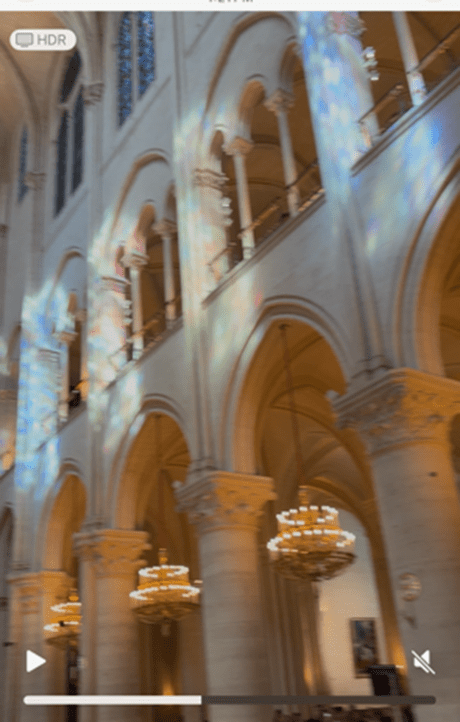
This image initiates that effort. It shows a spectacle not seen in centuries at gloriously rebuilt Notre Dame de Paris. The entire restoration from the fire of 2019 was magnificent, but encountering this long-gone ‘rainbow’ was enrapturing. Without the fire, this vista might have stayed lost forever.

After that inferno, the church’s walls were scrubbed of ages of candle smoke, incense, etc., and its stained glass consummately cleaned. Consequently, this cloud of limpid color, long obscured in the gloom, is now cast onto the stone-work overhead. The restorers likely anticipated its return, but I certainly had not, so discovering it astonished me.

Where I stood filming had been saturated with lead dust, ash from burned roof beams, rubble, all still in peril of structural collapse after the fire. That Notre Dame was not just restored, but is better than before, is evidence of determined, diligent, ingeniously potent human agency.

However: In Medieval Christian theology, God was light, which this revived iridescent glow assuredly suggests.  Thus, this may be pondered as divine approval, or affectionate reward, for how we deployed our collective gifts to rescue this venerable shrine, sacred to abstract aspiration.

I especially hope to write posts for three other photos from my journey. One is consonant with the majesty of human endeavor suggested here; the other two contrast with it.

I photographed Munich’s courthouse, where another intimation of our best Nature appeared. There, in 1943, members of the White Rose, a legendary anti-Nazi network, were tried and condemned to death for their ‘noble treason.’ Supposedly, they even dared scold their judge for moral dissolution and complicity with Hitler – a deed of defiant courage I find as awesome, in its context, as this compelling phenomenon in Notre Dame.

In contrast to that summit, two pictures I took at Dachau, suburban Munich site of Nazism’s prototype Concentration Camp, witness a chasm. One shows a statue of an anonymous inmate, inscribed ‘Honor to the Dead. Warning to the Living.’ The other is a photo of inmates taken by a guard, carefully conceived and crafted to sate Nazi mania to degrade and dominate the ‘other.’

Both these images feel ominously relevant to the political climate in America today, 2025.

The fact that so many people seem not to have learned the grim lessons places like Dachau symbolize makes me fear our species may have reached a pivot point. A point beyond which our Reason, spawning technology to serve the primally self-interested, may be as liable to degrade or destroy us, as to advance us.

Thus, until if and when I write about those three, the image here must serve to assert a proposition I ardently feel worth advocating: belief in the ultimate positivity, underlying and overarching, of our mortal existence. What these apparently unrelated things – this recovered spectacle at Notre Dame and the White Rose’s nobility – have in common, is that the instinctive admiration most of us feel for such marvels may suggest that simple goodness is the default of our nature, and wickedness a baser aberration. And they may help us keep faith in that default, despite all counter-evidence.

Scripture says that after the Great Flood, God set a rainbow in the Heavens in token of a promise never again to chastise humanity for its failings. The rainbow shown here may be mere optical happenstance, but such apparently random coincidences may act as mechanisms to move us to hope, may offset dispiriting, life-negating evidence, inspiring us to reckon that an elementally better world is possible. A world more worthy of this sensational vision, and of the soaring honor of the White Rose martyrs, than of demonic Dachau.

In terms of attaining the highest level of being we can, reaching beyond the Self alone – love – may prevail, where logic fails. So I invite readers to consider this image as evocative of tender, reassuring encouragement to such ‘reaching.’

Most humans’ spirits are not data driven, so physical experimentation, mathematical proofs, etc. are not tools for such undertakings, which are outside the realm of reason, alone. We must generate and embrace such Hope within our Selves. And it must subdue animal urges such as Nazism invoked, or we are lost.

Hope need never die, unless we let it expire. At grievously wounded Notre Dame, we did not, and as a result, got back this breath-taking apparition.

For Bastille Day: Libertines – Egomaniacs – Fratricides?

The recent Bezos Matri-Money in Venice reminds me of an episode from the French Revolution. We tend to think of the Fall of the Bastille, July 14, 1789 as the start of that grand historical process. It was pivotal, the most violent defiance of King Louis XVI’s authority to date, but was soon followed by an incident more pertinent today. We are not at a tipping point like that event turned out to be, yet it feels increasingly relevant.

On October 1, 1789 the Flanders Regiment reached Versailles to take over duties of a unit that defected at the Bastille uprising. At the same time, a bad harvest was making bread, staple of most French diets, costlier in Paris.

The King’s bodyguard threw a sumptuous banquet to welcome the Flandriens. As if luxuriant food as commoners faced starvation weren’t insensitive enough, the newcomers also displayed inordinate gestures of loyalty to Louis. The callousness of extravagant dining and obliviousness to broad frustration with a feckless King were dangerously at odds with the mood beyond the royal Court.

News of those antics got soon back to Paris, and as a result, a mass of irate women marched out to Versailles to remonstrate with Louis about the cost of bread. They breached the palace, and coerced the royal family to return to Paris, where they could be more easily controlled, guarded and menaced.

In 2025, there are no Divine-Right Kings on whom national publics can focus frustration. But we have our own focus: behavior like that extravaganza in Venice by those who, like Louis’ courtiers, evidently see themselves as above the concerns of (other) mortals.

It is a fair, if inexact, parallel to reaction to that Flandrien feast that today, beleaguered folk observing modesty’s ‘Dearth in Venice’ resent the ultra-rich absorbing ever more of Global wealth. Often by redirecting it from previously comfortable middle classes.

Even more reckless, today’s plutocrats try various ploys to pull up the socio-economic ladder, to make their privilege and power inassailable. (‘Ploys’ like rendering healthcare less accessible, reducing life expectancies; hence my citation of ‘Fratricide.’)

Was the unseemly profligacy of the wedding of merchant martinet Bezos due to delusion? Arrogance? Both?

Did its guests not realize the resentment their hyper-indulgence causes fellow citizens? Citizens watching as historically unique widespread financial and personal security –- which they consider the bedrock of any ‘just’ society – gets deliberately eroded?

Especially when many of those guests avoid taxes (as the accompanying image suggests) with the same vigor they siphon profit to themselves. Often, using techniques they – the groom first among them – devised or control.

(Sidebar: Is facilitating techno-charged rapacity ‘Evolutionary progress?’ Surely, this is not the highest state of development to which we can aspire!)

Can they actually believe their efforts to revive a Gilded Age – a glittering membrane over a dark reality of struggle for survival for most – will pass unnoticed, and unresisted, by ‘most?’

All this is an insufferable offense against simple fairness, so any popular wrath it ignites should come as no surprise. How can allegedly smart (rich) people be so blinkered they can’t see this is both intolerable, and untenable?

There is a huge difference between most people today, and French commoners in 1789. They were accustomed to hardship, hoping mainly that survival be as little difficult as possible, whereas most of us experienced ‘widespread financial and personal security’ not long ago.

We know life Can be better, and should not accept its being degraded so kleptocrats can outdo each other with grander yachts.

Why should so many give up so much, to pamper so few?

Or is it arrogance? Do members of the ‘élite’ simply not care what the common herd thinks? Or presume it can be reliably manipulated? But today’s ‘herd’ is educated enough to sustain a modern economy, so its members are aware life was not, and need/should not be, constant struggle for survival.

In honor of Bastille (Bez-steal?) Day, the subtitle of this post is a satire on three pillars Republican France has espoused since her tumultuous birth: ‘Liberté, égalité, fraternité’ ‘Liberty, equality, fraternity.’

Ideals that any libertines, egomaniacs or enablers of fratricide who made it onto the Venice guest list likely not just ignore, but consciously mock. Most especially égalité/equality. Their personal ‘ideals’ are obviously irreconcilable with France’s Secular Trinity and its promise of a better human condition.

To return to that women’s march: legendarily as they neared Versailles, palace staff tried to close its gates. But they hadn’t been shut in decades, and were rusted immovably in place. Heedless gentry had just presumed civilization would prevail to sustain (and be exploited by) them. Their presumption that their privilege was indestructible proved false, so when a reckoning came, it left them unable to shield themselves.

It wasn’t barbarians at those gates. It was wives and mothers fed up with being ‘subjects’ of those whose selfishness proved they did not merit their prerogatives.

Those rusted gates may prove a metaphor for glitterati who attended Bezos’ rites, then ignore justified anger from beyond their velvet cords and gated residences. Who assume civilization is there to protect them, even as they (‘Carnivores in Venice?’) prey on most of its members.

If Venice’s spectacle is 2025’s equivalent to the cluelessness of the banquet for the Flandriens, the equivalent to their tin-eared praise for Louis XVI may be our plutocrats’ shameless tax avoidance, a childish mindset that one may limitlessly ‘take,’ but need never ‘give.’

History may see capers like the flaunted opulence in Venice as what led a critical mass of people to conclude the economic structure benefits only a veneer of the powerful.

In another essay, I will speculate on cynical ways plutocracy may be trying to distract us commoners from noticing how we are being despoiled. Like Versailles’ gates, such gambits are liable to eventual failure, when snarled with the accumulated rust of popular rage.

That essay will be titled ‘Bread and Circuits.’ 

‘Resurgamus’: The Renewal of Notre Dame.

When the replacement for Medieval Saint Paul’s Cathedral in London, destroyed in the Great Fire of 1666 got started, its architect Christopher Wren told a workman to bring him a flat stone to use as a marker. The man happened to choose a tomb fragment bearing the Latin word ‘Resurgam,’ ‘I Shall Rise Again.’ He likely had no idea what it meant, but had inadvertently made an auspicious gesture. Wren’s Saint Paul’s became emblematic of London’s rebirth from the catastrophe, and a beloved site of British self-image.

Now, Notre Dame de Paris has also risen from ashes, reopened today, December 8, 2024, but unlike Gothic Saint Paul’s, has been exquisitely rebuilt, not replaced. Medieval cathedrals were concerted projects involving entire regions, and the virtual rebirth of Notre Dame has indeed been communal. But in this case, the community was global; donations, resources and expertise coming from around the world.

It – ‘she’, Our Lady of Paris – originated when people did not assume they could understand, let alone control, the world around them. The heartbreaking day of the blaze in 2019 echoed that sense, as alert and suppression equipment meant to protect from fire failed to do so, a reminder of the limits of technocracy and human efficacy in general.

But as we have renewed Notre Dame, she may now help renew us.

For she stands as testament to past, present, and future wonders we may perform, when inspired to a common objective not dictated by our constricted spheres of self-interest. What happened after the inferno showed how determined hearts can animate the deeds of the head and hand.

This church – sacred not only in her Christian context, but also as an artifact of human identity and innate potential – quickly came to be seen as more than a superb work of artistry and engineering.  Amid her fallen masonry, blackened timber, melted lead, restoration may initially have seemed objectively impossible. But as realization of the importance of doing so grew, rebuilding came to seem daunting; then difficult; and finally unstoppable.

For we may do the ‘objectively impossible,’ if and when our Spirit is willing. Without such collective focus, Notre Dame would have remained a pile of ruins. Instead, in a cultural groundswell, she was embraced as a compass point in the firmament of our general consciousness that needed to be lovingly, faithfully rebuilt. Passively accepting her loss would devalue the whole concept of civilization, for if such an icon of shared human heritage was not worth exertion to save, what part of it is? Or would be? 

Arguably, it made little sense to lavish such attention on a burned out old-building. But that is a mistaken reading; doing so showed itself to be an absolute imperative. For she was never just a pile of stones, but represents the very best of who and what we are, or aspire to be, raised toward the heavens as an offering of our fondest hopes and finest deeds.

So it seems appropriate to use the plural ‘Resurgamus,’ ‘We shall rise again’ here, for the reopening of Notre Dame shows how – together – we may ‘rise again,’ to keep entropy from prevailing. Our devotion for a monument to some of our greatest non-material motivations displays the power of our impulse to create, rather than yielding to chaos.

Or to redeem; as this great shrine to hope returns to welcome the world during this Christmas season, we may choose to rejoice in the premise she has represented across the Ages, echoed again in her revival: There can be fulfilling, benevolent purpose to our existence.

Indeed, Notre Dame may serve her original mission better now than when she was new, amid general illiteracy, incomprehension of natural mechanisms, etc. We understand the natural world far better now, but her mission was and is to proclaim faith that humanity – everyone able to consciously, deliberately choose to act out of Love (whether they do so or not) – is not born merely to die, and return to dust.

Originally meant to assert that we are more than ‘clay vessels,’ she has now shown again how we are fit, and obliged, to participate in and contribute to the wondrous existence from which we sprang, and of which we will always remain as parts.

Our capacity for aspiration soaring beyond what is known or evident has not changed, although perhaps our priorities in reflecting such have matured and deepened. Today that means, quite properly, caring more about our brethren’s well-being than stone, timber and glass surrogates of abstract ideals.

But Notre Dame is a sublime exception to that kinder momentum, a link to our legacy of genius and potent agency; irreplaceable, and thus unacceptable to be irreparable. Her rebuilding stands in contrast to the violence and destruction around us, evidence that we have it in within us to create a more civilized world; in, and for, flesh and blood. Her sacrifice by fire, and our determination to reverse it, has reminded us of this imperative, and of our ability to ‘right wrongs.’ Which also implies that she may now encourage us to strive in a more worldly manner: To bring Heaven to Earth, especially to those most in need of it.

Evoking this dimension of our nature may be a comfort, as contemporary culture gradually prompts us to regard ourselves as organic mechanisms with little evident purpose but prolongation and material enjoyment of our physical lives. But one consequence of that perspective is that our ‘value’ as individuals – absent any non-material one – as measured by algorithms capturing our online activity, purchasing history, etc., is now largely a measure of how exploitable we are as marketing targets.

Those who control the algorithms, collect the data, can sell to or manipulate us accordingly, and thus their own ‘organic mechanisms’ flourish. In such a worldview, exploitation seems to be an only logical choice; that is, one based Only on logic, devoid of any other considerations.

But we are built for exaltation, not just for exploitation, as endeavors like Notre Dame – her origin, and now her renewal – evince. We have shown ourselves, yet again, what we can do if we try to act in ways worthy of sentient beings capable of efforts reflecting continuity, not mere sustainers of organic flourishing. We can be about more than coarse self-aggrandizement; much more.

Many may find this proposition comforting. Faith – not just religious faith – can manifest as the belief in the possibility, often despite implausibility, of facilitating some desired, better reality.

And the resurgence of Notre Dame is a glorious instance of what we can achieve when we act in concert toward some enterprise as great as we, together, can be. Thus, it is not just her fabric that has been renewed, but her defining symbolism of an impetus that remains – resplendently – beyond measure, quantification, or formulation.

An energy arising from heart and spirit, ‘vital’ in every sense.