Various personal distractions have kept me from focusing on the followup post I mentioned at the end of my last one, ‘Promoting Freedom by Protecting Memory,’ about the 1905 Winter Palace Massacre in Czarist Russia. But to paraphrase Samuel Johnson, death ‘concentrates the mind wonderfully.’
And the death of Aleksei Navalny, all but certainly due, directly or indirectly, to Vladimir Putin, has concentrated my mind furiously, catalyzing that promised sequel, here. It will not take the form I originally envisioned, will serve largely as a partial vent for my current writhing wrath at Putin. Although that feels inexhaustible.
Dedicated to Navalny, this post proposes suggestions of how to perceive, and what to do in response to, his death. I will not advocate for revenge; vengeance is the province of spiteful men like Putin (and Hitler, who literally spoke of a ‘goddess of revenge’). Instead, justice is what we should rightly seek, and that can best take the form of punishing Putin by helping to thwart his mania to conquer and subjugate Ukraine, an enterprise whose criminality, cruelty and reckless stupidity Navalny condemned relentlessly.
Even if Navalny’s eventual Fate was not a real surprise to those following his opposition to Kremlin tyranny and corruption, it was still a shock. He may be credibly said to have represented what is good, noble, hopeful – and truly evolved – in us, as surely as Vladimir Putin personifies all that is not. No doubt he was flawed like everyone, but also exemplified attributes we properly admire, but rarely attain, such as granite-hard determination. One needn’t be angelic to offer a stark contrast to Putin, but Lion-hearted Navalny was a more extreme opposite than most of us could ever be.
The likes of Putin, who incarnate dark forces of human nature and history, are desperate to quell such noble impulses which they regard with cynicism and bewilderment, as obstacles to ‘realism’ in politics. But they are desperate fools if they imagine they can dissipate the loftiest acts and aspirations of Mankind with the odd well-placed assassination. Granted, the relative passivity and credulity up to now of the bulk of the Russian public to Putin’s criminal aggression against Ukraine has likely encouraged him to persevere with it. But his incomprehension of ‘principle’ makes it impossible for him to recognize that he cannot eliminate massive, rightful and reparable discontent by ‘well-placed assassination.’ Eventually, the underlying grievances will burst like a volcano’s lava dome, not manifest only in epic characters like Navalny.
Predictably, men as heartless and crude as Putin regard valor as folly, and likely felt Navalny was a fool for returning to Russia from Berlin, where he received medical treatment for a near-fatal poisoning (that was surely Putin’s doing). But authentic heroism is very different from folly.
Someone like Navalny – as he showed in deeds, as did the journalist Anna Politkovskaya – grasps a truth invisible to anyone like Putin: To a soaring soul, there can be values more precious than his own interests, or even his very life. And for Aleksei, the happiness of his country and her people was one such value. The Putins of this world – wherever they are – are blind to such concepts, cannot comprehend flights of the human spirit or seemingly anything but the coarse, transient rewards of ‘What’s in it for me?’ (As an American admirer of Putin once mocked American soldiers – who had died for their country in World War I France – buried ‘over there.’) Any ethical vision they may have ever possessed is occluded by the moral muck of unabashed self-dealing and indifference to collateral harm which they inhabit.
If you also are outraged by Navalny’s suspicious death, there can be no better response to it than to justify his courage by calling for immediate, greatly enhanced Western support for arming and aiding Ukraine against Putin’s militarist fantasies there. And by furthering – in any way you can imagine – Putin’s worst nightmare (and partial reason for his terror at the westernization of Ukraine): Creation of true, irreversible civil society, and the valuing of individuals, in Russia herself.
Because the inertia and indifference of Western public opinion are as vital as oxygen to Putin. His invasion assumed the Democracies, in their affluence and security, would do nothing meaningful in response to it, and let him go on heedlessly spending Russian and Ukrainian lives in pursuit of his delusional 19th Century style Chauvinism.
But using Navalny’s demise as a spur to frustrate the dark powers he struggled against is surely as effective a memorial, to his life and his death, as there could be. If I could somehow speak to the Russian nation, I would assure them that there are foreigners who hail their forefathers’ bravery in their country’s defense. I might then point out that Navalny faced huge, avoidable, risks for their sake, and in gratitude and inspiration, they might be willing to face lesser ones to validate his sacrifice.
The Russian people have never been more formidable than when their patriotism was inflamed, as Napoleon and Hitler learned; for their Motherland, they can, and will, fight like dragons. Given the extraordinary deeds that the great-grandparents of today’s Russians performed – rolling back Hitler’s barbarous rampage in their land all the way to his lair beneath Berlin – perhaps an appeal to their love for their country (rather than loyalty to its despicable leadership) and to their own dormant lion-hearted courage, is the best way to lead to the final destruction of autocracy in their midst:
For Autocracy continues to hold back their already splendid nation from attaining its full greatness which is to be found in its vast contributions to the arts and sciences; not in Mongol-style territorial expansion.
The World’s Democracies’ stalwart devotion to (and enlightened self-interest in) helping to sustain Ukraine may stoke the slumbering patriotism of the Russians by confronting them with just how utterly indifferent their current Czar is to the lives of their sons, husbands and brothers he will continue to waste in Ukraine; how totally focused he is on realizing his own fantasies of glory, and his horrifying concept of national honor.
I realize all of that is easy for me to say, far from Putin’s fierce police, tear gas, stun guns, and rubber batons. But Russians will face such forever if they don’t liberate themselves; as they did in 1917.
Speaking of 1917, there may be a grim but intriguing irony developing here. The rule of the last Czar, Nicholas II, was corrupt, incompetent and unsuited to modernity, but Nicholas was ultimately brought down by continuing to fight a conflict he had rashly helped provoke, but could not win – World War I – whose grave sufferings for his people he was too stubborn, prideful and oblivious to take seriously. In 1917, those people had finally had enough of him, his war, the feckless social order he represented, and they ousted him and his whole rotten misrule.
Perhaps Navalny’s murder will ultimately put a similar flame in today’s Russians, suffering due to a war Putin is too proud and indifferent to his people’s wishes and welfare, to recognize as utterly not worth the cost. Perhaps they will echo 1917, accept that they must take their destiny into their own hands, and repeat history by overthrowing him and his kleptocracy. Putin, as I have noted in other posts, suppressed official observance of the 2017 centennial of the fall of the Romanov dynasty, so it would be tragicomic if he comes to share their Fate due to his own myopic megalomania. In stifling public memories of 1917’s regime change, he himself may have lost sight of its crucial lesson: Rulers dare not take their subjects’ patience, obedience and timidity for granted.
Thus, he might provoke the very sort of popular uprising he wanted his subjugated public to forget, because he himself neglected its warning, and overestimated the feasibility of eternal repression. And his own eventual Fate might prove messier than the Romanovs’, who got gunned down in a Siberian cellar.
If so, let him face the dreadful destiny of Nicholas II to which his own cruelty consigns him, of obstinately clinging to a path that is as obviously unwise as it is repugnant (and in this, I don’t just mean the invasion of Ukraine, but his whole corruption-protecting police state apparatus), until his own people tear him from power. Or worse.
It will serve Putin right (and be a valuable warning for other tyrants) if he is devoured by the very forces that he has been arrogant, brutish and obtuse enough to disregard, or hubristically suppose he can control forever.
An intriguing premise, that: a self-isolating despot’s inability to recognize that he has slipped into a ‘reality’ at odds with the actual one, leading to the downfall of which he is no doubt petrified. Such self-destruction would prove there can be justice in this world.
And to my fellow Americans, I would warn that we must recognize the peril of letting someone like Putin, insensate of his people’s blood and sorrow, outlast our resolve to stop his current, terrible enterprise. Thus, we should demand more vigorous U.S. aid to frustrate his faith in brute force, and contempt for any moderate exercise of power.
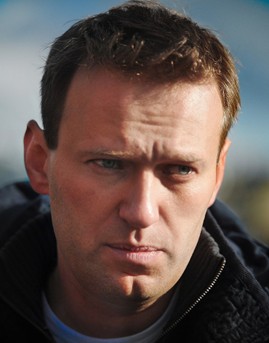
But even more important, Americans must think Very carefully about abandoning our image – to ourselves, and to the world – as friends and defenders of human liberty and progress (the accompanying image was chosen as a reminder of exactly that) by supporting any U.S. movement or politician that considers Vladimir Putin’s savagery ‘irrelevant’ to American interests. Or worse, admirable in itself.
Or supporting any person or party that doesn’t issue a full-throated, unreserved condemnation of the murder of Navalny, as well as all other Kremlin efforts to cradle-strangle individual freedom. Remember: Silence Gives Consent.
(Admittedly, America has its own ‘lava domes’ of justice denied, but they do not include overtly larcenous looting of the national economy, nor domestic political assassination as statecraft. And they are subjects for another time.)
May Navalny’s example flourish in death, even as Putin’s putrefies while he is still alive. To close with a sentiment that could well have inspired Navalny himself, ‘Blessed are they that hunger and thirst for righteousness, for they shall be satisfied.’
It is a rare privilege to witness souls as great as his, who hunger and thirst thus; especially when their goals seem futile. Surely, it behooves us, thus privileged, to help if we can, to ensure his quest was not ‘futile.’

 All Things Gaul