On a recent visit to Europe, a friend and I went from Paris to Sarlat (a lovely Medieval vestige in France’s Dordogne, itself a marvel of nature and history) then Munich, and finally Vienna. It was all rather wondrous.
I hope to post reflections on some pictures I took, as after my 2016 travels. But I am currently focused on a large writing project, so may compose only a few essays, about photos I deem especially significant.
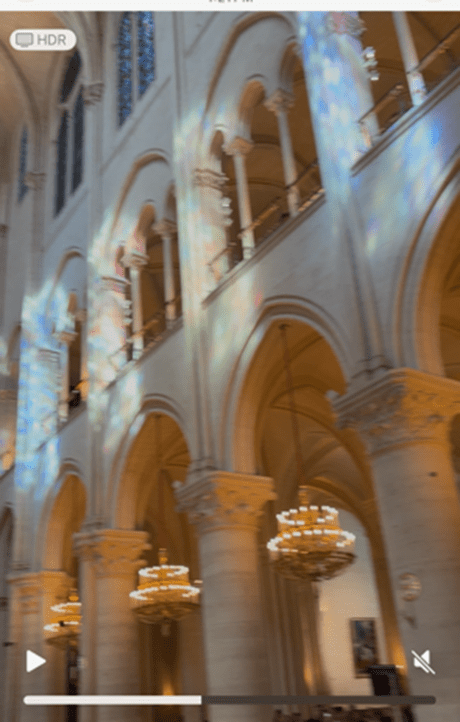
This image initiates that effort. It shows a spectacle not seen in centuries at gloriously rebuilt Notre Dame de Paris. The entire restoration from the fire of 2019 was magnificent, but encountering this long-gone ‘rainbow’ was enrapturing. Without the fire, this vista might have stayed lost forever.
After that inferno, the church’s walls were scrubbed of ages of candle smoke, incense, etc., and its stained glass consummately cleaned. Consequently, this cloud of limpid color, long obscured in the gloom, is now cast onto the stone-work overhead. The restorers likely anticipated its return, but I certainly had not, so discovering it astonished me.
Where I stood filming had been saturated with lead dust, ash from burned roof beams, rubble, all still in peril of structural collapse after the fire. That Notre Dame was not just restored, but is better than before, is evidence of determined, diligent, ingeniously potent human agency.
However: In Medieval Christian theology, God was light, which this revived iridescent glow assuredly suggests. Thus, this may be pondered as divine approval, or affectionate reward, for how we deployed our collective gifts to rescue this venerable shrine, sacred to abstract aspiration.
I especially hope to write posts for three other photos from my journey. One is consonant with the majesty of human endeavor suggested here; the other two contrast with it.
I photographed Munich’s courthouse, where another intimation of our best Nature appeared. There, in 1943, members of the White Rose, a legendary anti-Nazi network, were tried and condemned to death for their ‘noble treason.’ Supposedly, they even dared scold their judge for moral dissolution and complicity with Hitler – a deed of defiant courage I find as awesome, in its context, as this compelling phenomenon in Notre Dame.
In contrast to that summit, two pictures I took at Dachau, suburban Munich site of Nazism’s prototype Concentration Camp, witness a chasm. One shows a statue of an anonymous inmate, inscribed ‘Honor to the Dead. Warning to the Living.’ The other is a photo of inmates taken by a guard, carefully conceived and crafted to sate Nazi mania to degrade and dominate the ‘other.’
Both these images feel ominously relevant to the political climate in America today, 2025.
The fact that so many people seem not to have learned the grim lessons places like Dachau symbolize makes me fear our species may have reached a pivot point. A point beyond which our Reason, spawning technology to serve the primally self-interested, may be as liable to degrade or destroy us, as to advance us.
Thus, until if and when I write about those three, the image here must serve to assert a proposition I ardently feel worth advocating: belief in the ultimate positivity, underlying and overarching, of our mortal existence. What these apparently unrelated things – this recovered spectacle at Notre Dame and the White Rose’s nobility – have in common, is that the instinctive admiration most of us feel for such marvels may suggest that simple goodness is the default of our nature, and wickedness a baser aberration. And they may help us keep faith in that default, despite all counter-evidence.
Scripture says that after the Great Flood, God set a rainbow in the Heavens in token of a promise never again to chastise humanity for its failings. The rainbow shown here may be mere optical happenstance, but such apparently random coincidences may act as mechanisms to move us to hope, may offset dispiriting, life-negating evidence, inspiring us to reckon that an elementally better world is possible. A world more worthy of this sensational vision, and of the soaring honor of the White Rose martyrs, than of demonic Dachau.
In terms of attaining the highest level of being we can, reaching beyond the Self alone – love – may prevail, where logic fails. So I invite readers to consider this image as evocative of tender, reassuring encouragement to such ‘reaching.’
Most humans’ spirits are not data driven, so physical experimentation, mathematical proofs, etc. are not tools for such undertakings, which are outside the realm of reason, alone. We must generate and embrace such Hope within our Selves. And it must subdue animal urges such as Nazism invoked, or we are lost.
Hope need never die, unless we let it expire. At grievously wounded Notre Dame, we did not, and as a result, got back this breath-taking apparition.
 All Things Gaul