The Sustaining of the Light: Christmas Consolation.

A major life event has, up to now, distracted me from writing any posts for this Christmas season; my best friend Dr. Joseph Piszczor, died in November.

It was sudden, unexpected, and pummeling; yet it is exactly at such tribulation that the pull of faith that there must be more to life than ‘tribulation,’ that the vitalizing implications of Christmas may offer the most invaluable re-assurance and solace.

Today, the third Sunday of Advent, is called Gaudete – Rejoice – Sunday, a departure from contemplating Jesus’ approach, to yielding to its transforming joy. Thus, I post the venerable Christmas music, ‘Gaudete,’ whose breathless, urgent tone is more than encouragement, though less than command: It is exhortation.

And I have chosen to submit to its intensity; and to look upon the kindness of those around me, aware of my sorrow, as evidence of how we are all in this together. And that a desire to not be consumed by despair – for some hope beyond logical hope – is valid, beneficial, possibly even essential, by making it easier to bear the eventual loss of those we love, a de-emphasis of the Self – by embracing faith that it is but one part of a greater and glorious continuum – which makes us more fully alive and human.

My main post for Christmas is still being written, and will be dedicated to Joe, especially fitting, as he was a lover of great music. And in his memory and honor, I do, and shall rejoice.

True Russian Glory: Surpassing Nature

The opportunistic Russian invasion of Ukraine offers many reasons for pessimism about human affairs, but I would note the hopeful implications of how the tyrants’ main tools – cruelty, ruthlessness and repression, so long and often the ultimate deciders of ‘human affairs’ – are failing to win that struggle.

Russia’s attack might not have gone disastrously had capable managers executed it, but Putin’s regime regularly precludes ‘capable managers,’ as rulers like him dare not empower anyone clearly able to take over from them (this applies especially to military personnel, but Putin also pads upper ranks of the civilian administration with those dependent on his favor). So his dilemma is that what he demands most from subordinates is loyalty, but what he needs most to conquer valiant, resourceful Ukraine is competence. Faced with this choice, Putin has prioritized loyalty, and a ghastly battlefield impasse is the result.

However: The Russians’ bungling may have greater repercussions than just thwarting their own criminal assault (vital though its failure is). Might Putin’s shambolic conduct of his aggression manifest that modernity – increasingly reliant on subtle comprehension, planning, regulation, etc. – has passed a ‘point of no regression’? A threshold beyond which even a semblance of a modern state (like Putin’s kleptocracy) can no longer be kept functional with primordial methods like ‘cruelty, ruthlessness and repression?’

The uniformed bandits Putin entrusted with his ‘Special Military Operation’ are evidently deficient in the temperament and brains to handle the intricacies of 21st century warfare strategy, logistics, etc. Many of them presumably rose in rank due to willingness to implement his orders fiercely and without question, in return for being allowed to commit near-limitless thievery.

So is it really a surprise that tragicomic failure results from a culture in which loyalty precedes ability, corruption starts at the top, cascades down from the extravagant Black Sea villa ‘Putin-hof’, past layers of larcenous Apparatchiki, to ordinary soldiers (for example) rendering military vehicles useless by stripping out their copper wire to buy vodka with the proceeds of reselling it? Is it a shock that such a culture cannot just roll over well-organized, adept patriots like the resolute (NATO armed/trained) Ukrainians?

Thus, this bully-writ-large undertaking may have a positive side, if it exposes that despotism does not – cannot – deliver effective governance in the modern world. That a mentality of rule that comes from the Dark Ages cannot ‘keep the lights on’; that what worked for Ivan the Terrible does not succeed in the era of the Terabyte.

Of course, pitiless use of force was the habitual standard for rule everywhere, including in the West, till the mid-18th Century (for example, the Battle of Culloden, and subsequent repression in Scotland). But whereas much of the developed (modern, functional) world has long since progressed beyond such preliterate impulses, the Russians – acting as if the savagery of their barbaric medieval occupation by the Mongols is still a proper standard for behavior and leadership – evidently have not. Or at least, not nearly enough.

But such cannot remain the standard. Life’s complexity is getting deeper, the Kremlin dinosaurs are in way over their heads, and are lashing out in bewildered frustration at a world in which moderation, not their reflex primal resort to raw power, is likelier to avail. So the ludicrous course of the invasion may represent a little-remarked, but vital evolutionary step for humanity beyond the domination of those (like Vlad the Impeder) who would keep us unevolved and pliable forever.

If they can; and if the rest of us let them. Please bear this perspective in mind in terms of the interests of the civilized world in providing aid to Ukraine till it vanquishes Putin and the Jungle Law he personifies. This would be truly elemental progress, and we need to keep up its momentum.

Ukrainian victory is still far from certain, but their survival for this long in the face of a vastly larger and remorselessly cruel foe, suggests that the Putins of the world have not got (and cannot grasp) what it takes to operate a nation state that meets 21st century expectations. If their main goal is regime survival and blunt force is their go-to tactic to ensure it, its failure to prevail in Ukraine, and the resulting domestic disruption, may prove that such an approach will never again be a reliable means to run a country (especially one with grandiose ambitions) in today’s world.

Russian Goliath still has a club, but Ukrainian David has ditched his sling for a mace-spewing drone. Not that advanced warfare methodology can’t be used for offense as well as defense, but one may hope that the primal instinct that the strong can, and therefore should, tyrannize the less strong may start to wither, along with the efficacy of cruder means of doing so. ‘Evolutionary,’ in that both that instinct and means are more suitable for beasts than for an advancing Mankind.

By contrast to the mindset of Kremlin creatures, perhaps those ‘elites’ in the (especially, and mostly Western) business world who can truly command 21st Century technology and organization will eventually prove to the rest of us that they are sophisticated enough to recognize that the finest use of their talents would be to transcend the immemorial Alpha wolves of the world. That they may show wisdom – even greatness? – by realizing the worthiest rewards must come from using their gifts to benefit Mankind, as much as themselves; or more.

Will they? Time will tell; but the palisade of slender ultra-luxury ‘Money-Liths,’ residential towers on New York’s Billionaires’ Row – visible from areas of seething poverty further north – suggests this group has not yet grasped, or cares, that they may have it in their power to substantially improve the material human condition as few people have ever had. Especially if they decide to rise above the coarser reflex to pamper and exalt themselves as indulgently as gods; a deed higher than any super-tall skyscraper, that.

We may hope they will recognize and act on that realization, but in the meantime, at least the Putin-derthals are revealing their own possible obsolescence. And such – that is, great physical (especially, male upper-body) strength and savagery no longer translating to keys to overall dominance – would not be mere transition, but true transformation.

As to Putin’s invasion, I pray Ukraine stays free, but even if it doesn’t, the world has seen how the ferocity he and his accomplices assumed would quickly overwhelm its supposed decadent Westernizing weakness did so only at enormous costs, with humiliating setbacks and irreversible damage to Russia’s economy. The latter includes eviscerating her fossil fuel market, and driving out legions of citizens with the skills most needed by a modern society (including those smart enough not to want to be cannon-fodder for megalomaniac Kleptocrats).

Far better that Russian military might and barbarity fail conclusively and comprehensively, but the fact that these have been so much less effective than initially assumed may reflect a fundamental shift, in which the needs of modernity – on which those financial and technology elites of Billionaires Row and beyond depend for their comfort and plutocratic sway – are irreconcilable with the primeval supremacy of brute force. If no other good comes from all the barbarous tactics of this invasion, perhaps at least their patent ineffectiveness will contribute to their gradual invalidation and eventual disappearance.

Finally, lest anyone suspect that I am simply anti-Russia, let me show my respect and admiration for her common folk by offering the accompanying video of a Saint Petersburg ballerina performing exquisitely, as evidence of what Russians are capable of, rather than being the biped cattle the Nazis considered them (and as Putin still treats them).

The story behind the video strikes me as characteristically Russian; this artist is dancing, en pointe, on a frozen lake at 5 degrees F, as an ecological protest (as explained in the narration; I don’t know if she succeeded, but hope so). It may not be ‘heroic’ per se, and few Russians could or would do this, but this spectacle nevertheless seems like something that would rarely, if ever, happen anyplace else.

And if a people among whom such talent, grace and strength – seemingly as elemental as their overlords’ cynicism – are to be found, finally realize they don’t have to let their leaders treat them like disposable beasts of burden (the fault line between modern ‘citizens’ and feudal ‘subjects’) forever, they might enact extreme retribution on Putin. Perhaps involving his bodily orifices and Stalin’s disinterred bones, wielded by mothers of Russian soldiers lost to his dictatorial delusions.

Such would be vicious behavior, but a cathartic response to ages of equally vicious oppression. Putin is this great, though tragic, land’s latest protagonist of that kind of rule, but perhaps he will be its last. If ordinary Russians finally reject and destroy the foul apparatus he wields, they would prove they possess tough nobility and truly inherent splendor, as this video suggests.

Ironically, the opposite of the chauvinist ‘glory’ Putin envisages for their Motherland.

Perspectives of Cologne Cathedral, Germany: Interior, Facing Medieval Apse

CONTEXT: Seeing this great edifice was a comfort for me, an example of truly fine German culture after my exposure to remnants of its heinous Nazi spasm in Berlin.

Further perspective about my meditation on the Kolner Dom; as I wrote this in summer 2023 at my home in Chicago, I smelled the smoke from wildfires hundreds of miles away in central Canada. Those were almost certainly intensified, if not actually caused, by human-driven Global Warming, exemplifying what I have in mind as I try to make a distinction between ‘intelligence’ and ‘wisdom.’ Roughly differentiated, the first is what one Can do; the second is what one Should do.

For example, human brain power created the internet on which I post this blog. And when the web was new, few observers foresaw anything but benefits arising from it, yet it has not worked out like that (consider its impact by those who use it to sow dissent, reap ill-got gain, etc.). Technology has given many of us, in many lands, much better lives, but if presumed wholly beneficial and allowed to run free, it has/can also be instrumental in creating, stimulating and exploiting a consumerist ideal whose insatiable maw for resources is now disrupting the terrestrial cycles of our planet. 

That all arose from our intelligence, but certainly not from our wisdom. A mass-culture of material goals beyond actual needs – oversized vehicles and homes, disposable appliances, energy-intensive food production – is spreading, like swamping waves, far beyond its First World origins to ever-larger segments of the world’s human population, helping to proliferate quasi-natural disasters like those Canadian fires. The very Earth is reacting to having its material gouged out, processed, and the resulting detritus expelled into its atmosphere and oceans, manifesting as rising temperatures and sea levels.

This, despite science having long known of these terrifying ecological implications – because the long view of science – and for that matter, of most religions – is no match for a hyper-energized appetite for individual validation expressed through material acquisition. It cannot offset cultural priorities in which the fulfillment of the individual, not the long-term good of the community, is the prime focus. (To say nothing of marketing by short-term focused businesses that benefit from ‘hyper-energized appetites.’)  

For moderation to prevail, wisdom – ‘what one Should do’ – rather than mono-dimensional acumen used to exploit urges for immediate gratification (and revenue) must guide us. Moreover, wisdom, even when recognized, often gets ridden over. Since the Industrial Revolution, it has frequently been sidelined to pursue technologies, products, services, etc. devised to address (and profit from) some problem or aspect of Life, but distracting us from broader and deeper perceptions of it.

So sniffing that Canadian smoke makes me want to both laugh and weep at the assertion that Man is able to fully master his Fate, or even if he were, reliable to use that mastery appropriately while still so in thrall to self-interest. Our knowledge of physical reality has increased throughout time, but our control over it remains marginal; that is, we can better observe our physical World, but we didn’t make it, and our role in its unfolding has long been trivial. Up to now, when our misuse of much of that knowledge has made us become substantially destructive.

Thus, those flames in Canada may portend our vanities making a bonfire of us, rather than the other way round.

As an alternative to validation by materialism or cravings for self-involved fulfillment, I remind readers of the ingrained human heritage of pondering and valuing the immaterial, as the Kolner Dom does, though in stone, slate and glass. I noted in my January 1, 2023 post, ‘Entrancing’ (which I encourage you to read after this one), that all the life-improving knowledge modern science has gained for us has not truly altered our immutable relationship with eternity – Mortality – even as it has distorted it, by postponement. That elongation may have persuaded us to believe that mortality is a reality not worth contemplating because it is, in a rational sense, ‘immutable.’

But places like this cathedral were meant to confront that issue in ways from which we today, believing we control Nature as much as we need to (or at least as much as possible) might shrink. The imperative that drove its construction was a belief that, fundamentally, human activity was peripheral to inconceivably more encompassing forces of Creation. Such sacred spaces seek to define a role – for humans and for humanity – within that only semi-autonomous context.

In that interpretation, ‘Existence’ is an enterprise whose purpose is immeasurably more complex and wondrous than any and all of its discrete mechanisms that we may ever discover; they are not its ‘meaning, its underlying and overarching significance. Like some great spaceship, Existence’s actual purpose bodes to be far more than its separate parts might suggest, awesome beyond human quantification, substitution or emulation.

But not beyond human contemplation; not if we avail ourselves of doing so.

If we cannot evade physical Death no matter how long we can forestall it, visions of Life like those which summoned and raised this church assert that our awareness of mortality may serve a positive purpose. In its Christian context, a hope of Salvation as reward, but conceptually, a dimension in which whatever good we do in this world doesn’t simply vanish with us. Including love we have of others, be they family, friends, or everyone; for love beyond the Self is too worthy and vitalizing to be accepted as some mere ephemerality.

Thus, having some degree of care and acts for the benefit of others can expand our Being to overlap with theirs, and thus enlarge who we are beyond the boundaries of our own organism. And fixating on ‘our own organism’ (far beyond self-preservation) has been no small part of the impulse driving those forest fires, as results of the exaltation of the individual being presumed preeminent (and also quantifiably profitable).

The Nazis, it should be remembered, detested any ideas of love beyond one’s own ‘Volk’ – ‘Race’ – as ludicrous affronts to the eat-or-be-eaten laws of Nature, and intended to root them out of German thought, society and culture (for example, Hitler famously called conscience ‘a Jewish invention’).  It may be instructive to bear in mind how such terrible men, heartlessly focused on the good of their own rather than of Mankind, viewed empathy-based religions or philosophies; and on the unspeakable values they felt should replace them.

Nazism could not respect anyone who might need or benefit from the consolations, and propulsion, of extra-factual faith to face, and even exceed, the challenges of this life. In Nazism, there was only a primal pursuit of domination.

‘Anachronism’ is generally understood as something that is out of its own time, but I suggest it may also be something that is out of – beyond – time itself. Like the ageless treasure of transcending our impulses and narrow logic, both of which helped lead to, and facilitate, those Climate Change-intensified Canadian fires (and a host of other events caused by that same menace), to care for that which is beyond one’s Self alone.

The Nazis are gone, but the Dom remains, honoring the coming into the world of One believed to personify love beyond one’s Self, a consummation that we all, and each, are right to pursue. By following any path that is best for us individually, as those who conceived, built – and needed – the Dom, and its proffered reassurance, followed theirs.

Gothic churches were designed with powerful upward optics to suggest ascent to Heaven, and Cologne is surely one of the most successful examples of that intent. This is still a functioning church, and this image of its nave was taken from just inside its main entrance.

As a child, I had an unusual fascination with Gothic architecture. Back then I saw pictures of this interior, and so assumed I knew, more or less, what to expect when seeing the actual place. But I was wrong; no photograph could prepare me for its full, unfolding and enfolding reality, my presumptions brushed aside by the limpid intensity of the actual encounter. All churches of this style follow this basic template, but Cologne is one of its greatest achievements to proclaim a sacred space.

Upon entering, the sweep of its elemental verticality, softly augmented by the shimmering lavender haze of its stone and austere, yet sensual jewel-like glow through spare stained glass, was literally staggering; its time-stopping tranquility halted me in my tracks a few feet inside the door. My breath was gently squeezed out as if stepping up onto some threshold from one dimension to another, leaving me slightly panting with genuine awe, hushed and possibly on the cusp of a sob. It was arresting, but not intimidating.

The space seemed to absorb all noise of others present with a sense of sacred awe; if Eternity has a sound, it seemed that I was hearing it at that moment; non-substantial, yet mighty. And those were all fitting effects for a structure conceived as a regal repose for presumed relics of men who had knelt before the newborn Jesus, at a time when Western culture generally saw such objects as inexpressibly sacred milestones on a path to Paradise, a goal more easily sought and sustained in a setting like the Dom.

I admit to being more suggestible to such effects than many people, but here, that proved an asset, not a vulnerability. I have often been in ‘holy’ sites before, but this engagement felt truly different, and deeper in scope, like what can happen if sensibility is given leave to surpass rationality. That is not some inherently bad thing, when it is consoling and strengthening, beyond the harsh dictates of verifiable evidence – which is not necessarily proof.

This view faces the apse, the oldest part of the cathedral. It seemed melancholy that no one in the Medieval era, so largely dependent on religious faith to give meaning and resolution to human consciousness, ever got to see this vista. As noted in a prior post, the Dom was not completed until long after the worldview that spawned it was no longer predominant (if never entirely gone). For 300 years, the front end of the building, where this picture was taken was unfinished, with a low, wooden ceiling above it, surely blocking this sight of the high, graceful arc of the apse. Only in the mid-19th century were the entire nave, with this stunning view, fully realized as a pinnacle articulation of the Gothic aesthetic; and vision.

There are cathedrals with higher ceilings than Cologne’s, but its nave has the most extreme height-to-width ratio of any in the world. This vertiginous impression is enhanced by its configuration; it is relatively short, with only five bays of windows in front of the transept and four behind it. In most Gothic churches, the nave between the entrance and the transepts is longer, making the building look like a cross from overhead; Cologne looks almost like a plus sign. This abbreviation increases the already insistent sense of the ceiling’s altitude, and may have been the visual purpose for such horizontal compression. The interior proportions are ideal to seem intimate yet uplifting, not merely cavernous.

Polite, red-robed ushers answered questions and urged decorum, but for the latter, they hardly seemed to be needed. A space like this may leave a viewer speechless, whatever his or her everyday beliefs. Most visitors were at least quieted – if less dramatically so than my own reflex intake of breath, which had felt acute enough to seemingly draw me upward as the interior’s architecture pulls the eye.

During the Middle Ages, the exteriors of large churches were often likened to great ships, vessels to navigate the currents and storms of this world, and carry the righteous faithful – saved from its ordeals – safely to a longed-for port. Conversely, their serene interiors could hint at the security of the womb. And like a womb, this soaring, exquisite void feels as potent as the premise it is meant to convey: A life force opposed to the extinguishing power of the grave. It defines an embracing enclosure whose scale and sheltering volume allude to a root benevolence of ‘Creation,’ both as verb and noun.

Such impact, beyond easy description or facile appreciation, is visceral, and must resonate with amenable visitors (willing or unguarded), possibly even startling them as it did me. Its effect on a viewer arises from more than its artful stone and glass, and effortlessly glides above full capture by words. Contrary descriptors like ‘uplifting’ and ‘reposeful’ may both seem fully appropriate, yet still feel inadequate as I struggle to describe phenomena that are inherently indefinable in any ordinary sense.

The Kolner Dom may be as effective a monumental locus as anywhere, built to entice a beholder to venture beyond an exclusively rational grasp of life and respond to what is apprehended, not just to what is understood. I have been inside other spaces held to be sacred in some sense (they need not be gigantic to be overwhelming), but none made me feel so markedly enclosed yet unconfined; so invited to merge with something infinite.

The Medieval impulse to create such places, where beholders might rejoice just for being part of the same Creation as that which inspired their marvelous surroundings, was a great communal assertion (as well as evidence by its determined ingenuity) that human existence, in reflecting the agency of a benevolent deity, has worth, validity and purpose beyond that of creatures whose only plausible objective is winning a brutish contest of prolonging their own physical lives.

Of course, for individual persons, a desire for such prolongation is both necessary and natural. But for us as a species, it is not sufficient; and filling that insufficiency, somehow, may be a worthy life goal of each of us. In places like Cologne’s St. Peter’s Cathedral, one may observe, and even share in the endeavor of embracing hope for something beyond the apparent oblivion of death and nothingness. Faith that our worth and wondrousness reside, equally, in our transient singularity and in our everlasting commonality.

The transfixing calm of this setting seemed to both summon a reflexive questioning of whether there is more to life than we can see, grasp or measure, and to reward faith that there may be. It served, to me at least, as a reassuring reminder that I am a member of a far greater whole of “Being,” a realization that may unwittingly be obscured by contemporary culture’s priority of self-actualization.

Here, faith in such is conveyed as a notion that every person is born as a Golden Link – imperishable, and worthy of the love and rescue the faithful believed Christ offered up on the Cross – of a living chain that never ends or breaks.

Astounding Grace:

Not long ago, a man was shot to death late at night on a street not far from my home. It was evidently a random drive-by attack, and the killer did not know his victim (neither did I). It was an outrage and a tragedy, a grim undercurrent to the usual vibrancy and livability of my thriving urban neighborhood.

But a deed came of it which struck me, at least, as of surpassing beauty.

A couple days after this happened, I walked by the crime site. A spontaneous memorial had gone up, flowers from friends of the dead man, or empathic strangers aghast at his horrific fate. That seemed a very decent, proper response to the taking of the life of a relatively young person.

Next to the memorial, the victim’s brother had taped a note on the sidewalk thanking all who left expressions of sympathy, assuring how deeply these were appreciated, and that any flowers would be donated to a local nursing home in the dead man’s memory. It was eloquent in its succinct simplicity.

But to me, that lowly sheet of paper seemed a towering testament to nobility of heart. When first reading it, I could barely believe my eyes, for it amazed me that, in the depths of sorrow that brother was presumably enduring, he thought of decorum and gratitude. Many of us would have been immobilized with rage at such heartbreaking loss, such an unexpected mutilation of our lives. Yet here was this grieving man, acting out worthy attributes, prompted by despicable heartlessness.

‘Astounding grace’ indeed.

His words were moving, in more than one sense, for they can help drive away resignation to the brutality of this world, serving as evidence that ‘Humanity’ is not just a breeding swamp for callous cruelty. It can encompass gestures like that note, affirming we have it in us to be more than biped beasts. Some of us, even in extremity, can summon dignity – grace – as this brother did, when it may seem unimaginable to do so. It may be argued that he validated Humanity as much as the killer profaned it.

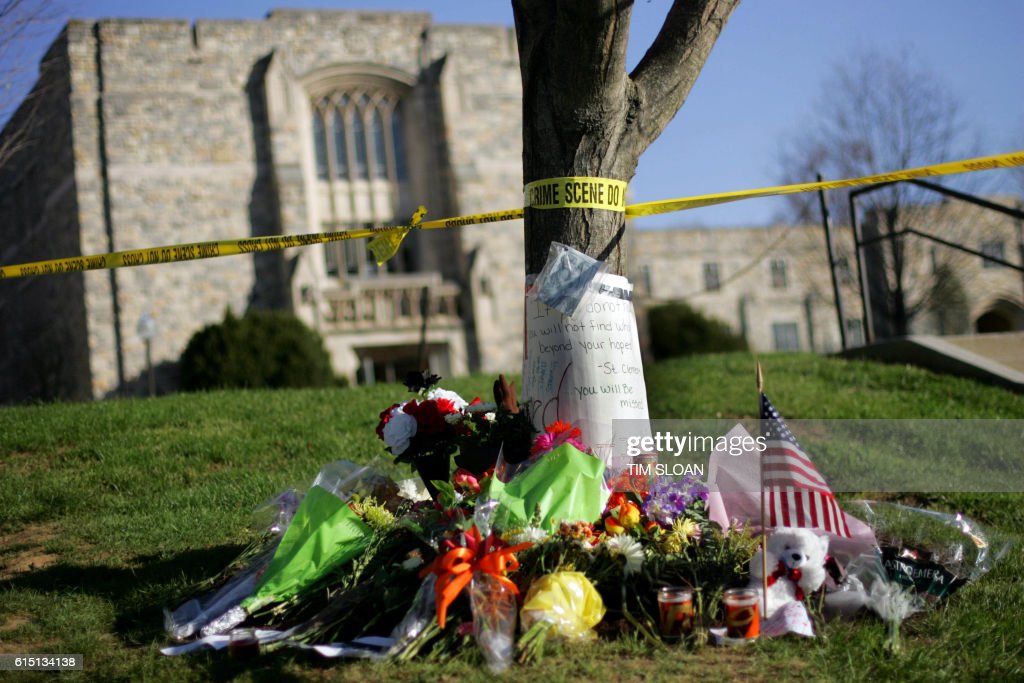
Respecting the mourning family’s privacy, I post the accompanying photo (instead of the actual site) of another memorial to victims of U.S. gun violence. There were quite a few online from which to choose, which itself is a depressing commentary on our culture. Many might see that as another reason to yield to cynicism, to protect one’s life from danger. And one’s heart from disappointment.

But I counter that this brother’s exquisite dignity and moderation under potentially engulfing distress are grounds to cling to faith that our better angels, rather than our falling ones, may ultimately prevail. Even if ‘ultimately prevail’ just means realizing that reflexive despair shuts out a force – Hope – that can make life worthwhile and sustainable, as much as breathing does.

Cynicism, presupposing the worst so as to avoid disappointment, is sometimes presented as mature realism. But cynicism is a suit of armor apt to eventually crush the soul of whoever chooses to wear it. Resisting it, and its cousin despair, is – like writing and taping that gentle memorandum onto the very concrete that may have been spattered with his brother’s blood – an act of will; a choice.

I grieve for these strangers, and hope the Police solve this crime, even while heartened it evoked such a stately response. It was a modest deed with vast implications, for if there is condemnation of our species in that killer’s crime, may there not also be affirmation for us in that brother’s decorous words? This dichotomy reflects the scope of the human spirit: within a single Being, we can be selfish, indifferent, profound and soaring. Such is our species; and often, if we look closely, perhaps our selves, also.  

We are at our best when we can, and do, summon whatever resources we may need to rise above our lowest impulses. So I propose there may be ‘hope’ for us all, in that even one of us can respond as this brother did.

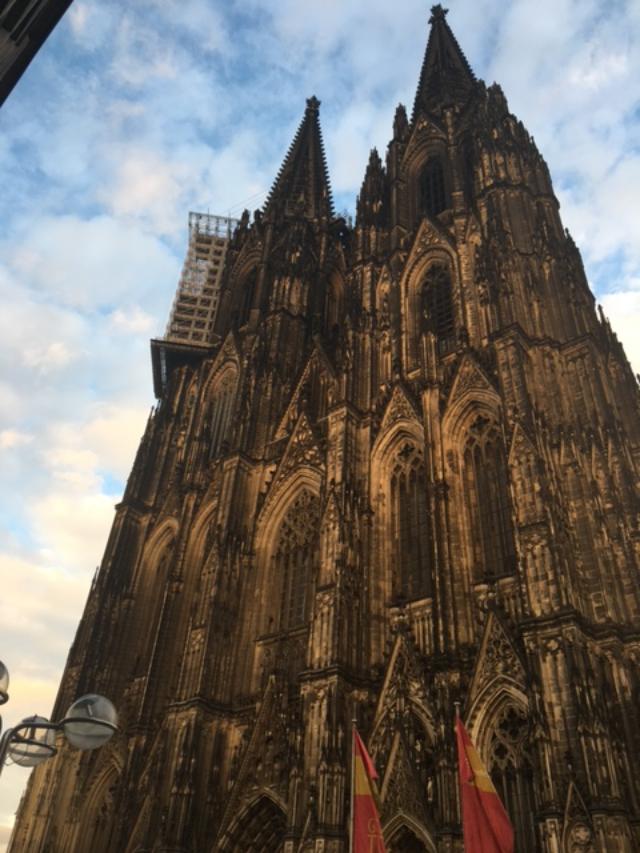
Cologne Cathedral Towers, Twilit:

These colossal spires, more than 500 feet tall, were in the original plans for the cathedral. As noted in prior reposts, part of those were rediscovered some 300 years after construction had been halted, leaving the church obviously, and clumsily, curtailed.

Whether it is a trick of the light or a variation in the type of stone, the towers almost seem luminescent in this picture, with the same evocative glow that appeared in my previous repost (July 16, 2022) of a sunset image of this building from the side. To me, here they suggest natural rock formations, rather than purely human labor. This sheen makes them look as much a part of the Earth – not merely on it – as sandstone pinnacles in America’s western deserts. There is an elevator leading to the roof of the Dom, but I didn’t use it, preferring to experience it at ground level, as it was principally meant to be seen; like this view.

The cathedral is, overall, resolutely Gothic, whereas buildings begun as long ago as it was often accrue embellishments from various eras through which they exist. Thus the great delay in completing the Kolner Dom likely ensured its final stylistic uniformity. Unlike many cathedrals completed in the same era they were begun, this one was spared much of the adulteration inflicted on fully Medieval ones, with Renaissance, Baroque or Rococo decor getting slapped over the original fabric. When Cologne cathedral was being finished in the mid-19th Century, no one wanted it to look anything but Gothic; and so it does, with very few exceptions.

The Dom is now the most heavily tourist-visited site in Germany; most people entering it now probably do so mainly as just another place of historic-artistic interest. And it certainly is that, but its formidable physical and extra-physical presences still present a setting in which contemplation may flourish, a sort of gravitational pull to which many so-disposed visitors surely find themselves responding.

Even in its long unfinished and ungainly state, the Dom was for generations a site of continental pilgrimage, owing to the supposed presence within it of the bones of the Three Kings, the Magi, men who attended the infancy of Christ. So each time I entered it, I reflected upon what Medieval folk – who never saw it complete, could only imagine its full, intended magnificence – might have hoped their journey here might grant them. And on what its tacit evocation of the tension between Eternity and human mortality may still offer us today; it was meant to summon and facilitate such meditation, and can continue to do so.

It is no coincidence that the English words ‘respire’ (breathe), ‘inspire’ and ‘aspire’ share the common root of the Latin, ‘spiritus,’ or spirit. In each case – including the process of breathing in and out – the very force of life itself is implied. ‘Respire’ means the constant cycling of that spirit, ‘inspire’ is the height and depth of expression it may generate, and ‘aspire’ refers to its fondest goals. So an inrush of breath elicited in a place like the Kolner Dom may also hearken to inspiration and aspiration.

Like all man-made spaces emblematic of faith that there is something to our ‘Being’ beyond the chaotic vale of tears we observe daily – even amid the assuaging technology of the 21st century – this church faces the issue of whether human life is irrelevant to an impassive cosmos, or has true and vital purpose. The Dom, like the ideals that brought it forth – joyously as the Three Kings kneeling at the manger – both proposes, and evinces, that it can.

That question takes different forms in different cultures, but its widespread preoccupation suggests it is an entirely natural human inclination, which we rightly use our Reason – as well as the other faculties that make us human – to explore. Animals fear danger and pain, but presumably do not contemplate mortality; our ability to do so may, of itself, alter our relationship to it. There may be some aspect of each of us as eternal as those great sandstone pinnacles in the desert; but unlike them, we can – should? – muse upon that possibility.

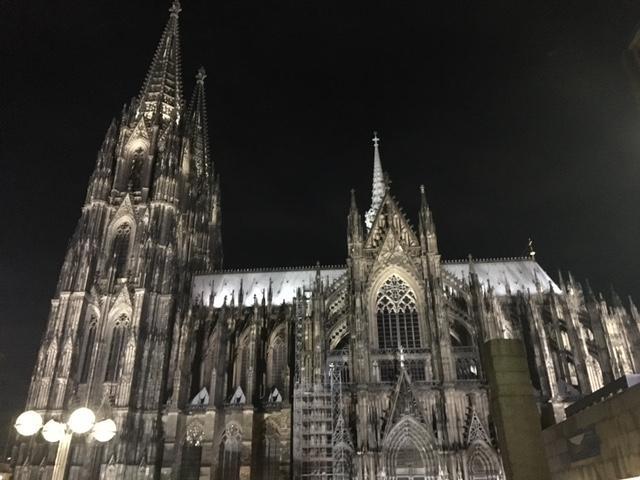
Cologne Cathedral Sideview, Floodlit:

This view of the Kolner Dom illustrates the building’s history and evolution. The part of the church to the right of the transept (the pointed gable), the apse, is complete Medieval construction, finished by about the year 1320. The transept and nave (the long, main open space where most of the congregation gathered for religious services) to the left of it were completed only part way up the walls, till the will and money for construction ran out in the 16th century.

The tower shown here at the left was only a stump about 100 feet high, and its twin rose just a few meters above its foundation. The building remained in that condition – less than one-third complete – for some 300 years. A Medieval crane on the stub of the near tower was left in place that whole time, becoming part of the city’s skyline, and a symbol of hope for the project’s ultimate revival.

It should be noted that before the Dom was completed, Cologne was mostly famous for its several exceptional churches in the Romanesque style that preceded Medieval Gothic (Gross St. Martin’s was the city’s emblem till the completion of the Dom; St. Gereon had the largest dome built in Europe between the Pantheon in Rome, and Brunelleschi’s in Florence). They were ancient and venerable, but the Dom eclipsed them all in splendor and fame, then were all grievously damaged or destroyed when the city was bombed in the 1940’s. Most were later restored, considered to be as integral to the city’s historic self-image as the newcomer cathedral; if not even moreso.  

When Cologne’s region became part of Prussia after the Napoleonic Wars, local Romantics, led by a vociferous Gothic-revering merchant, entreated the Prussian kings (the Protestant Hohenzollern dynasty) to finally complete the Kolner Dom according to a recently rediscovered 13th Century drawing of the original plans for its great front façade. At some point, it had been cut into 2 parts which ended up in different places, eventually recognized as intended for the Dom.

I don’t think original plans were ever found for the main nave and transepts, so their final as-built construction in the 19th Century probably had to be largely extrapolated from the façade drawing, the original apse, and the foundations laid long before for the unfinished nave. But I am unsure of that.

The Hohenzollerns agreed to patronize and help support the project. They had several likely reasons for doing so; they were famous for their militarism, so undertaking a legendary work of culture like the Kolner Dom could substantially refine their reputations. Also, finally finishing a great Catholic church, initiated long before the Reformation, would soothe the discomfort that many of their new, mainly Catholic, Rhineland subjects felt at suddenly being ruled by a leading Protestant realm.

Most important, the Hohenzollerns were already trying to position themselves (instead of the Catholic Austrian Habsburgs) as likely leaders of a future united Germany, and wanted to stimulate the spark of shared nationalism that was already stirring. The finally-consummated Kolner Dom would express German genius and artistry, as well as Prussian power and ambition. When eventually completed in 1880, its dedication was a national event, with the first Kaiser, Wilhelm I, in attendance.

A true architectural expert (unlike me) might dismiss today’s finished Cologne Cathedral as a latter-day adulteration of authentic Gothic design. But to most modern viewers, the building is a great aesthetic success; strong and graceful in a thoroughly Germanic manner, massive without being ponderous – and not semi-sensuous, as some French analog might be.

Cologne Cathedral from my Hotel Window:

At check-in, the desk clerk of my hotel in Cologne, a brief walk from the train station, asked if I wanted a room facing towards the cathedral, or away from it. At first I asked for one on the far side, assuming it would be quieter and that the great church would probably turn out to be too far away to see decently anyway. But my mind changed for no conscious reason, and I asked for the room with a view.

I often record reminder “voicenotes” on my phone, and after entering this chamber, started to speak disinterestedly into it, recording my room number, hotel breakfast hours, its address, etc. I still have that note, and in it, my voice suddenly crackles with delight as I look out the window and discover this stunning prospect: An imagined fantasy made real, not some vague, quasi “view.”  Very likely the most remarkable sight I will ever have from a window where I reside, even if briefly.

An exceptionally regal design was conceived for this glorious building because it was meant to house some of the most precious relics in Christendom, the alleged bones of the Magi (the Three Wise Men; the Three Kings ‘of Orient’) who, supposedly led by the star of Bethlehem, brought gifts to Jesus in the manger. The towers would have been the tallest structures in the world had they been completed during the Middle Ages (assuming they could have been finished with the building methods then). But within 30 years of the start of this building’s construction in the year 1248, the finances of the project had become unstable.

Cologne was rich (its location gave it access to both cargo ships from the North Sea and inland river-traffic trade), but it would be badly impacted by the discovery of America, which disrupted its profitable trading patterns. So work on the Dom sputtered on intermittently for more than 250 years before it came to a full halt, the original plans only about 30% built. And it would remain that way till construction was resumed in the middle of the 19th Century, for reasons (and motives) I will explain elsewhere.

This spectacle had the dazing effect on me that it might have been intended to have on a pilgrim coming to see the Relics of the Magi – even though, as a modern person, I have seen many other wondrous human works. And even though this building was not finished as shown here till long after the Middle Ages, for whose priorities it was conceived, were over. Unquestionably, the cathedral’s muscular grace, to say nothing of its tremendous scale, have the power to awe.  The Kolner Dom is so immense that its whole mass could not be photographed in a single picture from the open spaces adjacent to it; it wouldn’t fit the frame. A vantage like this one, several hundred feet away, was needed to encompass it all. Conversely however, its garlands of exquisite stone carving cannot be fully appreciated in such a full-scale shot; detail like that must be seen from closer up.

I savored this sight repeatedly during my stay in that hotel, and will keep that voicenote with its abrupt tone shift from distraction to enchantment forever, as a cherished souvenir. (In another now-precious voicenote, the cathedral’s great, sonorous bells can be heard ringing in the background of my speaking.)

This celebrated structure is truly one of the world’s great buildings. Like the far lesser known Virchow monument in Berlin, it seems a sort of counterweight to the poison of Nazism, an admirable face of German achievement that deserves our appreciation. But its story is about far more than stone and mortar, and cannot be told with reference to them alone. In other re-posts, I will deal with other factors integral to its origins, history, unlikely realization, what it was meant to assert, and to what it can continue to offer today.

The cathedral had a profound, wide-ranging impact on me, likely more than on most visitors. With my historical background and personal spiritual inclination, I came better prepared to register a fuller spectrum of its ‘totality.’ But its many aspects, and the attendant impressions of which I will write, were not just flickers of my own projecting: The character and aura of places that strive to represent their societies’ highest efforts and deepest beliefs – the Kolner Dom, the Parthenon, the Great Pyramid, Ankor Wat, etc. – may be accessed by anyone who will stand outside the push and flow of time, rushing events, and cultural assumptions, to admit them.

They exalt human aspiration and potential in ways that transcend the Ages, and the constraints of creed and individual experience.

Floodlit Cathedral Façade and Roman Arch, Cologne, Germany:

After Berlin in 2016, I only meant to visit one other German city. It wasn’t easy to decide which, as there are so many rich in history, culture, picturesque settings, etc., but I selected Cologne (Koln) in southwest Germany, principle center of the Rhineland, the basin of the great river. This area was long a powerhouse of the nation’s Industrial, and now post-Industrial, economy, with Cologne one of a group of towns (Bonn, Essen, Dusseldorf, etc.) that have grown till their regional boundaries seem to nearly overlap.

Two attractions, both referenced in this image, made me choose it. First, its heritage as one of Germany’s oldest municipalities; the Romans built an extensive urban outpost here, their Empire’s primary foothold in this part of Europe (Berlin, first documented ca. 1300 and long of little consequence, is comparatively new). Its name derives from Latin “Colonia” – Colony – which evolved to “Koln”; ‘Cologne’ is the French spelling. Considerable Roman ruins, including the rough arch shown here, still exist on and under its streets, and it has a superb museum of classical antiquities, mostly local.

Second in time, but more important to me personally, the city is home to what is arguably the greatest Gothic church on Earth, Cologne cathedral; in German, the Kolner Dom (formal name: St. Peter’s Cathedral). Its original design, conceived to hold the supposed relics of the Three Magi, was not completed till 600+ years after construction began; major currents of European history caused both its attenuation and its eventual completion. I’d been aware of this edifice since childhood, and felt that if I could only get to one place especially known for a splendid church, this may be the best of them all.

Cologne’s setting on the Rhine near its confluence with other waterways helped secure its long-term economic importance and prosperity. It remained substantial long after Rome fell, despite the general regression of the Dark Ages, through Medieval times and beyond, but during World War II its prominence and relative nearness to Britain (and its military airfields), made it a target of frequent Allied bombing. On the other hand, when the Third Reich was finally vanquished, the city, being far west, was captured by Americans, rather than Russians. So though already bombed nearly to dust, it was spared a paroxysm of street combat like Berlin suffered, and oppressive Soviet occupation.

I won’t write much on the Nazi era in Cologne as I did for Berlin, the historic focus of my travel in Europe, but it should be noted the Nazis regarded the place with suspicion. It had two alternate centers of power they could never fully co-opt nor crush: A robust presence of both Catholicism and Communism. The Church, though not as defiant of Fascism as it might have been, was by no means fully compliant with it, and was a stout obstacle to Hitler’s ultimate wish to scour Christianity from Aryan society. (In Nazism, Jesus was just another contemptible Jew, offering morality suitable only for vile weaklings. In fact, many Nazis felt that only weak and unworthy people needed the consolations of religion at all; in their view, the only truly worthy folk put their faith in strength, power and victory; ‘Sieg.’)

And Communism had been vigorous in the Rhineland’s vast labor base. The Nazis hated Marxism – like Christianity, a worldview with a Jewish founder – and decapitated the German Communist Party soon after taking power in 1933, imprisoning and killing its leaders, closing its newspapers, etc. But they couldn’t identify and coerce everyone who had ever voted ‘Bolshewik,’ so the heavily industrialized Ruhr Valley north of Cologne was one of several previously Red pockets in the Reich where National Socialism never fully took hold. Scorn, if not outright hostility to it, lay not far below the surface of Cologne’s vicinity; and Hitler knew it.

And his war brought cataracts of bombs down on the tepid town, as on most major German localities, although its lofty cathedral was relatively slightly damaged, deliberately spared by Allied warplanes to serve as a targeting coordinate. They apparently dropped their bombs on anything within ca. 2 miles around it, and thus most other cherished local buildings got smashed. Long after peace came, a few of those were painstakingly replicated, but it was impossible to restore all that were lost. Presumably, as in dozens of shattered urban areas across Europe, hard choices had to be made as to what had to be rebuilt immediately to return devastated, depopulated Cologne to life, and only then to revive its spirit.

Old photos include this arch, remnant of a large Roman gate, in front of the Dom, that seemed to show it had originally been about 15 feet lower. As part of reconstructing the wrecked city, the open space around the cathedral was raised so traffic can pass below it to allow unimpeded pedestrian access to the nearby main train station. The arch may have been lifted to the new grade level, but presumably in its previous horizontal location relative to the Dom, to (partially) preserve this remarkable spectacle, eloquently suggesting fundamental continuity between the distant past and present; of Cologne, and of the world.

Even so, disturbing this venerable artifact would have been a fitting metaphor for the epic upheavals this site, and city, have witnessed.

Berlin, Tiergarten: A Forest within a City:

A RELEVANT DIGRESSION: Before discussing this image, a restatement about my priorities:

As a self-identified historian, I am attracted to ‘grand’ themes, which often animate my posts for this blog. I fear this may sometimes seem pretentious (or grandiloquent), but please bear in mind the scope and gravity of some of my topics.

For example, many of my posts target Nazism, not just for its abominable crimes, but in shuddering revulsion at one of its root philosophies: It avidly asserted that human beings should adopt the kill-or-be-killed behavior of wild animals, claiming that Nature teaches that only the strong survive and that they have the right to prey on the weak – and Aryan Germans, of course, were ‘strong.’ This premise was not just the private fantasy of Nazi fanatics; it became state doctrine, part of schools’ curricula, and was promoted in official propaganda.

Far from encouraging rising above our bestial impulses as Western civilization had long done, Nazism treated imperatives, embedded in both Judeo-Christian ethics and Humanism, for compassion, empathy, moderation etc., as foul weaknesses to be replaced with nobler qualities; like lethal vainglory, utter ferocity and ruthless self-interest. The Law of the Jungle, Enthroned.

My tirades – jeremiads – about Hitler et al are not pretentious, in that my outrage is no pretense; I am deadly serious about the peril that he and his message of Satanic intemperance were, and still are. So I try to write urgent, bitter lessons of how monstrous phenomena like his worldview can seize control of human affairs.

If my words sometimes seem overheated, it is because I feel Hitlerism (or any win-no-matter-how mindset) remains a danger, and demands exposure as extreme as its potential harm and inherent depravity. And if believing we should follow the example of vicious, mindless animals isn’t depraved, I dare not imagine what is.

I understand most people are absorbed in the challenges of their own lives and cannot dwell on abstract menaces beyond them. But reminding, and warning about these, then become the tasks of people like me, who seem more inclined to brood upon ‘abstract menaces.’  

For we should not assume that Hitlerism, or anything akin to it, could never ‘seize control of human affairs’ again. In my view, every time anyone today doesn’t recognize (or care about) the dangers of glorifying triumph, criminal pride and callousness, if those serve their personal interests, they are blowing life onto the smoldering embers of the Nazi enterprise: Exalting in aggression more fit for brutes than for men and women.

And thus, they help keep that mindset abroad, like an evil spirit. Anyone – not just mad tyrants, but Wall Street wolves, law-scorning managers, salesmen pushing unsafe used cars for commissions, etc. – who believes it is a winner’s virtue to ignore all rules in order to win (or to not lose) is effectively a spiritual heir to Adolf Hitler. Whether they recognize/admit it, or not; if not his willing accomplices, his negligent accessories.

(I exclude those who bend rules in desperation just to survive, while regretting they must do so. I condemn only those who do so to flourish, perversely proud of their lack of conscience. Nor do I suggest that every instance, from mad tyrant to shifty used-car salesman, is equivalent. Some obviously cause far more damage than others, but no such deed is ‘harmless,’ because it helps perpetuate a loathsome attitude.)

So while some of my fellow Americans might be aghast if I claim there is similarity between the ravings of a psychotic dictator and our culture’s near deification of business success, to me, ‘Sieg, Heil’ (Victory, Hail) and our football motto, ‘Winning isn’t everything; it’s the Only thing,’ feel far too close for comfort, in spirit. It is not a huge stretch from that motto, writ large, to the Nazi belief that nothing matters but prevailing, by any means whatsoever. And thus, there are revered predators all over our economy: ‘Victory, Hail!’

The sentiment beneath, ‘Winning – is the only thing’ may not be a roaring fire, but it whiffs of those ‘smoldering embers.’ It would be better if those were smothered once and for all, rather than being revived/recycled by every soulless lout who can conceive of no reason to care about any welfare but his own. And who may even expect to be honored for doing so.

I don’t imagine that self-interest will miraculously vanish, nor should it. Properly used, it is natural, rightful, and a force for improvement; and certainly, I have my own. But if it gets glorified as the highest possible aspiration, Nazism grimly demonstrated where it may lead.

I hope this helps explain why I keep harping on Nazism; I fear the spark of its outlook is still far from extinguished. I sometimes write and advocate about other matters, but never with such unapologetic fervor as for this one.

And now for this image of the Tiergarten park in Berlin, depicting a truly ‘grand theme’; the Edenic enfolding of Nature, offering better lessons about peace, vitality and continuity than any words of mine ever could.

Berlin’s main central green space is called the ‘Tiergarten,’ literally the ‘Beast Garden’ – also a commonly-used German word for a ‘Zoo.’ As often happens in cities that originated in eras that had formal ruling classes, this park was once a wooded hunting preserve of those rulers (here, the Electors of Brandenburg).  They hunted “beasts” like stag, boar, etc., in this space, which still appears to be densely wooded, along with retaining its traditional name.  We roamed around in the park, and I was surprised at how extensive the tree cover was.  Unlike, say, carefully designed Central Park in Manhattan, other than the paved foot paths, the part of the Tiergarten we saw felt a great deal like untouched woodland.  And that is probably deliberate; Germans still have an exceptional affinity to Nature, from their ancient heritage as a forest people. Thus, it must have felt appropriate to leave a great patch of woods in as close to their primal condition as possible, in the center of a vast urban mass like Berlin. 

Many, if not all, of the trees shown here must be replants; most of the ones in this space previously were ruined or cut down, splintered when the Russians fought their way into town in 1945, or burned as fuel by Berliners during and after World War 2, when normal power service got bombed to a standstill. 

Parks are meant to be places of tranquility and self-restoration – ‘re-creation’ – and the Tiergarten seemed to serve that purpose admirably.  It has been replanted and revived as a soothing environment; somehow poignant, given the man-made calamities that once churned through it. Now the madness of men is displaced here by the reassuring constancy and resilience of Nature displaying its benevolence – which the Nazis disregarded in favor of their kill joyously-or-be killed interpretation of it, and which they sought to impose on humanity – reversing our evolutionary ascent to become masters of our passions. Rather than their slaves.

Berlin: Shrapnel-Mutilated Walls near Museum Island

CONTEXT: The mass of blasted ruins in Berlin has long since been cleared away, but unsettling reminders of the city’s near annihilation in 1945 still skulk on some of the few remaining pre-War buildings. This one, unmistakably marred with the scars of bombing and street warfare, was across the river from the Museum Island, where so many cultural treasures are located. The dome visible here is Berlin’s immense Protestant Cathedral, also on that island.

I photographed this image because its paradox seemed vividly compelling: evidence of human ferocity literally within sight of the fruit of human creativity: The assemblies of our collective genius on the Museum Island. Seeing the proximity of such glories to the ghastliness betokened by these wounded walls would later summon the verse below, ‘We Stones,’ out of me.

The very fact that we, as a species, are capable of such extreme opposites of behavior deserves – demands? – that we reflect on it, lest it ever take us unaware, again. As my verse asks – however clumsily – of us ‘men,’ and our recurrent appetite for raw dominance, ‘Can they not help but be so?’

When preparing to re-post this piece from my 2016 visit to Europe here, I discovered a revelatory irony: I didn’t know what this scarred building was when taking this photo. But when examining a satellite image of the vicinity to confirm the dome is the cathedral, I realized that this wall is near the Deutsches Historisches Musueum – the National Museum of German History (this structure itself seems to be part of the Haus Bastian, a Center for Cultural Education). So it may have been deliberately decided to leave this lacerated stonework ‘intact’ as very much a part of, and testament to, the gruesome chapter of Nazism (perhaps that’s what the sign on the wall at the right says, I didn’t notice). This would not only be consistent with the nearby Museum’s mission, but possibly a more instructive exhibition about ‘German History’ than any of the tidy displays within it.

One hopes that the adamant lesson about the horrendous potential peril of a feverish drive for ‘Mastery’ registers with Germans who happen to see these stones. In fact, with all who see them, wherever they come from.

And at an individual level, not just a nationality one.

We Stones –

Formed of magma in crushing heat, cooled over ages, our mother Earth slowly pushed us to her surface. For millennia, we formed her mantle and her mountainsides, only rarely reminded of the violence of our birth by earthquake, flood and lightning strike.

Then men shaped us with their clever tools, and bonded us together as shelter against the hostile Nature that made us all. For men, we resisted wind, cold, heat, rain, snow and storms, sheltering all within us in small worlds of survival.

But then men brought the violence of our birth back around us. Great, blasting flames fell day and night from the sky, till finally, humans making their own fire to destroy each other, surrounded, then reshaped us – once again.

Quiet returned, and with it our repose and inert witness. How can Men be so clever, yet also like the fierce, mindless Nature that formed us?

Can they not help but be so?