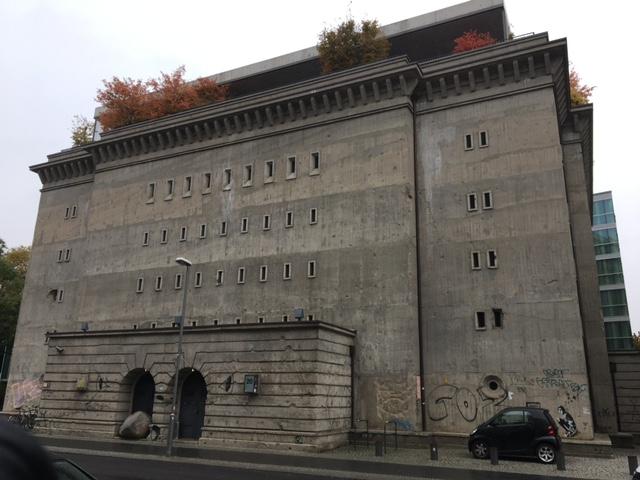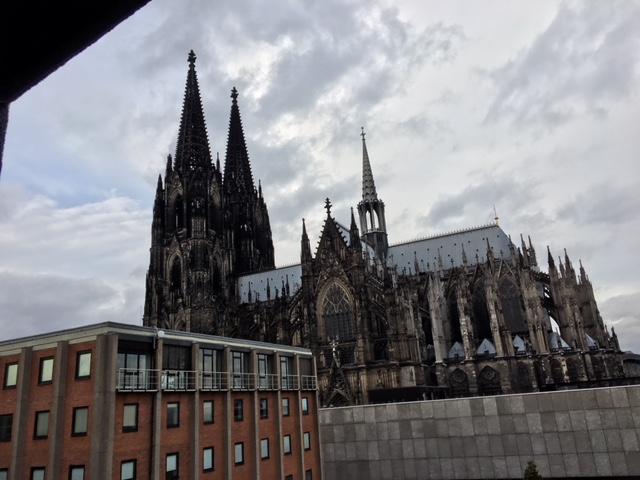
CONTEXT: After the forbidding Brutalist image of the anti-aircraft Flak tower, here is a contrasting sequel to both its appearance and purpose, less than half a mile away. In my post about the Ann Frank House’s relative nearness to the museum with Rembrandt’s revelatory ‘The Night Watch’ (posted July 17, 2022),I remarked the irony of that proximity: ‘a summit and an abyss of human endeavor, separated by a brief walk, yet from different worlds.’ And that contrast is reflected here also – with no poignant side-story like Anne’s – though this post contains a story of a different sort of tragic loss.
Few people alive today remember military conflict on a global scale like the second World War, but spectacles like that Flak Tower (and awareness of all the resources wasted on such things) may help drive home the message that national combat is the most pervasively awful, perversely counter-productive sorrow we inflict on ourselves. A British observer of World War I wrote of its devouring trenches, machine gun nests, high explosives, poison gas, etc., ‘It is all the work of the Devil.’
And so it is; in whatever guise ‘the Devil’ may take, trying to supplant our finest efforts and aspirations – such as are amassed on Berlin’s Museum Island – with our very worst ones. Unless one considers absolute indifference to the well-being of others a virtue, there is nothing noble, let alone, glorious about War – something about which we, who lack personal experience of it, must never let ourselves be deceived.
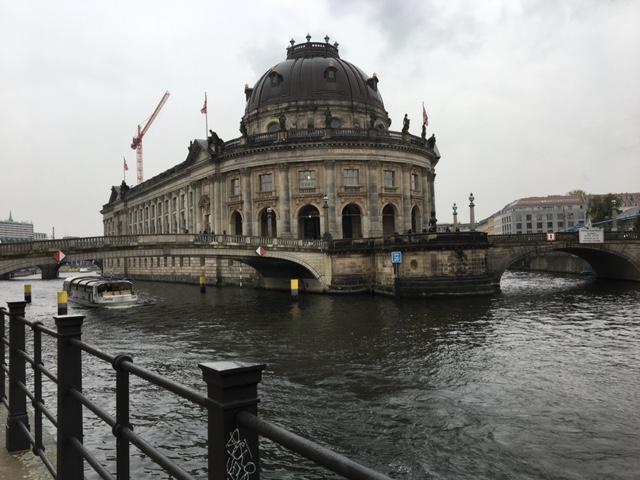
In another of my 2016 posts, this building appeared above a colorfully lit tour boat on the Spree river at night, a display of Berlin’s festive impulses. Germany’s capital is said to exploit its warm months more than any other city in Northern Europe, with an overabundance of outdoor events and pursuits. This was not so visible when we were there in mid-October, but the city felt very lively in any case. Even though signs of its destruction due to its role as Hitler’s capital can still be noticed, and it still suffers in the world’s consciousness from its (none too willing) association with him, it is not just a haunt of evil memories.
This building sits at the prow of Berlin’s Museum Island, home of a remarkable assembly of exhibition spaces for art owned by Prussia’s kings, and after 1871, by the Kaisers of the German Empire. Aside from this one, the Island is home to the Neues (New) Museum, the Altes (Old) Museum, and the Pergamonmuseum. The latter houses full-scale recreations of architectural elements from Middle Eastern antiquity, including the Ishtar Gate from Babylon. The seminal bust of Nefertiti, an ancient queen of Egypt, is in the Neues Museum.
The Bode Museum now displays sculpture. Originally it held Germany’s national painting Gallery, but after Communism fell and the city was re-united after 1989, the decision was made to move that collection to the new Gemaldegalerie in the Kulturforum (a district of cultural institutions – including the still-unconventional Orchestra Hall, the Philharmonie – south of the Tiergarten Park, created to replace arts venues destroyed in the war).
Or I should say, what remained of the national painting collection got moved. A void in today’s gathering of Old Master paintings (mostly German, Dutch, Flemish and Italian Renaissance) at the modern Gemaldegalerie is a wrenching reminder that violent struggle causes irreplaceable loss beyond human lives. Shortly before World War II, when it became apparent that aerial bombing was likely to be a part of any new military conflict (largely the fault of the Germans themselves, having prepared to greatly expand and enhance air warfare), major cities in the prospective combatant nations made plans to get their movable local treasures out of harm’s way.
Berlin did the same, evacuating much of the great art housed there to safer locations around the country. But there were many paintings in the Bode Museum (then still called by its original name, the Kaiser Friedrich Museum) too large or fragile to be moved. So when it was struck by Allied bombs dropped with the crude targeting mechanisms then available, a number of such monumental pieces were destroyed and lost forever; not just to Hitler’s Master Race, but to all of us. Presumably other treasuries on the Museum Island were also damaged in the bombing – as was the sumptuous Protestant Cathedral there – but I don’t know if their collections had already been removed.
(Something similar happened in the firebombing of Dresden; much of the music of Schuetz, a marvelous late Renaissance German composer which had never been copied, was incinerated and simply gone, depriving us all of whatever joy and delight it might have afforded.)
Today, the Gemaldegalerie, while rich in the modest-sized paintings that could be removed and thus preserved, is notably lacking in larger works. Their absence is a visual echo of how barbarism can tear at the fragile fabric of civilization. Part of Art’s purpose and mission is to moderate human behavior, but it cannot withstand fully unleashed passion; a burst of animal savagery can cause the work of the Ages to be undone.
CONTEXT: The next four posts are from my 2016 visit to Berlin. My friend Paul was with me, so he is the other part of any reference to ‘we’ in these.
I have already put several Berlin posts from that trip on this blog, but chose these to illustrate the whipsaw of history still visible, or manifest, in the city. That is, how the primitive priorities and bestial deeds of the Nazis came to appear, and to remain, amid the great achievements of previous, and 21st Century, German culture. They will show more about Berlin’s heritage as a place of civilization, but also lurking results of Hitler turning it into a stronghold of the unspeakable.
Realizing that such extremities can arise and abide within the same setting and society, may provide a tragic but worthwhile lesson about the breadth – for good and ill – of human capacities.
We were strolling aimlessly when we confronted this menacing apparition on Reinhardtstrasse. This was a platform for anti-aircraft guns (“flak”) to protect Berlin from Allied bombing during the war. It squatted there surrounded by ordinary new buildings; intricate construction to facilitate destruction.
It had the thickest cement walls I’ve ever seen, to resist direct bomb hits, an immovable relic of catastrophic violence like a facial wound that cannot be removed or fully hidden. Massive as this was, it was a lesser fortification; far larger such bastions were built in the Berlin area, some so immense that demolishing them might wreck precious infrastructure nearby. Those have just been allowed to deteriorate gradually, overgrowing with vegetation.
Thus this fearsome bulwark has been left in place, now housing creative-oriented businesses. Its solidity was hard to adapt, so office space got wedged into its existing voids brightened from their military austerity, with cosmetic exterior touches to soften its Bastille-like facade.
Even if one didn’t know its original purpose, there was no mistaking the grim demeanor of this sinister beast, making the harsh realities of war in every sense ‘concrete.’ It is a disfigurement of a city at peace – over which it still casts shadows – that made me shudder. Suggesting a vast dragon’s molar, it is a fittingly brutish image to reflect a regime that conceived and carried out a host of horrors of which the Holocaust was worst, if far from the only one.
The Nazis stole massively from their conquered territories; for example, nearly all concrete produced in occupied France was appropriated by the Germans for their own use, possibly including this tower. But like many Nazi policies, plundering defeated lands contributed to their own undoing, because starving subject national economies (and civilian populations) of resources and food for consumption in the Reich eventually weakened them too much to help the Nazi war effort. To say nothing of how the implacable rage that Germans exalting themselves as a ‘Master Race’ united overwhelming forces against them, including those starving civilian populations, avid for liberation and retribution.
Malevolence Hitler brewed in Berlin spread from the Pyrenees to the Volga like a great, swelling bladder of villainy till it burst, inevitably, on thorns that grew from the violence he had set loose on Earth. The feral aggression and depraved cruelty of Nazi Germany necessitated things like this tower to defend its own cities against counterstrikes by mighty foes it had provoked.
This bleak hulk failed in its original task of repelling the global onslaught a belligerent mindset had aroused, and now – exquisite irony – shelters creative activity instead. It is both a totem of war’s wastefulness, and an inadvertent, dire warning of what can happen if human reason is perverted to serve faith in brute force.
Quite a lesson there. Though sadly not all have learned it, as Russian ‘faith in brute force’ against Ukraine (as of June, 2023) shows. The fate of the Third Reich surely supports the premise that those who live by the sword are liable to perish by it. And rightly so; aside from all the harm they inflict, nothing less than the gradual improvement of human Nature itself may depend on such men, and such mindsets, not being allowed to prevail.
Another image of Prague, almost the opposite in scale and spirit of my panorama of its splendor from the Charles Bridge. In some ways, this intimate view seemed more typical of how the city’s atmosphere felt overall, in that it evokes what authentic, stable civilization looks, and feels, like.
This is not apparently a famous street, but set on a gentle slope with solid, quietly elegant buildings, it utterly charmed me. In most cities, such calm and unpretentious grace might make it extraordinary – even magical. Yet it seemed to be an area of casually dressed locals, and so may be just an ‘ordinary’ street in central Prague.
I have elementary knowledge of the city’s history, geography, etc., but it is not necessary to know much background about a place to sense when one is seeing something quite special there. This vista felt like a sort of mellow mist, yet also crystallized the essence of ‘authentic, stable, civilization.’
The young woman walking towards me here had a slight smile. I have wondered if she was a resident of the area, mildly pleased to see another tourist register her enchanting daily environs. I do not know, as we did not speak (I would not presume she knew English), but that was the impression her smile gave.
This modest street looked like an ambience to be embraced, not just ‘consumed,’ per the cultural reflex of the 21st Century. Civilization not as dismissal of the old, and frantic pursuit of novelty and progress, but as continuous and cumulative, rather than discrete and episodic. Of recognizing how the past may be imbued with experience that is now, and will remain, worth appreciating. And savoring.
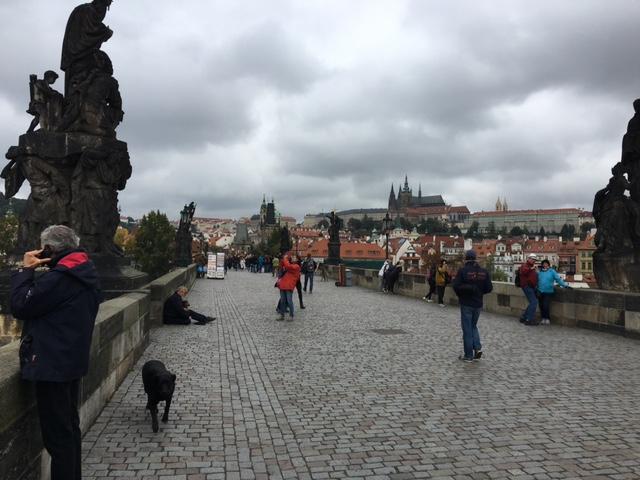
This is a classic view of Prague, showing some of its main monuments; for example, the spires of St. Vitus cathedral, standing proud above the red roofs of Hradcany Castle, are visible here. The gloomy skies notwithstanding, seeing this was a really singular experience; a panorama of characteristic Old World grandeur.
I took this picture from one of the city’s most beloved sights, its Medieval Charles Bridge (‘Karlov Most’) over the Vltava river, renowned for the sculptures that line it. Those had no unified theme, were clearly installed at different times in honor of different types of subjects, and given such prominent locations that many were probably major artworks in their own right. Most of the statues here are copies, the originals having been moved inside various venues to shield them from the elements.
Besides helping to discourage invaders, gates like those at each end of this bridge often had functions such as collecting tolls to pay for maintenance, or import taxes on transiting goods. Also, because bridges long enough to cross wide rivers were rare till the modern era, they often became focuses to spread information. For example, traitors’ heads were spiked on Old London Bridge as warnings; Venice’s Ponte Rialto was a prime place to hear news.
But Prague came close to having not survived to enchant us today. Heartbreaking as it was for the Czechs to yield their Sudetenland to Hitler in 1938 (after France and Britain warned them at the Munich Conference to do so, or fight the Third Reich alone), posterity should be grateful they submitted. Goering, head of the Nazi air force, had already threatened to bomb the city to dust – with regret, acknowledging it was a ‘lovely place’ – if the Czechs resisted this territorial theft.
All you see here might then have been destroyed, and lost. (As Paris might have been, had it become a battleground in 1940.)
We should also be glad Prague did not slash many wide, new streets through its venerable fabric for the sake of traffic efficiency (Paris and London did). A few such were added, but most of the central city still has an aura from less rational/regimented eras; small, labyrinthine byways. It is not the easiest urban geography to traverse or to learn, but there are plenty of towns that prioritize the needs of the car, and ease of navigation. Prague is rare both in scale and quality of ambience retained, for not having done the same.
In addition to surviving World War 2 mostly intact, the city’s historic center was largely left alone by the Communists who ruled Czechoslovakia from 1948 to 1989, which puts it in a small subset of places that history felicitously bypassed until their unfashionable, half-shabby prospect – by then rare – began to be admired. Prague, the national capital with some 1.3 million people in its region, is probably large enough to support skyscrapers, but none were visible. That suggests a deliberate decision after Democracy returned not to replace distinguished, elegant buildings in this core with new structures out of scale and harmony with such refined surroundings.
Czechoslovakia emerged from Nazi occupation, then Communist constraint in a subdued upheaval: The Velvet Revolution of 1989. After that, Prague, previously a treasure largely inaccessible behind the Iron Curtain, got rediscovered, to the delight of the world. And its charm – perhaps the word that best describes it – has been largely, and wisely, cherished and preserved since.
Water-fronting streetscapes like these had a certain sober charm which – since they have not been replaced en masse in the name of ‘progress’ – presumably reflects something of the Netherland’s national character. Though both Amsterdam and Venice are water-oriented, this Dutch town looked immeasurably tidier and more efficient than its Italian analogue (which I also visited for the first time on that 2016 European excursion). Unlike Venice’s seemingly random pattern of jagged canals and short, narrow streets unsuitable for motorized traffic, central Amsterdam has a carefully planned concentric layout.
And the desire for order of the city’s Golden Age proto-merchant culture is also suggested by the still-prevalent building stock visible here: Hundreds of narrow, 4 to 6 story-high residential structures, presumably built or owned largely out of profits from Dutch international trade or its domestic support enterprises. These structures appeared to be substantial but unpretentious, and evidently the fruit of careful investment. In contrast, older residential buildings in Venice did not give that impression.
That difference also represents a seismic shift in social priorities. Whereas most of Venice’s notable buildings seemed to be governmental, the palazzi of local nobility or religious properties, the multi-story blocks in which ordinary Venetians apparently lived along narrow pedestrian streets, in the era of the city’s zenith (several centuries before Amsterdam’s prominence) looked to be fairly non-descript, utilitarian – even a bit shabby, vertical hovels – shelter for the urban masses.
By contrast, the housing stock of Amsterdam presented solidity and order, not just crude abodes expeditiously thrown up. Looking at those rows of sturdy townhouses, one can perceive harbingers of a wealth-spreading, business-oriented society – not just a sprinkle of scattered elegance, based on restricted control of resources amid semi-squalor, typical of pre-Modern urbanism – that would continue to evolve, and help drive an interconnected world economy as it grew and prospered.
For example, the canal-side roadways visible here were likely originally built to facilitate moving commercial goods from water craft to markets in town, or beyond. Later they were adaptable to use for auto traffic and parking, whereas Venice’s haphazard layout precluded such re-purposing. Today, Amsterdam is still a locus of progress and evolution in civilization and economics, whereas Venice – a town tied to the Mediterranean as the world’s center of gravity, so then bypassed by oceanic exploration – has proven, physically and spiritually, far less ‘adaptable’ to change. Venice now mainly survives as a tourist destination, offering visitors evidence of its past glories. Reflect on that comparison, if/as you may.
The Dutch Republic was not democratic as Americans in the 21st Century might think of that word, but unlike almost all the rest of Europe, it was no longer wholly class-bound, either (as Venice, though also nominally a Republic, remained). Netherlanders then had less a “station” in life than a “standing,” which one could improve by personal determination and exertion; efforts that the ‘proto-merchant culture’ encouraged, and rewarded.
CONTEXT: I am currently nurturing some large writing projects, including an ambitious one for this blog. But rather than cease posting here till that is ready, I am going to re-post a few more items from my 2016 trip to Europe, starting with this one from Amsterdam. These will be relatively short, dealing mostly with substantial, not largely abstract themes. They are chosen in hopes they may provide context about places or events that inquisitive people might savor.
‘Exotic’ is a relative, subjective term. I live in Chicago, which seems comfortably familiar to me, but to someone from London, Moscow, Tokyo, Lima, Lagos, etc., my hometown may well seem ‘exotic’ – just as theirs would to me. For example, I was delighted when a group of visiting Parisians once told me they found Chicago – with its parapet of Skyscrapers and much of the best modern architecture anywhere sitting on the shore of glittering, opalescent Lake Michigan – ‘spectaculaire.’ They knew of nowhere in Europe where such stupendous works of Man abut such an auspicious natural setting.
I am very fond of my city and while I never considered it prosaic, it was a revelation to hear the impression it can make on people seeing it for the first time. So please consider: Might that also be true of wherever you live? Could there be things there you take for granted that would delight, even amaze, a newcomer? Paris’ inhabitants have appeared to me to be almost indifferent to their surroundings, even though those include some of the most elegant streets and structures in the world.
So while familiarity may breed indifference, never forget that our Earth is full of wonders and marvels, human and natural – or maybe denying easy categorization. Not all of them are ‘show-stoppers’ like Chicago’s rampart of cloudbusters, but many of them may be ‘breath takers’ anyway. And some of them may be in your life every day. So be attentive to the possibility of ‘wonders and marvels’ around you.
To start this interim series, something very cute from a museum in Amsterdam. By the way; ‘Brazilie’ is the Dutch name for ‘Brazil,’ where they once had colonies.
Amsterdam’s Rijksmuseum, in addition to artworks at the level of Rembrandt’s ‘Night Watch,’ was full of varied, whimsical items gathered globally, to remind the Dutch of the giant shadow their little land cast in its era of outsized, multifaceted achievement in the late 17th – early 18th centuries, when their ancestors sailed forth to explore, and exploit, vast reaches of the world. Its collection echoes a culture of openness to outside influence, upon which their culture apparently continues to evolve. This stuffed toy looked like an anteater, though I’m not sure (the Museum was closing as I dashed through its store, where this was displayed; no time to investigate). Such things don’t usually attract me, but now I wish I had bought this. It was a real novelty, and as you may agree, very cute.
Today’s Dutch people are reputed to be irreverent, resistant to pomposity and rote convention; very different from the severe character of their thrifty, Bible-guided forebears in their Golden Age – and possibly a logical development of their society’s drift away from rigid, approved behavioral codes. This is also reflected in their moral flexibility and live-and-let-live attitudes, demonstrated by the adult pleasures on show in Amsterdam.
It is also reflected in their attitude towards the Rijksmuseum itself. Although it contains some of the greatest creative treasures in the world, it did not seem like some set-apart temple of high culture, revered as a semi-sacred space and treated with hushed decorum. Instead, the Rijks felt more like an active part of contemporary Dutch identity. In fact, it is literally implanted in the everyday experience of Amsterdam, because a heavily used bike lane runs at street level between its wings. Such a synergy may say as much about the Netherlands of today as the displays inside the museum say about its Golden past.
It seems good the Rijks is part of dynamic communal life rather than an inviolate temple to be venerated at a worshipful remove. Great art requires concentration to create, or fully appreciate; but not necessarily humble reverence, for its energy to spread and affect a broader community. And that is surely true for sensations from the natural world around us, too.
CONTEXT: I first put this piece online in late October 2022, prompted by dark Kremlin hints then of using nuclear weapons pre-emptively before Ukrainian ‘terrorists’ did so first. Now threats of escalation are coming from that quarter again, on the pretext that Russia – waxing indignant that what it routinely does to the neighbor it invaded might now be done to it – is being attacked by (alleged) Ukrainian drones. So far, this has been on a minuscule scale, compared to the Russian V2-like weapons unleashed on non-military targets in Kyiv, etc.
The sacrifice of many thousands of Russian troops so far in Putin’s Special Military Operation (which he assumed would be easy – as Hitler did, of his invasion of the USSR) should prove that he sees his own people as mere tools, expendable for greater goals. Like the goal of appeasing his own gross pride at the loss of lands and peoples from Russian control at the fall of the USSR. So it wouldn’t be a surprise if he was behind bombings in 1999 which killed mere dozens. Nor would it be implausible if the current drone strikes are actually engineered by his regime now, as an excuse to unleash more and greater violence on its innocent neighbor-victim.
However: a wise friend suggested that instead of focusing my fury on Putin (as I have elsewhere), I take the broader perspective of Prince Andrei in ‘War and Peace’: That is, we suppose Great Men, like Napoleon, ‘lead’ history, but in fact they really follow it, by embodying the spirit of their times. A fair observation; Putin is likely merely the point of a spear of pre-modernRussian culture, which continues to allow him and kindred scoundrels to slash their way to the top of society. A culture that assumes brute force and brutish self-interest will always prevail in the human world.
But Ukraine is frustrating that assumption. Its valor, combined with the efficiency of NATO military hardware, organizational advice, intelligence – that is, every advantage of societies whose people are free to reach and harness their full potential, not be mindless slaves of the ruthless and powerful – are helping to show that Dark Age attitudes like those of Russia’s past and present rulers are not apt to ‘prevail’ in modernity (again, as Hitler also learned).
A hidebound cynic like Putin can neither accept nor grasp that, so the Free World needs to keep demonstrating it till this Mongol-inspired Muscovy mindset is conclusively bested by humane, righteous rationality. If not stopped, Putin and the whole awful ‘spirit’ he currently personifies, may inflict, on their own Motherland, the very destruction they insist the West is trying to achieve. That is, cause the dissolution of the Russian nation. And that, given how many times Russians have shownsuch great gifts as a people – when allowed to – would be a tragedy not just for them, but for the world.
A chilling reminder of some grim history, possibly relevant again: Vladimir Putin eventually achieved absolute power in Russia, arising directly from the terror bombing of several apartment buildings in Moscow (shown in the picture above, with a separate, explanatory article) and other Russian cities in 1999. Those crimes were cast as the work of Chechen terrorists, during a combat lull between Russia and its rebellious breakaway Muslim province, Chechnya.
But this ghastly episode may echo today, in 2022, in Russian hints that Ukrainians are planning nuclear terrorism.
Putin, having back then been recently named successor to the tragicomic Russian President and buffoon-in-chief Boris Yeltsin, used those bombings – which collapsed mid-rise civilian residential buildings at night, killing scores of sleeping innocents – as a pretext to restart the war against Chechnya. That led to an orgy of atrocities on both sides, with a bloody, poisoned ‘peace’ eventually won by Moscow.
But it has long been suspected – almost assumed – that those bombings were carried out by the secret police with Putin’s permission, if not his outright instigation, intending to blame the Chechens. That would serve as a motive to reignite the war against them, while also showing Russians they needed a strong leader like him to protect them. And given how he then pulverized the slumbering Chechen insurgency, it seems the worldview of those who gain power in Russia cannot tolerate not crushing any foe to dust.
(And there goes that Russian rulers’ ‘tick’ again, of being just fine with sacrificing the lives of their common people – ‘little cogs,’ as Stalin called them – for a supposedly greater good; like their gaining, or staying in power.)
I don’t speak Russian, but almost wonder if the language even has a word for ‘credibility,’ the idea that one’s past actions entitle one to be believed or trusted – or not – or if that idea even exists in a Russian context. Because the official story of Chechen culpability for the 1999 bombings may be just one of a long, sordid history of barely plausible lies told by rulers at the Center of Russian power, the Kremlin. For example, in 1946, they asserted that, after the Red Army drove the Nazis out of Eastern European nations the Germans had overrun, those nations pleaded for the Soviets to stay – ‘to defend us from Capitalism.’ They were supposedly happy to go from German to Russian slavery; that’s about probable as it sounds.
Either the Kremlinites are so contemptuous of common folk (and not just in Russia) that they assume such drudges will believe whatever Authority tells them, no matter how transparently unlikely it seems – like Chechens supposedly believing wholesale massacre of innocent civilians might help win their freedom – or so cynical they don’t care whether their fabrications are convincing or not.
(The Nazis contrived a ‘false flag’ operation as a rationale for invading Poland in 1939, ‘Operation Canned Goods.’ They took some habitual criminals from German prisons, dressed them in Polish army uniforms, shot them, then left their bodies near a border radio transmitter as ‘proof’ of a Polish incursion into Germany – justifying the huge, long-planned Nazi attack on Poland a few hours later. Hitler had told his generals ‘I will provide a pretext for war; never mind if it is plausible or not.’ And so very possibly Putin too, with the Moscow bombings, then Chechen bloodbath; Vultures of a feather flock together, it seems.)
I raise this ancient history now because of the ominous news that the Russians – who are the ones acting like rampaging, school/mall/hospital/infrastructure-targeting Nazis, not the phantom Fascists whom Putin tells his credulous base he is attacking their peaceful neighbor to destroy – say Ukraine is preparing a dirty nuclear bomb to spew radioactivity on Russian troops; or to sabotage a vast nuclear plant on occupied Ukrainian land. So now if such things happen, he’ll blame them on Kyiv as an excuse for committing worse war crimes than he has already.
Putin appears to have drifted into a surreal state of detachment from reality, a delusional brew of irresponsible indifference to potential calamity. Apparently, in his megalomania, nothing matters more than that his criminally conceived, ill-planned, and ludicrously executed aggression should not fail miserably. And he may stop at nothing to avoid that humiliating outcome. Or at least make the world pay for his frustration.
This is the sort of outlook and behavior alluded to in my March, 2022 FB post, ‘A Sustaining Folly,’ which was partly about how I feel the Russian people deserve far better rulers than they have historically gotten. But it takes epic personal courage to defy vicious, officially-empowered criminals like Putin and his ilk, prone to over-react to any resistance like the savages they are.
As to the echo of the ’99 residential bombings in terms of use of nuclear arms, rarely in my life have I hoped more fervently to be wrong. But if Putin suddenly asserts that ‘The Ukrainians plan to commit Nuclear Terrorism,’ – so Moscow can respond in kind, or worse – please recall those bombed Muscovites, slaughtered in their sleep.
You heard it here first: Putin may replay a trick that worked for him before, assuming no one remembers or cares. But some of us do, and indeed, must.
To conclude, this situation reminds me of an observation I’ve long held about the difference between human intelligence and actual wisdom: A species with the wisdom to wield nuclear weapons would have had the wisdom never to have created them. So God help All of us, that such power – and I don’t just mean atomic weapons – has found its way into the hands of a man like Putin.
‘The Glorious Revolution’ is the name usually given to the English ruling class’ overthrow of their King, James II, in 1688. It’s a complex story, but here’s a summary: At that time, most Englishmen were Protestant, and deeply suspicious that James, a convert to Catholicism, would try to make England a ‘Papist’ country again. To forestall that, a clique of the most powerful men in the realm persuaded William of Orange, leader of the Protestant Netherlands and husband of Mary Stuart – James’ Protestant daughter and first heir to his throne, after his young son – to sail, with Mary, to England to depose James, then become co-sovereigns.
This plan succeeded, virtually without bloodshed. When it became known that William and Mary were coming to claim his crown, James’ military command would not support him, nor would many of his most prominent subjects. With no army that would defend his hold on rule, James fled to France. The Presumptors arrived in England to widespread acclaim and approval, and were formally offered co-monarchy – contingent on their accepting several conditions including new, clear limits on their actual powers.
The royal couple agreed to those terms, and it was from this time that the executive supremacy of England’s Parliament over its Monarch began to irreversibly grow: The proto-version of the ‘Constitutional Monarchy’ of King Charles III’s impending coronation.
For in addition to its religious motives, the aim of 1688’s ‘palace coup’ was to preclude royal Absolutism as in France, whose King Louis XIV was virtual autocrat of his nation. England’s upper classes – indeed, most of society – wanted no such possible despotism, so henceforth their sovereign’s governance would be highly circumscribed, with more and more practical control gradually accruing to Parliament’s House of Commons (an elected body, but at the time, only male property-owners could vote). Eventually, the events of 1688 led to the successful version of Britain’s monarchy – with a King or Queen as nominal reporting authority and political backstop of last resort, but not day-to-day leader – that he, or she, is now.
It was indeed a ‘Glorious Revolution’ that such fundamental change happened with so little violent resistance, and led to a robust, durable socio-political framework. The nation’s ruling classes effectively ‘established’ themselves, not the monarch, as having supreme political jurisdiction. This would shift over generations, as literacy and economic influence became more widespread, to ‘majority rule’ with voting rights for virtually all adults.
But my title for this post, ‘Inglorious Revolution,’ alludes to a simmering suspicion regarding events some 250 years later, in 1936, which may still have implications for Charles III. The accompanying photo shows his great uncle, King Edward VIII, speaking into a radio microphone to deliver his abdication speech in that year, announcing to the world that he was giving up his throne to marry his twice-divorced American mistress, Wallis Warfield-Simpson.
At that time, as official head of the Church of England (Anglicanism), a British monarch was not allowed to wed a divorced person, but Edward made the monumental decision to yield his regal stature so he could make Wallis his wife. He was succeeded by his unprepared younger brother Albert as King George VI, father of the late Queen Elizabeth, and King Charles’ grandfather. After abdicating, Edward went into voluntary exile and duly married Wallis, but putting his personal happiness before the great office expected of him caused him to be largely ostracized by his family, disrespected by much of the British public, and to rarely set foot in the United Kingdom till his death in 1972.
Almost since he renounced the crown, there has been a drip of innuendo to suggest that Edward had not been fit to be King anyway. Beyond abandoning his responsibilities, which implied he had no sense of duty, after his abdication (but still before World War II) he and Wallis were public, ostentatious admirers of Nazism. It is suspected Hitler hoped to restore him to the throne and make Wallis Queen, if Germany conquered Britain in the war he was already planning. Worse, British Secret Service records hint that Edward was not unwilling to listen to such overtures from Hitler, an inexcusable disloyalty in one who had once personified his country. And after the War, he was involved in some base business deals that would have been rejected by any ‘man of honor.’
However: If Edward VIII didn’t have a sterling character, neither did many of his royal predecessors. For example, his grandfather King Edward VII had been so lascivious as Prince of Wales he was often referred to as ‘Dirty Bertie.’ And the reckless, tin-eared extravagance of George IV could well have ignited a French-style Revolution in Britain. Besides, many other blue-blooded Brits have famously acted anything but ‘noble.’ Edward’s position, and his antics with Wallis were so prominent and overt that, supposedly, they couldn’t just be discreetly overlooked; yet those of at least two ignoble Kings in the modern era had been.
While I have no reason to doubt that abdicating for personal romance was selfish and indifferent to consequences – upsetting society and threatening the exalted position he was born to hold (and source of all his privilege), the monarchy itself, that his affinity for Nazism, his petulance about his later treatment by his family and the British public, and his vulgar grasping for shady profit, etc. – are all true, there has also been indismissible evidence that his fall was ultimately due to something more than just his attachment to Mrs. Simpson.
It has been suggested that Edward’s insistence on marrying Wallis, a supposed deal-breaker that meant he absolutely could not remain King, could have been ‘finessed’ somehow. For example, Parliament might have devised some legal dispensation for him to marry his American divorcée, but instead, Wallis got used as a convenient pretext to get rid of him in as little unseemly a manner as possible.
In this interpretation, he actually was, in effect, deposed because his approach to kingly duties had alarmed some powerful domestic interests. His outlook, temperament and pleasure-seeking lifestyle were the opposite of those of his arch-respectable father/predecessor George V, and not only did he embrace far looser etiquette, he showed overt disdain, even contempt, for the petrified rituals of the royal court, much affronting Britain’s ruling caste.
But more crucially, as Prince of Wales during the early 1930’s – the Great Depression – and during his short reign after the death of his father early in 1936, Edward had been visible (and fairly candid) in suggesting that the government was not doing enough to help people who had lost their jobs, homes, or were otherwise still suffering in the aftermath of the economic turmoil.
Edward, who had always been rich and privileged, presumably had no idea of the intricacies of public financial and employment policy needed to provide such help. But he could see that many of his common people were enduring privation, while those who might have known how to fund social relief – the government, and especially the business community – didn’t want to raise taxes to aid their fellow citizens, or otherwise further complicate their own affairs at such a challenging time. So even if Edward wasn’t especially virtuous, in that instance he appeared to be aware of and empathic to the distress of his many suffering subjects.
Which was far more than could be said of many members of Britain’s higher social strata – both hereditary and ‘in trade’ – at the time. But for them, some of his public deeds and statements came too close to forbidden royal meddling in politics; and worse, to outright populism. His perceived ‘socialist’ sympathies made him a favorite of a great deal of the public, even when he was no longer King; and thus a lingering anxiety for Britain’s ‘Establishment’.
Much criticism rightly attaches to his later visits as a private citizen to Nazi Germany and personal meeting with Hitler. But the reality may be a bit more nuanced; one reason Edward (like a great many other people of all classes in Britain and elsewhere) felt Nazism couldn’t be all bad was because under it, Germany had virtually solved its unemployment problems, and generally appeared more efficient, dynamic and forward-looking than the Democracies, still struggling with the effects of the Depression. Besides, Hitler was a stout foe of Communism, which was then the primary nightmare of both middle class citizens, and the economic elite of the UK. (No doubt, including some of those who had contrived or approved of Edward’s downfall.)
I don’t know if the Duke of Windsor (the title Edward was given after abdicating) realized how much of the Third Reich’s prosperity was due to Hitler’s accelerating rearmament program in violation of the Treaty of Versailles at the end of the Great War. In that, along with other public works programs, millions of unemployed Germans found jobs. Thus, if one averted one’s eyes from Nazism’s ghastly facets – especially its violence against Jews (if Edward was ‘anti-Semitic,’ like a great many Englishmen, it was likelier to be stodgy social bias than murderous hatred), but also its egocentric pro-Aryan racism, its overt preparations to plunge Europe into war again, and any number of other less visible criminal intents – it might indeed appear to be ‘successful’ in ways that Democracy, encumbered by elections, rule of law, respect for individual rights, the search for political consensus, etc. – did not.
Such obstacles are easily, if inconclusively, overcome in any nation run by a dictator unanswerable to elected representatives or the citizenry. At the time, Mussolini, head of Fascist Italy, also got a lot of admiration, like Hitler, as a ‘doer,’ rather than a ‘talker.’ (A grim lesson; if strength is all you value in a ruler, you will eventually get savagery, when strength alone cannot overcome the practical complexities of rule.)
In this version of events, the real reason the ‘Establishment’ decided Edward had to go was not so much about Wallis – though her being a flippant, irreverent divorced American was indeed a problem for many of them – as about the prospect of a charismatic, seemingly open-minded king, whose office and aura might give him standing to insert input into official policy. As far as such people were concerned, Constitutional monarchs were not supposed to draw attention to themselves by word or deed in ways that created difficulties for the government (or other influential parties). For them, Edward, possibly oblivious to the depth of antagonism he was provoking, presumably crossed a line to unacceptability. As to the politicians, they may have feared that much of the populace might start to look to a genuinely concerned king for guidance, rather than to Parliament, jeopardizing their monopoly on political dominance.
A Monarch of England has the legal rights and duties ‘to be consulted, to advise, and to warn’ the regime of the day, which nominally derive their legitimacy as His or Her government. But any trend to actually impact, if not control, public policy, was something many of those in whose interests the country was really being run were determined to prevent. Especially, one suspects, if it meant government interference in the pitiless functions of the Free Market, and re-distribution of wealth to rescue the less fortunate.
But the politicians, bluebloods and lucre-men dared not expose the real reason for their disapproval of Edward: As King, he would have a preeminent platform from which to chasten them to do more for their dispossessed fellowmen (though no right to command them to do so). And he had already shown that he might make use of that podium. Thus, the religious implications of his desire to marry ‘the woman I love’ were used as a less blunt guise to maneuver him out of the way (facilitated by Prime Minister Stanley Baldwin, and the hidebound Archbishop of Canterbury Cosmo Lang).
Support and personal affection for Edward were apparently broadly felt among common Britons, so if this analysis of the forces that stealthily led to the loss of his crown is true, it was the most blatant case in modern times of the ruling class overriding the wishes of a vastly larger number of the ruled to get their preferred outcome: Edward gone, replaced on the throne by his pliable, tradition-loving younger brother as King George VI under a cynical aegis of ‘propriety.’ A tacitly, tastefully executed Coup d’état.
Let me make that clearer: The powerful got huffy that a King might violate the nation’s Democratic spirit by getting political – even as they, themselves, disregarded the apparent will of many, if not most Britons that Edward remain on the throne. So who was violating the supposedly sacrosanct ‘Democratic spirit’ more? A Sovereign who felt, and sometimes showed, actual concern for Britain’s downtrodden? Or its most comfortable, prosperous folk, invoking that spirit – while ignoring broader public opinion – because they didn’t want their yachts rocked? So much for the Establishment’s devotion to any Principle other than self-interest.
Events like the abdication frequently lack a ‘smoking gun,’ which makes definitive conclusions elusive. Thus, no one can know for sure if the forces noted above were truly decisive in forcing the issue, or were most or only some, part of it. I am no ardent apologist for Edward, who seems to have often acted, privately and publicly, like a clueless, spoiled teenager. Further, if he sincerely grasped how much hope ordinary people were putting in him – and had the character to put his duty to them first – he might have sacrificed his passion for Wallis and stayed King, so as to be a voice for his less fortunate subjects when they most needed one.
It may never be possible to assess for sure if this is why he was told he had to give up either Wallis or his crown – in the expectation/hopes that he would choose her – so that the ‘insiders’ would be rid of him and his incipient, ominous popularity. But if they were, the covert power-centers of the United Kingdom would likely have an interest, even today, in concealing whose wishes ‘matter’ and whose don’t, even as reminders of Edward’s genuine flaws are allowed to trickle out.
And it would have been the ‘Inglorious Revolution’ of my title. ‘Inglorious,’ as in a sordid, shadowy, self-serving ruse of an ousting: More ‘revolting’ than revolutionary.
Now, as longtime Prince of Wales, Charles, like his great uncle Edward VIII, also publicly expressed opinions that upset some strong quarters. If he does any such as King, and discreet whispers start to circulate that he is unfit for his office – despite decades of preparation for it – and perhaps should be nudged aside in the interests of ‘protecting democracy,’ please remember: It might not be the first time a King of England got driven out, theoretically due to personal failings, but in fact because he peeved some literal powers behind the throne.
I don’t pretend to have expert knowledge of British history and law, but am aware that, as to the parameters of 21st Century ‘Kingship,’ George V, who died 12 years before Charles was born, was a fairly hands-on sovereign, even called ‘an ideal constitutional monarch.’ During his reign (1910 – 36, including World War I), circumstances required him more than once to make practical political decisions reserved to the monarch such as use of royal assent, constitutional interpretation, etc., when events led to paralysis in the national government, or other potential crises.
His granddaughter, the late Elizabeth II – possibly sensing, or pointedly warned of, what actually brought down her uncle Edward VIII – was relatively passive for most of her 70 years as Queen. Legally, she really didn’t have many prerogatives of actual rule, but presumably had the same ones as George V, but seemingly rarely used them. Perhaps that was due to her training to reign, to a docile personality, because analogous issues to George V’s never arose for her – or perhaps she practiced utmost caution, having seen the friction her uncle’s overstepping the sensibilities of the powerful caused, whether or not it had directly led to his undoing.
King Charles may decide that, within the legal limits of English Kingship’s sphere – indeed, in the essence of his coronation oath to care for the well-being of all his people, not just the wealthy and prominent – he will be more engaged in setting the tone of national life than his late, beloved mother. If so, he might want to study his great-grandfather George V’s actions, if he hasn’t already, as a model for his own, to try to make his reign more useful to his nation than just a pageant, tourist attraction or platinum-handled rubber stamp.
As an American, I am not habituated to monarchy, and certainly couldn’t approve of the antique model of it, in which random birth leads to supreme rulership; there must be a better mechanism than that. Only after affirming that, will I say that neither do I sneer at Kingship as simply a perverse anachronism, for any nation with that tradition, current or recent. Elizabeth II showed that the office could still be unifying and stabilizing, as well as immeasurably coloring the lives of, and giving a sense of national purpose and community to, people who have, or perceive, few other sources of such benefits: The Disregarded.
Speaking of whom, it appears that many of the Westminster class, the elected Members of Parliament, are in danger of forfeiting (if they have not done so already) the ‘Democratic mandate’ which they piously intone validates their jurisdiction above a hereditary King or Queen. Britain’s long-ruling Conservative/Tory party’s claims to represent all citizens have worn so thin, they are now largely codswallop. It rules much as its American cousin, the Republican party, does: Protecting, increasing and entrenching the wealth, privilege and security of those who are already wealthy, privileged and secure – and hoping the mass electorate doesn’t notice. Assertions that they also govern in the interests of lowlier voters must appear a cynical charade, given how poorly they generally serve those constituents any time their wishes conflict with that of their actual ‘base’: The Mighty.
Further, I would point out that popular election led – in a semi-comical case in point – indirectly to the accession of the buffoonish Boris Johnson (a Prime Minister is ordinarily the head of whichever party has a majority in the House of Commons); hardly an example in popular election’s favor. Nowadays, Tory politicians may seem to be scarcely veiled shills for the affluent citizens of the UK, for whom the public apparatus of monarchy mainly serves as a decorous fig leaf of respectable pretense for their coarsely self-serving conduct of national policy.
That being the case – and having lived for 4 years under the Presidency of a man vividly unfit by experience, temperament and intellect for such responsibilities, but made so by ‘popular election’ (actually, the Electoral College) – my faith in its superiority as a mechanism for selecting leaders is no longer absolute. While I would never advocate Kingship in the U.S., for Britain – sometimes referred to as a ‘Royal Republic’ – a modestly more engaged Sovereign, adroitly calling attention to the (tactfully styled) ‘inadequate policies’ of those claiming to lead by right of election, however squalidly won or retained, might be genuinely helpful to a great many Britons.
At one time, ‘the Commons’ really did need to check royal overreach. But now, Britain may have come to the point where a wise, temperate ‘Carollus Rex’ might be able to contribute meaningfully to implementing the chivalrous substance of his sacred oath for his sacred office, to serve, protect and defend as much as possible the well-being of his people. All of them.
Because the Tories have sure as Hell shown – again and again, posturing brazenly all the way – they can’t be trusted to govern for the ‘well-being of his people’ in terms of shifting taxes, slicing public services, ad nauseam.
(I fantasize about drafting a mock coronation oath in which the feigned paternalistic care is stripped out, and the King curtly pledges to reign in – not to ‘rein in’ – the interests of the Grandees of the City of London’s financial markets and all other plutocrats, domestic and foreign: Arab, Russian, etc. It would drop the alleged concern for regular, left-behind Britain, where incomes are shrinking along with public services eroded by tax-slashing Conservatives. It would also include a firm reproof to his subject ‘proles’ not to press their tiresome hopes for a secure, First World standard of living, if providing such might disturb the Elysian comfort of their betters.)
In their virulent self-regard, too many in that ‘ruling caste’ seem to presume the Monarchy is mainly there to perform an edifying ceremonial role, and otherwise irrelevant. But they may be proved wrong.
Therefore, if King Charles III actually tries to have legitimate (‘advising and warning’) influence on what priorities ‘His’ government might focus on – to not just act as an ornamental bulwark of a Status Quo beloved by those who benefit most from it – be on the lookout. Scandals about, for example, his past romantic improprieties, may suddenly start to twitch again, questioning his worthiness for his exalted station. Or possibly the dominant cabal will even toy with dispensing with monarchy itself, if they decide it has finally become more trouble than it is worth, encumbering, rather than sustaining their primacy – national identity and the sensibilities of millions among the lower orders be damned. But here is some advice to those privileged beneficiaries: Your lot may have dispensed with the callow Edward VIII when people were less informed and likelier to believe whatever ‘authority’ said. But don’t assume you’ll get away with a second ‘Inglorious Revolution,’ shoddy, shadowy, shameless, and anything but patriotic.
Such people’s cynicism corrodes the respectable regal institution they rely on to dignify and camouflage their none too well-concealed self-interest. And thereby, they rely on a man about to take an oath – before God and the World – that he will reign for the welfare of his entire nation. But also a man whose judicious guidance might help moderate the disenchantment of a growing segment of the ‘United’ Kingdom, those exploited but otherwise ignored by entitled magnates, public and private, who still don’t grasp that Brexit may have been just a warning tremor of an Earthquake of gathering discontent beneath their feet.
CONTEXT: A final re-post, for now, from my 2016 visit to Berlin with my friend Paul. I post this to try to exorcise my still-throbbing rage at this image – as you, kind reader, will surely understand when you see it. This post was meant to convey stark, heartbreaking evidence of why Soviet style Communism not only would, but must succumb, as an encumbrance to the happiness of the world. This, my last word on the Berlin Wall, is chosen to affirm my opinion on that matter.
However: As I have aged (matured?), I cannot reconcile donning a metaphorical robe of righteousness to validate oneself and all that is dear to one – like a proud proclamation that ‘All men are created equal’ – then acting as if somehow, such assertions offset behaving non-righteously. For a coarse but valid example, let’s ask Native- and Black Americans how ‘equal’ America seems to them.
Loving something – as I love my country – or someone, doesn’t mean we must pretend the object of our affection is perfect. Indeed, love may let us recognize its potential to become better than it is, and strive to make it so. Thus, in my last post, about ‘Checkpoint Charlie,’ I suggested that despite having outlasted Communism and providing more material abundance, the American system of Capitalism is far from ‘perfect’ in various senses. And that we Americans should not avert our eyes from the harm and injustice that system is capable of doing.
For example – an echo of what you will see in this post – no doubt, innocent American children have also died needlessly because some executive made a ‘business decision’ to cut corners on car safety design – until the number of people killed in car crashes necessitated adding features to prevent such deaths. No robe of righteousness can conceal the implications and consequences of a culture that so often ‘puts profit before people.’
But for my last word on the subject: I believe absolutely that willingness to kill babies to uphold state control is far worse than accidents due to callousness (despicable though that is). A government that would do so has forfeited any right to obedience or respect, let alone patriotism. Be outraged and thankful the Berlin Wall and the awful regime that needed, built and maintained it are gone, but do not then be satisfied that our own society is faultless. Recognize its flaws, care for it in spite of them, and – if you feel it is worthwhile – resolve to help bring it closer to its ideals than it was, or is.
Photos of Children Killed Trying to Escape through Berlin Wall: The weather when Paul and I went to the site of this remnant of the Wall and memorial to fugitives murdered trying to get past it was chilly, gray and damp – thoroughly suitable for so depressing a spectacle. It started to rain as we walked around, as if Nature herself were weeping at this site of such bleak evidence of the folly and failings of men (that may sound like a cliché, but truly is how it felt). Many people had been killed at the Wall, their names and pictures enshrined here, but it was particularly infuriating to see these images of children – presumably their ages when they died, probably with parents risking all their lives to get to freedom – so that I may have snarled involuntarily aloud on seeing these. I’m not sure I did, but given the setting and provocation would not have been the least embarrassed to do so.
No single political ideology is so all-encompassing as to address every human need and aspiration. And any that assert that they are – as did both Communism and Nazism – must fall short, and often resort to force to maintain the semblance of inerrancy, so at odds with actual experience. The Soviet Eastern bloc was no Workers’ Paradise, no matter how often or loudly its rulers bellowed that it was. Their reflex was to suppress evidence to the contrary, and to treat anyone who wouldn’t play along with their official fictions as a criminal.
Capitalism certainly outlasted Communism, but that doesn’t mean that it was, or is, remotely perfect. No system in which some members flourish massively while others starve can ever be considered “ideal.” But that doesn’t mean I’d find any sort of Totalitarianism preferable to America’s messy, contentious, always-in-progress democracy.
And if I’d had any uncertainty about that before, seeing those pictures of dead babies certainly squashed it. Any sort of regime that can only survive by killing people, even children – for the heinous offense of wanting to live elsewhere is in effect, committing human sacrifice to the idols of its doctrine, rather than admit it is not flawless – is inherently doomed. The sooner it croaks the better; and that surely includes North Korea.
CONTEXT: This is another image and text from my 2016 visit to Berlin. This scene may have changed in the years since, as might the accuracy of my reference to trolleys remaining only in what had been East Berlin. I’ve heard since that there is some possibility of reinstalling them in former West Berlin given the traffic there, and Germany’s wish to discourage the prevalence of sole-occupancy cars, tohelp reduce Global Warming.
Which, along with its attendant mass refugees, and the worldwide emboldening of dictators such as Orban (and Putin/Xi) – as governments and business communities foolishly fray mutually beneficial Social Contracts with their countrymen – are developments that have accelerated or appeared, since this picture was taken.
One thing that has not changed since then, distressingly, is the dangerous and dispiriting way nations that had relative economic equality (or at least not ludicrous inequality) in the 30 years after World War II have continued to revert to a 19th Century/quasi-Third World social structure of a thin stratum of extremely rich, but heartless, stupidly shortsighted people – who divert more and more national wealth to themselves – and everyone else, from whom that wealth gets diverted, struggling to maintain a decent standard of living.
And justifiably resentful of needing to do so.That is relevant to the point I try to make at the end of this post, and it seems more true now than it did then. Which is depressing, but also ominous.
Even before the Berlin Wall was begun in 1961, travel between the city’s Soviet, and French, British and American zones was closely regulated, but not enough to stop the debilitating flow of East Germans to the West. This site on the broad roadway of the Friedrichstrasse was the only authorized entry/exit point between the American and Soviet sectors after the Wall was built.
The Americans officially regarded the division of Berlin as temporary, so never constructed permanent control-structures here (the wooden guardhouse now in place is a mockup erected to mark the original’s location). ‘Checkpoint Charlie’ saw frequent heartbreak and desperation after the Wall went up, as East Germans tried guile to sneak past here, as their country became, ever more, a veritable prison.
Please note the KFC sign, of a Kentucky Fried Chicken. I’m not sure that spreading relentless consumerism means that Capitalism “won” in the sense of proving objectively better than Communism, as this crass sign is hardly a banner of noble hopes fulfilled. But its presence at an iconic site of the Cold War certainly shows who buried whom (Soviet Premier Khrushchev, when his country was winning the Space Race, had jovially taunted the West “We will bury you.”).
Since 1990, eastern Berlin is being updated in ways Communist economics could not afford to do after the city’s devastation in the War, so as to gradually become indistinguishable from former West Berlin (other than trolley cars in the East, which had been ripped out of the West due to the abundance of private cars there). But putting a fast-food logo by a place that perhaps deserves reflection – even thoughtful respect, given what it has witnessed – suggests that not all change is invariably ‘improvement.’
Marxism failed to deliver on its Utopian promises, and was only sustained by force in East Europe till its inevitable collapse. However, a reality check would seem to be in order: Most Soviet Bloc propaganda about Capitalism and “bourgeois Democracy” was a tissue of lies, but it included one assertion that was not, and is not, so easily dismissed. It said that of all the supposed Freedoms in Democracy and Capitalism, the most basic is the ‘Freedom to Starve.’
Please reflect on whether that assertion actually was, and is, still basically true, if – when – you see homeless beggars in America. In post-war Communist Europe, state control of resources meant that almost no one chronically went hungry out of inability to make money, even if the general diet was pretty spare and bland. In my view, actions speak louder than platitudes, so our stated values of justice, fairness and equity are grievously compromised by the reality that some of our fellow citizens are effectively treated as acceptable collateral casualties of the Free Market.
For me, that echoes – distantly, but still too close for comfort – with Stalin’s indifference to the colossal loss of Russian troops’ lives in order to conquer Hitler. We in the West might not sacrifice blood that way, but it is less clear that we will not sometimes let whole lifetimes be wasted.
This should not be idly accepted in any society professing that each person has value – in America, ‘endowed by their Creator’ – as distinct from his or her worth in hard assets. That concept is the supposed foundation of our celebration of the Individual, and is stained when any life is treated as being of no inherent importance. Even that of a homeless beggar.
In this case, Soviet propaganda seems to have been right on the money; so to speak. No one – not even a Communist – is wrong All the time.