It was obvious that a day would come when U.S. states whose political cultures deny Global Warming would have to confront its inescapable effects. Please see the article below, from January, 2020 (shortly BC – Before COVID).
First, a few relevant thoughts:
In the year 2000, Florida put Denier-in-Chief, George W. Bush in the White House instead of environmentalist Al Gore, due to a recount of the state’s votes (the Supreme Court shut the process down when ‘W’ was ahead). During that sharply contested recount, the media spoke a lot about ‘hanging chad,’ the not-quite-detached punches of paper ballots that were being examined.
Well, now ‘Hanging Chad’ has led to ‘Sinking Flo.’ It is an unhappy, but remarkable irony that Florida – mostly surrounded by the sea and largely flat – was pivotal (no doubt, against the wishes of many if not most of its voters) in halting progress to address climate change for the 8 years of W’s terms. Not long after Bush’s ‘election,’ I predicted that this outcome would eventually bite Florida in the backside due to rising seas. Sure enough, now they are more at risk from that threat than almost anywhere else in the U.S.
I don’t like ‘Schadenfreude’ (the German word for the unkind act of reveling in the misfortune of others). But it’s hard for me not to be at least somewhat bemused by the predicament Florida’s vote back in 2000 has now helped land it in. I will not ‘revel’ in their misfortune, but is a bit of ‘Chad-enfreude’ – feeling some (bitter) satisfaction at having been proved right – permissible?
The article ends by saying that some of these states’ officials might walk away from federal aid rather than admit the reason they need it is that Global Warming is not just some liberal hoax or fantasy – though not Florida’s officials, who realize they now need all the help they can get. As to those officials in other at-risk states, let this sink in (so to speak): They would sacrifice their own citizens – often the most vulnerable, like the minorities in New Orleans’ Lower Ninth Ward, hit hardest by Hurricane Katrina in 2005 – rather than admit they were/are wrong. How low can they go?
We may find out. Sadly, many innocent victims of their stubborn refusal to acknowledge accelerating (and frightening) evidence – and not just in the U.S. – may also find out.
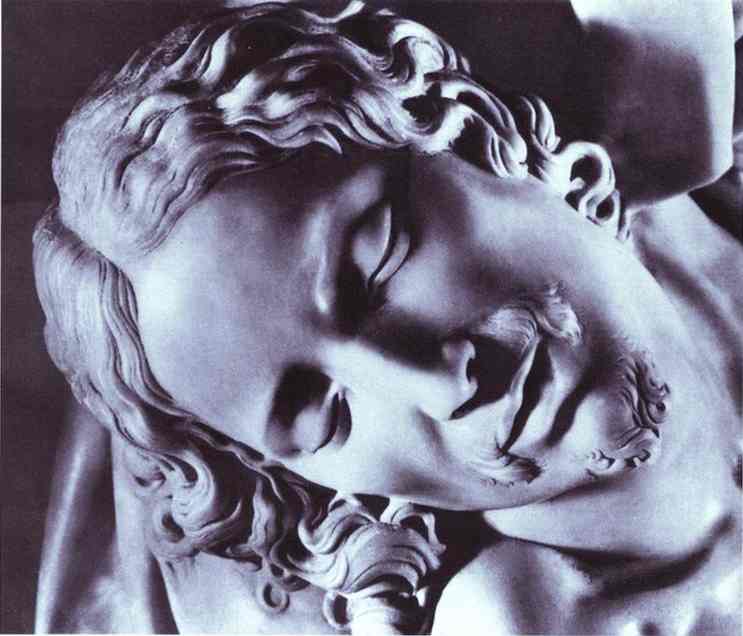
This is the head of Christ of Michelangelo’s Pieta, usually seen from the side rather than in this arresting full-face perspective. In a rendering whose eloquence itself radiates the miraculous, it conveys epic suffering, but also serenity that such has been endured to open Paradise to all the children of God.
Might this image suggest what the ultimate evolved state of humanity could be? Or should be? Capable of Love that, counter-intuitively, actualizes the Self by acting with regard for the Other that is limitless, and thereby – for the ‘Self’ passes away, but there will always be ‘Others’ – merging with eternity and infinity? In my view, that may be the truest possible meaning of Enlightenment.
As we all know, altruism can be dauntingly difficult in practice. But for inspiration, one may reflect on Michelangelo’s depiction here of how a sublime benevolence might appear.
Queen Elizabeth was likely the most globally famous person, for the longest time, of anyone in history. Thus, she was a constant in the firmament of most people in the world today, including mine, if rarely consciously. Hence her death seems an occasion for some reflection.
No doubt the Queen had many failings, limitations any of us might have, was neither perfect nor saintly. But her privilege and fame should not be held against her, as they probably came at great personal cost, which only those nearest her could be aware of. Also not, in light of how she often put those advantages to use for the common good.
As an American, I have no direct experience of monarchy, but have seen what my society, which routinely sanctifies unrestrained pursuit of personal interest with no tempering presence (like the institution Elizabeth embodied, to try and remind us of values like moderation and ‘honor’) can become. This perspective colors the remarks that follow.
Unlike many people in my circle I am not a fervent fan of theater, but the only New York Broadway show I ever really wanted to see, and did, is relevant for Elizabeth’s passing: ‘The Audience,’ with the marvelous Helen Mirren portraying the Queen. It was a fictionalized version of a weekly meeting (audience) she had with her then-current Prime Minister; 14 of them, from Winston Churchill to Boris Johnson. Those encounters were the Prime Minister’s obligation to keep the sovereign informed about all important matters (presumably including secret ones) the government was undertaking. Those conferences were absolutely confidential; no one else knew what was said during them. So ‘The Audience’ is only thoughtful speculation.
Mirren’s Queen was admirably regal, yet deeply humane. Also pretty savvy, for someone whose position put her above the muck of practical politics, but to whom the highest ranking politician in the land was responsible. Mirren’s age (makeup) changed as the show progressed, from the 25 year-old Elizabeth was at her accession to the throne, to the font of mature, self-reliant wisdom she became.
I believe the play reached an ingenious – and now very pertinent – resolution. In scenes where the Queen was alone speaking to us spectators, and also summarized at the end, she pointed out that her role caused her to cross paths with many of the smartest, toughest, bravest, most talented and generally remarkable people in the world, from Britain and beyond. But she was self-aware enough to recognize that she herself was no prodigy, just an ordinary person whom Fate had thrust into an extraordinary locus of fame and influence which her own modest abilities could never have won for her.
From that realization, Mirren’s Elizabeth offered a great lesson: That all these extraordinary people had, like her, gifts that amounted to random acts of Fate. Like so many of them, she made the most of her position and what skill she had, or learned, to use it. Yet also like them, she could have been just an anonymous citizen but for the intervention of events she could neither foresee nor control. In their cases usually their own favorable genetics, in hers the abdication of her uncle King Edward VIII which led to the unexpected reign of her father George VI, because of which Princess Elizabeth became heir to the throne, then Queen, in 1952.
‘The Audience’ suggested (if I recall) that Elizabeth’s very ‘ordinariness’ qualified her to speak to the Mighty and the prodigies of the world on behalf of us common folk. Including the world-class politicians who became her Prime Ministers, and to whom she (not having to worry about re-election) was shown as often giving good advice.
Perhaps in real life, the actual Queen Elizabeth bore such contingency in mind to try to restrain, or at least reproach – within her limited temporal scope – the most extreme actions of the callous gifted with whom her station brought her face to face (for me, epitomized by Margaret ‘feed-the-weak-to-the-strong’ Thatcher).
The overriding lesson is that we are all on the ‘wheel of Fate’ to some extent, from a hereditary sovereign to those ‘smartest, toughest, bravest, most talented people’ in the world – whether they recognize (or admit) it or not – whom she would never have met but for the circumstance of her birth. In ‘The Audience,’ the Queen adroitly reminded Thatcher that as a person born fortunate and gifted (and I assume, ruthless), she should not regard everyone who had not succeeded financially or professionally as failures, their lives and labor to be exploited by the world’s ‘winners.’ Like Margaret Thatcher.
If the late Queen truly did harbor such attitudes, it surely helps explain why she was as successful – stabilizing, reassuring, beloved – an entity as she was. In this interpretation she could, and did show how a less-gifted person might determine to exemplify grace, probity, continuity, etc., while (because there was no place higher for her to rise) immune to personal ambition. She apparently simply expected of herself what her people expected, and needed, from her.
Elizabeth II helped her monarchy to evolve, survive and in some ways, thrive. No longer holding absolute power as ‘the Lord’s anointed’ as Kings long did, British royalty’s most useful purpose today may be to pull the attention of the Mighty – like it or not – to the interests of those who have less voice in the running of their country than the Westminster cliques, and barely covert, but massive power of the financial City of London.
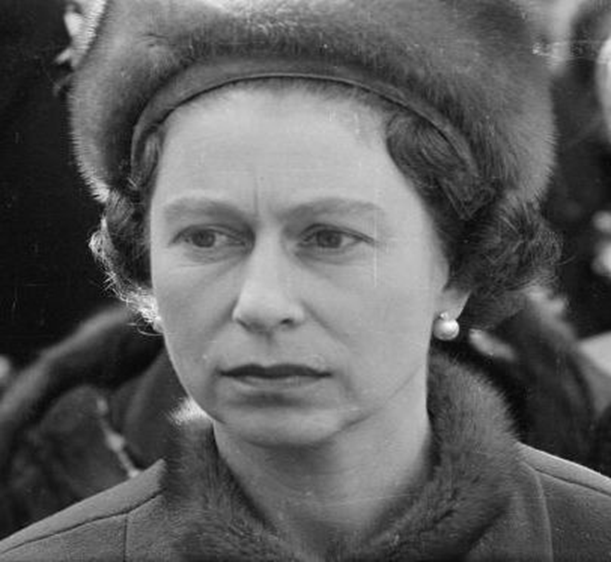
Another aspect of her life that deserves reflection is speculation about her degree of emotional depth. To that end, I offer the accompanying photo of her taken in Aberfan, Wales after a catastrophe there in 1966. A huge pile of spoil from a coal mine collapsed, buried part of the town, including its grade school, killing 144 people, mostly children.
The Queen has periodically been said to lack normal emotions, but look at her facial expression here, from when she visited the site several days after the disaster. This is hardly the face of one unmoved by the sorrow and tragedy she is seeing in a devastated community. The Aberfan avalanche was one of most terrible domestic events during her reign. She didn’t go there immediately after it, but as she confided much later, that was not because she was unsympathetic, let alone unfeeling.
On the contrary: She’d feared that if she went there while they were still dragging out the bodies of dead children, she might dissolve in tears at the spectacle. But that was exactly what this shattered village did not need; confirmation, by one who had not lost a child there, that their calamity was indeed, overwhelming. So she waited till she felt sure she could display supportive empathy, rather than more fuel for the grief by succumbing to it herself.
This was one of very few occasions when she was seen to shed discreet tears in public. In fact, it took much courage and sense of duty to voluntarily walk into a setting of horror most people would shun. Nevertheless, she later confessed that letting a week pass before going to Aberfan was one of her worst regrets as Queen. For Elizabeth, it was that, as personification of ‘the Nation,’ she must share – and be seen to share – in its tribulations, not just its triumphs.
(The people of Aberfan understood her hesitation. Further, they later said they would have been too dazed or absorbed in frantic rescue efforts to register her presence had she visited sooner. Her arrival after the initial shock passed allowed them to benefit from her recognition and support in their unspeakable loss.)
Look at that picture again. Her heart was probably cracking at the ghastly distress around her, but breaking down herself would not have helped her suffering subjects, so she forced herself to be strong for their sake. For that matter, during those Prime Ministerial audiences, she was probably told horrifying state secrets. No one will ever know what dreadful knowledge she had to bear alone, without even the comfort of her husband and children.
To reference the play ‘The Audience’ again, I could well believe that a person as feeling, and empathic, as Helen Mirren portrayed might well display such a facial expression, of being profoundly moved by events around her, even as she knew it was vital to (visibly) maintain her composure.
Bearing such burdens, publicly or privately, for the welfare of her people, is what I call truly ‘princely.’ Am I allowed to use the low term ‘gumption’ about royalty? For the late Queen sure seemed to have it, proving that monarchy and democracy are not invariably incompatible.
Her walkabout in Aberfan, along with many other high-visibility episodes of comfort and soothing, on top of the re-assurance of her consistent presence in the national consciousness shows just how much good a supposedly ‘ordinary’ person can do, if they believe that their duty is to embody and vocalize the better aspects of our Nature.
Elizabeth I was called ‘Good Queen Bess,’ in the golden later part of her 45-year reign, after the defeat of the Armada in 1588. Elizabeth II is surely as deserving of that title, both as a devoted ruler and orienting landmark in the background of so many of her subjects’ lives.
Contemporary considered opinion, including of many Britons, seems to be that sophisticated people look upon monarchy (even Queen Elizabeth) as a quaint anachronism to be indulged at best, but eliminated if possible, as contrary to logic and utility. But our world is not composed of only ‘sophisticated’ people, and does not function solely for their benefit.
More important, nor should it. Less cosmopolitan individuals, everywhere, should have someone who can speak on their behalf to the powerful, and uphold values like the need for some persistent degree of comity and civility, which get routinely violated in daily life. Queen Elizabeth, at the summit of her society, had both the visibility and inclination to do so. Surely there is some middle way between Pollyannaish optimism, and well-informed nihilism.
And the Queen seemed to try to navigate that indistinct line, affirming that all traditional values are not outdated or toxic. For her countrymen who deeply revered her and her title, despite her lack of power or Britain’s isolation among major nations in retaining a crown – indeed, for less jaded citizens for whom the complexity of the modern world seems overpowering – some sort of boosting inspiration may be essential. Perhaps including respect for largely benign traditions, upheld by a gracious, and caring sovereign – herself a ‘benign tradition.’
Moreover, it is ill-judged to dismiss or disparage the sheer, centering power of familiarity. Watching and listening to her address to her Realm during the worst days of COVID, surely gave great solace to millions of her people who feared the world as they knew it might be coming to an end – no doubt, even to many sophisticated (otherwise) anti-Monarchists. Just as she intended it to.
Forgive me now, for getting somewhat political: I am confident my readers are informed enough to know that a British sovereign has little real power (as I have noted in here), though not none. But far from being a ‘quaint anachronism’ or vehicle of tourism-generating spectacle, I hope that, as King, Charles III might be able to use his position as skillfully as his mother did, to temper (within his constitutional boundaries), how Britain since Thatcher has reverted to red-fanged Capitalism. Its economy now looks, in large part, like a Lucretocracy mainly conforming to the interests of the Square Mile (the district around the Bank of England, one of the dominant financial centers of the world; sometimes called ‘The Second British Empire’).
These financiers’ laser-focused, limitless appetite for profit has led them, for example, to suck in the blood money of villains from around the globe, making a laughingstock of the vaunted British self-image of ‘fair play,’ to say nothing of worldwide tax evasion and resource despoliation. They also treat most of the United Kingdom as a negligible, disrespected backwater, existing mainly to support the needs of greater London as a playground for plutocrats. Or for a small stratum of unreformed British aristocrats who haven’t gotten the memo about the perils of excess inequality amid the rightful expectations of a functional democracy.
(This attitude probably had a lot to do with why so much of England beyond London voted for Brexit. To the shock of the home counties’ ‘Elites,’ whom such voters felt routinely ignored them, their values and their well-being. That pushback must come should have been obvious.)
So may King Charles rise to challenges as great as his title is grand, to be as much a stabilizing gravity, and wise counselor as his mother strove to be, in a society evolving so spasmodically that it could fly apart with no sturdy hub – like a crown? – around which to revolve as a common point of cultural reference. As the ultimate ‘elite’ institution, the monarchy dare not be a focus for resisting change, where change is needed for the sake of fairness and civil stability. On the other hand, out-of-control deformation can lead to centrifugal forces that could cause said society to come undone.
A wise King may still dampen or discreetly channel such energies, for an institution that may be an encumbering obstacle in some situations may be a saving anchor in others. Like the address by the Queen and other Royals during COVID, when the British people badly needed encouragement that they could resist and defeat the menace. As the Queen’s father, George VI did during Hitler’s Blitz.
For Charles to reign successfully thus would be to continue his mother’s devotion to all the people of Britain. No statue or other monument could be a greater testament, or tribute, to her memory.
Returning to ‘familiarity,’ if I may close by presuming to speak for hundreds of millions of other people worldwide who, like me, are not from her Kingdom or her Commonwealth: Elizabeth was, in a very real sense, ‘the World’s Queen.’ She was more peripheral to us than to them of course, but nevertheless, a familiar, and reassuring part of our ‘firmament.’ Her COVID address helped calm me that there was still sanity, resolution and empathy in the World (especially in contrast to America’s own Head of state during the crisis).
For all like-minded people everywhere, may I say, Thank you, Your Majesty – Elizabeth II, by the Grace of God – for showing, and upholding, what nearly divine Grace looks like.
I will be putting up a full post on Queen Elizabeth and her reign by the time of her funeral, Monday. But for now, an interim observation:
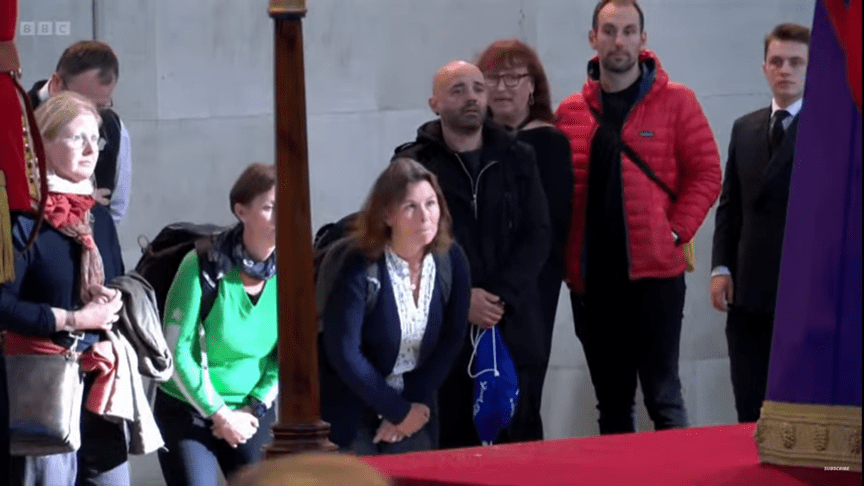
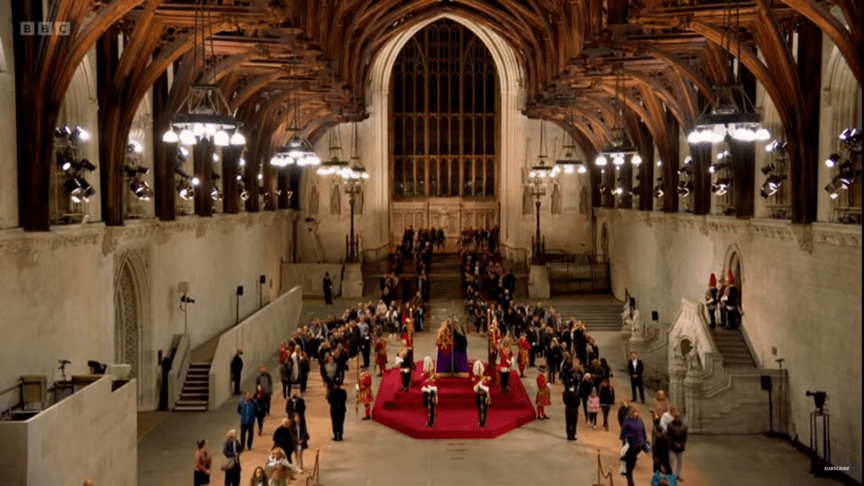
Judging by the live BBC video of her lying in state, the reaction and behavior of her people is perhaps the finest reflection of, and tribute to the personal example she set. They are waiting for more than 10 hours in line, for only about 10 seconds near her coffin. Apparently without misbehavior or histrionics, and with a quiet dignity.
Her Majesty would have been proud of their acts of decorous duty – as she long performed her own duty – as well she should be. Common people, acting not at all ‘common.’
I am not sure such decorum would prevail in similar situations elsewhere. But then, there probably are few, if any ‘similar situations elsewhere,’ because the Queen’s office and role in the life of her nation were so unique. ‘Majesty,’ in every sense, as much for them as for her.
And as if to honor that dynamic, here, traditional British values are emerging again, to show the bond between Elizabeth and so very many of her subjects. Few mourners are wearing the sort of dark, formal clothes probably worn at the funeral of her father, George VI, 70 years ago; they are dressed comfortably for a long wait out of doors. But such externalities aside, the synergy of respect and affection – long reciprocated between them and her – is apparent, and vital.
The regal setting and flawless ceremonial are marvelous to watch, but perhaps the greatest spectacle is seeing her legacy of leaving a nation still willing, able and glad to act in a seemly manner – and not just in a ceremonial occasion like this – as expressed by a line in a hymn sung at her coronation, addressed to ‘All People that on Earth do Dwell’:
‘For it is seemly so to do.’ Even in grief, as part of the ongoing story of British civilization.
One need not be British to find this absolutely charming. At first, I couldn’t believe this wasn’t some CGI Platinum Jubilee stunt, but it is in fact Her Majesty, proving that being ‘regal’ need not mean being serious to the point of pomposity. Would that every renowned person – and no one alive has (ever?) been so renowned, for so long, as the Queen – displayed such easy and gracious aplomb.
I approve on principal that hereditary monarchs no longer have substantial power. But cursory observation shows that popular election does not invariably yield deserving, trustworthy or competent leaders. And a sovereign like Elizabeth shows there is much to be said for having a stabilizing institution that embodies reassuring continuity and solidarity, its legitimacy granted by Fate (birth), rather than political clout obtained through crass maneuvering, often beholden to interests at odds with those of a nation as a whole.
CONTEXT: My 2016 journey through Europe began in Paris, but ended with less than a full day in Amsterdam. I selected that city as a departure point because I wanted to see Rembrandt’s masterpiece, ‘The Night Watch’ there (which I’ve written on extensively, items I may re-post here). Writing about that quick visitlater brought out my inner historian, in my observations below about the Netherlands, especially in the mid-17th – mid-18th centuries when it was a principal world power.
Before Amsterdam, I had spent several days in Cologne, Germany inspecting and pondering its cathedral (the ‘Kolnerdom’, shown earlier in this blog, lit by the setting sun). In this piece, I graze upon the differences in the two worlds represented by Cologne’s great church, and the very different world nurtured in, and by post-Reformation Amsterdam (noting its most famous church, the Westerkerk, tellingly modest compared to the Kolnerdom).
The ‘Rijksmuseum,’ or ‘State Museum,’ houses many of the greatest works from the Dutch Golden Age of painting, including Rembrandt’s ‘Night Watch,” but it is not only an art collection. It displays items that show many aspects of the nation’s history and contributions, including the outsized role the little Dutch Republic played in the Seventeenth and Eighteenth centuries’ great burst of exploration of the wider world by Europeans.
I had hastened from lunch to see ‘The Night Watch’ before the museum closed. After paying that homage, I spent the remaining 40 minutes examining the rest of the paintings there (all of them Dutch, I think, as a place dedicated to telling only the homeland’s story, not of world culture in general).
So there was really no time for me to do more than pass through other galleries of artifacts of the nation’s scientific, commercial and maritime, etc., heritage, nor the many displays from Dutch colonial territories around the world. Their empire later ebbed in size, much of it taken over by the British, including their North American and South African possessions. The Dutch East Indies, modern Indonesia, remained their largest foreign colony until after World War II, when it became independent.
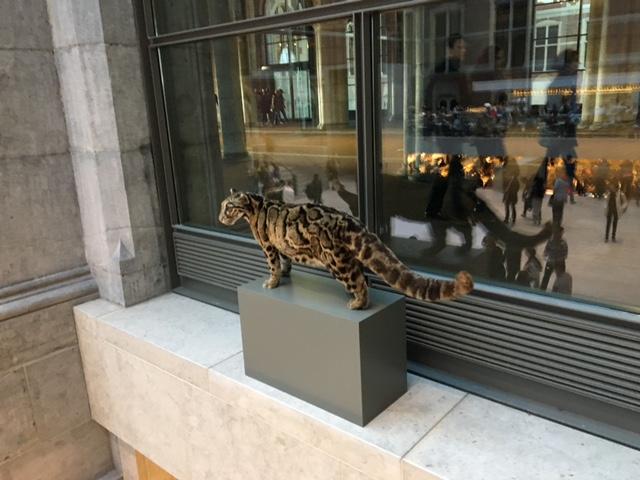
But this beastie in the Rijksmuseum caught my eye; there was no explanatory panel, but I think it is a stuffed ocelot. It was probably from some tropical colony of the Netherlands, brought (alive or dead) back to the homeland as trophy or curiosity. Presumably, elsewhere in the museum were also relics of the spice trade in the Far East, the greatest single source of wealth from Dutch overseas domains, and perhaps specimens of the plants on which the precious herbs grew.
Such items (likely privately acquired and eventually chosen for the Rijks) showed the people back home how wide and varied the world really was, very different from the flat Earth Medieval view that had preceded it. What Medieval Europeans knew (or thought they knew) about other parts of the world was mostly via convoluted and often inaccurate legends, but here were genuine articles brought from distant places previous Europeans had not even known existed, let alone seen.
Such questing and curiosity were consonant with the incipient Renaissance-Reformation mindset that human beings can control their fates and environments; very different from the other-worldly preoccupations of Cologne cathedral. However, looking back on how exploration, colonial exploitation and subsequent developments harmed other parts of the human and natural world – in some ways that still continue into the 21st Century – whether that new quest for control, propelled by still-imperfect men and their desires, was an unreservedly good development is not entirely clear.
Amsterdam was one of the places where the practical effect of Protestantism leading to greater individual self-actualization began to manifest itself most visibly and extensively. In that outlook, men did not have to believe that they were, more or less, essentially at the behest and mercy of divine manipulation and intervention.
That certainly is not, of itself, a bad thing, as I, steeped in the American culture of self-determination, will vigorously agree. It is splendid that we can better understand and manage the planet we inhabit, and human life today is unquestionably better in innumerable aspects than when either the Kolner Dom or Amsterdam’s (much later) Westerkerk were begun.
Yet, our world today – now, so much the product of human reason and individual autonomy – is still hardly Utopian. That is a realization that merits reflection.
Please find peace, hope and joy wherever you seek them, in this customary season of gladness. The ability to reason is part of being human, but every bit as much so are impulses to rejoice and to hope. So though logic may suggest life is inherently sad and futile because it ends, our reflexive reluctance to accept that bleak conclusion leads us, rightly, to use faculties other than logic alone. Hope is just as vital and elemental. And ‘Accuracy’ is not necessarily the same as ‘Truth.’
Few of us can be so monolithically rational as to easily embrace a self-annihilating interpretation; nor should we be. If logic demands we do so, then it – used exclusively – may be thwarting us as much, or more, than it empowers us. Reason itself, arguably, makes it implausible that the marvel of existence could be pointless, however obscure its intent may seem from our finite perspective.
Western culture developed to hold that the cosmos isn’t just an indifferent, devouring void. Anything so amazing, if mysterious, could not be mere happenstance; it had to arise from an act of loving Creation. That led to faith that each human life, by virtue of our consciousness enabling us to ponder our origins and purpose, parallels the mechanism of Creation, and is thus a precious sprig of it. And the Christmas story (in which I personally find deep comfort and lofty joy) proclaims that every such sprig is worthy of love, validation and, if needed, saving, despite what it has done or failed to do.
Whatever you believe, celebrate every aspect of your personhood, and savor hope and joy wherever you find them, or where they find you. To do so is to defy that supposed ‘indifferent, devouring void’; or to negate its power. Your spirit – our spirit – may be stronger than it could be. Besides, you are a member of the human family, and realizing that one is part of a family should always be cause for happiness and belonging.
CONTEXT: Lest new readers assume that I only think, or write about serious matters, here is something that appealed to my taste for communal mirth. I often try to articulate things people may be aware of, but only consider in passing. But in this post, I just let myself get caught in the current of a charming bit of silliness that wafted across my (cyber-) path. Because life should be ‘savored,’ not just ‘chewed upon.’
As many of you know, I am a stalwart Gallophile, a lover of France, her people, culture etc.
But cruising YouTube recently, I found this video, a reminder of the marvelous eccentricity of which British society (for all its supposed stiff-upper lip values) is capable. A gloriously silly song being performed by its creator, while the audience thrills and deftly contributes. It happened at the enormous, august Royal Albert Hall (RAH) in London, the site of many such wonders of public whimsy and informality. RAH has certainly seen terrific high-art performances, but its massive size makes it inherently ‘popular’; even ‘democratic’ (witness the audience participation here).
So for a venue dedicated to the memory of the late Prince Albert by his stubbornly-grieving widow (and reputed royal killjoy) Queen Victoria, RAH has seen some highly eccentric, but hugely entertaining spectacles. Perhaps some have even coaxed unintended smiles out of Victoria and Alberts’ spirits?
(I incidentally wish Good Queen Bess – as I call Elizabeth II now, as Elizabeth I was known late in her reign – had been there for this shared fest, joining in the fun.)
To hearten anyone shell-shocked by COVID and all the world’s other travails of late, here is a paraphrase of a line from the poet Shelley, in which Life may be speaking to us all:
CONTEXT: A bleak artifact of the Cold War between the U.S./NATO and U.S.S.R./Warsaw Pact from about 1950 to 1990, and a focus of superpower military friction which we who lived at that time feared could spark World War III at any moment; a terrifying anxiety to constantly endure. I may repost more captions (referred to in here) about it that I wrote for my other pictures from Berlin later, on this blog.
But I include this item as one of my first blog posts, because in it I speculate that the Nazis’ beastliness could probably only be defeated by an even bigger beast, like Stalin’s U.S.S.R. A depressing, but plausible observation. The Russians overran eastern Germany and captured Berlin in Spring 1945, taking ferocious revenge on German civilians for Hitler’s unprovoked invasion of their land and the innumerable and unspeakable atrocities committed there by German armed forces. It must have seemed like the wrath of one of the warlike Norse gods the Nazis had revered (Thor?) was being visited on them. Nazism proudly lived by the sword, and – unsurprisingly – perished by it, taking much of the prior world with it in its collapse.
The Wall, mandated by pressure from that Soviet ‘bigger beast,’ was started in 1961, meant to stop the outflow of East Germans into (free) West Berlin. So it was actually, in effect a monument to the failure and dysfunction of ossified Communism to create a world most people would not flee if allowed to do so. This essay reflects on the dynamics that finally dissipated Marxism’s inflexible, sacrosanct ideology, as well as on the ultimately futile means deployed to impose and sustain it.
(As noted before, the ‘we’ mentioned in this piece is my friend Paul from Boston, who was with me for the middle part of my travels, from Salzburg to Berlin.)
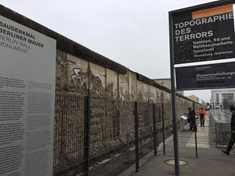
This is not the same preserved Wall section I discussed in earlier posts, but one we saw from our passing tour bus. As I later learned, this is right next to the Topography of Terror, the memorial on the site of Gestapo headquarters, whose horrendous dungeons survived because the Wall’s Death Strip was later built over their ruins. In a bit of mordant irony, that Strip was one iniquity succeeding another (Gestapo HQ), until events rendered it too, unsustainable – though far less violently than the military apocalypse that subsumed the Gestapo along with all of Hitler’s other foul works.
The Berlin Wall finally fell because Mikhail Gorbachev, Soviet president in the late 1980s, had made clear to Soviet client governments in Eastern Europe that he would not use Russian armed force to keep them in power, as the U.S.S.R. had done in Hungary in 1956 and Czechoslovakia in 1968. And as it became obvious that the Iron Curtain was corroding, the East German regime – though willing to kill a handful of its would-be escapees – had no stomach to slaughter its own citizens en masse. Or at least, not without Russian backing. Or perhaps they finally realized there was no way they could do so with a straight face, and maintain their obviously sham pretense of being ‘a People’s government.’
The details of how the Wall finally ceased to imprison East Germans are complex, but its abrupt opening was sudden, fast and chaotic. On November 9, 1989, after the regime made an ambiguous announcement about loosening transit restrictions at the Wall, crowds of East Berliners approached it demanding to pass into West Berlin, and – almost miraculously – its guards, unsure what their superiors had really intended, let them do so. It was like the opening of the Red Sea to Moses.
Other Ossies (Easterners), on hearing this news, dropped what they were doing and sprinted past the barriers and into the West. They feared their rulers might capriciously change their minds, clamp the gates shut again, and massacre disobedient citizens (as had happened 5 months earlier at Tienanmen Square in Beijing). Many probably had only the clothes on their backs, unsure if they could ever return home, but were willing to abandon their whole prior lives for a straight-forward chance at the liberties they knew existed beyond the Wall. Only vicious force like the Nazis would have used, without hesitation – which the East German state would not – could have crushed such a huge popular upsurge.
The Wall ultimately turned out to be a futile, feeble thing, its grip inexorably worn down by the restive, rumbling hostility of millions of Europeans and their hopes for self-actualization, instead of a Socialist straight-jacket worldview. With wondrous irony, it was almost inadvertently opened by bureaucratic fumbling between the East German regime and its security forces.
(In Moscow’s Eastern Bloc, obedience to Marxist doctrine often counted for more than practical competence. The confusion that led to a sudden lapse of restrictions may have been partly a spectacular instance of people who got critical jobs because they were loyal, rather than because they were capable.)
And the evil spell of fear and helplessness in nations where the U.S.S.R. had imposed Stalinist Communism after World War II withered over a few breathtaking weeks, crushed under newly assertive popular aspirations. If you want to see the power of collective will and spirit, find and watch film of that electrifying November night at the Wall. It was astonishing, glorious, and intoxicating to people watching it on television, as much of the world did. East Berliners standing atop the Wall, with the Brandenburg Gate in the background, bashed at it with sledgehammers charged by decades of pent-up rage. That was an image for the Ages; the atmosphere in Paris after the fall of the Bastille may have felt much the same.
Lenin, father of the Soviet Union, once said that a successful revolution is usually just ‘the kicking in of a rotten door.’ And so it was; in 1989, the ‘Annus Mirabilis’ (Year of the Miracle), the festering Soviet Empire in Eastern Europe collapsed with relatively minor ripples. The West’s dynamics of individuals’ worth and autonomy – which, rather than sullen Russian passivity were the true opposites of the Nazis’ glorification and mobilization of our worst instincts – had finally outlasted the East’s downtrodden subservience.
Such a ruthless, despotic use of Soviet power had been essential to do most of the bloody, brute work of pummeling Hitlerism to death. But whether those Western style ‘dynamics’ have triumphed forever is still unfolding now, in 2017.
(And regrettably is still ‘unfolding,’ in 2022, as of this re-posting. Demolishing the concrete of the Wall was only the start, and possibly, the easy part, of making a truly ‘Free’ world.)
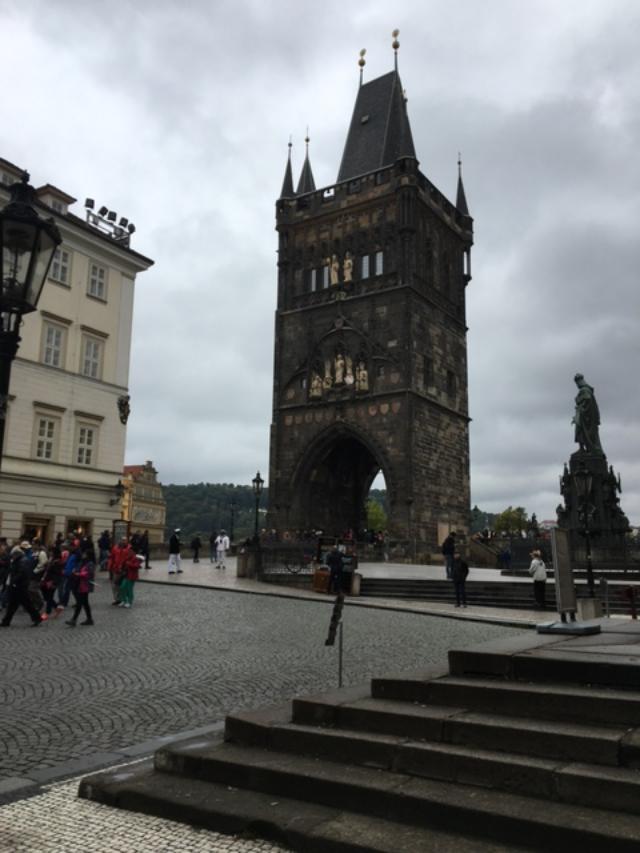
CONTEXT: One of the most famous and scenic bridges in the world and a foremost sight of Prague, where we spent a single day en route from Vienna to Berlin. Its famous collection of statuary was accumulated over generations, but its fortified towers at each end are near-original, and common features of Medieval bridges. Such crossings were difficult and costly to build and maintain, so were placed at points of great strategic or commercial importance. They often also served a defensive purpose, with fortifications like this gate tower at either end to repel invaders who might cross them to attack any city in which they were located. Old London Bridge, built in the Twelfth Century, had similar construction.
Here is the fortification at the other end of this bridge, nearer the Old Town. Its roadway is now only for pedestrians, and was very lively even on a chilly day in October. On a fair day in June, it must be as crowded as St. Mark’s Square in Venice.
I’m glad so many people can now travel, a privilege once limited by poor transport and expense, although such democratization can change an ambiance drastically. Lovely and evocative of distant ages as places like this are, it is hard to contemplate the sweep of passing time when forcefully reminded of the here and now by jostling groups chattering in many languages. But personally, I am willing to accept a diminished individual experience for the benefits of living at a time when ordinary people can have the luxury of travel. That is, are not considered their leisure-class betters’ mere workhorses, who have no business expecting any of the good things of life, and who rarely get them.
Moreover: Travel enables us to learn about both the cultural variations and fraternal similarities of our neighbors on this planet. For example, the many Chinese visitors I saw in Prague probably knew very little about the place, yet some of them appeared to be on the verge of tears of joy at what fantastic, exotic sights they were seeing. That was something that I – their fellow non-Czech – could fully share with them.
Some of us may like to study in advance to understand at a deeper level what we will see in our journey. But “Wonder” is a universal language; it needs no translation or practice.