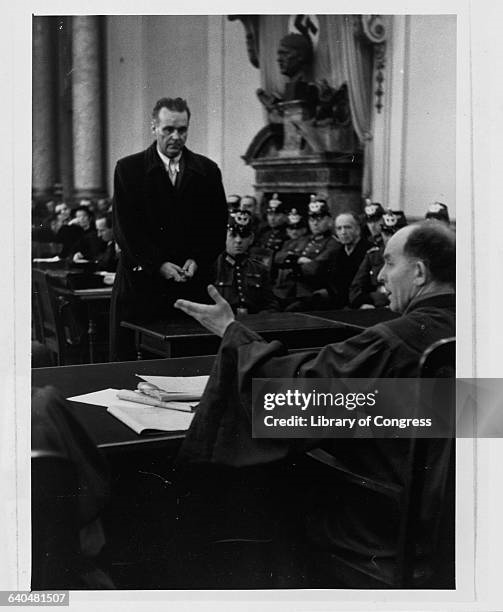
The accompanying image shows Roland Freisler, Chief Judge of Nazi Germany, in his court. Sometimes called ‘Hitler’s Executioner,’ here he is being watched by a group of regular German police in their distinctive helmets.
I don’t know who the man facing Freisler is, but if he was in the hands of this robed thug, he was almost certainly considered an enemy by the Nazis. He had likely been tortured, and this trial is a sham pretense of judicial process, performed for purposes of propaganda and public intimidation. He is probably doomed, as Freisler routinely imposed the death penalty. His melancholy facial expression shows he already knows his likely Fate, as not so much the ‘accused,’ as the ‘condemned.’
This image implies something American policemen and women may find themselves facing: The critical, pivotal role of ordinary ‘cops-on-the-beat’ in facilitating tyranny.
The Gestapo, Hitler’s savage Secret State Police, never numbered more than a few thousand agents, when Germany’s population was nearly 70 million. So to make up for their small number, that baleful Bund encouraged the general public to help suppress disloyalty by spying on, and denouncing each other.
But for actual day-to-day enforcement of Nazi law and oppression, the Gestapo largely depended on local police in Germany, and in lands they conquered in their wars of aggression. They were the practical force that implemented most Nazi tyranny; without their active cooperation, Hitler’s security apparatus could never have had the fearsome control that it did.
American policemen and women today should bear this precedent in mind: Generally, ‘tyranny’ cannot function without the help and complicity of people like themselves. So if they realize they are being suborned for policies that repress, rather than protect, freedom, they may be wise to consult their consciences (and their own long-term best interests) before taking a first step onto a slippery slope of being the henchmen of ruthless Hierarchs whose only real principle is the defense of their own interests.
(Officers should also remember that Authoritarians rarely reciprocate loyalty. They may privilege their enforcers in the short term, but will remorselessly sell them out to benefit or save themselves. If they were honorable, they most likely would not need to be ‘authoritarian.’
Before aiding such a person, officers should consider his record for showing loyalty – with deeds, not just words – to those who show it to him.)
And to beware of any pretense of serving society (or just some ‘worthy classes’ of it) by carrying out directives that are clearly intended to do the opposite. For example, Freisler’s department was officially called ‘The People’s Court,’ (Volksgericht), when it was obviously mainly a tool of public control, and state terror.
Surely, Americans did not give their lives at Anzio, Normandy, Bastogne etc., in the belief they were helping to destroy Nazism, only to have something alarmingly similar eventually develop here. Do we no longer appreciate their sacrifice?
Officers, would you really want to do something Adolf Hitler would approve, like enshrining the merciless rule of the Ruthless over the sacred Constitutional rights of American citizens?
I hope our police begin to anticipate this scenario. What vision of ‘law and order’ are they willing to defend? One like that pictured here? Or the vision to which Americans profess to aspire, of life, liberty and the pursuit of happiness? And not just for themselves, or those just like themselves.
Our lawmen and women may have to face whether they are (or ever have been) serious about such ideals, or are just paying them lip service. They may have to decide at what point they will no longer be willing to ‘just follow orders,’ if the orders they are being given are unmistakably intended to distort the letter and spirit of American law – more than has ever happened before in our history – for the benefit of a cynical, insidious, self-interested minority.
Distant lands may not be the only places where Americans’ liberties must be struggled for. Who, exactly, do our regular polices’ consciences bid them to ‘serve and protect’? Better to ask themselves such questions now, than to suddenly confront those decisions, unprepared.
And to reflect on the meaning of this picture: Police as servants of evil, rather than its adversaries.
 All Things Gaul