FOR BASTILLE DAY: HONORING LIGHT, AND FIRE

France recently made a choice that re-affirmed what she reveres and encourages. It arguably offers inspiration for everyone, so is worthy of special note today, Bastille Day.

For over 200 years, France has honored her very greatest citizens at the Panthéon, a grand temple-like structure in Paris. Only a very select cohort get commemorated there, those who excelled in service to the nation, or to writing and science of global stature. For comparison, the ashes of Voltaire, the greatest philosopher of France or almost anywhere, are enshrined within. Many others were Napoleonic officials largely unknown today, reflecting evolving political and cultural priorities.

But this year, French President Macron directed that, for the first time, an historian, Marc Bloch, be ‘Panthéonisé,’ have a monument within its walls. The attached video shows part of the formal ceremony of his induction into this Gallic Valhalla (Gal-halla?). This reflects not only gratitude, but inspiration – even appropriate awe – at his glorious example.

This exalted privilege was bestowed on Bloch partly for his immense contributions to global study of history, but also for selflessly risking his life opposing France’s Nazi occupiers, who eventually martyred him.

His scholarly deeds alone might qualify him for this elevation, but his extraordinary bravery absolutely must. Other great minds (Zola, Marie Curie, Victor Hugo etc.), and gallant citizens (Jean Moulin, another patriot martyr) are lionized there, but few, if any, others so exemplify both the ‘Light and Fire’ – the mind and the spirit – referenced by this post’s title.

Fittingly, the Panthéon is not far from the Sorbonne, France’s elite university and venerable epicenter of academic excellence. Bloch taught there during the 1930s, contributing substantially to its heritage.

Born in Lyon in 1886, he was ardently patriotic, out of unforced love for his homeland, and her Revolutionary pillars, Liberty, Equality and Fraternity. He fought valiantly for France in World War I, was wounded twice, receiving two of his nation’s highest awards, the Croix de Guerre medal, and induction into her Legion of Honor. A secular Jew, Bloch likely felt spurred to demonstrate his loyalty in response to the Dreyfus Affair, when a Jewish army officer was falsely accused of espionage. It had convulsed the country during his childhood, and its anti-Semitic tremors lingered long.

After the Great War, he resumed his studies, devising (with colleague Lucien Lefebvre) the Annales School of history. That method examined the impact of ordinary people, not the famous and powerful, on historical events. Since there are few records, for example, of lives of serfs (topic of Bloch’s magnum opus ‘Feudal Society’), ‘Annales’ inquiry required cross-disciplinary extrapolation from long-disregarded sources to study them.

This approach implicitly bypassed ‘Great Man’ history, focused on Caesar, Charlemagne, Napoleon, Churchill, etc. Ironic, as Bloch will now be remembered in a temple officially dedicated to the nation’s ‘Great Men.’

When France declared war on Nazi Germany in 1939, Bloch, by then a 53 year-old professor, re-enlisted in the Army as a logistician. It was patriotic, but probably also from fierce desire to obstruct Hitler, embodiment of all that Bloch, elite scholar and individualist citizen, must detest. The feeling would be mutual; Jew-hating Hitler was also violently anti-intellectual.

The Germans, having converted their country into a war-making machine, swiftly defeated France, then occupied the northwestern half of its territory, leaving the southeast nominally ‘free.’ Its improvised capital was at a Spa town now synonymous with national dishonor: Vichy.

Expelled from teaching at the Sorbonne by Nazi bans on Jewish educators, Bloch moved to the free Zone, where he taught again, and eventually joined the Resistance, ‘Partisans’ combating the German occupiers. This was an act of almost insane courage, due to his age, relative notoriety, and being, as a Jew, already a prime target of Nazism.

It is breathtaking to ponder the terrible dangers to which he knowingly exposed his flesh and blood for abstract principles he considered more precious than his own life. He was given vital noncombat work, such as translation, coordination, and composing Resistance propaganda.

Examine Bloch’s picture in the video; he is late middle-aged, not some naïve, reckless youth. He knew the lurking horrors of the world, and surely realized what risks he faced among the Partisans. He faced them anyway, entering a lion’s den like the Old Testament Prophet Daniel, but unlike him, paid with terrible suffering when the beasts devoured him.

In 1943 in Lyon, Bloch was betrayed into the grip of the Gestapo, and interrogated under torture for months, supposedly revealing nothing. He was executed June 16, 1944, along with other Partisans, partly as a precaution, after the D-Day Invasion. A witness said Bloch’s last act was comforting a terrified adolescent prisoner, also about to be shot.

Facing imminent death himself, surely in pain from torture, yet still kind enough to soothe a distraught comrade. What humanity, both profound and soaring! And like Daniel, the articles of faith he treasured – France and her Republican virtues – lived on after him. Perhaps even partly because of him: An historian who, himself, contributed to history by hastening the liberation of his beloved country.

I once wrote a meditation about a holding cell I saw in the ruins of Gestapo headquarters in Berlin. Bloch’s Self sacrifice recalls that I said that if that site ‘saw mainly cruelty and horror, it must also have seen Olympian courage and nobility.’ He unquestionably showed those qualities, struggling against Fascism.

Few of us have the brainpower to attain his scholarly stratum, but theoretically, more people may be capable of heroism. Yet very few of us actually are, so his bravery may be even more astounding than his brilliance.

Now his nation is according him recognition commensurate with his splendid feats. Part of Macron’s decision was likely a wish to address a deeply sensitive chapter of French history. Her Occupation by the Nazis is still an infamous memory, because many Frenchmen aided Hitler not out of expediency – shameful enough – but conviction, seeing him as Europe’s bulwark against Bolshevism. They became his avid accomplices, persecuting their countrymen, especially Jewish ones.

The Great War hero Pétain, who resolutely preferred Hitlerism to Stalinism, became Vichy’s Premier. He set up a regime with like-minded reactionaries who hated many fellow Frenchmen – Liberals, Jews, Communists – more than the conquering Germans. Vichy connived with the Nazis in various ways, most ghastly, deporting multitudes of Jews to death camps from France, where some 80,000 perished.

For decades after, while many who cooperated with the Occupiers were still alive (and some in public office), France avoided confronting the scope of its societal culpability. Now that the War Generation is mostly dead, Macron likely intends Bloch’s commemoration at this most hallowed venue of French greatness, to suggest how the squalid implications of Vichy’s collaboration should be countered.

For Bloch’s spectacular gallantry, even Panthéonisation, a pinnacle rite of national reverence, may seem inadequate. He said of his death-daring decision to resist, ‘There can be no salvation where there is no sacrifice.’

I have no better descriptor for such magnificent nobility than the one I used before: ‘Olympian.’ Or possibly, in deference to his background, ‘Samsonian.’

In recognizing Bloch thus, France pays a debt – atonement? – not only to a patriotic hero, but to one who, by his scholarship, indirectly promoted values for which he ultimately died: the worth and sanctity of the ordinary individual. One whose view of history was that it is not moved only by men on thrones or horseback, but also by ‘ordinary individuals,’ he supported that view by defying bestial oppressors. Not with swords or guns, but words and ideas.

The disgrace of Vichy may always stain France, as tolerating the thwarting of Reconstruction may forever mark America. Societies that cannot acknowledge past error cannot improve, because they deny experience. By celebrating Bloch thus, Macron has decided France needs to face this shame, but also to learn from, and move beyond it.

Bloch’s life offers a luminous ember that France – indeed, the world – can use to kindle determination to resist the darkness to which any quasi-wolves like Hitler would make humanity revert. Republican France was Hitler’s nemesis militarily, but also philosophically, for the hopes of her Revolution were – and are – mutually exclusive with those of Fascism.

If any life could help inspire such determination, Marc Bloch’s could. By honoring him, his nation shines light on a detestable corner of her national story, but also re-asserts her vibrant desire to promote human progress.

Such progress may take place in libraries and classrooms, or cells and torture chambers, sometimes as much as in armed battle.

As against the ramparts of the Bastille, on July 14, 1789.
‘Lo, How a Rose ‘ere Blooming – ‘

The title of this post is the traditional English translation of the name of a classic German Christmas carol, ‘Es ist ein Rose entsprungen.’ It refers to a rose, lovely and fragile, that nevertheless blooms amid the cold and darkness of Winter.

The rose referred to in those lyrics is Jesus, who offers light to the world, and not just amid the darkness of winter. His coming at Christmas, and the attached photo are connected by imagery of the rose. In this case, specifically, by a White Rose.

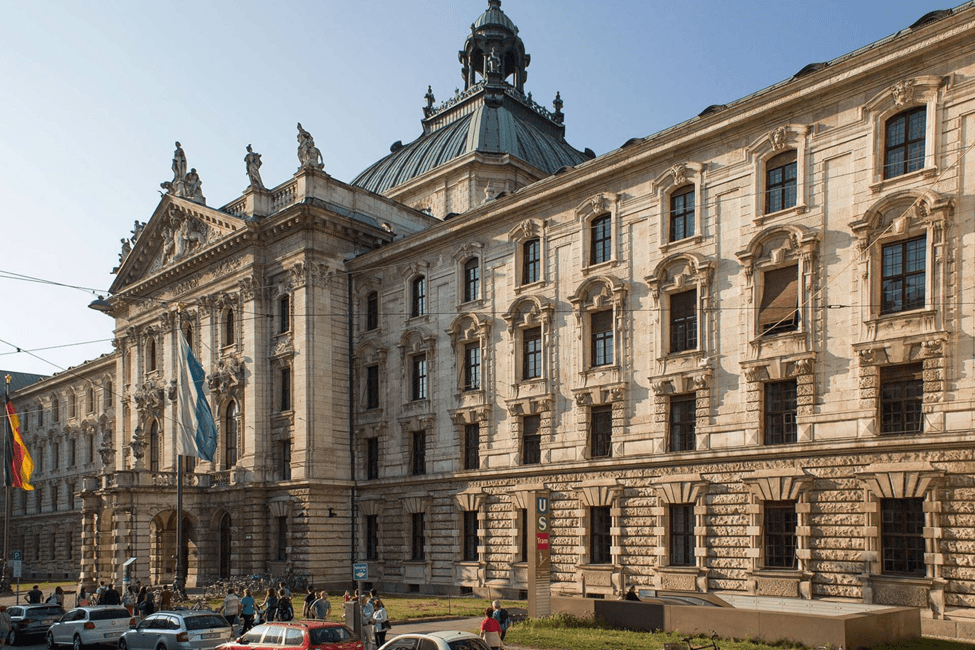
I took this during my visit to Europe last October. It shows Bavaria’s main courthouse, the Justiz Palast in Munich. In February of 1943, as the course of World War 2 was shifting irreversibly against Germany’s Nazi rulers, this building was the site of the trial of brother and sister Hans and Sophie Scholl, and Christoph Probst (arguably the intellectual epicenter of the circle), principal members of ‘Die Weisse Rose,’ the White Rose, code-name for a group of young resisters to Hitler’s regime. Its members had profound moral hostility to Nazism, and some, including Hans, had served in the Army on the Russian front, and witnessed German atrocities in the USSR.

The Scholls and their co-conspirators were patriots clear-sighted enough to know by then that the war was lost, despite the government’s frantic lies about its course. They wanted to save their beloved country from complete destruction by the overwhelming power of the enemies Hitler had brought down upon it. In fact, this courthouse still bears scars from the bombing that would befall Munich the next year, 1944.

But beyond patriotism, Sophie and Hans were also impelled by deep, resolute Christian faith. They knew perfectly well the awful risks they faced at the hands of the Regime’s savage Gestapo secret police, but felt stiffened to resist it by writing, printing, and spreading vehement anti-Hitler leaflets (considered high treason). They believed their creed, if sincere, obliged them to resist evil, no matter the danger.

Presumably, knowing that Jesus had accepted giving up His life for the world figured into their commitment. The White Rose’s members did not seek martyrdom, but did not shrink from its peril either.

Sophie, probably because heroism is not usually associated with women, has become a legend of principled resistance to evil. But she did not act alone; after being caught (by tragic happenstance) distributing their leaflets, she, Hans, and their associate Probst were arrested, tried, convicted, and beheaded. Sophie’s captors were so astonished by her courage and resolve, they offered to mitigate her guilt from the capital crime with which she had been charged, for they had surely never encountered such authentic nobility by doctrine-spewing Hitler Youth. But she refused to accept, forthrightly stating that she would not recant what she knew to be true and rightful, and bend to the ruthless might and criminality of Nazism.

I had not sought this building; only walking past it, and reading ‘Justiz Palast’ did it occur to me it was likely where White Rose members were tried by the screaming judge Roland Freisler, ‘The Fuehrer’s Executioner.’ To suddenly grasp what had happened here, then reflect on the soaring courage and honor once shown within was both arresting – I stopped mid-step as that realization came over me – and awe-inspiring. Unlike the recovered colored light in Notre Dame in Paris (described in an earlier post), here, my wonder was engendered not by powerful, inadvertent visual symbolism, but directly by human deeds.

If seemingly, more-than-human deeds.

The passionate idealism of the White Rose was the strongest possible rebuke to the carefully curated cruelty and fanaticism of the Hitler Youth, saturated by the Nazi state in racist, bestial ideology. If callow, juvenile men can be manipulated into believing that their worst instincts are actually nobly warlike, the Scholls and others showed how youthful ‘passionate idealism’ may also see right through malevolence, and valiantly oppose it.

If the White Rose members had been exclusively logical, they would have kept their mouths shut, their heads down and their non-combatant status as university students intact. But they did not, for they discerned a duty more precious than their very survival. In serving that, they did far more than deserve to be remembered. They have left a source of inspiration like few who have ever lived, igniting the full power of the soul to act beyond transient concerns, in the interest of values whose urgency never fades. Their determination starkly, absolutely contrasted with some of history’s worst acts of inhumanity.

The example of their bravery and self-sacrifice matters critically in a world where brute force such as (but not restricted to) Nazism too often seizes control of events. Again, the Scholls and Probst had stalwart Christian worldviews, so it seems likely that Jesus’ care for the whole human family – the antithesis of Nazi racial theory – must have been part of their inspiration.

(Of course, such devotion can arise from non-religious sources, but in this case, their intensely personal, if not rigidly formal, faith enabled these young folk to confront death, rather than yield to its menace.)

It is often in seemingly irrational deeds like theirs, floridly contrary to Self-interest, that the scope and potential of our humanity may sparkle most brilliantly. In such cases, we may benefit from decisions that cannot be rationalized, as much, or more, than from many that make perfect sense.

The White Rose was a bloom that will never wither, just as Jesus is the rose, blooming at Christmas, abiding despite all the malevolence in our oft-sinister world. By not doing the sensible thing, the Scholls showed that decency and honor have not perished – in a way adjacent to how Christ showed the same, in love and kindness. I am not nearly brave or strong enough to have done what they did, but am inexpressibly grateful to them for showing that, however implausible, it is not impossible.

Indeed, I have noted in other writings that our finest actions are often not our most rational ones. Surely, all readers of this post know of instances when people braved danger or suffered pain that they didn’t have to, out of simple, heroic decency. Or purest love.

Though this post seeks to honor the White Rose as an instance of aspiration adequate in scope for Christmas, nothing I write could possibly do justice to the splendor shown by its members, and especially its martyrs. The best I can do is to marvel at the implications of their deeds and ethics.

 As long as we have hearts to swell and eyes to tear with admiration, members of this tiny circle may be remembered; and emulated. They did not stop Hitler or his monstrous war, but they proved that not even his towering evil could exterminate righteousness, for it was, and is, still to be found around us. An invaluable lesson and a spectacular bequest to the world.

I cannot accept that the human sphere must be merely a cynical contest of genetic material, of our individual gifts or our burdens. The White Rose was proof that such random circumstances can be exceeded, as Christmas suggests Divine hope – and faith – that we can each, conceivably, resolve to rise above such constraints. And far from being exclusively the refuge of the weak and passive – as the Nazis derisively presumed – the Christianity of this trio, at least, made them guerillas for Christ.

The legacy of the Scholls and Probst reminds us how even the most demonic sway in our terrestrial element can never fully overcome the life force that summoned it, in the beginning, as ex-nihilo Creation. When hope guards rectitude as indispensable as that the White Rose defended, all the shadow in existence cannot, and did not, subdue it.

American Police: Which Vision will You Defend?

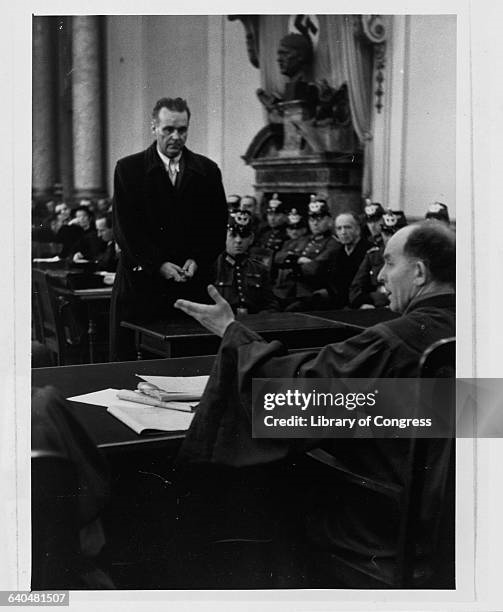
The accompanying image shows Roland Freisler, Chief Judge of Nazi Germany, in his court. Sometimes called ‘Hitler’s Executioner,’ here he is being watched by a group of regular German police in their distinctive helmets.

I don’t know who the man facing Freisler is, but if he was in the hands of this robed thug, he was almost certainly considered an enemy by the Nazis. He had likely been tortured, and this trial is a sham pretense of judicial process, performed for purposes of propaganda and public intimidation. He is probably doomed, as Freisler routinely imposed the death penalty. His melancholy facial expression shows he already knows his likely Fate, as not so much the ‘accused,’ as the ‘condemned.’

This image implies something American policemen and women may find themselves facing: The critical, pivotal role of ordinary ‘cops-on-the-beat’ in facilitating tyranny.

The Gestapo, Hitler’s savage Secret State Police, never numbered more than a few thousand agents, when Germany’s population was nearly 70 million. So to make up for their small number, that baleful Bund encouraged the general public to help suppress disloyalty by spying on, and denouncing each other.

But for actual day-to-day enforcement of Nazi law and oppression, the Gestapo largely depended on local police in Germany, and in lands they conquered in their wars of aggression. They were the practical force that implemented most Nazi tyranny; without their active cooperation, Hitler’s security apparatus could never have had the fearsome control that it did.

American policemen and women today should bear this precedent in mind: Generally, ‘tyranny’ cannot function without the help and complicity of people like themselves. So if they realize they are being suborned for policies that repress, rather than protect, freedom, they may be wise to consult their consciences (and their own long-term best interests) before taking a first step onto a slippery slope of being the henchmen of ruthless Hierarchs whose only real principle is the defense of their own interests.

(Officers should also remember that Authoritarians rarely reciprocate loyalty. They may privilege their enforcers in the short term, but will remorselessly sell them out to benefit or save themselves. If they were honorable, they most likely would not need to be ‘authoritarian.’

Before aiding such a person, officers should consider his record for showing loyalty – with deeds, not just words – to those who show it to him.)

And to beware of any pretense of serving society (or just some ‘worthy classes’ of it) by carrying out directives that are clearly intended to do the opposite. For example, Freisler’s department was officially called ‘The People’s Court,’ (Volksgericht), when it was obviously mainly a tool of public control, and state terror.

Surely, Americans did not give their lives at Anzio, Normandy, Bastogne etc., in the belief they were helping to destroy Nazism, only to have something alarmingly similar eventually develop here. Do we no longer appreciate their sacrifice?

Officers, would you really want to do something Adolf Hitler would approve, like enshrining the merciless rule of the Ruthless over the sacred Constitutional rights of American citizens?

I hope our police begin to anticipate this scenario. What vision of ‘law and order’ are they willing to defend? One like that pictured here? Or the vision to which Americans profess to aspire, of life, liberty and the pursuit of happiness? And not just for themselves, or those just like themselves.

Our lawmen and women may have to face whether they are (or ever have been) serious about such ideals, or are just paying them lip service. They may have to decide at what point they will no longer be willing to ‘just follow orders,’ if the orders they are being given are unmistakably intended to distort the letter and spirit of American law – more than has ever happened before in our history – for the benefit of a cynical, insidious, self-interested minority.

Distant lands may not be the only places where Americans’ liberties must be struggled for. Who, exactly, do our regular polices’ consciences bid them to ‘serve and protect’? Better to ask themselves such questions now, than to suddenly confront those decisions, unprepared.

And to reflect on the meaning of this picture: Police as servants of evil, rather than its adversaries.