FOR BASTILLE DAY: HONORING LIGHT, AND FIRE

France recently made a choice that re-affirmed what she reveres and encourages. It arguably offers inspiration for everyone, so is worthy of special note today, Bastille Day.

For over 200 years, France has honored her very greatest citizens at the Panthéon, a grand temple-like structure in Paris. Only a very select cohort get commemorated there, those who excelled in service to the nation, or to writing and science of global stature. For comparison, the ashes of Voltaire, the greatest philosopher of France or almost anywhere, are enshrined within. Many others were Napoleonic officials largely unknown today, reflecting evolving political and cultural priorities.

But this year, French President Macron directed that, for the first time, an historian, Marc Bloch, be ‘Panthéonisé,’ have a monument within its walls. The attached video shows part of the formal ceremony of his induction into this Gallic Valhalla (Gal-halla?). This reflects not only gratitude, but inspiration – even appropriate awe – at his glorious example.

This exalted privilege was bestowed on Bloch partly for his immense contributions to global study of history, but also for selflessly risking his life opposing France’s Nazi occupiers, who eventually martyred him.

His scholarly deeds alone might qualify him for this elevation, but his extraordinary bravery absolutely must. Other great minds (Zola, Marie Curie, Victor Hugo etc.), and gallant citizens (Jean Moulin, another patriot martyr) are lionized there, but few, if any, others so exemplify both the ‘Light and Fire’ – the mind and the spirit – referenced by this post’s title.

Fittingly, the Panthéon is not far from the Sorbonne, France’s elite university and venerable epicenter of academic excellence. Bloch taught there during the 1930s, contributing substantially to its heritage.

Born in Lyon in 1886, he was ardently patriotic, out of unforced love for his homeland, and her Revolutionary pillars, Liberty, Equality and Fraternity. He fought valiantly for France in World War I, was wounded twice, receiving two of his nation’s highest awards, the Croix de Guerre medal, and induction into her Legion of Honor. A secular Jew, Bloch likely felt spurred to demonstrate his loyalty in response to the Dreyfus Affair, when a Jewish army officer was falsely accused of espionage. It had convulsed the country during his childhood, and its anti-Semitic tremors lingered long.

After the Great War, he resumed his studies, devising (with colleague Lucien Lefebvre) the Annales School of history. That method examined the impact of ordinary people, not the famous and powerful, on historical events. Since there are few records, for example, of lives of serfs (topic of Bloch’s magnum opus ‘Feudal Society’), ‘Annales’ inquiry required cross-disciplinary extrapolation from long-disregarded sources to study them.

This approach implicitly bypassed ‘Great Man’ history, focused on Caesar, Charlemagne, Napoleon, Churchill, etc. Ironic, as Bloch will now be remembered in a temple officially dedicated to the nation’s ‘Great Men.’

When France declared war on Nazi Germany in 1939, Bloch, by then a 53 year-old professor, re-enlisted in the Army as a logistician. It was patriotic, but probably also from fierce desire to obstruct Hitler, embodiment of all that Bloch, elite scholar and individualist citizen, must detest. The feeling would be mutual; Jew-hating Hitler was also violently anti-intellectual.

The Germans, having converted their country into a war-making machine, swiftly defeated France, then occupied the northwestern half of its territory, leaving the southeast nominally ‘free.’ Its improvised capital was at a Spa town now synonymous with national dishonor: Vichy.

Expelled from teaching at the Sorbonne by Nazi bans on Jewish educators, Bloch moved to the free Zone, where he taught again, and eventually joined the Resistance, ‘Partisans’ combating the German occupiers. This was an act of almost insane courage, due to his age, relative notoriety, and being, as a Jew, already a prime target of Nazism.

It is breathtaking to ponder the terrible dangers to which he knowingly exposed his flesh and blood for abstract principles he considered more precious than his own life. He was given vital noncombat work, such as translation, coordination, and composing Resistance propaganda.

Examine Bloch’s picture in the video; he is late middle-aged, not some naïve, reckless youth. He knew the lurking horrors of the world, and surely realized what risks he faced among the Partisans. He faced them anyway, entering a lion’s den like the Old Testament Prophet Daniel, but unlike him, paid with terrible suffering when the beasts devoured him.

In 1943 in Lyon, Bloch was betrayed into the grip of the Gestapo, and interrogated under torture for months, supposedly revealing nothing. He was executed June 16, 1944, along with other Partisans, partly as a precaution, after the D-Day Invasion. A witness said Bloch’s last act was comforting a terrified adolescent prisoner, also about to be shot.

Facing imminent death himself, surely in pain from torture, yet still kind enough to soothe a distraught comrade. What humanity, both profound and soaring! And like Daniel, the articles of faith he treasured – France and her Republican virtues – lived on after him. Perhaps even partly because of him: An historian who, himself, contributed to history by hastening the liberation of his beloved country.

I once wrote a meditation about a holding cell I saw in the ruins of Gestapo headquarters in Berlin. Bloch’s Self sacrifice recalls that I said that if that site ‘saw mainly cruelty and horror, it must also have seen Olympian courage and nobility.’ He unquestionably showed those qualities, struggling against Fascism.

Few of us have the brainpower to attain his scholarly stratum, but theoretically, more people may be capable of heroism. Yet very few of us actually are, so his bravery may be even more astounding than his brilliance.

Now his nation is according him recognition commensurate with his splendid feats. Part of Macron’s decision was likely a wish to address a deeply sensitive chapter of French history. Her Occupation by the Nazis is still an infamous memory, because many Frenchmen aided Hitler not out of expediency – shameful enough – but conviction, seeing him as Europe’s bulwark against Bolshevism. They became his avid accomplices, persecuting their countrymen, especially Jewish ones.

The Great War hero Pétain, who resolutely preferred Hitlerism to Stalinism, became Vichy’s Premier. He set up a regime with like-minded reactionaries who hated many fellow Frenchmen – Liberals, Jews, Communists – more than the conquering Germans. Vichy connived with the Nazis in various ways, most ghastly, deporting multitudes of Jews to death camps from France, where some 80,000 perished.

For decades after, while many who cooperated with the Occupiers were still alive (and some in public office), France avoided confronting the scope of its societal culpability. Now that the War Generation is mostly dead, Macron likely intends Bloch’s commemoration at this most hallowed venue of French greatness, to suggest how the squalid implications of Vichy’s collaboration should be countered.

For Bloch’s spectacular gallantry, even Panthéonisation, a pinnacle rite of national reverence, may seem inadequate. He said of his death-daring decision to resist, ‘There can be no salvation where there is no sacrifice.’

I have no better descriptor for such magnificent nobility than the one I used before: ‘Olympian.’ Or possibly, in deference to his background, ‘Samsonian.’

In recognizing Bloch thus, France pays a debt – atonement? – not only to a patriotic hero, but to one who, by his scholarship, indirectly promoted values for which he ultimately died: the worth and sanctity of the ordinary individual. One whose view of history was that it is not moved only by men on thrones or horseback, but also by ‘ordinary individuals,’ he supported that view by defying bestial oppressors. Not with swords or guns, but words and ideas.

The disgrace of Vichy may always stain France, as tolerating the thwarting of Reconstruction may forever mark America. Societies that cannot acknowledge past error cannot improve, because they deny experience. By celebrating Bloch thus, Macron has decided France needs to face this shame, but also to learn from, and move beyond it.

Bloch’s life offers a luminous ember that France – indeed, the world – can use to kindle determination to resist the darkness to which any quasi-wolves like Hitler would make humanity revert. Republican France was Hitler’s nemesis militarily, but also philosophically, for the hopes of her Revolution were – and are – mutually exclusive with those of Fascism.

If any life could help inspire such determination, Marc Bloch’s could. By honoring him, his nation shines light on a detestable corner of her national story, but also re-asserts her vibrant desire to promote human progress.

Such progress may take place in libraries and classrooms, or cells and torture chambers, sometimes as much as in armed battle.

As against the ramparts of the Bastille, on July 14, 1789.
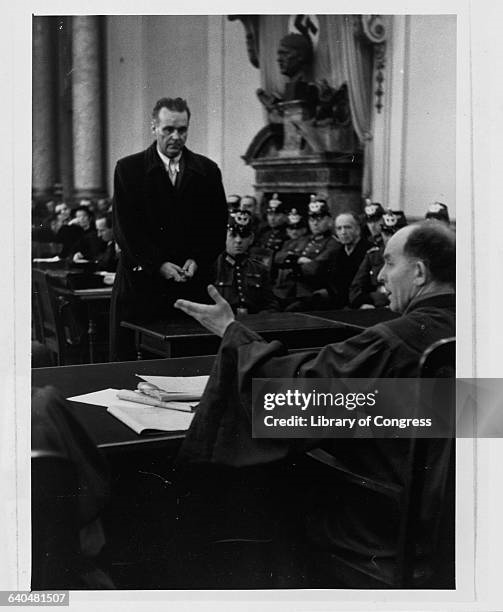
American Police: Which Vision will You Defend?

The accompanying image shows Roland Freisler, Chief Judge of Nazi Germany, in his court. Sometimes called ‘Hitler’s Executioner,’ here he is being watched by a group of regular German police in their distinctive helmets.

I don’t know who the man facing Freisler is, but if he was in the hands of this robed thug, he was almost certainly considered an enemy by the Nazis. He had likely been tortured, and this trial is a sham pretense of judicial process, performed for purposes of propaganda and public intimidation. He is probably doomed, as Freisler routinely imposed the death penalty. His melancholy facial expression shows he already knows his likely Fate, as not so much the ‘accused,’ as the ‘condemned.’

This image implies something American policemen and women may find themselves facing: The critical, pivotal role of ordinary ‘cops-on-the-beat’ in facilitating tyranny.

The Gestapo, Hitler’s savage Secret State Police, never numbered more than a few thousand agents, when Germany’s population was nearly 70 million. So to make up for their small number, that baleful Bund encouraged the general public to help suppress disloyalty by spying on, and denouncing each other.

But for actual day-to-day enforcement of Nazi law and oppression, the Gestapo largely depended on local police in Germany, and in lands they conquered in their wars of aggression. They were the practical force that implemented most Nazi tyranny; without their active cooperation, Hitler’s security apparatus could never have had the fearsome control that it did.

American policemen and women today should bear this precedent in mind: Generally, ‘tyranny’ cannot function without the help and complicity of people like themselves. So if they realize they are being suborned for policies that repress, rather than protect, freedom, they may be wise to consult their consciences (and their own long-term best interests) before taking a first step onto a slippery slope of being the henchmen of ruthless Hierarchs whose only real principle is the defense of their own interests.

(Officers should also remember that Authoritarians rarely reciprocate loyalty. They may privilege their enforcers in the short term, but will remorselessly sell them out to benefit or save themselves. If they were honorable, they most likely would not need to be ‘authoritarian.’

Before aiding such a person, officers should consider his record for showing loyalty – with deeds, not just words – to those who show it to him.)

And to beware of any pretense of serving society (or just some ‘worthy classes’ of it) by carrying out directives that are clearly intended to do the opposite. For example, Freisler’s department was officially called ‘The People’s Court,’ (Volksgericht), when it was obviously mainly a tool of public control, and state terror.

Surely, Americans did not give their lives at Anzio, Normandy, Bastogne etc., in the belief they were helping to destroy Nazism, only to have something alarmingly similar eventually develop here. Do we no longer appreciate their sacrifice?

Officers, would you really want to do something Adolf Hitler would approve, like enshrining the merciless rule of the Ruthless over the sacred Constitutional rights of American citizens?

I hope our police begin to anticipate this scenario. What vision of ‘law and order’ are they willing to defend? One like that pictured here? Or the vision to which Americans profess to aspire, of life, liberty and the pursuit of happiness? And not just for themselves, or those just like themselves.

Our lawmen and women may have to face whether they are (or ever have been) serious about such ideals, or are just paying them lip service. They may have to decide at what point they will no longer be willing to ‘just follow orders,’ if the orders they are being given are unmistakably intended to distort the letter and spirit of American law – more than has ever happened before in our history – for the benefit of a cynical, insidious, self-interested minority.

Distant lands may not be the only places where Americans’ liberties must be struggled for. Who, exactly, do our regular polices’ consciences bid them to ‘serve and protect’? Better to ask themselves such questions now, than to suddenly confront those decisions, unprepared.

And to reflect on the meaning of this picture: Police as servants of evil, rather than its adversaries.

Grains of Sand for Infernal Machines:

CONTEXT: I first posted the accompanying New York Times article (along with my own commentary) in 2020, shortly before COVID appeared and wracked the world. Then we had more immediate dangers to worry about.

Rather than this long-term one. Somehow, it feels like a good time to post this perspective again. On the premise of ‘an ounce of prevention.’

—————————————————–

This New York Times piece is one of few things I’ve reposted here, but it seems especially worthy. It advises how ordinary people can help thwart extraordinary evil by just not abetting it through passive resignation. And such ‘ordinary people’ surely includes me.

Friends who remember my postings about sites associated with Nazism from my 2016 trip to Europe may recall that I admitted not being brave enough to have overtly resisted Hitler’s rule by terror. In my post about a cell in the ruins of Gestapo headquarters in Berlin, I marveled at the ‘Olympian’ courage many prisoners held there must have shown, withholding vital information that savage interrogators tried to wrench from them with fearsome tortures.

The bravery of those who fight tyrants despite great odds is the inverse of their foes’ evil. They shine some of the brightest radiance in human nature into some of its darkest recesses; like that cell.

But other than praising such heroes and asserting that we who now enjoy peace and freedom partly due to their refusal to yield intelligence (that might have enabled Hitler to win) should honor them forever, I had no further recommendation. Not being heroic myself, I can hardly exhort others to be so, can only urge us all to be mindful and grateful to those with the character (or whatever alchemy gives some men and women the hearts of lions) to actively defy, and thus often help thwart, the full measure of Inhumanity of which Man is capable. One should feel awed by their strength, even if also humbled – and ineffectual.

Now, to the rescue from such disempowerment comes this NYT piece. It asserts that thinking our only possible responses to atrocity are overt resistance, or feeling helpless and inert, is a false, even harmful, dilemma. Righteousness may not be as hard or perilous as these stark alternatives suggest. Crime on a vast scale often depends on many factors – including bystanders not getting in the way – operating unimpeded if it is to avail. This essay prescribes non-dramatic actions one may take to diminish or frustrate the harm the wicked can accomplish.

Moreover, it says that assuming that we can do nothing absolves us, mistakenly, from considering how we might hamper criminal enterprises with minimal effort and risk, thus preserving our moral integrity while often aiding innocent victims. The author, a descendant of German Jews who left their homeland soon after Hitler took power, points out how the Holocaust could never have functioned so efficiently had non-Jews, in Germany or its conquered lands, encumbered it by withholding their cooperation, or abject passivity. Silence may not always give consent, but neither does it impede.

Indirectly hindering some demonic activity is not the stuff of legends like actively confronting it, but may still help slow or even grind it to a halt. Heroes of resistance should inspire us, but superhuman deeds may not be the only strategy available against horrendous undertakings.

If we cannot all radiate light as heroes do, we may try to reflect their brilliance, or at least not be acquiescent voids in which darkness may easily prevail. In my eulogy for my mother in 2015, I wrote that my late parents were very fine people, but not ‘demigods’, and that great scientists, explorers, titans of business, etc. – those whose feats benefit many lives (in addition to noble souls who dared the worst to fight the likes of Nazism) – form a thin stratum of our species who figuratively ‘help keep the world turning.’

But I also wrote that most people, although our lives and deeds are far more modest in scope, can still contribute something hugely important. We can make our world ‘Worth continuing to turn,’ rather than just be a grim cockpit where the strongest creatures rule and survive somewhat longer, but the Universe would be essentially unchanged if our planet fell into the Sun.

For most of us, helping to preserve the positive energy of conscious existence simply by not obstructing it may be the greatest impact of our time on Earth. That is individually modest, but collectively stupendous, the least of which we should all be capable, differentiating us among worlds and arguably the highest use of the human gift of reason: To try to tell right from wrong. And not everyone succeeds at this basic (if often difficult) task; we have all known people whose acts and attitudes make the world a worse place, even if not at the level of a Hitler.

This author helps us to seek the best in ourselves, to see how, even if we cannot be Odyssean, we may still help curb the deepest malice of the wicked. Even ordinary folk like me can do our small, but vital part, helping to disrupt the Devil’s vision, if we ever find ourselves in its periphery.

May none of us ever have to do so, but may we remember this lesson if Fate presents us with the choice.

Another Side of D-Day: ‘Where have all the flowers gone?’

A late Uncle of mine had been an officer serving in Britain in the U.S. Navy at the time of D-Day (code name, Operation Overlord). Though I don’t believe he was involved in the first wave of the invasion on June 6, 1944, he was there a few days later, in some support role. I never learned what he saw and experienced then, because he didn’t want to talk about it. Even the immediate aftermath of the initial landings was ghastly, and not something he cared to re-live.

The World War II Western Allies, the British, Canadians and Americans, are still rightly proud and grateful for what our countrymen began 80 years ago today. First of all, the awesome personal courage and sacrifice; most of the American troops who landed on the French beaches that day had never been in actual combat before, so their very first experience of it was being hurled against Hitler’s fearsome ‘Atlantic Wall,’ the grim fortifications built in Nazi held lands from Norway to the Pyrenees. They were faced with ‘the deep end of the pool’ – when that pool was a lake of fire.

Yet those American kids leaped into that lake, toward a storm of steel from German machine guns and artillery, because they believed they were fighting to help restore freedom to Humanity. As indeed they were, and for which France is still thankful.

And beyond that heroism, there was the epic planning for the invasion, thousands of logistical details from supplies procurement, to planning to transport troops in an orderly sequence, to ingenious deception to make the Nazis believe the invasion would come at the Pas de Calais, far from Normandy, to keep them diverting their strength there while the Allies solidified their toe-hold on the Norman beaches.

The place and timing of the landings of course, had been among the deepest secrets of the War, so the public had no idea it was coming. Thus on that day, President Franklin Roosevelt addressed America (including the anxious families of soldiers) by radio, extolling the valor and enterprise of the undertaking by America’s young men – ‘the pride of our nation’ – while asking for prayers for their deliverance and ultimate victory.

Only after acknowledging all of these facts does it seem appropriate to point out the following:

D-Day was an epic undertaking, unquestionably essential to the eventual destruction of Hitler and the Nazis. But – please forgive me, I do not use this term lightly – it was really something of a side-show to the main event. A very big and important ‘side-show,’ but still a lot smaller than the monstrous, and truly savage, War on the Eastern Front – Germany against the USSR – where Hitler, as a result of his unprovoked invasion, faced off with Stalinism; two forces of equally primitive ferocity. The statistical truth is that four out of five – Four out of Five – casualties the Nazis suffered in the course of the whole war were inflicted on the Eastern, Russian front.

So it isn’t strictly accurate to think of D-Day as the ‘turning of the tide’ against Nazi Germany’s wars of aggression, as the invasion is often now characterized from the American perspective. In hindsight, it is clear that the ‘turning’ was at Stalingrad, the titanic and hideous battle that lasted from Autumn of 1942 to well into 1943, between the German and Soviet armies. It was the first time Hitler’s Wehrmacht had been not just stopped, but definitively, undeniably thrashed. And it was stupendous.

Stalin, adamant to relieve the German pressure on his country, had been demanding a second front against Hitler in the west since 1942, and (suspicious bastard that he was), found it hard to accept the Anglo-Americans’ explanation for delaying invading western Europe until they were thoroughly prepared to do so successfully. He felt the Allies were stalling just so the Russians would sustain more losses, so as to weaken his Communist regime. And in view of how much Churchill, Britain’s Prime Minister was known to loathe Communism, such suspicions were not wildly implausible.

Operation Overlord was of course, an essential nail in Hitler’s coffin; but it was far from the first, or most pivotal one. It was, arguably the beginning of the end, the point at which it became certain Germany would eventually be overwhelmed. But the agonizing reversal of her military juggernaut was at Stalingrad, where the tide that turned was on the Volga River there, crimson with Russian blood. Awful as Anglo-Canadian-American losses on D-Day were, the deaths on both sides at Stalingrad were spectacularly greater, in the hundreds of thousands.

And Hitler’s need to deploy the bulk and best of his forces in the East – those stationed in France were not just far fewer in number, but were of lesser quality – made the Overlord landings far less bloody than they might have been.

So we Americans, in particular, ought to recognize how misinterpreting the scope of our role in crushing Nazism has – justifiably, in my view – rankled Russian sensibilities for decades. And that resentment is still playing out today, in 2024, manifest in Vladimir Putin’s festering outrage at perceived Western ingratitude – and worse, ignorance – for what his own country paid to destroy Hitler.

Thus, I have put an image here of men at arms around water. It may call to mind the American assault of Omaha Beach – ‘Bloody Omaha’ – but is actually from eight months earlier, the Battle of the Dnieper, in Eastern Europe. The Dnieper is a vast river, and the Soviet Red Army was determined to cross it, to pursue the Nazis, whom they had been steadily driving out of conquered Soviet territory. This battle – though little-known or remarked in the West – was so huge and horrendous that the Dnieper at some points turned red with the blood of Russian soldiers, killed by the Nazis as they tried to cross it. Just as the Volga had been stained, at Stalingrad.

We may rightly pause to lament their fate; certainly, their own ruler Stalin, cared very little about individual Russian lives. (Sound familiar?)

Here is more about why I feel it is vital to point all this out:

No one is wrong all the time. Although Hitler’s response to Germany’s defeat in World War I was in every sense criminal, even he had a point, that the treaty of Versailles, dictated by the winners, had been unfair to his country. Especially in that it explicitly obliged her to accept the entire guilt for having started the war, which simply was not true, and much of the European public knew it. Prussian militarism had certainly been a crucial factor in starting ‘The Great War’ of 1914 – 1918, but was by no means the only one. Hitler’s reaction to the staggering blows of defeat followed by defamation was maniacal and monstrous, but the source of that resentment – unlike most of his others – was not entirely delusional.

And in the interest of accuracy, fairness and of redressing dangerous and harmful misunderstanding – much as I hate to admit it, as I utterly detest him – the same is true of Vladimir Putin, current faux Czar and heartless, spendthrift waster of the lives of ordinary Russians (and Ukrainians).

Putin has many false, delusional, cruel beliefs, but as noted above, he does have at least one legitimate grievance. He, and a great many Russians of his generation, feel that their erstwhile Western Allies have never fully grasped nor appreciated the unspeakable magnitude of their country’s suffering – set upon by the Nazis in a war of annihilation against the sub-human Slavs, and their noxious regime of ‘Judeo-Bolshevism’ (a Nazi definition) – in what the Russians refer to as ‘The Great Patriotic War,’ instead of World War II.

Also, about 2 weeks after the D-Day landings, the Soviet Red Army began ‘Operation Bagration,’ a colossal counterblow at the Germans, mostly in what is now Byelorussia. This obliged Hitler, still thrashing in Normandy, to confront an even more crucial threat in the East, which was, of course, just what was intended: to force the Nazis to fight on two fronts, in the East and West (at this time, they were also still fighting in Italy; ironically, the Americans had entered Rome on June 4, two days before D-Day).

So by all means, let us remember, honor – and learn from – the valor and sacrifice of D-Day. But Americans especially, who suffered no combat on our territory, as European Russia was barbarically ravaged, should never forget that for all we paid in money and material (much of it provided to the USSR, and critical to its war effort), the Russians paid on a Biblical scale in blood and lives.

Their losses are beyond reckoning – almost beyond imagining – but aside from the gargantuan, spiteful physical damage the Germans committed, the Russians are generally held to have had approximately 20 million dead – maybe more – military and civilians (in the occupied USSR the Nazis often killed civilians, Jewish and Gentile Russians, like rodents; Jews were explicitly targeted, but non-Jews were still subhuman Slavs, killed for the most minor infractions or even simply to reduce local food consumption).

The Soviet mortality of 1941-45 was so stupendous that it altered the demographics of the nation to this day. In the absence of millions of young men killed in the fighting, the birthrate of the USSR – and of today’s Russia – never fully recovered.

American deaths in the war were approximately 420,000. A terrible toll – one of whom was my own mother’s fiancé before she met my father, and I don’t think she ever fully got over her grief. But for context, one cemetery for the mass graves dug outside Leningrad for the dead of its horrifying siege by the Nazis holds just under 500,000 victims. There are more Russian war dead – most of them civilian residents of Leningrad – in that one cemetery than all the American losses, globally, in the entire conflict.

The Soviet Union sustained deaths (a great proportion of them non-combatants) in a ratio of more than 40 to 1, as opposed to those of the U.S. If one reflects on that, the seething anger of Putin and many of his countrymen – when they hear D-Day called the ‘turning of the tide’ for Nazism – gets easier to understand. And to acknowledge as proper.

So as you honor D-Day, please also register, and honor, the epic, heroic, and far more tragic sacrifices made then by our Russian Allies – ruled by Stalin, indifferent to spending the lives of his own citizens like pocket change, to grind Hitler’s war machine to a halt, and begin to reverse it.

Victory was paid for with a nightmarish trauma for the Russian people from which they will probably never recover, persisting in their folk memory after the last eye-witnesses are gone. They are right to expect that we, in the West, step outside our own historical reference ‘bubble’ and at the very least be aware of what they went through. And to appreciate it.

(Russians are not the only ones who notice, and abhor, the apparent American tendency to assume that anything in which we were not directly involved, cannot be very important. Our nearest neighbors, the Mexicans and Canadians, would almost certainly agree, even though their grievances are not as bitter as having a national calamity of apocalyptic proportions overlooked or disregarded. As many Russians feel we have done to them. But we are all citizens of the same world.)

Their suffering was incomparably worse than America’s, or even Britain, which endured the Blitz, but didn’t have millions of German troops rampaging on its soil, all indoctrinated to believe that the residents were essentially two-legged vermin, and acting accordingly, as they did with the Russians – Slavic and Jewish. No one in the West – not even the conquered French – had to endure anything like that at Hitler’s hands.

So today’s Russians have a right to our gratitude, and respect, for the unimaginably greater sorrows they endured and overcame.

The Nazis capitulated at Stalingrad on February 2, 1943; perhaps we should remember that date – with awestruck salutes for the resolute courage of those triumphant Russians, struggling in the jaws of Hell on Earth, as that battle surely was – just as we recall June 6, 1944. To do so might even help to calm the frenzy of East-West recriminations that still linger.