‘Oh Come Let Us Reflect Him’ (Redux)

Below is my Christmas post from 2022. It seems appropriate again this year, as it was partially meant to rebuke a current pretense calling itself ‘Christian Identity,’ which is in reality an indignation-driven Reactionary political movement.

The raucousness of this imposture’s proponents continues to twist and corrode the word ‘Christian,’ causing it to seem, in much of the public mind, synonymous with ‘cruel, ignorant hypocrite.’ Worse, political developments have emboldened those proponents to seek, and perhaps obtain, greater influence in American society.

Personally, striving (if often failing) to act as Jesus’ examples and words seem to bid, I find this phenomenon heartbreaking. Many such ‘Christian Identity’ people would likely entirely miss the point of my ‘Oh Come Let Us Reflect Him’ – how actions speak louder than words (or bellows) – or consider it irrelevant.

I try to understand the plight of such folk, pummeled by our popular culture, which reveres fame, wealth, dominance – things beyond their reach, though which Christ generally condemned – even as they try to validate themselves, mostly, it seems, by striving to ‘devalidate’ the worth (and welfare) of others. Their outlook is not a lie if they truly believe it. But they are deeply mistaken and self-serving if they do, fouling a sacred ideal.

And I can no longer let their questionable self-image pass uncontested, so may write a post that will try to refute this movement, as much as possible, as being, in any sense, Christian. Again, I can forgive its adherents’ rage for self-value – ‘forgiveness,’ like humility, being duties of which so many of them seem unaware, of trying to follow Jesus – and in a free country, they can believe what they like.

But people spurred to malice by outrage at reduced cultural/economic status-privilege should not be allowed to present, or see, themselves, unchallenged, as disciples of a Prince of Peace. They degrade a holy name, saving truths, and a real path (abnegation of Self) to personal actualization. Perhaps I can persuade others, looking on aghast at ‘cruel, ignorant hypocrites’ against taking them at their word about an identity they claim, yet deeply dishonor, and a faith whose moral standing they are mutilating. Whether they realize it – or even care – or not.

My continued silence would imply indifference or assent to this pretense. But I am Not indifferent, and I Do Not Assent.

I have adjusted the refrain of the carol, ‘Oh Come All Ye Faithful’ by a single word, to re-affirm a core aspect of Christmas which seems increasingly to get obscured: Jesus personified willingness to sacrifice the Self for the Other. Thus any act of loving generosity may be said to ‘reflect’ Him. And I hope anyone who is not Christian will try to accept that striving to act in this way really is supposed to be a defining element of sincerely following Christ.

This, despite the fact that many people who claim to revere Christ often do not act so as to ‘reflect’ a grasp of His intentions, nor apparently recognize any need to do so. Or who may believe lip service is sufficient. This includes any ‘identity/culture warriors’ who assume the Prince of Peace wants them to behave heartlessly in His name.

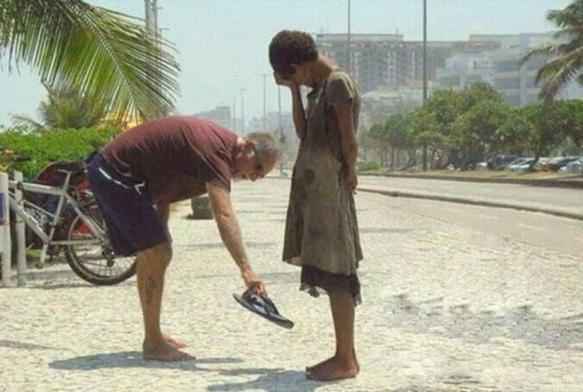
Further, I would assert that, as the accompanying image suggests, it is more important to follow His example, than merely proclaim one’s adherence to it. Thus, while the man giving his sandals to the poor boy may embrace some other religion, or none at all, I sense that Jesus – presumably preferring hallowing acts to hollow words – would rejoice in his compassion anyway.

Here is another expression of my point in changing that single word:

‘Wherever selfless love is shared,
Know that He is present there.’

(All people of goodwill practice decency and kindness; I do not presume to claim those as uniquely Christian values. Only that they are obligations – of which they should never lose sight, and always strive – for those who do call themselves ‘Christian.’ As one who does call myself such, I acknowledge often failing at those, but accept my lifelong duty to keep trying.)

We humans can use our gift of reason to choose to obey our finest impulses, and thereby deliberately summon the best of our humanity. Particularly when doing so goes against our own immediate interests; like giving away one’s footwear to a brother being who needs it more. The mere existence, and exercise, of such empathy nudges our whole world slightly closer to Paradise for everyone; hence, the dirt that will get on this giver’s feet transfigures as the soil of the Garden of Eden.

So whether you regard Christ as a factor in your life or not, may the loving care this image shows inspire you to ‘summon the best of your humanity’ also. It is the simplest thing that many of us can do – regardless of why – to better this Life. 

Which I would venture to believe must gladden Him, also.

Come, Rejoice.

I often post a version of ‘Veni, Veni, Emmanuel’ for Christmas. This year I have chosen one that pleads, with awed splendor, for a consolation beyond any other to enter and lighten our world. For some of us – fearful of the future – such beauty counters the sense that life holds little other than dread.

If this music lets you feel comfort, hope and peace, revel freely, not trying to justify or rationalize them. Comfort, hope and peace are often less of the mind than the heart, which must at times prevail, lest it shrivel; and us with it.

For example, the initial refrain of ‘Gaude,’ ‘Rejoice,’ here is a chord of piercing beauty, but trying to dissect that would defeat the purpose of artistry. A desire to understand how things work can be hugely beneficial, but the arranger, Kodaly, wanted to summon uplift and inspiration, not provide a cognitive exercise.

For most of us experiencing wonder, joy, etc. – sensations that make life feel worth living – their underlying mechanics are irrelevant. Instead of trying to capture wonder, we should let it, peacefully, capture us. It is unnecessary to understand exactly why this happens, and can even be another case of ‘defeating the purpose’ – here, of personal peace.

As to the message of the lyrics, ‘Emmanuel’ translates as ‘God with us,’ but may also imply ‘God in us.’ If we are watchful, we may recognize echoes of divinity in our midst; Angels, not in the guise of winged men. That is, any of us may transcend our Self to act, without consideration, for the benefit, comfort or rescue of an Other, and thus be revealed – even to our Selves – as agents of benevolence surpassing our apprehension.

So perhaps, we are not a lost cause after all. Indeed, Christmas commemorates a supreme instance – in need of no validation beyond the sustaining hope it affords – of love, incarnate, offering grace greater than the fallen state of Humankind.

We must not be blind to the harshness of the world, but neither should we blind ourselves to marvels it may present. That can become a self-fulfilling prophecy in which darkness is all we ever perceive, depriving us of the full spectrum of our personhood.  

We do not all share the same advantages and burdens, but may all share in the same wonders; as well as the same dreads. In a world of dispiriting facts, it is a mark of being human – imperfect, vulnerable and constrained – to need, feel, and embrace respite such as this majestic, melodic invitation to Hope holds out, luminous, before us.

‘Veni, gaude’; Come, rejoice.

‘Resurgamus’: The Renewal of Notre Dame.

When the replacement for Medieval Saint Paul’s Cathedral in London, destroyed in the Great Fire of 1666 got started, its architect Christopher Wren told a workman to bring him a flat stone to use as a marker. The man happened to choose a tomb fragment bearing the Latin word ‘Resurgam,’ ‘I Shall Rise Again.’ He likely had no idea what it meant, but had inadvertently made an auspicious gesture. Wren’s Saint Paul’s became emblematic of London’s rebirth from the catastrophe, and a beloved site of British self-image.

Now, Notre Dame de Paris has also risen from ashes, reopened today, December 8, 2024, but unlike Gothic Saint Paul’s, has been exquisitely rebuilt, not replaced. Medieval cathedrals were concerted projects involving entire regions, and the virtual rebirth of Notre Dame has indeed been communal. But in this case, the community was global; donations, resources and expertise coming from around the world.

It – ‘she’, Our Lady of Paris – originated when people did not assume they could understand, let alone control, the world around them. The heartbreaking day of the blaze in 2019 echoed that sense, as alert and suppression equipment meant to protect from fire failed to do so, a reminder of the limits of technocracy and human efficacy in general.

But as we have renewed Notre Dame, she may now help renew us.

For she stands as testament to past, present, and future wonders we may perform, when inspired to a common objective not dictated by our constricted spheres of self-interest. What happened after the inferno showed how determined hearts can animate the deeds of the head and hand.

This church – sacred not only in her Christian context, but also as an artifact of human identity and innate potential – quickly came to be seen as more than a superb work of artistry and engineering.  Amid her fallen masonry, blackened timber, melted lead, restoration may initially have seemed objectively impossible. But as realization of the importance of doing so grew, rebuilding came to seem daunting; then difficult; and finally unstoppable.

For we may do the ‘objectively impossible,’ if and when our Spirit is willing. Without such collective focus, Notre Dame would have remained a pile of ruins. Instead, in a cultural groundswell, she was embraced as a compass point in the firmament of our general consciousness that needed to be lovingly, faithfully rebuilt. Passively accepting her loss would devalue the whole concept of civilization, for if such an icon of shared human heritage was not worth exertion to save, what part of it is? Or would be? 

Arguably, it made little sense to lavish such attention on a burned out old-building. But that is a mistaken reading; doing so showed itself to be an absolute imperative. For she was never just a pile of stones, but represents the very best of who and what we are, or aspire to be, raised toward the heavens as an offering of our fondest hopes and finest deeds.

So it seems appropriate to use the plural ‘Resurgamus,’ ‘We shall rise again’ here, for the reopening of Notre Dame shows how – together – we may ‘rise again,’ to keep entropy from prevailing. Our devotion for a monument to some of our greatest non-material motivations displays the power of our impulse to create, rather than yielding to chaos.

Or to redeem; as this great shrine to hope returns to welcome the world during this Christmas season, we may choose to rejoice in the premise she has represented across the Ages, echoed again in her revival: There can be fulfilling, benevolent purpose to our existence.

Indeed, Notre Dame may serve her original mission better now than when she was new, amid general illiteracy, incomprehension of natural mechanisms, etc. We understand the natural world far better now, but her mission was and is to proclaim faith that humanity – everyone able to consciously, deliberately choose to act out of Love (whether they do so or not) – is not born merely to die, and return to dust.

Originally meant to assert that we are more than ‘clay vessels,’ she has now shown again how we are fit, and obliged, to participate in and contribute to the wondrous existence from which we sprang, and of which we will always remain as parts.

Our capacity for aspiration soaring beyond what is known or evident has not changed, although perhaps our priorities in reflecting such have matured and deepened. Today that means, quite properly, caring more about our brethren’s well-being than stone, timber and glass surrogates of abstract ideals.

But Notre Dame is a sublime exception to that kinder momentum, a link to our legacy of genius and potent agency; irreplaceable, and thus unacceptable to be irreparable. Her rebuilding stands in contrast to the violence and destruction around us, evidence that we have it in within us to create a more civilized world; in, and for, flesh and blood. Her sacrifice by fire, and our determination to reverse it, has reminded us of this imperative, and of our ability to ‘right wrongs.’ Which also implies that she may now encourage us to strive in a more worldly manner: To bring Heaven to Earth, especially to those most in need of it.

Evoking this dimension of our nature may be a comfort, as contemporary culture gradually prompts us to regard ourselves as organic mechanisms with little evident purpose but prolongation and material enjoyment of our physical lives. But one consequence of that perspective is that our ‘value’ as individuals – absent any non-material one – as measured by algorithms capturing our online activity, purchasing history, etc., is now largely a measure of how exploitable we are as marketing targets.

Those who control the algorithms, collect the data, can sell to or manipulate us accordingly, and thus their own ‘organic mechanisms’ flourish. In such a worldview, exploitation seems to be an only logical choice; that is, one based Only on logic, devoid of any other considerations.

But we are built for exaltation, not just for exploitation, as endeavors like Notre Dame – her origin, and now her renewal – evince. We have shown ourselves, yet again, what we can do if we try to act in ways worthy of sentient beings capable of efforts reflecting continuity, not mere sustainers of organic flourishing. We can be about more than coarse self-aggrandizement; much more.

Many may find this proposition comforting. Faith – not just religious faith – can manifest as the belief in the possibility, often despite implausibility, of facilitating some desired, better reality.

And the resurgence of Notre Dame is a glorious instance of what we can achieve when we act in concert toward some enterprise as great as we, together, can be. Thus, it is not just her fabric that has been renewed, but her defining symbolism of an impetus that remains – resplendently – beyond measure, quantification, or formulation.

An energy arising from heart and spirit, ‘vital’ in every sense.

Reflections from London: Pathos and Progress

Today, November 2, was the birthday of my late mother, so I dedicate this post to her memory. Also to honor and advocate for the power of kindness and wise compassion, such as she often showed. That is relevant to my overall topic here, about our potential to advance beyond archaic lower impulses.

November 2 is also ‘All Souls Day’ in the Catholic tradition, when we may reflect on all those – not just our loved ones or co-religionists – who have gone before us in the great, turbulent narrative of Mankind.

Both those references, to advancement and reflection, apply to this post, which comes from my recent October, ’24, visit to Europe (London, Paris, Bordeaux). It deals specifically with a dark chapter of that narrative, one that our civilization has largely left behind, and with the hopeful implications of our having done so.

The word ‘Tyburn’ still resonates among many historically aware people. It is the name of a site originally beyond the western fringe of London (which has now grown up around it) where, for more than 500 years, men and women (and sometimes, children) convicted of capital crimes in the city were executed.

It lingers in the cultural semi-consciousness as a place of injustice, cruelty, indifference (as well as deep grief and sorrow) and other base attributes supposedly indelibly in Human Nature. Yet Tyburn may also now be considered a point from which ‘Human Nature’ has arguably taken a substantial step forward.

Perhaps the most somber incident during my 2016 visit to Europe was in Amsterdam, when I stood outside Anne Frank’s House, where she and her Jewish family hid from the occupying Nazis, only to be betrayed, resulting in most of them dying in the Death Camps. I had gone there immediately after viewing works by Rembrandt in Amsterdam’s Rijksmuseum, a short distance away.

In my eventual online post about that episode, I referred to the end points of my walk to the House – starting at a venue of breathtaking creativity, but ending at one of abominable cruelty – as ‘A summit and an abyss of human endeavor, separated by a brief walk, yet from different worlds.’

Tyburn is no direct analogue to the Anne Frank House. If anything, its eventual fate reflects the sort of peaceful evolution which the Nazis, rabid advocates of the law of the Jungle, disdained and tried to thwart. But like the Frank House, it too, is only a short stroll from a locality of preoccupied vitality.

London’s largest retail district, Oxford Street, bustles immediately east of Tyburn, oblivious in its materialist spirit to the nearby place of morbid memory. Oxford’s commerce is hardly as exalted as the artistry on display in that Amsterdam museum, but like it, is an acute contrast to the mournful spot that Tyburn was for many generations.

The accompanying photo shows the extremely modest memorial – possibly thus due to shame by British society today at what was done here – to ‘Tyburn Tree.’ That was a gibbet which stood here from 1571 till the mid-Eighteenth Century, consisting of three vertical poles with horizontal beams between them, upon which multiple condemned persons could be hanged simultaneously. Before and after the ‘Tree,’ Tyburn was used to publicly carry out executions, till those were moved to Newgate Gaol (Jail) in the 1780s.

I had explicitly planned to go see this plaque when in London. An ancient city, it has many fascinating attractions, but I wanted to seek parts of its story beyond ‘attractions.’ Tyburn is one such, which should be remembered and pondered, as it so long epitomized how fearsome and punitive our world once was. So I arranged for my sister (who accompanied me in London and Paris) to browse an Oxford Street store nearby, while I made my semi-pilgrimage to this focus of melancholy.

If one feels any need to reflect on dark, sad aspects of history, Tyburn is certainly a ‘focus’ to do so. Over the centuries of its use as a place of judicial killing, masses of ordinary folk were put to death here at the behest of a callous, hierarchical society, making it one of the grimmest places in the world before mechanized killing. (The Tower of London, more famous as a place of executions, was used to do away with the high-born who had offended the Crown. Commoners were consigned to the disgrace of Tyburn, with its jeering spectators and general chaos)

One of the most shocking things about Tyburn to 21st Century sensibilities is how many people were hanged there for petty larceny, a relatively trivial offense no right-minded person today would dream warranted dying for.

Statistics of how many executions there were, how many were hangings, how many of each sort of crime, etc. may be available in scholarly sources, but I did not seek those out for this post. For context however, it is believed that, during its 500 years as the main site where the law put Londoners to death, several thousand were slain here.

My interest is more in what such a phenomenon can tell us about who we were, and by implication, who we have become, and still are becoming. Bluntly, Tyburn was a place where English society proved that it valued property more than life; or at least the lives of the ‘lower orders.’ My unverified impression is that most of the people dispatched here were hanged for often paltry crimes such as the theft of the equivalent of 3 days’ wages. Again, these were offenses for which no modern person should ever accept that capital punishment was appropriate.

Thus, however many ‘souls’ were hanged here for such deeds, it was too many.

Those found guilty of more serious crimes, like murder and treason were also disposed of here, but again, class status played a crucial role – especially in cases of rebellion/treason. Noble folk found guilty of such were usually beheaded in, or near, the Tower, while commoners endured the gruesome ignominy of Tyburn.

Far worse, traitors from of a lower social ‘station’ were ineligible for the relatively merciful death of beheading, reserved to those ‘gently born.’ Lower status men were subjected to the full, horrific, meant-to-terrify traitor’s death, including being torn apart (quartered) by horses, along with other torments.

Thus, what happened at this site for so long should offend us today from various perspectives: First, it reflected a generally savage environment. Also, no doubt, many of the condemned were innocent of the crimes with which they were charged, but got swept up by a court system whose real concern was the protection of the elite’s privilege, property and prestige, more than individual guilt or innocence.

Worse, many, if not most of the victims did things that absolutely wouldn’t rate a death sentence today (even if such still existed). Capital punishment was applied to such a broad range of crimes that it was seemingly the preferred response to almost any sort of getting out of line against the social order, or even against mere convention.

Especially such as hanging for theft, when the guilty party may have acted out of desperation, starving in a culture whose priority was not the general welfare, but ferociously upholding a self-serving Status Quo. Like gibbeting a man for stealing a week’s bread to feed his hungry family when he could find no honest means of doing so. He got snared in a web in which his ‘betters’ got, and kept, the best of everything.

Worst of all in my view, even those who committed deeds we still abhor, like murder and rape, were often made to suffer in ways so perversely cruel that arguably they negated any moral high ground of the authority that would impose them. They were naked, cathartic revenge and intimidation, masquerading as justice.

How can any law that mandates human beings be disemboweled (part of the martial penalty for treason) consider itself to be defending civilization, rather than legitimizing barbarism? Any society that imposes such atrocities is acting out of organic self-interest, arguably little, if at all, better than those upon whom it inflicts them.

All of us today can, and should, be relieved that we are now living in a world where such things cannot, or should not, happen to us (or to anyone else). Slipshod convictions are far rarer, and ‘cruel and unusual punishment’ is expressly prohibited. Even non-lethal penalties during this timeframe were often ghastly, including whipping, branding and pillories.

Returning to the photo, this plaque is not at all prominent, set in a traffic island (ironically, triangular like the setup of the ‘Tree’ itself). Most of the drivers passing it probably don’t even know it is there, or don’t register that it marks a miasma of injustice (‘legality’ notwithstanding), the scene of uncounted deaths over centuries of enforcement of societal norms set by those who benefited most from them. To say nothing of the ongoing bestialization of a citizenry already roughened by the struggles of daily life.

As cars roared around me, I said a prayer for all the Souls whose mortal lives were ended there: Those wrongly accused, those guilty of crimes we would now consider misdemeanors, and those made to suffer in ways we couldn’t even find people today willing to inflict, regardless of the offense. Even for the genuinely guilty, and truly evil ones, of whom there must have been many, themselves often victims of squalid realities.

The former site of Tyburn is now mostly overlooked, but I had felt some compulsion to visit it. I cannot believe that most of those ‘souls’ deserved what was done to them here; not in severity, and possibly, not at all. I mused – hoped? – that my lamentations might at least partly offset the sheer dreadfulness this place both witnessed and reflected, and might minutely help compensate for the inequity of their wrongful sufferings and death being forgotten. Or just ignored.

As the Colosseum, where bloodshed was staged as entertainment, is now a ruin, so Tyburn – where a public reduced to semi-savagery by the brutishness of their grinding existences came to enjoy watching brother beings perish – is now long gone. An abandoned, shameful echo of life as pitiless conflict, and a mass failure of empathy for ‘brother beings.’

There are likely still some people today, in 2024, who might regard the agony of others as a diversion, as the mob often did at Tyburn. But such persons are now repugnant outliers; our culture has, as a whole, grown beyond such bloodlust. Most people today (I fervently want to assume) would be aghast at the idea of public hangings, or worse, as amusement.

All of which may explain why this site is now so modestly marked. Some acknowledgment of the enormity it represents may have seemed needed for propriety – but not to be proudly emphasized. Like a gross transgression committed in one’s raw immaturity of which one grows to be remorseful, ashamed, and even penitent. (As far as I know, British law today does not allow Capital punishment for anything, even Regicide; killing the King.)

I choose to interpret the transition of English culture beyond the need for a place like Tyburn and the values it was used to oppressively sustain, as mirroring the gradual improvement of our species. As proof that our ability to reason may manifest as an inclination to empathize. And as demonstrating that any assertion that Human Nature is immutably corrupt and selfish is not indisputably true.

Those who believe that facts, such as evidence of recurrent human baseness, must be accepted at face value, are free to do so. Those like me, who have faith that events may have subtler implications beyond their face value alone, are equally free (and in my opinion equally justified) to follow that path instead.

Such a hope also is a tribute to my mother; indeed, to most mothers. Perhaps the kindness, sympathy and tolerance that their role in bearing, protecting, and nurturing vulnerable life requires of them will, slowly but inexorably, continue to shape our world more than primitive impulses we should strive to subdue in order to deserve, and to attain, our fullest humanity.

Impulses like valuing our property (and our prosperity) more than others’ lives. That we should leave more and more ‘Tyburns’ behind, and recall them with only shame and a shudder, as we come to regard each other less mainly as competitors for survival. Such is an outmoded habit, an artifact starkly unsuitable for our brighter Age.

Just as the Tyburn Tree would be.
Gratitude to Mr. Biden: ‘See, a Yielding Hero Comes.’

In our culture, the term ‘yielding hero’ may sound like a contradiction. Heroes are meant to be forceful benders of Fate to their will, often indifferent to any ethical nuance or collateral harm they cause pursuing their glorious objectives. The very opposite of the passivity of ‘yielding.’

But in Mr. Biden’s case it is no contradiction. In recusing his candidacy for re-election, he has, for the sake of our nation’s well-being, yielded his most cherished personal ambition. Instead of gambling with America’s essence as a great experiment in freedom, he has now proven his love for her and her mission, beyond a shadow of a doubt.

As I posted on Independence Day, there is often nothing heroic about stubbornly pursuing a goal that has become impossible, counter-productive or even harmful. As some politicians have been known to do, apparently feeling that causing civic uproar is preferable to admitting defeat – as any mature, dignified adult, capable of caring about something more than his own fragile ego, would do.

So to suitably praise Biden’s honor and courage, I offer the accompanying music by Handel (of ‘Messiah’), ‘See, the Conquering Hero Comes.’ This version is instrumental, but the original lyrics refer to the triumph of Judas Maccabeus, a Jewish leader who led armed resistance against Greeks trying to repress the Hebrew faith.

This piece has long been used in tribute to those who have performed near super-human feats. Especially for ‘conquerors’ like Napoleon, Wellington, Grant, or Zhukov; people whose victories changed, or saved the world (though usually also making hordes of widows and orphans in the process). But it is occasionally deployed for others who perform truly epic, consequential acts, so I consider it a worthy tribute for what Mr. Biden has recently done.

If all that sounds grandiose, it is because this work is mainly played in the very grandest of contexts. That must surely include championing America as ‘a great experiment in freedom’ rather than as a bastion of ossified social privilege, with a phony self-image of virtuous equality maintained by self-deception and coercion.

So now I submit it with a title adjusted for Mr. Biden, truly a ‘yielding hero.’ He is likely too modest not to feel embarrassed at an accolade like this, but his deeds and devotion justify it. For anyone, especially one with the self-confidence and vast abilities to properly serve as U.S. President, setting aside one’s own vanity for a greater purpose is absolutely an act of Self-effacing courage that warrants admiration, and even awe. His feat may rescue our democracy from many who care about nobody’s freedom or well-being but their own, and thus it deserves to become legendary. Few would ever be called on to make so great an offering-up; fewer still would rise to the challenge.

Biden’s predecessor, unable to grasp or accept that the Presidency was not only, or mainly, about him, acted as if he saw the office largely in terms of personal advantage and self-validation. For instance: He was known to parade state secrets to foreign officials, bragging ‘I have great intel[ligence]!’ In reality, he was proving that, no matter how much ‘intel’ the CIA, NSA, etc. gave him, he lacked the brains for the most intricately sensitive job in the world. He was inexcusably obtuse about possibly putting espionage methods, output and the lives of human assets at risk by exposing them. This is but one stark example, among a great many, of how utterly unfit and dangerously out of his depth that person was.

(What must those sophisticated foreign visitors have thought of us, for electing someone so childishly fixated on flaunting his own status?)

Mr. Biden’s career has long demonstrated that he would never behave, nor think, that way. Now his withdrawal has affirmed this, showing unequivocally that he realizes there are things – like not compromising our significant progress towards recognizing the worth and autonomy of all our fellow citizens – greater than himself. That is something no Narcissist could do; and might well congratulate their own ‘character’ for being unwilling to do.

One might reasonably assume that no one could attain the Presidency without understanding that putting the nation first is one of the role’s sacrosanct duties, and being willing to act accordingly. Shockingly, recent history has shown that assumption cannot be taken for granted.

But in Joe Biden, faithfulness to those principles is manifest, and concrete. So countless thanks to him for displaying sound judgment, and a Patriotism pure and profound enough to put the peace and well-being of our Republic and her people before everything, including his own historical legacy.

Doing so may be the greatest service he ever renders his country, and that’s saying a great deal, given the COVID chaos he inherited, and how much his political skills subdued its consequences. To say nothing of sincerely upholding his oath to ‘preserve, protect and defend the Constitution,’ rather than treating it as a nuisance-obstacle to his personal affirmation.

Bravo, Joe; may history remember and esteem you as one who not only cherishes, but truly, deeply, comprehends America. And the daunting standards to which she should hold herself.

And as what an authentic ‘Winner,’ looks like; by yielding, rather than vaingloriously persisting.

For Independence Day: Recognizing True Patriotism

My accompanying 2021 post, contrasting the ethics Mr. Gore showed in 2000 to those displayed on January 6, 2021, seems apt again; sadly. Because now, Mr. Biden, due to his performance in the June 27 debates (pressure on top of doing the most stressful job in the world, please remember) may confront a dilemma like Gore’s, between his own ambition and the sake of our nation, which he has served so long and so well.

As Gore did then, Biden may be facing a moment of truth: Does he love America enough to set aside his personal vanity, if necessary, to help ensure she does not revert to unfit, irresponsible governance? Enough to retire in favor of a more reliably electable nominee?

(The GOP candidate has proven he would never put America’s interests before his own. He is likelier to sneer at selflessness as the weakness of ‘suckers and losers,’ having done so before – then lied about it – upon encountering concepts like honor and patriotism. And decency.)

I am no political savant, and can’t specify where the line falls between being resolute and just stubborn; but I know there is such a line. I could wish Gore would reach out to Biden to ask (former V.P. to former V.P.) how great a sacrifice the latter would make in the interests of a greater good. No one else has as much standing, due to his own example, to ask that impudent question. That’s not going to happen, but seems appropriate.

In any case, if Biden decides to stay in the race, we can be reasonably sure it is because he has consulted, then made a clear calculation to do so, rather than a reflex never to defer to anything but his own ego.

——————————

In Honor of Al Gore:

This is an appropriate time to remember the actions of former Vice-President Al Gore late in the year 2000. As many of you will recall, he conceded that year’s election, and the Presidency, to George W. Bush, after the U.S. Supreme Court decided that the deadline for questioning the pivotal, feverishly contested vote in Florida had passed. Mr. Gore had good reason to believe he might have actually won Florida, but that possibility is not my subject here.

Rather, it is to hold up Gore for retrospective praise, now that we have just seen behavior in such stark contrast to his. Acting as any authentic patriot should (and would) have, he accepted personal defeat, subordinating his own ambition to the welfare of our nation. In yielding further plausible claims to victory, he sacrificed his hopes and ego for a greater good. Ironically, his decision strongly suggests he had the judgment and character to lead a superpower.

Anyone who would not have done the same is almost certainly unworthy of the crucial trust of high office.

Gore’s acquiescence brings to mind the Biblical judgment of Solomon, of a mother who so loved her child that she was willing to release it to a rival claimant rather than see it rent in half and killed. I doubt Gore is a saintly man; back then, he was probably seething privately at conceding. But at that pivotal moment, he was unwilling to be the cause of dangerous national divisiveness, admitting that the well-being of our Republic was more important than his own political destiny.

Some people are unwilling, or unable, to grasp ethics that high.

In light of recent events, Gore’s behavior long ago – deeply disappointed, but still accepting the authority of the law and putting the fate of America first – urgently deserves to be reflected on now.

His deed also rebuked the toxic, simian ‘Real Man’ concept of a winner as one who cares only about satisfying his pride; who thinks rules are for weaklings; who cares nothing for decency, let alone decorum; who feels entitled to victory simply for being ruthless enough to stop at nothing to achieve it; and who is brutishly indifferent to any harm he does while pursuing his Hubris.

But Real ‘winners’ Will concede; will grant that other people’s welfare is more important than their personal aspirations; will recognize that moral principle is more valuable than fleeting triumph. Gore showed honor, maturity, responsibility, and a degree of grace – even if somewhat grudgingly so. Thus he has won the right to deserve respect and gratitude forever.

So I hope those planning the 2021 Inauguration give him a prominent place there. His decision to yield in late 2000 – which has never looked more statesmanlike or wiser than now – deserves a standing ovation when he arrives.The recent counter-example to his behavior of 20 years ago should make us appreciate its value now, more than ever.

Another Side of D-Day: ‘Where have all the flowers gone?’

A late Uncle of mine had been an officer serving in Britain in the U.S. Navy at the time of D-Day (code name, Operation Overlord). Though I don’t believe he was involved in the first wave of the invasion on June 6, 1944, he was there a few days later, in some support role. I never learned what he saw and experienced then, because he didn’t want to talk about it. Even the immediate aftermath of the initial landings was ghastly, and not something he cared to re-live.

The World War II Western Allies, the British, Canadians and Americans, are still rightly proud and grateful for what our countrymen began 80 years ago today. First of all, the awesome personal courage and sacrifice; most of the American troops who landed on the French beaches that day had never been in actual combat before, so their very first experience of it was being hurled against Hitler’s fearsome ‘Atlantic Wall,’ the grim fortifications built in Nazi held lands from Norway to the Pyrenees. They were faced with ‘the deep end of the pool’ – when that pool was a lake of fire.

Yet those American kids leaped into that lake, toward a storm of steel from German machine guns and artillery, because they believed they were fighting to help restore freedom to Humanity. As indeed they were, and for which France is still thankful.

And beyond that heroism, there was the epic planning for the invasion, thousands of logistical details from supplies procurement, to planning to transport troops in an orderly sequence, to ingenious deception to make the Nazis believe the invasion would come at the Pas de Calais, far from Normandy, to keep them diverting their strength there while the Allies solidified their toe-hold on the Norman beaches.

The place and timing of the landings of course, had been among the deepest secrets of the War, so the public had no idea it was coming. Thus on that day, President Franklin Roosevelt addressed America (including the anxious families of soldiers) by radio, extolling the valor and enterprise of the undertaking by America’s young men – ‘the pride of our nation’ – while asking for prayers for their deliverance and ultimate victory.

Only after acknowledging all of these facts does it seem appropriate to point out the following:

D-Day was an epic undertaking, unquestionably essential to the eventual destruction of Hitler and the Nazis. But – please forgive me, I do not use this term lightly – it was really something of a side-show to the main event. A very big and important ‘side-show,’ but still a lot smaller than the monstrous, and truly savage, War on the Eastern Front – Germany against the USSR – where Hitler, as a result of his unprovoked invasion, faced off with Stalinism; two forces of equally primitive ferocity. The statistical truth is that four out of five – Four out of Five – casualties the Nazis suffered in the course of the whole war were inflicted on the Eastern, Russian front.

So it isn’t strictly accurate to think of D-Day as the ‘turning of the tide’ against Nazi Germany’s wars of aggression, as the invasion is often now characterized from the American perspective. In hindsight, it is clear that the ‘turning’ was at Stalingrad, the titanic and hideous battle that lasted from Autumn of 1942 to well into 1943, between the German and Soviet armies. It was the first time Hitler’s Wehrmacht had been not just stopped, but definitively, undeniably thrashed. And it was stupendous.

Stalin, adamant to relieve the German pressure on his country, had been demanding a second front against Hitler in the west since 1942, and (suspicious bastard that he was), found it hard to accept the Anglo-Americans’ explanation for delaying invading western Europe until they were thoroughly prepared to do so successfully. He felt the Allies were stalling just so the Russians would sustain more losses, so as to weaken his Communist regime. And in view of how much Churchill, Britain’s Prime Minister was known to loathe Communism, such suspicions were not wildly implausible.

Operation Overlord was of course, an essential nail in Hitler’s coffin; but it was far from the first, or most pivotal one. It was, arguably the beginning of the end, the point at which it became certain Germany would eventually be overwhelmed. But the agonizing reversal of her military juggernaut was at Stalingrad, where the tide that turned was on the Volga River there, crimson with Russian blood. Awful as Anglo-Canadian-American losses on D-Day were, the deaths on both sides at Stalingrad were spectacularly greater, in the hundreds of thousands.

And Hitler’s need to deploy the bulk and best of his forces in the East – those stationed in France were not just far fewer in number, but were of lesser quality – made the Overlord landings far less bloody than they might have been.

So we Americans, in particular, ought to recognize how misinterpreting the scope of our role in crushing Nazism has – justifiably, in my view – rankled Russian sensibilities for decades. And that resentment is still playing out today, in 2024, manifest in Vladimir Putin’s festering outrage at perceived Western ingratitude – and worse, ignorance – for what his own country paid to destroy Hitler.

Thus, I have put an image here of men at arms around water. It may call to mind the American assault of Omaha Beach – ‘Bloody Omaha’ – but is actually from eight months earlier, the Battle of the Dnieper, in Eastern Europe. The Dnieper is a vast river, and the Soviet Red Army was determined to cross it, to pursue the Nazis, whom they had been steadily driving out of conquered Soviet territory. This battle – though little-known or remarked in the West – was so huge and horrendous that the Dnieper at some points turned red with the blood of Russian soldiers, killed by the Nazis as they tried to cross it. Just as the Volga had been stained, at Stalingrad.

We may rightly pause to lament their fate; certainly, their own ruler Stalin, cared very little about individual Russian lives. (Sound familiar?)

Here is more about why I feel it is vital to point all this out:

No one is wrong all the time. Although Hitler’s response to Germany’s defeat in World War I was in every sense criminal, even he had a point, that the treaty of Versailles, dictated by the winners, had been unfair to his country. Especially in that it explicitly obliged her to accept the entire guilt for having started the war, which simply was not true, and much of the European public knew it. Prussian militarism had certainly been a crucial factor in starting ‘The Great War’ of 1914 – 1918, but was by no means the only one. Hitler’s reaction to the staggering blows of defeat followed by defamation was maniacal and monstrous, but the source of that resentment – unlike most of his others – was not entirely delusional.

And in the interest of accuracy, fairness and of redressing dangerous and harmful misunderstanding – much as I hate to admit it, as I utterly detest him – the same is true of Vladimir Putin, current faux Czar and heartless, spendthrift waster of the lives of ordinary Russians (and Ukrainians).

Putin has many false, delusional, cruel beliefs, but as noted above, he does have at least one legitimate grievance. He, and a great many Russians of his generation, feel that their erstwhile Western Allies have never fully grasped nor appreciated the unspeakable magnitude of their country’s suffering – set upon by the Nazis in a war of annihilation against the sub-human Slavs, and their noxious regime of ‘Judeo-Bolshevism’ (a Nazi definition) – in what the Russians refer to as ‘The Great Patriotic War,’ instead of World War II.

Also, about 2 weeks after the D-Day landings, the Soviet Red Army began ‘Operation Bagration,’ a colossal counterblow at the Germans, mostly in what is now Byelorussia. This obliged Hitler, still thrashing in Normandy, to confront an even more crucial threat in the East, which was, of course, just what was intended: to force the Nazis to fight on two fronts, in the East and West (at this time, they were also still fighting in Italy; ironically, the Americans had entered Rome on June 4, two days before D-Day).

So by all means, let us remember, honor – and learn from – the valor and sacrifice of D-Day. But Americans especially, who suffered no combat on our territory, as European Russia was barbarically ravaged, should never forget that for all we paid in money and material (much of it provided to the USSR, and critical to its war effort), the Russians paid on a Biblical scale in blood and lives.

Their losses are beyond reckoning – almost beyond imagining – but aside from the gargantuan, spiteful physical damage the Germans committed, the Russians are generally held to have had approximately 20 million dead – maybe more – military and civilians (in the occupied USSR the Nazis often killed civilians, Jewish and Gentile Russians, like rodents; Jews were explicitly targeted, but non-Jews were still subhuman Slavs, killed for the most minor infractions or even simply to reduce local food consumption).

The Soviet mortality of 1941-45 was so stupendous that it altered the demographics of the nation to this day. In the absence of millions of young men killed in the fighting, the birthrate of the USSR – and of today’s Russia – never fully recovered.

American deaths in the war were approximately 420,000. A terrible toll – one of whom was my own mother’s fiancé before she met my father, and I don’t think she ever fully got over her grief. But for context, one cemetery for the mass graves dug outside Leningrad for the dead of its horrifying siege by the Nazis holds just under 500,000 victims. There are more Russian war dead – most of them civilian residents of Leningrad – in that one cemetery than all the American losses, globally, in the entire conflict.

The Soviet Union sustained deaths (a great proportion of them non-combatants) in a ratio of more than 40 to 1, as opposed to those of the U.S. If one reflects on that, the seething anger of Putin and many of his countrymen – when they hear D-Day called the ‘turning of the tide’ for Nazism – gets easier to understand. And to acknowledge as proper.

So as you honor D-Day, please also register, and honor, the epic, heroic, and far more tragic sacrifices made then by our Russian Allies – ruled by Stalin, indifferent to spending the lives of his own citizens like pocket change, to grind Hitler’s war machine to a halt, and begin to reverse it.

Victory was paid for with a nightmarish trauma for the Russian people from which they will probably never recover, persisting in their folk memory after the last eye-witnesses are gone. They are right to expect that we, in the West, step outside our own historical reference ‘bubble’ and at the very least be aware of what they went through. And to appreciate it.

(Russians are not the only ones who notice, and abhor, the apparent American tendency to assume that anything in which we were not directly involved, cannot be very important. Our nearest neighbors, the Mexicans and Canadians, would almost certainly agree, even though their grievances are not as bitter as having a national calamity of apocalyptic proportions overlooked or disregarded. As many Russians feel we have done to them. But we are all citizens of the same world.)

Their suffering was incomparably worse than America’s, or even Britain, which endured the Blitz, but didn’t have millions of German troops rampaging on its soil, all indoctrinated to believe that the residents were essentially two-legged vermin, and acting accordingly, as they did with the Russians – Slavic and Jewish. No one in the West – not even the conquered French – had to endure anything like that at Hitler’s hands.

So today’s Russians have a right to our gratitude, and respect, for the unimaginably greater sorrows they endured and overcame.

The Nazis capitulated at Stalingrad on January 31, 1943; perhaps we should remember that date – with awestruck salutes for the resolute courage of those triumphant Russians, struggling in the jaws of Hell on Earth, as that battle surely was – just as we recall June 6, 1944. To do so might even help to calm the frenzy of East-West recriminations that still linger.

Music for Easter Monday:

This song is not about Easter, but it is what Easter is about: ‘Love, sweet love.’ And always was, and should be, about.

Nothing I could say about Easter’s doctrine or metaphysics could be more moving than the pure import of these lyrics, nor than the desire of these youthful performers to offer hope and solace amid Covid. So I will only add that those feel fully in accord with Jesus’ heart of love, of which, there is indeed ‘just too little’ in our world.

When this music was new, during the U.S.-U.S.S.R. Cold War, it had the same vibe shown here: Appealing especially to young people not yet hardened by adult responsibilities, nor seduced by self-interest.

Rejecting hopeful ideals is often seen as shrewd maturity, but this pop classic is a case where simplicity is more compelling than sophistication. Perhaps this song, with its message dear to the Angels, will kindle hope for you too, even if life has encumbered such for you, as it does for many who live long enough to be laden with its burdens.

As someone far pithier than me said, ‘You are as old as your fears, and as young as your hopes.‘ Idealism is easier before the duties of adulthood must be shouldered; Life’s stern realities can be rocks on which we can be wrecked, but they don’t have to be. Even for us who are no longer young, yet who still care about making this Life less awful for a dearth of sweet love (and indifference to that dearth may eventually backfire on ourselves), the promise of such an ideal can be embraced, and celebrated.

Music for Good Friday, Message for All of Time:

I last posted this video several years ago, first deploying it in 2014 for the Easter after the death of my father. Then, it felt needful to me to believe that the certain, eventual loss of those we love need not affirm that life is largely meaningless. Such feelings have stirred again for me now, with the death of my best friend, Dr. Joe P. in November, as noted in recent posts.

For unlike my 93 year-old father, Dr. Joe’s passing seemed callous and even perverse, in that he was far younger and had done so much good in his life for others.  And as great as were the contributions (as a physician) of his extreme intelligence, in my view, his kindness and compassion were even finer gifts to the world. Truly noble and more fully human, ‘gifts’ whose value our current culture does not recognize, observe or honor enough. But the artistry in this video seemed to offer a bearable answer – which sensibility might, but reason, alone, cannot – to the ephemerality of even a life like Joe’s.

Rarely is a truly iconic image of Western Art like Michelangelo’s sublime Pieta combined with folk music like this Appalachian tune, yet in this astonishing video, this partnership is appropriately ‘wondrous.’ The force of the premise that super-human love could rescue all of us from our imperfect nature and consequent fixations may have inspired Michelangelo to create the breathtaking image of melancholy beauty here. As well as the singer who has given us this impossibly poignant interpretation of this hymn.

Though ‘wondrous love’ is especially associated with Jesus’ crucifixion, recalled on Good Friday, it would be a waste to evoke its power only once a year. It is not just available year-round; its presence, promise and succor encompass the beginning of time, to beyond its end.

We may reflect on wondrous love today as manifest in Christ’s sacrifice of His life, but can also rely on its constant ambience, like the air on which we depend, though seldom notice. Love of such scope is a dimension like time and space, background context of everyone and everything, a defining attribute of ‘Creation’ itself.

If Christmas is presented as being when incomprehensible, inexpressible hope entered the world, Easter is when that hope came full cycle  – a cycle I rejoice in now, in Joe’s memory – unveiling a death-negating tranquility. In effect, it offers us the option of ultimately joining an in-gathering of all things to God Himself, as at the ‘beginning of time.’

Sharing the Universe with such accessible bliss, we are never in this life ‘alone,’ even when we may fear or presume – or even wish – that we are. We are parts of something so inconceivably vast and pervasive that we may not even recognize that it exists, something implicitly greater than the Self alone, which Jesus surpassed, and overcame, on the cross.

And the ‘Other love’ shown on Good Friday, consummated in the Resurrection, asserts insistently that our lives have value – not always apparent even to ourselves, and not just as the instinct for self-preservation – for whose sake even crucifixion is worth suffering.

Tolstoy and Navalny: ‘The more things change …‘

This is film of the funeral of the author Leo Tolstoy in 1910, posted as relevant to a grotesque tussle over the remains of Aleksei Navalny, implacable, leonine foe of Vladimir Putin. Russian authorities, not wanting a high-visibility ceremony for their greatest enemy (nor to expose evidence of what they did to him) demanded his mother agree to a private funeral before releasing his body. But Navalnaya stood her ground, refused this blackmail, and the Kremlin relented, discharging Aleksei to her.

Tolstoy’s funeral is partly parallel to this, for he too was a passionate, peerless voice against the evils that the regime of his day, Czarism, visited on the ordinary Russians it trod down. As this shows, his passing led to an outpouring of grief and love by common people for one who, implicitly, steadfastly spoke truth to power for their sake.

Note how mourners kneel as one, in gratitude and honor, when Tolstoy’s coffin appears. Masses of peasants – many of whom had not read his works (or were illiterate, still then common in Russia) realized that Count Leo, despite being an aristocrat, wrote on their behalf, often depicting their suffering under the injustices of the Imperial system.

Tolstoy was a Pacifist social critic, whereas Navalny was a fearlessly assertive agent of change, but the mass affection for a champion against oppression shown here is just the sort of spectacle (potential spark?) Putin most fears. And rightly, for while Tolstoy’s passing did not galvanize an uprising, a grand funeral for Navalny conceivably might. Or at least inspire Russians not to just let his dreams be buried with him.

Nicholas II didn’t send troops to quell this shadow rebuke to his rule but Putin, lacking an Emperor’s legitimacy, might not forbear from violent response to a populist funeral for Navalny. What latter-day ‘Cossacks’ might he call out to put down scenes like this, reproving his regime?

The whole world will be watching; or should be.  And in 2024, the record won’t be just a single piece of black and white silent film.