REMEMBERING POPE FRANCIS:

Francis I died a year ago today. In fond memory, I repost the item below, written for Easter 2025, but rededicated to him after his passing, to convey how he acted, as ‘Vicar of Christ.’

Bless you Jorge Bergoglio, for visibly striving to live the words of your namesake: It is in giving that we receive.

And Francis’ legacy keeps giving. His successor, Leo XIV, chose a name whose last bearer initiated the Church’s engagement with modernity; a choice suggesting progressive attitudes. Including addressing conflicts today’s economics often amplify, over the right of all God’s children to just shares in God’s world.

Francis pointedly lived simply, whereas Leo does so less modestly. He may feel that his sacred office legitimately requires some degree of ‘majesty,’ but may also do so in concession to Catholics who miss papal grandeur. He has returned to the Apostolic Palace, wears satin robes, authorizes certain rites, etc., presumably at least partly to assure those preoccupied with such issues that he respects their sensibilities.

Preferring symbolic splendor to unambiguous Gospel directives feels to me like a distinction between ‘religion’ and ‘faith.’ However, I sense Leo wears satin robes without forgetting there were none such at the stable in Bethlehem; nor Calvary. For he continues Francis’ true priorities, especially defending vulnerable people from predation. Or despair, as Francis is shown doing here.

Leo (Robert Prevost), born in 1955, is the first Pontiff to grow up with the Second Vatican Council’s changes to Catholic practice. He may have experienced those, as I did; sensing the Holy Spirit, moving through the world like a warm breeze at dawn. If so, he may have found that emollient sensation inspiration enough for a lifetime.

Religion cannot fully suffice for anyone who has savored faith, lighting the heart like benign flame that warms without burning. ‘Splendor’ is fitting for the marvel of Christ’s teachings, but no substitute for them. And the Holy Spirit cannot be captured by incense, brocade, nor anything less sublime than Herself.

However much some may advocate Papal grandiosity, it remains superficial; worse, inconsistent with the core Catholic value of humility. But far more corrosive is an apparent desire (by many of those advocates) for formal affirmation that oneself/peers are saved, and all others damned. To me, such feels uncomfortably like sinful Pride.

‘Grandiosity’ distracts from the transforming glow that Jesus’ sacrifice of Self invites. Leo seemingly recognizes that, as a tremendous potential of humanity: That we can, if we will, exceed being mere organisms appeasing their appetites – whatever form those may take. So I rejoice at his acts and rhetoric, particularly addressed to societies whose dominant principles tend to Self-indulgence; material, or otherwise.

The Church long ago lost any temporal authority. Her only power now is the only one that ever truly mattered: to assert Divine love for everyone, and the joy attainable by reciprocating it, to each other.

Francis deployed that assertion against obsessive excess as the definition of a ‘successful’ life. Leo, persisting, may help inspire many who prefer rote ritual, with supporting dogma – or who have no faith at all – that the radiance of Christ’s way may surpass any shiny, enticing alternative.

A radiance parallel to ‘the Holy Spirit, moving through the world like a warm breeze at dawn.’

————————————————————————————–

ECHOES OF RESURRECTION:

This image shows Pope Francis kissing a man with a ghastly skin disease. I don’t know if this encounter was prearranged, or if Francis just spotted this poor soul in a crowd. Either way, he responded as Christ did with lepers, who were then shunned for fear of contagion, and prejudice that they were spiritually ‘unclean.’

Francis’ parallel act of surpassing kindness reverberates as an unaffected demonstration of what love beyond one’s Self may enable us to do. As here, when it likely required overcoming reflexive revulsion, and fear of possible contagion, to comfort a child of God who has likely often been ‘shunned.’

Our best deeds are often not our most rational ones, but a response like this to suffering is fitting for anyone who thinks it worthy to emulate Jesus. Especially for a successor to Saint Peter.

If this meeting was spontaneous, the Pope had to trust the man’s (presumable) assurance that his condition was not highly communicable. But in his role as ‘Vicar of Christ,’ he may have felt obliged – in fact, inspired – to follow Jesus’ example with outcasts. This is a breathtaking illustration of how care for the misery of a brother being – here, one who has surely endured much isolation – may enable us to set aside our sensibilities, and even our own safety.

Caring for another as oneself may be a joyful gift to give, simultaneously a denial of Self, and yet the Self’s finest affirmation. Here, we witness someone heavy laden, being reminded that he need not carry the cross he has been given to bear, alone.

In basic Christian belief, love enabled Jesus, the Christ, to physically transcend death itself. We ourselves cannot do that, but here we behold the transcending power of love in action. I cannot know if Jesus’ bodily Resurrection literally happened, but can have faith that its implications can change the World. That is a reality we may create, and by which we may be re-created; that is, made anew.

Francis could not miraculously cure this man, as Scripture asserts Jesus did on numerous occasions. But short of that, what might Jesus do in such a situation?

Surely, something like the gesture in this picture.

Uplifted: Solace for Easter

Today in Christian tradition is the day Mankind is most intimately offered hope and joy, the consummation of the cycle initiated at Christmas. Easter is the fruit of Jesus’ sacrifice of Self for the welfare of all Others, His return representing how we may rise to the fullness of our humanity.

That is, a means to exceed our corporeal bounds alone, a premise in which we may partake by living consonantly with His example, the contentment to be gained by caring for more than just our Selves. By the outward-focused form of love, generally known by its Greek name: Agapé.

I initially thought to follow my post ‘The Radical Realism of Good Friday,’ with a representation of such awesome implications, the ‘Gloria’ of Beethoven’s ‘Missa Solemnis.’ I personally know no music that better depicts divine omnipotence.

But I’m not really comfortable using endorphin-evoking works like the ‘Gloria’ in a religious context, which should need no bombast.  So instead, I chose the hymn ‘Christ the Lord is Risen Today.’ This is often performed with a triumphalist tone (like the ‘Gloria’), but this version is serenely modest; all the trumpets in the world could not make its underlying message more potentially compelling.

Bach, Beethoven’s peer in music’s pantheon, might have said that in his B-Minor Mass, he was channeling the divine, just serving as God’s instrument. Beethoven, who lived 75 years later during the hyper-individualistic Romantic Era, might have asserted the opposite: God was Being channeled through him, and his personal genius.

For that very reason, monumental though it is, the ‘Gloria’ feels unsuitable for the gentleness elicited and required by Agapé – from whose true nature, its hyperbole may even distract (tempt?) us. Easter’s message, that love is both the source and sustenance of life, may give us pause to wonder if there is more to our Being than physical existence. And if, with its flaws and challenges, physical existence should be assumed to be the only reality that matters. That it may not be, is perhaps the single most quintessential element of ‘faith.’

Of course, the ‘Gloria’ is also worth listening to, and to ponder whether any species that could produce such a thing could be just an apparatus of flowing blood, firing nerve endings, etc. If it implies that we are inexpressibly beyond mere biological mechanisms; or at least, capable of aspiring to act as if we are. Something that echoes of the infinite promise bestowed today – not in spite of our imperfections, but because of them, in effect evoking greater love, as from a parent – in which we may repose faith, find peace and gain strength.

Not because our bodies will not return to dust, but because the best of our innermost being – the genuine good that we do, parallel to the benevolence Christ offered – need not vanish with our flesh, but may go on reverberating, contributing to the well-being of those who live after us. Whatever form such ongoing presence may take, it may constitute Eternal Life, in the realest sense, for Agapé may connect us with both eternity and infinity. Including with our brother beings, forever.

So please enjoy and contemplate this gently insistent music. What it lacks in grandeur, it may, with its lyrics, make up in serene suggestion of the goodness of existence.

To any who will allow themselves to perceive ‘existence,’ thus.    

‘Father, forgive them’; The Radical Realism of Good Friday:

The ‘Realism’ is that our world is never, ultimately, made better by returning evil for evil. And that seems ‘Radical,’ because it is so often at odds with an ingrained reflex to do exactly that.

Good Friday, traditionally observed as the day Jesus was crucified but forgave those inflicting the ordeal, sets an admittedly super-human standard for love. But can we, at least, aim instead for not going to the opposite extreme? Especially in in our public interactions?

A specific trigger brings me to this issue: Recently, I overheard someone speak merrily about the possibility of the natural death of the current President (whose name I prefer to avoid using), then going to the Tower named for him here in Chicago, singing a taunting song of joy.

To clarify: I believe this President is a bestiary of every trait a wise, effective leader should Not have. He lacks the intellect, impulse control, empathy, maturity and awareness of life’s hardships, to perform a job of skull-cracking pressure, which may also demand nuance, even delicacy. Very few people have this rare combination of attributes, and he is obviously not one of them.

No one need enlighten me as to how unfit as a ruler, how vulgar, shallow and generally wretched as a person he is. I hold him and all he embodies in disgust, at the very best. The same goes for the attitudes and actions of his most strident, intolerant, self-involved followers.

But it’s said that imitation is the sincerest form of flattery. And I absolutely will not ‘flatter’ him by permitting myself to be dragged to his level. Thus, under No circumstances could I share or endorse a horrid impulse to rejoice in his death. Doing so would make me as spiteful and vicious as him and his devotees.

How could any thoughtful person with a functional conscience let themselves follow such examples? People who got outraged when he snarked at the deaths of Rob Reiner and Robert Mueller, talking about exulting if his life ends? Does repaying him and his zealots with their own hurtfulness fit a self-image of rational tolerance?

To return to the subject of Good Friday: Surely, the only alternative to its transcending Self-denial is not to give free rein to our animal instinct, and reflex to retaliate. If one really desires a better world, deeds like enduring and forgiving crucifixion are hardly the only means by which to do so.

Simple forbearance may be a good compromise. As a parallel, consider the mechanics of air-conditioning: It does not ‘create’ cool air; it extracts heat. Forbearance, rather than forgiveness, may be like that; not creating love, but tempering passions from combusting.

One need not be Christian, or religious at all, to recognize that one cannot realistically hope for a better world by contributing to its negativity. Is it ‘rational’ to hope for such while repaying spiteful abuse in kind, rather than at least trying to resist the urge to do so? Again, if we cannot do the very best, can’t we at least try not to do the worst?

The provocations of this President and his Lib-owning legions can be outrageous, but is our (Liberal) dedication to reason and tolerance too frail to control the impulse for payback? We risk becoming like those we profess to loathe and surpass; a horrifying irony.

The President is some 80 years old and appears to have few good health habits, so Nature may take its course at any time. If he passes away in office, I will not mourn him, beyond the human condition of mortality.

But I sure as hell won’t sing and dance, even in private. It is irrelevant that he has not behaved so as to merit such consideration; my response will reflect upon me, not upon him. More generally, if we on the ‘rational, tolerant’ Left disparage the backwardness of his base, how is it different if we let ourselves be seized by base impulses?

Shouldn’t we know, and behave, better?

And there could be a fearsome practical consequence for behaving thus. In the event of his death, masses of Americans who follow him (not recognizing their own real interests) will be grief-stricken. So that man might do more harm to this Nation in death than life, if civil tumult arises between his mourners, and opponents who overtly acclaim his passing.

Is that worth a fleeting spasm of cathartic jubilation? No matter what misdeeds he has done, what odious prejudices and resentments he fed, it is reprehensible and civically reckless to risk provoking dire conflict which dignified self-control would let us avoid.

Jesus said from the cross, ‘Father, forgive them, they know not what they do.’ All my readers do not share my personal (Catholic Left) religiosity, or any at all. For people like me, Jesus’ abnegation of the Self by the sacrifice of His own flesh is a marvel of both sorrow and hope, by which to be inspired.

While I personally find this premise sublime, I realize it is not such for everyone. Nor easy to conform to, even for us who strive to do so. But all sensible, responsible folk should recognize the value of moderation.

Schadenfreude, rejoicing in the sorrows of a fallen foe (or a total stranger) is one of the most unworthy of human behaviors. Anyone deliberately indulging it can stop wondering why the world stays awful: It stays ‘awful’ in no small part because of exactly what you are doing.

Again, there is a middle ground between more-than-human forgiveness, and Schadenfreude: Accepting that the world may benefit more from Self restraint than it ever can from surrendering to spite. Especially, having witnessed what kind of world unfolds when people who routinely act that way get empowered.

Someone must stop the cycle of excess; and greater honor attaches to them who do. All of us, whatever our ideology, should, at least, refrain from unleashed acrimony. It may only better the world at a glacial pace, but it doesn’t just keep making the problem worse, which is progress in itself.

If this President dies in office, rejoicing at it would help maintain a feral, tribal element in the life of our nation. As such, it would be an ultimately self-defeating response; and tragic, not to have been recognized as such beforehand.

Today’s ‘Radical Reality’ is that Not yielding to impulse may be the best way to ultimately procure the kind of world we insist we want. Jesus this day set a precedent whose value – in an era where the primacy of the Self, rather than its subordination to the Other, is treated as paramount – our culture struggles to recognize, let alone accept. Despite ages of evidence that ‘returning evil for evil’ invariably degrades and cumulatively hinders us all.

Thus, Christ’s surpassing of that reflex continues to offer light, even from darkness as deep at that on Calvary.

‘The Laurel Wreath is Ready Now, To Place Upon his Loyal Brow’

This title is from ‘When Johnny Comes Marching Home,’ a song for Union soldiers who did their duty during the Civil War, earning the praise, gratitude and esteem of their communities. Men who deserved a laurel wreath, an ancient symbol of victory.

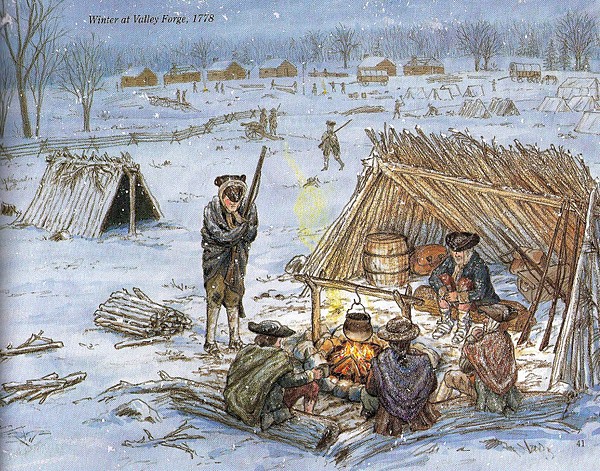
The same could be said for soldiers like those in this image of hungry, freezing men of Washington’s Army at Valley Forge in the terrible winter of 1778, when their determination for independence was desperately important. It helped the new United States hold out till war aid against mighty Britain began to arrive from France and Spain.

Members of America’s armed forces in 2026 should bear this legacy and standards of courage in mind. Probably none of Washington’s Continentals ever got an actual laurel wreath, but America’s survival to become a flourishing republic – far from perfect, but free from Kings – was the greatest memorial to their valiant resolution.

I am distressed that it feels necessary to point out that our military’s ultimate loyalty is supposed to be to the Constitution – and to nothing, and no one else. But at this moment, doing so seems vital, as our politics are driven by vicious men who typically show concern for nothing but their own interests and egos. Worse, who believe that their inclination to use intimidation and force make them natural rulers, rather than agents of barbarism.

Will our servicemen and women recall, and sustain this legacy of Valley Forge? Or might they ‘just follow orders’ to fire upon, and enslave their fellow citizens, rather than be taunted as ‘suckers and losers’ if they hesitate?  Would they help install a king in all but name, after their forebears gallantly expelled George III from his American colonies, because most of their people wanted to be citizens, not ‘subjects?’

Will they adhere to their oaths? Their nominal superiors not only ignore their own, but pursue self-involved, primal dominance, and scoff that morality is for weak fools.

Our approaching Midterm elections may show whether American military personnel, of any rank, believe that today, honor and patriotism can be discarded so as to be one of the self-identified ‘winners’ to whom, bluntly, Might makes Right. Whatever shortcomings there were and are in American self-government, they must surely be worse if people utterly unsuited to rule honorably (or competently) gain unconstrained power. Especially by trying to use military force to thwart the consent of the governed.

The rebels at Valley Forge had no certainty they would prevail; only faith and hope. And they knew if they lost, British law said they could be disemboweled, drawn and quartered, then beheaded as traitors.

Do American military men and women today have such stalwart commitment to liberty? Will they obey the Constitution, rather than would-be despots who might use armed violence to subvert it? Do they deserve a laurel wreath for loyalty, as ‘Johnny,’ or the soldiers shown here, did?  

They should consider all this before being confronted with a need to decide where their ultimate loyalty lies. And they should ask, before putting their careers, reputations and maybe their very lives on the line, if they can trust the ones demanding they do so, to reciprocate any sacrifice they make.

To go by their record, those who might ask them to betray their oath and heritage might abandon them once they serve their purpose. It seems a risky bet to reject a noble legacy to put faith in people who have acted as if they see anyone who helps them as expendable tools. Or as contemptible fools, for expecting arch-cynics to keep their promises.

Let alone, for some gullible wish to march home with pride, rather than shame.

A Choice to Rejoice:

Every year, I post a version of ‘Oh Come, Oh Come, Emmanuel,’ perhaps the most venerable song of Christmas. With Medieval roots, allusions to the Old Testament, its lyrics originally in Latin as ‘Veni, Veni Emmanuel,’ it is often performed with grand solemnity. Or when sung in English, in a tone of quasi-theatrical religious effusion.

But I feel its innermost nature, rather than solemn or theatrical, is awed reverence, hushed as the light of twinkling stars and evoking a limitless force that sustains them. So this year I have chosen an unadorned piano solo, displaying a common English translation. Those words will be my focus here, for when not inscrutably cloaked in Latin, they are as meaningful and compelling as the austere, ageless melody.

Especially consider ‘ransom captive Israel.’ It could be a reference to the Babylonian Captivity, or Roman oppression of the Jewish people. But there may be a broader interpretation: ‘captive Israel,’ refers not just to the Chosen people but to all children of God, everywhere and always, in lonely exile outside the Gates of Paradise since the fall of Adam.

Without speaking stridently, this song echoes ancient inspiration that can brighten our entire condition, conveying melancholy at human woe, yet encouraging us in hope for ‘power o’er the grave.’ And it poignantly addresses our desire, unspoken or unrecognized, for relief from the disappointing, browbeating world most of us experience, relief that may materialize ‘in cloud and majesty and awe.’

Jesus, these words cumulatively intimate, offers rescue from the sense of exile from the Edenic world that was, and is, supposed to be. And they subtly, but insistently affirm faith that, in the hands of Providence, all will be well. If only in an ultimate dimension, which we can never fully perceive.

Most people, at some time in their lives, will feel the sting of events beyond their control, no matter how autonomous or gifted they are. Our culture nudges us to focus (ever so profitably) on our individual selves, but ‘We’ are more marvelous together, than any of us alone can ever be.

So to perceive our value only in terms of the Self is to reject a sense in which we might, effectively, attain eternal life. That is, by living so as to contribute to the welfare of humanity after us, so that they will benefit from any benevolence we contributed or sustained. As opposed to living for ourselves alone, and thus simply vanishing when our bodies die.

‘Death’s dark shadows put to flight.’ The premise, on reflection, is not necessarily that our physical lives can be eternal; it is that our presence in this life need never disappear entirely. Jesus incarnated faith that we are worth far more than just our imperfect Selves, and pledges that faith to us, forever. This carol’s tone bespeaks grievous discouragement, but also hope that its longed-for remedy appears at Christmas.

The coming of Christ, who overcame the Self to redeem all Others, may offer solace to anyone who hopes there must be more to us, and our existence, than the intellect alone may ever compass.

As events, fate or passage of time diminish our individual deeds, unique qualities, advantages or burdens, all that remains to each of us, for better or worse, is the substance of our own humanity. And it is for refuge in that substance to which these words allude, by overwhelming grace that may ‘close the path to misery.’

One cannot, in any sense, truly grasp infinity, but one may yield to and merge with it, as this music pleads by proxy. Christ’s coming, mission and vertiginous love assert our fundamental value, merely by the exercise of the trait that distinguishes us from other life forms; the ability to reason – empathically.

It is less important that the existence of love like that can be factually proven, than that we act as though we are moved by its example. For that is the promise Jesus represents for all who grasp it, and reciprocate it, with lives that perpetuate the cycle of giving, joyously, that propelled Creation itself.

This timeless melody inspires awe, but its words of both jubilation and serenity also reward contemplation. Always, but especially in this season of Emmanuel, ‘God with us.’

Another Side of D-Day: ‘Where have all the flowers gone?’

A late Uncle of mine had been an officer serving in Britain in the U.S. Navy at the time of D-Day (code name, Operation Overlord). Though I don’t believe he was involved in the first wave of the invasion on June 6, 1944, he was there a few days later, in some support role. I never learned what he saw and experienced then, because he didn’t want to talk about it. Even the immediate aftermath of the initial landings was ghastly, and not something he cared to re-live.

The World War II Western Allies, the British, Canadians and Americans, are still rightly proud and grateful for what our countrymen began 80 years ago today. First of all, the awesome personal courage and sacrifice; most of the American troops who landed on the French beaches that day had never been in actual combat before, so their very first experience of it was being hurled against Hitler’s fearsome ‘Atlantic Wall,’ the grim fortifications built in Nazi held lands from Norway to the Pyrenees. They were faced with ‘the deep end of the pool’ – when that pool was a lake of fire.

Yet those American kids leaped into that lake, toward a storm of steel from German machine guns and artillery, because they believed they were fighting to help restore freedom to Humanity. As indeed they were, and for which France is still thankful.

And beyond that heroism, there was the epic planning for the invasion, thousands of logistical details from supplies procurement, to planning to transport troops in an orderly sequence, to ingenious deception to make the Nazis believe the invasion would come at the Pas de Calais, far from Normandy, to keep them diverting their strength there while the Allies solidified their toe-hold on the Norman beaches.

The place and timing of the landings of course, had been among the deepest secrets of the War, so the public had no idea it was coming. Thus on that day, President Franklin Roosevelt addressed America (including the anxious families of soldiers) by radio, extolling the valor and enterprise of the undertaking by America’s young men – ‘the pride of our nation’ – while asking for prayers for their deliverance and ultimate victory.

Only after acknowledging all of these facts does it seem appropriate to point out the following:

D-Day was an epic undertaking, unquestionably essential to the eventual destruction of Hitler and the Nazis. But – please forgive me, I do not use this term lightly – it was really something of a side-show to the main event. A very big and important ‘side-show,’ but still a lot smaller than the monstrous, and truly savage, War on the Eastern Front – Germany against the USSR – where Hitler, as a result of his unprovoked invasion, faced off with Stalinism; two forces of equally primitive ferocity. The statistical truth is that four out of five – Four out of Five – casualties the Nazis suffered in the course of the whole war were inflicted on the Eastern, Russian front.

So it isn’t strictly accurate to think of D-Day as the ‘turning of the tide’ against Nazi Germany’s wars of aggression, as the invasion is often now characterized from the American perspective. In hindsight, it is clear that the ‘turning’ was at Stalingrad, the titanic and hideous battle that lasted from Autumn of 1942 to well into 1943, between the German and Soviet armies. It was the first time Hitler’s Wehrmacht had been not just stopped, but definitively, undeniably thrashed. And it was stupendous.

Stalin, adamant to relieve the German pressure on his country, had been demanding a second front against Hitler in the west since 1942, and (suspicious bastard that he was), found it hard to accept the Anglo-Americans’ explanation for delaying invading western Europe until they were thoroughly prepared to do so successfully. He felt the Allies were stalling just so the Russians would sustain more losses, so as to weaken his Communist regime. And in view of how much Churchill, Britain’s Prime Minister was known to loathe Communism, such suspicions were not wildly implausible.

Operation Overlord was of course, an essential nail in Hitler’s coffin; but it was far from the first, or most pivotal one. It was, arguably the beginning of the end, the point at which it became certain Germany would eventually be overwhelmed. But the agonizing reversal of her military juggernaut was at Stalingrad, where the tide that turned was on the Volga River there, crimson with Russian blood. Awful as Anglo-Canadian-American losses on D-Day were, the deaths on both sides at Stalingrad were spectacularly greater, in the hundreds of thousands.

And Hitler’s need to deploy the bulk and best of his forces in the East – those stationed in France were not just far fewer in number, but were of lesser quality – made the Overlord landings far less bloody than they might have been.

So we Americans, in particular, ought to recognize how misinterpreting the scope of our role in crushing Nazism has – justifiably, in my view – rankled Russian sensibilities for decades. And that resentment is still playing out today, in 2024, manifest in Vladimir Putin’s festering outrage at perceived Western ingratitude – and worse, ignorance – for what his own country paid to destroy Hitler.

Thus, I have put an image here of men at arms around water. It may call to mind the American assault of Omaha Beach – ‘Bloody Omaha’ – but is actually from eight months earlier, the Battle of the Dnieper, in Eastern Europe. The Dnieper is a vast river, and the Soviet Red Army was determined to cross it, to pursue the Nazis, whom they had been steadily driving out of conquered Soviet territory. This battle – though little-known or remarked in the West – was so huge and horrendous that the Dnieper at some points turned red with the blood of Russian soldiers, killed by the Nazis as they tried to cross it. Just as the Volga had been stained, at Stalingrad.

We may rightly pause to lament their fate; certainly, their own ruler Stalin, cared very little about individual Russian lives. (Sound familiar?)

Here is more about why I feel it is vital to point all this out:

No one is wrong all the time. Although Hitler’s response to Germany’s defeat in World War I was in every sense criminal, even he had a point, that the treaty of Versailles, dictated by the winners, had been unfair to his country. Especially in that it explicitly obliged her to accept the entire guilt for having started the war, which simply was not true, and much of the European public knew it. Prussian militarism had certainly been a crucial factor in starting ‘The Great War’ of 1914 – 1918, but was by no means the only one. Hitler’s reaction to the staggering blows of defeat followed by defamation was maniacal and monstrous, but the source of that resentment – unlike most of his others – was not entirely delusional.

And in the interest of accuracy, fairness and of redressing dangerous and harmful misunderstanding – much as I hate to admit it, as I utterly detest him – the same is true of Vladimir Putin, current faux Czar and heartless, spendthrift waster of the lives of ordinary Russians (and Ukrainians).

Putin has many false, delusional, cruel beliefs, but as noted above, he does have at least one legitimate grievance. He, and a great many Russians of his generation, feel that their erstwhile Western Allies have never fully grasped nor appreciated the unspeakable magnitude of their country’s suffering – set upon by the Nazis in a war of annihilation against the sub-human Slavs, and their noxious regime of ‘Judeo-Bolshevism’ (a Nazi definition) – in what the Russians refer to as ‘The Great Patriotic War,’ instead of World War II.

Also, about 2 weeks after the D-Day landings, the Soviet Red Army began ‘Operation Bagration,’ a colossal counterblow at the Germans, mostly in what is now Byelorussia. This obliged Hitler, still thrashing in Normandy, to confront an even more crucial threat in the East, which was, of course, just what was intended: to force the Nazis to fight on two fronts, in the East and West (at this time, they were also still fighting in Italy; ironically, the Americans had entered Rome on June 4, two days before D-Day).

So by all means, let us remember, honor – and learn from – the valor and sacrifice of D-Day. But Americans especially, who suffered no combat on our territory, as European Russia was barbarically ravaged, should never forget that for all we paid in money and material (much of it provided to the USSR, and critical to its war effort), the Russians paid on a Biblical scale in blood and lives.

Their losses are beyond reckoning – almost beyond imagining – but aside from the gargantuan, spiteful physical damage the Germans committed, the Russians are generally held to have had approximately 20 million dead – maybe more – military and civilians (in the occupied USSR the Nazis often killed civilians, Jewish and Gentile Russians, like rodents; Jews were explicitly targeted, but non-Jews were still subhuman Slavs, killed for the most minor infractions or even simply to reduce local food consumption).

The Soviet mortality of 1941-45 was so stupendous that it altered the demographics of the nation to this day. In the absence of millions of young men killed in the fighting, the birthrate of the USSR – and of today’s Russia – never fully recovered.

American deaths in the war were approximately 420,000. A terrible toll – one of whom was my own mother’s fiancé before she met my father, and I don’t think she ever fully got over her grief. But for context, one cemetery for the mass graves dug outside Leningrad for the dead of its horrifying siege by the Nazis holds just under 500,000 victims. There are more Russian war dead – most of them civilian residents of Leningrad – in that one cemetery than all the American losses, globally, in the entire conflict.

The Soviet Union sustained deaths (a great proportion of them non-combatants) in a ratio of more than 40 to 1, as opposed to those of the U.S. If one reflects on that, the seething anger of Putin and many of his countrymen – when they hear D-Day called the ‘turning of the tide’ for Nazism – gets easier to understand. And to acknowledge as proper.

So as you honor D-Day, please also register, and honor, the epic, heroic, and far more tragic sacrifices made then by our Russian Allies – ruled by Stalin, indifferent to spending the lives of his own citizens like pocket change, to grind Hitler’s war machine to a halt, and begin to reverse it.

Victory was paid for with a nightmarish trauma for the Russian people from which they will probably never recover, persisting in their folk memory after the last eye-witnesses are gone. They are right to expect that we, in the West, step outside our own historical reference ‘bubble’ and at the very least be aware of what they went through. And to appreciate it.

(Russians are not the only ones who notice, and abhor, the apparent American tendency to assume that anything in which we were not directly involved, cannot be very important. Our nearest neighbors, the Mexicans and Canadians, would almost certainly agree, even though their grievances are not as bitter as having a national calamity of apocalyptic proportions overlooked or disregarded. As many Russians feel we have done to them. But we are all citizens of the same world.)

Their suffering was incomparably worse than America’s, or even Britain, which endured the Blitz, but didn’t have millions of German troops rampaging on its soil, all indoctrinated to believe that the residents were essentially two-legged vermin, and acting accordingly, as they did with the Russians – Slavic and Jewish. No one in the West – not even the conquered French – had to endure anything like that at Hitler’s hands.

So today’s Russians have a right to our gratitude, and respect, for the unimaginably greater sorrows they endured and overcame.

The Nazis capitulated at Stalingrad on February 2, 1943; perhaps we should remember that date – with awestruck salutes for the resolute courage of those triumphant Russians, struggling in the jaws of Hell on Earth, as that battle surely was – just as we recall June 6, 1944. To do so might even help to calm the frenzy of East-West recriminations that still linger.

Reaping the Whirlwind:

It was obvious that a day would come when U.S. states whose political cultures deny Global Warming would have to confront its inescapable effects. Please see the article below, from January, 2020 (shortly BC – Before COVID).

First, a few relevant thoughts:

In the year 2000, Florida put Denier-in-Chief, George W. Bush in the White House instead of environmentalist Al Gore, due to a recount of the state’s votes (the Supreme Court shut the process down when ‘W’ was ahead). During that sharply contested recount, the media spoke a lot about ‘hanging chad,’ the not-quite-detached punches of paper ballots that were being examined.

Well, now ‘Hanging Chad’ has led to ‘Sinking Flo.’ It is an unhappy, but remarkable irony that Florida – mostly surrounded by the sea and largely flat – was pivotal (no doubt, against the wishes of many if not most of its voters) in halting progress to address climate change for the 8 years of W’s terms. Not long after Bush’s ‘election,’ I predicted that this outcome would eventually bite Florida in the backside due to rising seas. Sure enough, now they are more at risk from that threat than almost anywhere else in the U.S.

I don’t like ‘Schadenfreude’ (the German word for the unkind act of reveling in the misfortune of others). But it’s hard for me not to be at least somewhat bemused by the predicament Florida’s vote back in 2000 has now helped land it in. I will not ‘revel’ in their misfortune, but is a bit of ‘Chad-enfreude’ – feeling some (bitter) satisfaction at having been proved right – permissible?

The article ends by saying that some of these states’ officials might walk away from federal aid rather than admit the reason they need it is that Global Warming is not just some liberal hoax or fantasy – though not Florida’s officials, who realize they now need all the help they can get. As to those officials in other at-risk states, let this sink in (so to speak): They would sacrifice their own citizens – often the most vulnerable, like the minorities in New Orleans’ Lower Ninth Ward, hit hardest by Hurricane Katrina in 2005 – rather than admit they were/are wrong. How low can they go?

We may find out. Sadly, many innocent victims of their stubborn refusal to acknowledge accelerating (and frightening) evidence – and not just in the U.S. – may also find out.