‘Lo, How a Rose ‘ere Blooming – ‘

The title of this post is the traditional English translation of the name of a classic German Christmas carol, ‘Es ist ein Rose entsprungen.’ It refers to a rose, lovely and fragile, that nevertheless blooms amid the cold and darkness of Winter.

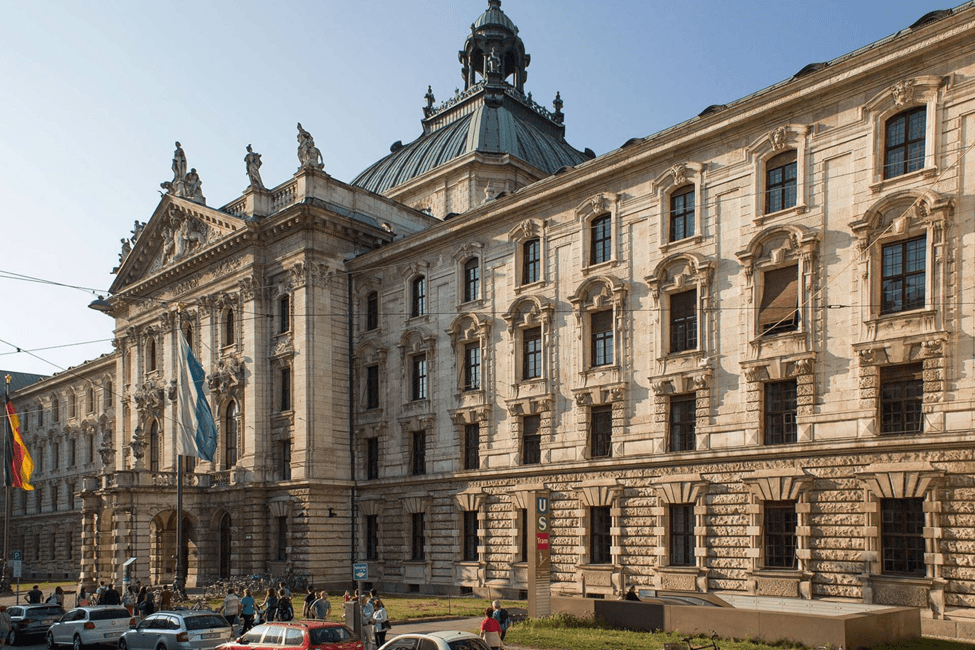
The rose referred to in those lyrics is Jesus, who offers light to the world, and not just amid the darkness of winter. His coming at Christmas, and the attached photo are connected by imagery of the rose. In this case, specifically, by a White Rose.

I took this during my visit to Europe last October. It shows Bavaria’s main courthouse, the Justiz Palast in Munich. In February of 1943, as the course of World War 2 was shifting irreversibly against Germany’s Nazi rulers, this building was the site of the trial of brother and sister Hans and Sophie Scholl, and Christoph Probst (arguably the intellectual epicenter of the circle), principal members of ‘Die Weisse Rose,’ the White Rose, code-name for a group of young resisters to Hitler’s regime. Its members had profound moral hostility to Nazism, and some, including Hans, had served in the Army on the Russian front, and witnessed German atrocities in the USSR.

The Scholls and their co-conspirators were patriots clear-sighted enough to know by then that the war was lost, despite the government’s frantic lies about its course. They wanted to save their beloved country from complete destruction by the overwhelming power of the enemies Hitler had brought down upon it. In fact, this courthouse still bears scars from the bombing that would befall Munich the next year, 1944.

But beyond patriotism, Sophie and Hans were also impelled by deep, resolute Christian faith. They knew perfectly well the awful risks they faced at the hands of the Regime’s savage Gestapo secret police, but felt stiffened to resist it by writing, printing, and spreading vehement anti-Hitler leaflets (considered high treason). They believed their creed, if sincere, obliged them to resist evil, no matter the danger.

Presumably, knowing that Jesus had accepted giving up His life for the world figured into their commitment. The White Rose’s members did not seek martyrdom, but did not shrink from its peril either.

Sophie, probably because heroism is not usually associated with women, has become a legend of principled resistance to evil. But she did not act alone; after being caught (by tragic happenstance) distributing their leaflets, she, Hans, and their associate Probst were arrested, tried, convicted, and beheaded. Sophie’s captors were so astonished by her courage and resolve, they offered to mitigate her guilt from the capital crime with which she had been charged, for they had surely never encountered such authentic nobility by doctrine-spewing Hitler Youth. But she refused to accept, forthrightly stating that she would not recant what she knew to be true and rightful, and bend to the ruthless might and criminality of Nazism.

I had not sought this building; only walking past it, and reading ‘Justiz Palast’ did it occur to me it was likely where White Rose members were tried by the screaming judge Roland Freisler, ‘The Fuehrer’s Executioner.’ To suddenly grasp what had happened here, then reflect on the soaring courage and honor once shown within was both arresting – I stopped mid-step as that realization came over me – and awe-inspiring. Unlike the recovered colored light in Notre Dame in Paris (described in an earlier post), here, my wonder was engendered not by powerful, inadvertent visual symbolism, but directly by human deeds.

If seemingly, more-than-human deeds.

The passionate idealism of the White Rose was the strongest possible rebuke to the carefully curated cruelty and fanaticism of the Hitler Youth, saturated by the Nazi state in racist, bestial ideology. If callow, juvenile men can be manipulated into believing that their worst instincts are actually nobly warlike, the Scholls and others showed how youthful ‘passionate idealism’ may also see right through malevolence, and valiantly oppose it.

If the White Rose members had been exclusively logical, they would have kept their mouths shut, their heads down and their non-combatant status as university students intact. But they did not, for they discerned a duty more precious than their very survival. In serving that, they did far more than deserve to be remembered. They have left a source of inspiration like few who have ever lived, igniting the full power of the soul to act beyond transient concerns, in the interest of values whose urgency never fades. Their determination starkly, absolutely contrasted with some of history’s worst acts of inhumanity.

The example of their bravery and self-sacrifice matters critically in a world where brute force such as (but not restricted to) Nazism too often seizes control of events. Again, the Scholls and Probst had stalwart Christian worldviews, so it seems likely that Jesus’ care for the whole human family – the antithesis of Nazi racial theory – must have been part of their inspiration.

(Of course, such devotion can arise from non-religious sources, but in this case, their intensely personal, if not rigidly formal, faith enabled these young folk to confront death, rather than yield to its menace.)

It is often in seemingly irrational deeds like theirs, floridly contrary to Self-interest, that the scope and potential of our humanity may sparkle most brilliantly. In such cases, we may benefit from decisions that cannot be rationalized, as much, or more, than from many that make perfect sense.

The White Rose was a bloom that will never wither, just as Jesus is the rose, blooming at Christmas, abiding despite all the malevolence in our oft-sinister world. By not doing the sensible thing, the Scholls showed that decency and honor have not perished – in a way adjacent to how Christ showed the same, in love and kindness. I am not nearly brave or strong enough to have done what they did, but am inexpressibly grateful to them for showing that, however implausible, it is not impossible.

Indeed, I have noted in other writings that our finest actions are often not our most rational ones. Surely, all readers of this post know of instances when people braved danger or suffered pain that they didn’t have to, out of simple, heroic decency. Or purest love.

Though this post seeks to honor the White Rose as an instance of aspiration adequate in scope for Christmas, nothing I write could possibly do justice to the splendor shown by its members, and especially its martyrs. The best I can do is to marvel at the implications of their deeds and ethics.

 As long as we have hearts to swell and eyes to tear with admiration, members of this tiny circle may be remembered; and emulated. They did not stop Hitler or his monstrous war, but proved that not even his towering evil could exterminate righteousness, for it was, and is, still to be found around us. An invaluable lesson and a spectacular bequest to the world.

I cannot accept that the human sphere must be merely a cynical contest of genetic material, of our individual gifts or our burdens. The White Rose was proof that such random circumstances can be exceeded, as Christmas suggests Divine hope – and faith – that we can each, conceivably, resolve to rise above such constraints. And far from being exclusively the refuge of the weak and passive, the Christianity of this trio, at least, made them guerillas for Christ.

The legacy of the Scholls and Probst reminds us how even the most demonic sway in our terrestrial element can never fully overcome the life force that summoned it, in the beginning, as ex-nihilo Creation. When hope guards rectitude as indispensable as that the White Rose defended, all the shadow in existence cannot, and did not, subdue it.

A Choice to Rejoice:

Every year, I post a version of ‘Oh Come, Oh Come, Emmanuel,’ perhaps the most venerable song of Christmas. With Medieval roots, allusions to the Old Testament, its lyrics originally in Latin as ‘Veni, Veni Emmanuel,’ it is often performed with grand solemnity. Or when sung in English, in a tone of quasi-theatrical religious effusion.

But I feel its innermost nature, rather than solemn or theatrical, is awed reverence, hushed as the light of twinkling stars and evoking a limitless force that sustains them. So this year I have chosen an unadorned piano solo, displaying a common English translation. Those words will be my focus here, for when not inscrutably cloaked in Latin, they are as meaningful and compelling as the austere, ageless melody.

Especially consider ‘ransom captive Israel.’ It could be a reference to the Babylonian Captivity, or Roman oppression of the Jewish people. But there may be a broader interpretation: ‘captive Israel,’ refers not just to the Chosen people but to all children of God, everywhere and always, in lonely exile outside the Gates of Paradise since the fall of Adam.

Without speaking stridently, this song echoes ancient inspiration that can brighten our entire condition, conveying melancholy at human woe, yet encouraging us in hope for ‘power o’er the grave.’ And it poignantly addresses our desire, unspoken or unrecognized, for relief from the disappointing, browbeating world most of us experience, relief that may materialize ‘in cloud and majesty and awe.’

Jesus, these words cumulatively intimate, offers rescue from the sense of exile from the Edenic world that was, and is, supposed to be. And they subtly, but insistently affirm faith that, in the hands of Providence, all will be well. If only in an ultimate dimension, which we can never fully perceive.

Most people, at some time in their lives, will feel the sting of events beyond their control, no matter how autonomous or gifted they are. Our culture nudges us to focus (ever so profitably) on our individual selves, but ‘We’ are more marvelous together, than any of us alone can ever be.

So to perceive our value only in terms of the Self is to reject a sense in which we might, effectively, attain eternal life. That is, by living so as to contribute to the welfare of humanity after us, so that they will benefit from any benevolence we contributed or sustained. As opposed to living for ourselves alone, and thus simply vanishing when our bodies die.

‘Death’s dark shadows put to flight.’ The premise, on reflection, is not necessarily that our physical lives can be eternal; it is that our presence in this life need never disappear entirely. Jesus incarnated faith that we are worth far more than just our imperfect Selves, and pledges that faith to us, forever. This carol’s tone bespeaks grievous discouragement, but also hope that its longed-for remedy appears at Christmas.

The coming of Christ, who overcame the Self to redeem all Others, may offer solace to anyone who hopes there must be more to us, and our existence, than the intellect alone may ever compass.

As events, fate or passage of time diminish our individual deeds, unique qualities, advantages or burdens, all that remains to each of us, for better or worse, is the substance of our own humanity. And it is for refuge in that substance to which these words allude, by overwhelming grace that may ‘close the path to misery.’

One cannot, in any sense, truly grasp infinity, but one may yield to and merge with it, as this music pleads by proxy. Christ’s coming, mission and vertiginous love assert our fundamental value, merely by the exercise of the trait that distinguishes us from other life forms; the ability to reason – empathically.

It is less important that the existence of love like that can be factually proven, than that we act as though we are moved by its example. For that is the promise Jesus represents for all who grasp it, and reciprocate it, with lives that perpetuate the cycle of giving, joyously, that propelled Creation itself.

This timeless melody inspires awe, but its words of both jubilation and serenity also reward contemplation. Always, but especially in this season of Emmanuel, ‘God with us.’

For Easter Monday: Echoes of Resurrection

(This post was conceived, and largely composed, before the death of Pope Francis. Now I dedicate it to his memory, and to hopes his joyous proclamation of Christ’s meaning for Humanity may continue to ‘go forth and multiply.’)

This image shows Pope Francis kissing a man with a ghastly skin disease. I don’t know if this encounter was prearranged, or if Francis just spotted this poor soul in a crowd. Either way, he responded as Christ did with lepers, who were then shunned for fear of contagion, and prejudice that they were spiritually ‘unclean.’

Francis’ parallel act of surpassing kindness reverberates as an unaffected demonstration of what love beyond one’s Self may enable us to do. As here, when it likely required overcoming reflexive revulsion, and fear of possible contagion, to comfort a child of God who has likely often been ‘shunned.’

Our best deeds are often not our most rational ones, but a response like this to suffering is fitting for anyone who thinks it worthy to emulate Jesus. Especially for a successor to Saint Peter.

If this meeting was spontaneous, the Pope had to trust the man’s (presumable) assurance that his condition was not highly communicable. But in his role as ‘Vicar of Christ,’ he may have felt obliged – in fact, inspired – to follow Jesus’ example with outcasts. This is a breathtaking illustration of how care for the misery of a brother being – here, one who has surely endured much isolation – may enable us to set aside our sensibilities, and even our own safety.

Caring for another as oneself may be a joyful gift to give, simultaneously a denial of Self, and yet the Self’s finest affirmation. Here, we witness someone heavy laden, being reminded that he need not carry the cross he has been given to bear, alone.

In basic Christian belief, love enabled Jesus, the Christ, to physically transcend death itself. We ourselves cannot do that, but here we behold the transcending power of love in action. I cannot know if Jesus’ bodily Resurrection literally happened, but can have faith that its implications can change the World. That is a reality we may create, and by which we may be re-created; that is, made anew.

Francis could not miraculously cure this man, as Scripture asserts Jesus did on numerous occasions. But short of that, what might Jesus do in such a situation?

Surely, something like the gesture in this picture.

Music for Good Friday: ‘Sweet Cross’

Here is music from Bach’s ‘Saint Matthew Passion,’ his incandescent depiction of Christ’s somber death: ‘Komm Susses Kreuz’ – ‘Come, Sweet Cross.’

Its title may puzzle; how could a cross, an object of abysmal cruelty, be ‘sweet?’ But in Bach’s milieu, it also symbolized comfort, consolation and deliverance: For as Jesus endured His cross, He will help us withstand ours. Thus assisted, we may tremble less, to face our own tribulations.

Such seeming passivity may affront our inclination to problem-solve, rather than to withstand. But while human efforts have hugely improved life, none of us gets through it avoiding all fear, pain, sorrow etc. But that does not make life inherently futile, for as Bach intimates here, when we face adversity our own efforts cannot redress or soothe – yet facing such feels unbearable – we may avail ourselves of hope that resigned anguish need not be our only response to it.

Hope that Christ enrobes us with unfathomable love of which we are rarely conscious. It should be no disgrace to need help beyond what we (or the full genius of our species) are capable of, for the premise that all we really are is bustling sparks of carbon is more than most of us might want to accept with equanimity. Faith is willingness to grasp comfort, strength and hope in things than are not rational. Things like ‘unfathomable love.’

The aria’s lyrics ask of Jesus, ‘give your cross to me,’ offering to carry it for Him. This also suggests how ministering to others enriches us by transcending the limits of the Self. We often see evil in the world, but rarely unimaginable goodness, like Jesus’ sacrifice of Self, in every sense. How to respond to such? Bewilderment? Dismissive incredulity? Awed that it is even conceivable, and inspired to follow its example?

I chose this performance by Thomas Quasthof, who was deformed at birth by Thalidomide. As if in rare compensation, he was bestowed a fabulous voice which, as here, can do justice to Bach’s art. Still, if Quasthof curses God every day for his afflictions, I couldn’t blame him.

But in such resentment, as in his gift, he would personify an extreme example of the sorrows and joys, challenges and rewards, defects and wonders of being human. Quasthoff’s very existence implies how, because we are all imperfect, we would be wiser to help bear each other’s burdens, as well as share in each other’s gifts.

Enabling us to enter Paradise was Jesus’ mission on this day. And unless our own malign actions prevent it, we may also rejoin the essence of Creation: That unfathomable love, which is ‘sweet’ indeed.

And the mournful, yet ecstatic tones which Bach deploys here, may ease us into embracing that transforming grace. 

‘Oh Come Let Us Reflect Him’ (Redux)

Below is my Christmas post from 2022. It seems appropriate again this year, as it was partially meant to rebuke a current pretense calling itself ‘Christian Identity,’ which is in reality an indignation-driven Reactionary political movement.

The raucousness of this imposture’s proponents continues to twist and corrode the word ‘Christian,’ causing it to seem, in much of the public mind, synonymous with ‘cruel, ignorant hypocrite.’ Worse, political developments have emboldened those proponents to seek, and perhaps obtain, greater influence in American society.

Personally, striving (if often failing) to act as Jesus’ examples and words seem to bid, I find this phenomenon heartbreaking. Many such ‘Christian Identity’ people would likely entirely miss the point of my ‘Oh Come Let Us Reflect Him’ – how actions speak louder than words (or bellows) – or consider it irrelevant.

I try to understand the plight of such folk, pummeled by our popular culture, which reveres fame, wealth, dominance – things beyond their reach, though which Christ generally condemned – even as they try to validate themselves, mostly, it seems, by striving to ‘devalidate’ the worth (and welfare) of others. Their outlook is not a lie if they truly believe it. But they are deeply mistaken and self-serving if they do, fouling a sacred ideal.

And I can no longer let their questionable self-image pass uncontested, so may write a post that will try to refute this movement, as much as possible, as being, in any sense, Christian. Again, I can forgive its adherents’ rage for self-value – ‘forgiveness,’ like humility, being duties of which so many of them seem unaware, of trying to follow Jesus – and in a free country, they can believe what they like.

But people spurred to malice by outrage at reduced cultural/economic status-privilege should not be allowed to present, or see, themselves, unchallenged, as disciples of a Prince of Peace. They degrade a holy name, saving truths, and a real path (abnegation of Self) to personal actualization. Perhaps I can persuade others, looking on aghast at ‘cruel, ignorant hypocrites’ against taking them at their word about an identity they claim, yet deeply dishonor, and a faith whose moral standing they are mutilating. Whether they realize it – or even care – or not.

My continued silence would imply indifference or assent to this pretense. But I am Not indifferent, and I Do Not Assent.

I have adjusted the refrain of the carol, ‘Oh Come All Ye Faithful’ by a single word, to re-affirm a core aspect of Christmas which seems increasingly to get obscured: Jesus personified willingness to sacrifice the Self for the Other. Thus any act of loving generosity may be said to ‘reflect’ Him. And I hope anyone who is not Christian will try to accept that striving to act in this way really is supposed to be a defining element of sincerely following Christ.

This, despite the fact that many people who claim to revere Christ often do not act so as to ‘reflect’ a grasp of His intentions, nor apparently recognize any need to do so. Or who may believe lip service is sufficient. This includes any ‘identity/culture warriors’ who assume the Prince of Peace wants them to behave heartlessly in His name.

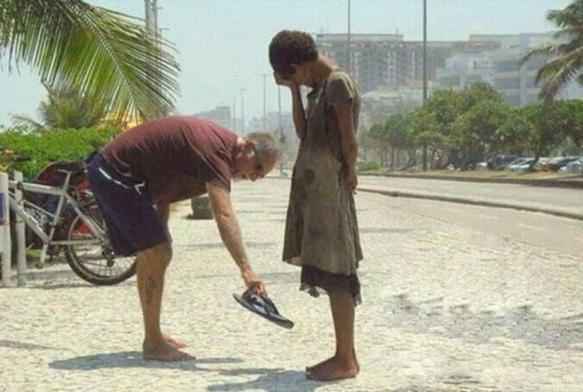
Further, I would assert that, as the accompanying image suggests, it is more important to follow His example, than merely proclaim one’s adherence to it. Thus, while the man giving his sandals to the poor boy may embrace some other religion, or none at all, I sense that Jesus – presumably preferring hallowing acts to hollow words – would rejoice in his compassion anyway.

Here is another expression of my point in changing that single word:

‘Wherever selfless love is shared,
Know that He is present there.’

(All people of goodwill practice decency and kindness; I do not presume to claim those as uniquely Christian values. Only that they are obligations – of which they should never lose sight, and always strive – for those who do call themselves ‘Christian.’ As one who does call myself such, I acknowledge often failing at those, but accept my lifelong duty to keep trying.)

We humans can use our gift of reason to choose to obey our finest impulses, and thereby deliberately summon the best of our humanity. Particularly when doing so goes against our own immediate interests; like giving away one’s footwear to a brother being who needs it more. The mere existence, and exercise, of such empathy nudges our whole world slightly closer to Paradise for everyone; hence, the dirt that will get on this giver’s feet transfigures as the soil of the Garden of Eden.

So whether you regard Christ as a factor in your life or not, may the loving care this image shows inspire you to ‘summon the best of your humanity’ also. It is the simplest thing that many of us can do – regardless of why – to better this Life. 

Which I would venture to believe must gladden Him, also.