Reflections for Saturday, June 14: ‘Tough’ versus ‘Vicious’:

This post is occasioned by the surreally unself-aware fantasy planned for Washington D.C. for Saturday, June 14. As a taxpayer being charged to indulge that fantasy, I’d like to provide a (countering) reality check:

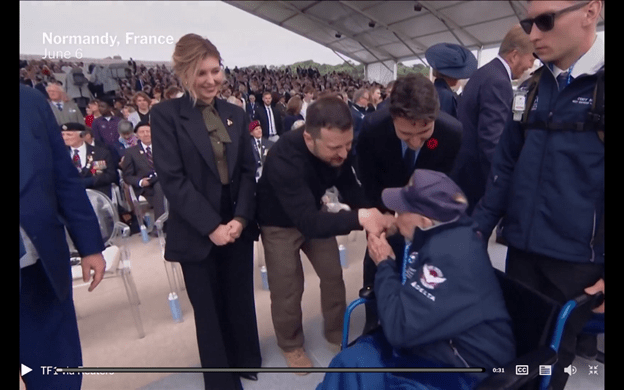
The accompanying image is from June 6, 2024, the 80th Anniversary of D-Day. The man in a wheelchair is Melvin Hurwitz, one of few living American veterans of that bath of fire in Normandy, attending a memorial service there. In awed gratitude, Hurwitz is kissing the hand of another distinguished guest and foe of tyranny, Volodymyr Zelenskyy, President of Ukraine.

‘You are the savior of the people!’ exclaimed Mr. Hurwitz, suggesting, rightly, how Zelenskyy’s ongoing fight to expel marauders from his homeland is, ultimately, on behalf of all who want a world not ruled by just-below-the-surface residue of our lower animal nature: brute force.  Zelenskyy reciprocated with respectful modesty, as one brave person to another. These men, having put their lives in jeopardy for righteousness decades apart, seem ‘tough’ in every positive sense.

Whereas those who present themselves as strong, but with a history of ‘dodging’ actual danger – and imposing harm or sacrifice on the vulnerable to prove their strength – are not: They are merely, contemptibly, ‘vicious.’

(Not that being authentically tough is invariably virtuous. Many loyal Nazis died fighting to enlarge or preserve Hitler’s Reich. But my focus here is unmasking pretense of stalwart character.)

Vladimir Putin is certainly such. One may recall photos of him during COVID, sitting at the end of a comically long table with conferees at the far end, so Putin could stay safe from contamination. Hardly a display of great personal courage; over-cautious, at the very best.

If he were as brave and patriotic as he wants the world to believe, he might have volunteered to leave East Germany, where he was a KGB agent, to serve as a political officer among Soviet troops invading Afghanistan in the 1980’s. That’s what he could have done, were he willing to put his life at hazard for his country on a savage battlefield.

But men like Putin are as adept at cynicism as rationalization, and thus prone to perceive (or at least describe) real selflessness as naiveté by ‘suckers and losers.’

Which brings us back to the point of this post. Readers can surely think of other public figures determined to be thought resolute (and ‘manly’), although they are known to shrink from personal hardship, let alone peril.

‘Tough vs. vicious’ is a crude distinction, but we’re dealing with a crude reality: Those like Zelenskyy are genuinely tough: Willing to face and overcome adversity for goals that are undeniably just and rightful. Whereas Putin, and men like him, are just vicious; perfectly willing to cause others pain, but shirking risk themselves.

(Few females claim to be ‘acting like women’ when ravening like animals. I regret that we males seem far more apt to act on our baser inclinations – then insist such ‘ape-titudes’ are virtues. However, I have seen and known women who can be tough in the very best sense: gallant.)

My term for such men is Counter-Evolutionaries. They benefit from cultures, societies etc., in which the Law of the Jungle prevails, rather than the World that is possible if humanity got better: Kinder, less prideful, more empathic and communal. None feeding their Egos at the expense of others’: More ‘Evolved.’

Such Evolution (defined as outgrowing tendencies of creatures that lack Reason) of our nature is the last thing Counter-Evolutionaries want. They resist it reflexively and deliberately, preferring an immutable cockpit in which the merciless prey on the weak, and they can exploit human reason to serve feral instinct.

They may even try to reverse the tide of history to restore situations in which they throve and exalted, no matter how objectively bad they were for others (like Putin’s USSR fetish). And they try to hoodwink or coerce the rest of us to share or submit to their primitive worldview.

My tough-vicious dichotomy may seem coarse and simplistic, but still offers a useful, not wholly inaccurate, perspective: Bear in mind that being thought tough is often craved by the craven. Also, that a man focused on a retrograde goal like physical dominance is likely not up to the complexities of 21st Century rulership.

Thus, I see the ingenuity of Ukrainians defending themselves from the ferocity of hospital/school/mall-targeting Russian intruders by using brains instead of brutality as a hopeful, if tragically slow, sign of our species’ progress. Their innovative, carefully planned and skillfully executed resistance has made victory costly, maybe impossible, for Putin, whose habitual recourse is blunt force.

A regime like his is not apt to be fertile ground for ‘innovative, carefully planned and skillfully executed’ tactics or policies. Despots usually prize loyalty over competence, a priority that has eventually undone many of them. As may well be happening in the Kremlin.

Nobody is perfect. Zelenskyy must have failings; we all do, even oft-lionized Churchill. But most of us still appreciate ideals of courage and honor – such as this image celebrates – in which to place hope, faith and trust, rather than simply drowning in the vortex of life’s squalor.

And squalid is how Brutes-in-suits like Putin view most of us; they presume everyone is as malevolent as themselves, or fools and weaklings if they aren’t. In their mindset, the only admirable course is to grasp wealth, power, fame, by any means.

Consider this picture again: This is not just what toughness looks like, it shows how it behaves when it is truly ‘honorable’: two true fighters against forces of darkness, recognizing and rightly hailing each other.

It could be a tableau of nobility for the Ages.

Americans may want to bear this image, as well as my tough vs. vicious generalization, in mind Saturday, June 14, to offset the grotesque spectacle of self-delusion anticipated that day in Washington.  

Given the current state of our nation’s affairs, we should probably just be content if no horses in the Parade get appointed Senators.

Another Side of D-Day: ‘Where have all the flowers gone?’

A late Uncle of mine had been an officer serving in Britain in the U.S. Navy at the time of D-Day (code name, Operation Overlord). Though I don’t believe he was involved in the first wave of the invasion on June 6, 1944, he was there a few days later, in some support role. I never learned what he saw and experienced then, because he didn’t want to talk about it. Even the immediate aftermath of the initial landings was ghastly, and not something he cared to re-live.

The World War II Western Allies, the British, Canadians and Americans, are still rightly proud and grateful for what our countrymen began 80 years ago today. First of all, the awesome personal courage and sacrifice; most of the American troops who landed on the French beaches that day had never been in actual combat before, so their very first experience of it was being hurled against Hitler’s fearsome ‘Atlantic Wall,’ the grim fortifications built in Nazi held lands from Norway to the Pyrenees. They were faced with ‘the deep end of the pool’ – when that pool was a lake of fire.

Yet those American kids leaped into that lake, toward a storm of steel from German machine guns and artillery, because they believed they were fighting to help restore freedom to Humanity. As indeed they were, and for which France is still thankful.

And beyond that heroism, there was the epic planning for the invasion, thousands of logistical details from supplies procurement, to planning to transport troops in an orderly sequence, to ingenious deception to make the Nazis believe the invasion would come at the Pas de Calais, far from Normandy, to keep them diverting their strength there while the Allies solidified their toe-hold on the Norman beaches.

The place and timing of the landings of course, had been among the deepest secrets of the War, so the public had no idea it was coming. Thus on that day, President Franklin Roosevelt addressed America (including the anxious families of soldiers) by radio, extolling the valor and enterprise of the undertaking by America’s young men – ‘the pride of our nation’ – while asking for prayers for their deliverance and ultimate victory.

Only after acknowledging all of these facts does it seem appropriate to point out the following:

D-Day was an epic undertaking, unquestionably essential to the eventual destruction of Hitler and the Nazis. But – please forgive me, I do not use this term lightly – it was really something of a side-show to the main event. A very big and important ‘side-show,’ but still a lot smaller than the monstrous, and truly savage, War on the Eastern Front – Germany against the USSR – where Hitler, as a result of his unprovoked invasion, faced off with Stalinism; two forces of equally primitive ferocity. The statistical truth is that four out of five – Four out of Five – casualties the Nazis suffered in the course of the whole war were inflicted on the Eastern, Russian front.

So it isn’t strictly accurate to think of D-Day as the ‘turning of the tide’ against Nazi Germany’s wars of aggression, as the invasion is often now characterized from the American perspective. In hindsight, it is clear that the ‘turning’ was at Stalingrad, the titanic and hideous battle that lasted from Autumn of 1942 to well into 1943, between the German and Soviet armies. It was the first time Hitler’s Wehrmacht had been not just stopped, but definitively, undeniably thrashed. And it was stupendous.

Stalin, adamant to relieve the German pressure on his country, had been demanding a second front against Hitler in the west since 1942, and (suspicious bastard that he was), found it hard to accept the Anglo-Americans’ explanation for delaying invading western Europe until they were thoroughly prepared to do so successfully. He felt the Allies were stalling just so the Russians would sustain more losses, so as to weaken his Communist regime. And in view of how much Churchill, Britain’s Prime Minister was known to loathe Communism, such suspicions were not wildly implausible.

Operation Overlord was of course, an essential nail in Hitler’s coffin; but it was far from the first, or most pivotal one. It was, arguably the beginning of the end, the point at which it became certain Germany would eventually be overwhelmed. But the agonizing reversal of her military juggernaut was at Stalingrad, where the tide that turned was on the Volga River there, crimson with Russian blood. Awful as Anglo-Canadian-American losses on D-Day were, the deaths on both sides at Stalingrad were spectacularly greater, in the hundreds of thousands.

And Hitler’s need to deploy the bulk and best of his forces in the East – those stationed in France were not just far fewer in number, but were of lesser quality – made the Overlord landings far less bloody than they might have been.

So we Americans, in particular, ought to recognize how misinterpreting the scope of our role in crushing Nazism has – justifiably, in my view – rankled Russian sensibilities for decades. And that resentment is still playing out today, in 2024, manifest in Vladimir Putin’s festering outrage at perceived Western ingratitude – and worse, ignorance – for what his own country paid to destroy Hitler.

Thus, I have put an image here of men at arms around water. It may call to mind the American assault of Omaha Beach – ‘Bloody Omaha’ – but is actually from eight months earlier, the Battle of the Dnieper, in Eastern Europe. The Dnieper is a vast river, and the Soviet Red Army was determined to cross it, to pursue the Nazis, whom they had been steadily driving out of conquered Soviet territory. This battle – though little-known or remarked in the West – was so huge and horrendous that the Dnieper at some points turned red with the blood of Russian soldiers, killed by the Nazis as they tried to cross it. Just as the Volga had been stained, at Stalingrad.

We may rightly pause to lament their fate; certainly, their own ruler Stalin, cared very little about individual Russian lives. (Sound familiar?)

Here is more about why I feel it is vital to point all this out:

No one is wrong all the time. Although Hitler’s response to Germany’s defeat in World War I was in every sense criminal, even he had a point, that the treaty of Versailles, dictated by the winners, had been unfair to his country. Especially in that it explicitly obliged her to accept the entire guilt for having started the war, which simply was not true, and much of the European public knew it. Prussian militarism had certainly been a crucial factor in starting ‘The Great War’ of 1914 – 1918, but was by no means the only one. Hitler’s reaction to the staggering blows of defeat followed by defamation was maniacal and monstrous, but the source of that resentment – unlike most of his others – was not entirely delusional.

And in the interest of accuracy, fairness and of redressing dangerous and harmful misunderstanding – much as I hate to admit it, as I utterly detest him – the same is true of Vladimir Putin, current faux Czar and heartless, spendthrift waster of the lives of ordinary Russians (and Ukrainians).

Putin has many false, delusional, cruel beliefs, but as noted above, he does have at least one legitimate grievance. He, and a great many Russians of his generation, feel that their erstwhile Western Allies have never fully grasped nor appreciated the unspeakable magnitude of their country’s suffering – set upon by the Nazis in a war of annihilation against the sub-human Slavs, and their noxious regime of ‘Judeo-Bolshevism’ (a Nazi definition) – in what the Russians refer to as ‘The Great Patriotic War,’ instead of World War II.

Also, about 2 weeks after the D-Day landings, the Soviet Red Army began ‘Operation Bagration,’ a colossal counterblow at the Germans, mostly in what is now Byelorussia. This obliged Hitler, still thrashing in Normandy, to confront an even more crucial threat in the East, which was, of course, just what was intended: to force the Nazis to fight on two fronts, in the East and West (at this time, they were also still fighting in Italy; ironically, the Americans had entered Rome on June 4, two days before D-Day).

So by all means, let us remember, honor – and learn from – the valor and sacrifice of D-Day. But Americans especially, who suffered no combat on our territory, as European Russia was barbarically ravaged, should never forget that for all we paid in money and material (much of it provided to the USSR, and critical to its war effort), the Russians paid on a Biblical scale in blood and lives.

Their losses are beyond reckoning – almost beyond imagining – but aside from the gargantuan, spiteful physical damage the Germans committed, the Russians are generally held to have had approximately 20 million dead – maybe more – military and civilians (in the occupied USSR the Nazis often killed civilians, Jewish and Gentile Russians, like rodents; Jews were explicitly targeted, but non-Jews were still subhuman Slavs, killed for the most minor infractions or even simply to reduce local food consumption).

The Soviet mortality of 1941-45 was so stupendous that it altered the demographics of the nation to this day. In the absence of millions of young men killed in the fighting, the birthrate of the USSR – and of today’s Russia – never fully recovered.

American deaths in the war were approximately 420,000. A terrible toll – one of whom was my own mother’s fiancé before she met my father, and I don’t think she ever fully got over her grief. But for context, one cemetery for the mass graves dug outside Leningrad for the dead of its horrifying siege by the Nazis holds just under 500,000 victims. There are more Russian war dead – most of them civilian residents of Leningrad – in that one cemetery than all the American losses, globally, in the entire conflict.

The Soviet Union sustained deaths (a great proportion of them non-combatants) in a ratio of more than 40 to 1, as opposed to those of the U.S. If one reflects on that, the seething anger of Putin and many of his countrymen – when they hear D-Day called the ‘turning of the tide’ for Nazism – gets easier to understand. And to acknowledge as proper.

So as you honor D-Day, please also register, and honor, the epic, heroic, and far more tragic sacrifices made then by our Russian Allies – ruled by Stalin, indifferent to spending the lives of his own citizens like pocket change, to grind Hitler’s war machine to a halt, and begin to reverse it.

Victory was paid for with a nightmarish trauma for the Russian people from which they will probably never recover, persisting in their folk memory after the last eye-witnesses are gone. They are right to expect that we, in the West, step outside our own historical reference ‘bubble’ and at the very least be aware of what they went through. And to appreciate it.

(Russians are not the only ones who notice, and abhor, the apparent American tendency to assume that anything in which we were not directly involved, cannot be very important. Our nearest neighbors, the Mexicans and Canadians, would almost certainly agree, even though their grievances are not as bitter as having a national calamity of apocalyptic proportions overlooked or disregarded. As many Russians feel we have done to them. But we are all citizens of the same world.)

Their suffering was incomparably worse than America’s, or even Britain, which endured the Blitz, but didn’t have millions of German troops rampaging on its soil, all indoctrinated to believe that the residents were essentially two-legged vermin, and acting accordingly, as they did with the Russians – Slavic and Jewish. No one in the West – not even the conquered French – had to endure anything like that at Hitler’s hands.

So today’s Russians have a right to our gratitude, and respect, for the unimaginably greater sorrows they endured and overcame.

The Nazis capitulated at Stalingrad on January 31, 1943; perhaps we should remember that date – with awestruck salutes for the resolute courage of those triumphant Russians, struggling in the jaws of Hell on Earth, as that battle surely was – just as we recall June 6, 1944. To do so might even help to calm the frenzy of East-West recriminations that still linger.

Tolstoy and Navalny: ‘The more things change …‘

This is film of the funeral of the author Leo Tolstoy in 1910, posted as relevant to a grotesque tussle over the remains of Aleksei Navalny, implacable, leonine foe of Vladimir Putin. Russian authorities, not wanting a high-visibility ceremony for their greatest enemy (nor to expose evidence of what they did to him) demanded his mother agree to a private funeral before releasing his body. But Navalnaya stood her ground, refused this blackmail, and the Kremlin relented, discharging Aleksei to her.

Tolstoy’s funeral is partly parallel to this, for he too was a passionate, peerless voice against the evils that the regime of his day, Czarism, visited on the ordinary Russians it trod down. As this shows, his passing led to an outpouring of grief and love by common people for one who, implicitly, steadfastly spoke truth to power for their sake.

Note how mourners kneel as one, in gratitude and honor, when Tolstoy’s coffin appears. Masses of peasants – many of whom had not read his works (or were illiterate, still then common in Russia) realized that Count Leo, despite being an aristocrat, wrote on their behalf, often depicting their suffering under the injustices of the Imperial system.

Tolstoy was a Pacifist social critic, whereas Navalny was a fearlessly assertive agent of change, but the mass affection for a champion against oppression shown here is just the sort of spectacle (potential spark?) Putin most fears. And rightly, for while Tolstoy’s passing did not galvanize an uprising, a grand funeral for Navalny conceivably might. Or at least inspire Russians not to just let his dreams be buried with him.

Nicholas II didn’t send troops to quell this shadow rebuke to his rule but Putin, lacking an Emperor’s legitimacy, might not forbear from violent response to a populist funeral for Navalny. What latter-day ‘Cossacks’ might he call out to put down scenes like this, reproving his regime?

The whole world will be watching; or should be.  And in 2024, the record won’t be just a single piece of black and white silent film.

Putin and the Death of Navalny: The Vicious and the Valiant.

Various personal distractions have kept me from focusing on the followup post I mentioned at the end of my last one, ‘Promoting Freedom by Protecting Memory,’ about the 1905 Winter Palace Massacre in Czarist Russia. But to paraphrase Samuel Johnson, death ‘concentrates the mind wonderfully.’

And the death of Aleksei Navalny, all but certainly due, directly or indirectly, to Vladimir Putin, has concentrated my mind furiously, catalyzing that promised sequel, here. It will not take the form I originally envisioned, will serve largely as a partial vent for my current writhing wrath at Putin. Although that feels inexhaustible.

Dedicated to Navalny, this post proposes suggestions of how to perceive, and what to do in response to, his death. I will not advocate for revenge; vengeance is the province of spiteful men like Putin (and Hitler, who literally spoke of a ‘goddess of revenge’). Instead, justice is what we should rightly seek, and that can best take the form of punishing Putin by helping to thwart his mania to conquer and subjugate Ukraine, an enterprise whose criminality, cruelty and reckless stupidity Navalny condemned relentlessly.

Even if Navalny’s eventual Fate was not a real surprise to those following his opposition to Kremlin tyranny and corruption, it was still a shock. He may be credibly said to have represented what is good, noble, hopeful – and truly evolved – in us, as surely as Vladimir Putin personifies all that is not. No doubt he was flawed like everyone, but also exemplified attributes we properly admire, but rarely attain, such as granite-hard determination. One needn’t be angelic to offer a stark contrast to Putin, but Lion-hearted Navalny was a more extreme opposite than most of us could ever be.  

The likes of Putin, who incarnate dark forces of human nature and history, are desperate to quell such noble impulses which they regard with cynicism and bewilderment, as obstacles to ‘realism’ in politics. But they are desperate fools if they imagine they can dissipate the loftiest acts and aspirations of Mankind with the odd well-placed assassination. Granted, the relative passivity and credulity up to now of the bulk of the Russian public to Putin’s criminal aggression against Ukraine has likely encouraged him to persevere with it. But his incomprehension of ‘principle’ makes it impossible for him to recognize that he cannot eliminate massive, rightful and reparable discontent by ‘well-placed assassination.’ Eventually, the underlying grievances will burst like a volcano’s lava dome, not manifest only in epic characters like Navalny.

Predictably, men as heartless and crude as Putin regard valor as folly, and likely felt Navalny was a fool for returning to Russia from Berlin, where he received medical treatment for a near-fatal poisoning (that was surely Putin’s doing). But authentic heroism is very different from folly.

Someone like Navalny – as he showed in deeds, as did the journalist Anna Politkovskaya – grasps a truth invisible to anyone like Putin: To a soaring soul, there can be values more precious than his own interests, or even his very life. And for Aleksei, the happiness of his country and her people was one such value. The Putins of this world – wherever they are – are blind to such concepts, cannot comprehend flights of the human spirit or seemingly anything but the coarse, transient rewards of ‘What’s in it for me?’ (As an American admirer of Putin once mocked American soldiers – who had died for their country in World War I France – buried ‘over there.’) Any ethical vision they may have ever possessed is occluded by the moral muck of unabashed self-dealing and indifference to collateral harm which they inhabit.

If you also are outraged by Navalny’s suspicious death, there can be no better response to it than to justify his courage by calling for immediate, greatly enhanced Western support for arming and aiding Ukraine against Putin’s militarist fantasies there. And by furthering – in any way you can imagine – Putin’s worst nightmare (and partial reason for his terror at the westernization of Ukraine): Creation of true, irreversible civil society, and the valuing of individuals, in Russia herself.

Because the inertia and indifference of Western public opinion are as vital as oxygen to Putin. His invasion assumed the Democracies, in their affluence and security, would do nothing meaningful in response to it, and let him go on heedlessly spending Russian and Ukrainian lives in pursuit of his delusional 19th Century style Chauvinism.

But using Navalny’s demise as a spur to frustrate the dark powers he struggled against is surely as effective a memorial, to his life and his death, as there could be. If I could somehow speak to the Russian nation, I would assure them that there are foreigners who hail their forefathers’ bravery in their country’s defense. I might then point out that Navalny faced huge, avoidable, risks for their sake, and in gratitude and inspiration, they might be willing to face lesser ones to validate his sacrifice.

The Russian people have never been more formidable than when their patriotism was inflamed, as Napoleon and Hitler learned; for their Motherland, they can, and will, fight like dragons. Given the extraordinary deeds that the great-grandparents of today’s Russians performed – rolling back Hitler’s barbarous rampage in their land all the way to his lair beneath Berlin – perhaps an appeal to their love for their country (rather than loyalty to its despicable leadership) and to their own dormant lion-hearted courage, is the best way to lead to the final destruction of autocracy in their midst:

For Autocracy continues to hold back their already splendid nation from attaining its full greatness which is to be found in its vast contributions to the arts and sciences; not in Mongol-style territorial expansion.

The World’s Democracies’ stalwart devotion to (and enlightened self-interest in) helping to sustain Ukraine may stoke the slumbering patriotism of the Russians by confronting them with just how utterly indifferent their current Czar is to the lives of their sons, husbands and brothers he will continue to waste in Ukraine; how totally focused he is on realizing his own fantasies of glory, and his horrifying concept of national honor.

I realize all of that is easy for me to say, far from Putin’s fierce police, tear gas, stun guns, and rubber batons. But Russians will face such forever if they don’t liberate themselves; as they did in 1917.

Speaking of 1917, there may be a grim but intriguing irony developing here. The rule of the last Czar, Nicholas II, was corrupt, incompetent and unsuited to modernity, but Nicholas was ultimately brought down by continuing to fight a conflict he had rashly helped provoke, but could not win – World War I – whose grave sufferings for his people he was too stubborn, prideful and oblivious to take seriously. In 1917, those people had finally had enough of him, his war, the feckless social order he represented, and they ousted him and his whole rotten misrule.

Perhaps Navalny’s murder will ultimately put a similar flame in today’s Russians, suffering due to a war Putin is too proud and indifferent to his people’s wishes and welfare, to recognize as utterly not worth the cost. Perhaps they will echo 1917, accept that they must take their destiny into their own hands, and repeat history by overthrowing him and his kleptocracy. Putin, as I have noted in other posts, suppressed official observance of the 2017 centennial of the fall of the Romanov dynasty, so it would be tragicomic if he comes to share their Fate due to his own myopic megalomania.  In stifling public memories of 1917’s regime change, he himself may have lost sight of its crucial lesson: Rulers dare not take their subjects’ patience, obedience and timidity for granted.

Thus, he might provoke the very sort of popular uprising he wanted his subjugated public to forget, because he himself neglected its warning, and overestimated the feasibility of eternal repression. And his own eventual Fate might prove messier than the Romanovs’, who got gunned down in a Siberian cellar.

If so, let him face the dreadful destiny of Nicholas II to which his own cruelty consigns him, of obstinately clinging to a path that is as obviously unwise as it is repugnant (and in this, I don’t just mean the invasion of Ukraine, but his whole corruption-protecting police state apparatus), until his own people tear him from power. Or worse.

It will serve Putin right (and be a valuable warning for other tyrants) if he is devoured by the very forces that he has been arrogant, brutish and obtuse enough to disregard, or hubristically suppose he can control forever.

An intriguing premise, that: a self-isolating despot’s inability to recognize that he has slipped into a ‘reality’ at odds with the actual one, leading to the downfall of which he is no doubt petrified. Such self-destruction would prove there can be justice in this world.

And to my fellow Americans, I would warn that we must recognize the peril of letting someone like Putin, insensate of his people’s blood and sorrow, outlast our resolve to stop his current, terrible enterprise. Thus, we should demand more vigorous U.S. aid to frustrate his faith in brute force, and contempt for any moderate exercise of power.

But even more important, Americans must think Very carefully about abandoning our image – to ourselves, and to the world – as friends and defenders of human liberty and progress (the accompanying image was chosen as a reminder of exactly that) by supporting any U.S. movement or politician that considers Vladimir Putin’s savagery ‘irrelevant’ to American interests. Or worse, admirable in itself.

Or supporting any person or party that doesn’t issue a full-throated, unreserved condemnation of the murder of Navalny, as well as all other Kremlin efforts to cradle-strangle individual freedom. Remember: Silence Gives Consent.

(Admittedly, America has its own ‘lava domes’ of justice denied, but they do not include overtly larcenous looting of the national economy, nor domestic political assassination as statecraft. And they are subjects for another time.)

May Navalny’s example flourish in death, even as Putin’s putrefies while he is still alive. To close with a sentiment that could well have inspired Navalny himself, ‘Blessed are they that hunger and thirst for righteousness, for they shall be satisfied.’

It is a rare privilege to witness souls as great as his, who hunger and thirst thus; especially when their goals seem futile. Surely, it behooves us, thus privileged, to help if we can, to ensure his quest was not ‘futile.’