‘Lo, How a Rose ‘ere Blooming – ‘

The title of this post is the traditional English translation of the name of a classic German Christmas carol, ‘Es ist ein Rose entsprungen.’ It refers to a rose, lovely and fragile, that nevertheless blooms amid the cold and darkness of Winter.

The rose referred to in those lyrics is Jesus, who offers light to the world, and not just amid the darkness of winter. His coming at Christmas, and the attached photo are connected by imagery of the rose. In this case, specifically, by a White Rose.

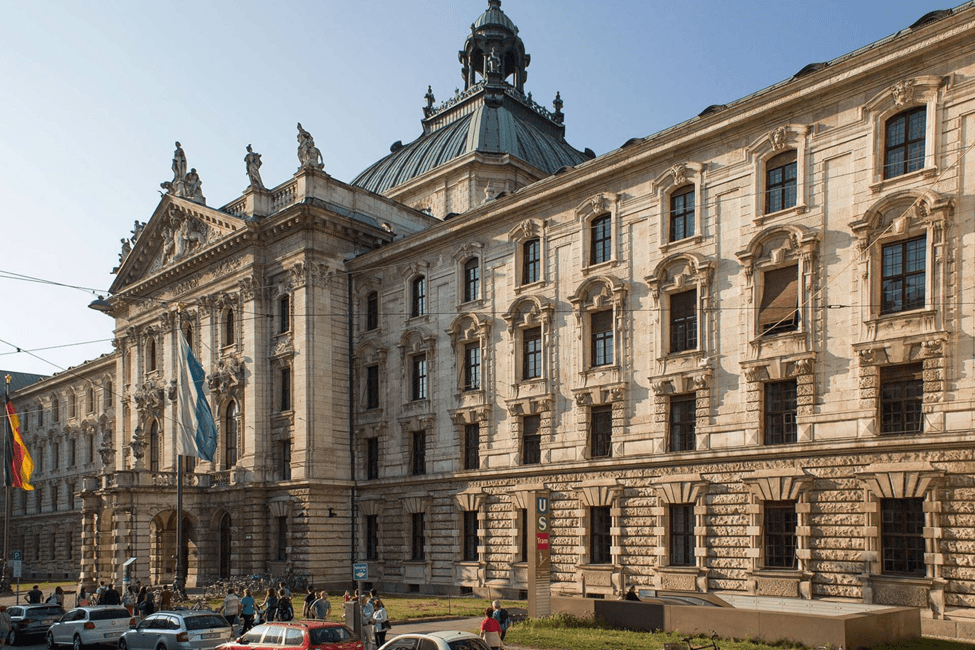
I took this during my visit to Europe last October. It shows Bavaria’s main courthouse, the Justiz Palast in Munich. In February of 1943, as the course of World War 2 was shifting irreversibly against Germany’s Nazi rulers, this building was the site of the trial of brother and sister Hans and Sophie Scholl, and Christoph Probst (arguably the intellectual epicenter of the circle), principal members of ‘Die Weisse Rose,’ the White Rose, code-name for a group of young resisters to Hitler’s regime. Its members had profound moral hostility to Nazism, and some, including Hans, had served in the Army on the Russian front, and witnessed German atrocities in the USSR.

The Scholls and their co-conspirators were patriots clear-sighted enough to know by then that the war was lost, despite the government’s frantic lies about its course. They wanted to save their beloved country from complete destruction by the overwhelming power of the enemies Hitler had brought down upon it. In fact, this courthouse still bears scars from the bombing that would befall Munich the next year, 1944.

But beyond patriotism, Sophie and Hans were also impelled by deep, resolute Christian faith. They knew perfectly well the awful risks they faced at the hands of the Regime’s savage Gestapo secret police, but felt stiffened to resist it by writing, printing, and spreading vehement anti-Hitler leaflets (considered high treason). They believed their creed, if sincere, obliged them to resist evil, no matter the danger.

Presumably, knowing that Jesus had accepted giving up His life for the world figured into their commitment. The White Rose’s members did not seek martyrdom, but did not shrink from its peril either.

Sophie, probably because heroism is not usually associated with women, has become a legend of principled resistance to evil. But she did not act alone; after being caught (by tragic happenstance) distributing their leaflets, she, Hans, and their associate Probst were arrested, tried, convicted, and beheaded. Sophie’s captors were so astonished by her courage and resolve, they offered to mitigate her guilt from the capital crime with which she had been charged, for they had surely never encountered such authentic nobility by doctrine-spewing Hitler Youth. But she refused to accept, forthrightly stating that she would not recant what she knew to be true and rightful, and bend to the ruthless might and criminality of Nazism.

I had not sought this building; only walking past it, and reading ‘Justiz Palast’ did it occur to me it was likely where White Rose members were tried by the screaming judge Roland Freisler, ‘The Fuehrer’s Executioner.’ To suddenly grasp what had happened here, then reflect on the soaring courage and honor once shown within was both arresting – I stopped mid-step as that realization came over me – and awe-inspiring. Unlike the recovered colored light in Notre Dame in Paris (described in an earlier post), here, my wonder was engendered not by powerful, inadvertent visual symbolism, but directly by human deeds.

If seemingly, more-than-human deeds.

The passionate idealism of the White Rose was the strongest possible rebuke to the carefully curated cruelty and fanaticism of the Hitler Youth, saturated by the Nazi state in racist, bestial ideology. If callow, juvenile men can be manipulated into believing that their worst instincts are actually nobly warlike, the Scholls and others showed how youthful ‘passionate idealism’ may also see right through malevolence, and valiantly oppose it.

If the White Rose members had been exclusively logical, they would have kept their mouths shut, their heads down and their non-combatant status as university students intact. But they did not, for they discerned a duty more precious than their very survival. In serving that, they did far more than deserve to be remembered. They have left a source of inspiration like few who have ever lived, igniting the full power of the soul to act beyond transient concerns, in the interest of values whose urgency never fades. Their determination starkly, absolutely contrasted with some of history’s worst acts of inhumanity.

The example of their bravery and self-sacrifice matters critically in a world where brute force such as (but not restricted to) Nazism too often seizes control of events. Again, the Scholls and Probst had stalwart Christian worldviews, so it seems likely that Jesus’ care for the whole human family – the antithesis of Nazi racial theory – must have been part of their inspiration.

(Of course, such devotion can arise from non-religious sources, but in this case, their intensely personal, if not rigidly formal, faith enabled these young folk to confront death, rather than yield to its menace.)

It is often in seemingly irrational deeds like theirs, floridly contrary to Self-interest, that the scope and potential of our humanity may sparkle most brilliantly. In such cases, we may benefit from decisions that cannot be rationalized, as much, or more, than from many that make perfect sense.

The White Rose was a bloom that will never wither, just as Jesus is the rose, blooming at Christmas, abiding despite all the malevolence in our oft-sinister world. By not doing the sensible thing, the Scholls showed that decency and honor have not perished – in a way adjacent to how Christ showed the same, in love and kindness. I am not nearly brave or strong enough to have done what they did, but am inexpressibly grateful to them for showing that, however implausible, it is not impossible.

Indeed, I have noted in other writings that our finest actions are often not our most rational ones. Surely, all readers of this post know of instances when people braved danger or suffered pain that they didn’t have to, out of simple, heroic decency. Or purest love.

Though this post seeks to honor the White Rose as an instance of aspiration adequate in scope for Christmas, nothing I write could possibly do justice to the splendor shown by its members, and especially its martyrs. The best I can do is to marvel at the implications of their deeds and ethics.

 As long as we have hearts to swell and eyes to tear with admiration, members of this tiny circle may be remembered; and emulated. They did not stop Hitler or his monstrous war, but proved that not even his towering evil could exterminate righteousness, for it was, and is, still to be found around us. An invaluable lesson and a spectacular bequest to the world.

I cannot accept that the human sphere must be merely a cynical contest of genetic material, of our individual gifts or our burdens. The White Rose was proof that such random circumstances can be exceeded, as Christmas suggests Divine hope – and faith – that we can each, conceivably, resolve to rise above such constraints. And far from being exclusively the refuge of the weak and passive, the Christianity of this trio, at least, made them guerillas for Christ.

The legacy of the Scholls and Probst reminds us how even the most demonic sway in our terrestrial element can never fully overcome the life force that summoned it, in the beginning, as ex-nihilo Creation. When hope guards rectitude as indispensable as that the White Rose defended, all the shadow in existence cannot, and did not, subdue it.

A Different Enlightenment:

On a recent visit to Europe, a friend and I went from Paris to Sarlat (a lovely Medieval vestige in France’s Dordogne, itself a marvel of nature and history) then Munich, and finally Vienna. It was all rather wondrous.

I hope to post reflections on some pictures I took, as after my 2016 travels. But I am currently focused on a large writing project, so may compose only a few essays, about photos I deem especially significant.

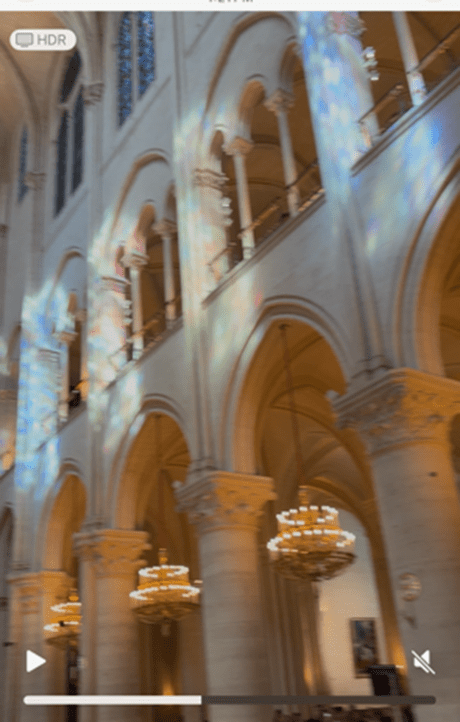
This image initiates that effort. It shows a spectacle not seen in centuries at gloriously rebuilt Notre Dame de Paris. The entire restoration from the fire of 2019 was magnificent, but encountering this long-gone ‘rainbow’ was enrapturing. Without the fire, this vista might have stayed lost forever.

After that inferno, the church’s walls were scrubbed of ages of candle smoke, incense, etc., and its stained glass consummately cleaned. Consequently, this cloud of limpid color, long obscured in the gloom, is now cast onto the stone-work overhead. The restorers likely anticipated its return, but I certainly had not, so discovering it astonished me.

Where I stood filming had been saturated with lead dust, ash from burned roof beams, rubble, all still in peril of structural collapse after the fire. That Notre Dame was not just restored, but is better than before, is evidence of determined, diligent, ingeniously potent human agency.

However: In Medieval Christian theology, God was light, which this revived iridescent glow assuredly suggests.  Thus, this may be pondered as divine approval, or affectionate reward, for how we deployed our collective gifts to rescue this venerable shrine, sacred to abstract aspiration.

I especially hope to write posts for three other photos from my journey. One is consonant with the majesty of human endeavor suggested here; the other two contrast with it.

I photographed Munich’s courthouse, where another intimation of our best Nature appeared. There, in 1943, members of the White Rose, a legendary anti-Nazi network, were tried and condemned to death for their ‘noble treason.’ Supposedly, they even dared scold their judge for moral dissolution and complicity with Hitler – a deed of defiant courage I find as awesome, in its context, as this compelling phenomenon in Notre Dame.

In contrast to that summit, two pictures I took at Dachau, suburban Munich site of Nazism’s prototype Concentration Camp, witness a chasm. One shows a statue of an anonymous inmate, inscribed ‘Honor to the Dead. Warning to the Living.’ The other is a photo of inmates taken by a guard, carefully conceived and crafted to sate Nazi mania to degrade and dominate the ‘other.’

Both these images feel ominously relevant to the political climate in America today, 2025.

The fact that so many people seem not to have learned the grim lessons places like Dachau symbolize makes me fear our species may have reached a pivot point. A point beyond which our Reason, spawning technology to serve the primally self-interested, may be as liable to degrade or destroy us, as to advance us.

Thus, until if and when I write about those three, the image here must serve to assert a proposition I ardently feel worth advocating: belief in the ultimate positivity, underlying and overarching, of our mortal existence. What these apparently unrelated things – this recovered spectacle at Notre Dame and the White Rose’s nobility – have in common, is that the instinctive admiration most of us feel for such marvels may suggest that simple goodness is the default of our nature, and wickedness a baser aberration. And they may help us keep faith in that default, despite all counter-evidence.

Scripture says that after the Great Flood, God set a rainbow in the Heavens in token of a promise never again to chastise humanity for its failings. The rainbow shown here may be mere optical happenstance, but such apparently random coincidences may act as mechanisms to move us to hope, may offset dispiriting, life-negating evidence, inspiring us to reckon that an elementally better world is possible. A world more worthy of this sensational vision, and of the soaring honor of the White Rose martyrs, than of demonic Dachau.

In terms of attaining the highest level of being we can, reaching beyond the Self alone – love – may prevail, where logic fails. So I invite readers to consider this image as evocative of tender, reassuring encouragement to such ‘reaching.’

Most humans’ spirits are not data driven, so physical experimentation, mathematical proofs, etc. are not tools for such undertakings, which are outside the realm of reason, alone. We must generate and embrace such Hope within our Selves. And it must subdue animal urges such as Nazism invoked, or we are lost.

Hope need never die, unless we let it expire. At grievously wounded Notre Dame, we did not, and as a result, got back this breath-taking apparition.

For Bastille Day: Libertines – Egomaniacs – Fratricides?

The recent Bezos Matri-Money in Venice reminds me of an episode from the French Revolution. We tend to think of the Fall of the Bastille, July 14, 1789 as the start of that grand historical process. It was pivotal, the most violent defiance of King Louis XVI’s authority to date, but was soon followed by an incident more pertinent today. We are not at a tipping point like that event turned out to be, yet it feels increasingly relevant.

On October 1, 1789 the Flanders Regiment reached Versailles to take over duties of a unit that defected at the Bastille uprising. At the same time, a bad harvest was making bread, staple of most French diets, costlier in Paris.

The King’s bodyguard threw a sumptuous banquet to welcome the Flandriens. As if luxuriant food as commoners faced starvation weren’t insensitive enough, the newcomers also displayed inordinate gestures of loyalty to Louis. The callousness of extravagant dining and obliviousness to broad frustration with a feckless King were dangerously at odds with the mood beyond the royal Court.

News of those antics got soon back to Paris, and as a result, a mass of irate women marched out to Versailles to remonstrate with Louis about the cost of bread. They breached the palace, and coerced the royal family to return to Paris, where they could be more easily controlled, guarded and menaced.

In 2025, there are no Divine-Right Kings on whom national publics can focus frustration. But we have our own focus: behavior like that extravaganza in Venice by those who, like Louis’ courtiers, evidently see themselves as above the concerns of (other) mortals.

It is a fair, if inexact, parallel to reaction to that Flandrien feast that today, beleaguered folk observing modesty’s ‘Dearth in Venice’ resent the ultra-rich absorbing ever more of Global wealth. Often by redirecting it from previously comfortable middle classes.

Even more reckless, today’s plutocrats try various ploys to pull up the socio-economic ladder, to make their privilege and power inassailable. (‘Ploys’ like rendering healthcare less accessible, reducing life expectancies; hence my citation of ‘Fratricide.’)

Was the unseemly profligacy of the wedding of merchant martinet Bezos due to delusion? Arrogance? Both?

Did its guests not realize the resentment their hyper-indulgence causes fellow citizens? Citizens watching as historically unique widespread financial and personal security –- which they consider the bedrock of any ‘just’ society – gets deliberately eroded?

Especially when many of those guests avoid taxes (as the accompanying image suggests) with the same vigor they siphon profit to themselves. Often, using techniques they – the groom first among them – devised or control.

(Sidebar: Is facilitating techno-charged rapacity ‘Evolutionary progress?’ Surely, this is not the highest state of development to which we can aspire!)

Can they actually believe their efforts to revive a Gilded Age – a glittering membrane over a dark reality of struggle for survival for most – will pass unnoticed, and unresisted, by ‘most?’

All this is an insufferable offense against simple fairness, so any popular wrath it ignites should come as no surprise. How can allegedly smart (rich) people be so blinkered they can’t see this is both intolerable, and untenable?

There is a huge difference between most people today, and French commoners in 1789. They were accustomed to hardship, hoping mainly that survival be as little difficult as possible, whereas most of us experienced ‘widespread financial and personal security’ not long ago.

We know life Can be better, and should not accept its being degraded so kleptocrats can outdo each other with grander yachts.

Why should so many give up so much, to pamper so few?

Or is it arrogance? Do members of the ‘élite’ simply not care what the common herd thinks? Or presume it can be reliably manipulated? But today’s ‘herd’ is educated enough to sustain a modern economy, so its members are aware life was not, and need/should not be, constant struggle for survival.

In honor of Bastille (Bez-steal?) Day, the subtitle of this post is a satire on three pillars Republican France has espoused since her tumultuous birth: ‘Liberté, égalité, fraternité’ ‘Liberty, equality, fraternity.’

Ideals that any libertines, egomaniacs or enablers of fratricide who made it onto the Venice guest list likely not just ignore, but consciously mock. Most especially égalité/equality. Their personal ‘ideals’ are obviously irreconcilable with France’s Secular Trinity and its promise of a better human condition.

To return to that women’s march: legendarily as they neared Versailles, palace staff tried to close its gates. But they hadn’t been shut in decades, and were rusted immovably in place. Heedless gentry had just presumed civilization would prevail to sustain (and be exploited by) them. Their presumption that their privilege was indestructible proved false, so when a reckoning came, it left them unable to shield themselves.

It wasn’t barbarians at those gates. It was wives and mothers fed up with being ‘subjects’ of those whose selfishness proved they did not merit their prerogatives.

Those rusted gates may prove a metaphor for glitterati who attended Bezos’ rites, then ignore justified anger from beyond their velvet cords and gated residences. Who assume civilization is there to protect them, even as they (‘Carnivores in Venice?’) prey on most of its members.

If Venice’s spectacle is 2025’s equivalent to the cluelessness of the banquet for the Flandriens, the equivalent to their tin-eared praise for Louis XVI may be our plutocrats’ shameless tax avoidance, a childish mindset that one may limitlessly ‘take,’ but need never ‘give.’

History may see capers like the flaunted opulence in Venice as what led a critical mass of people to conclude the economic structure benefits only a veneer of the powerful.

In another essay, I will speculate on cynical ways plutocracy may be trying to distract us commoners from noticing how we are being despoiled. Like Versailles’ gates, such gambits are liable to eventual failure, when snarled with the accumulated rust of popular rage.

That essay will be titled ‘Bread and Circuits.’ 

American Police: Which Vision will You Defend?

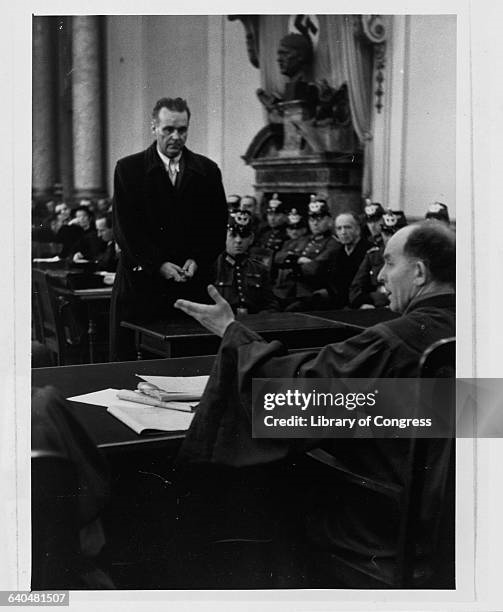
The accompanying image shows Roland Freisler, Chief Judge of Nazi Germany, in his court. Sometimes called ‘Hitler’s Executioner,’ here he is being watched by a group of regular German police in their distinctive helmets.

I don’t know who the man facing Freisler is, but if he was in the hands of this robed thug, he was almost certainly considered an enemy by the Nazis. He had likely been tortured, and this trial is a sham pretense of judicial process, performed for purposes of propaganda and public intimidation. He is probably doomed, as Freisler routinely imposed the death penalty. His melancholy facial expression shows he already knows his likely Fate, as not so much the ‘accused,’ as the ‘condemned.’

This image implies something American policemen and women may find themselves facing: The critical, pivotal role of ordinary ‘cops-on-the-beat’ in facilitating tyranny.

The Gestapo, Hitler’s savage Secret State Police, never numbered more than a few thousand agents, when Germany’s population was nearly 70 million. So to make up for their small number, that baleful Bund encouraged the general public to help suppress disloyalty by spying on, and denouncing each other.

But for actual day-to-day enforcement of Nazi law and oppression, the Gestapo largely depended on local police in Germany, and in lands they conquered in their wars of aggression. They were the practical force that implemented most Nazi tyranny; without their active cooperation, Hitler’s security apparatus could never have had the fearsome control that it did.

American policemen and women today should bear this precedent in mind: Generally, ‘tyranny’ cannot function without the help and complicity of people like themselves. So if they realize they are being suborned for policies that repress, rather than protect, freedom, they may be wise to consult their consciences (and their own long-term best interests) before taking a first step onto a slippery slope of being the henchmen of ruthless Hierarchs whose only real principle is the defense of their own interests.

(Officers should also remember that Authoritarians rarely reciprocate loyalty. They may privilege their enforcers in the short term, but will remorselessly sell them out to benefit or save themselves. If they were honorable, they most likely would not need to be ‘authoritarian.’

Before aiding such a person, officers should consider his record for showing loyalty – with deeds, not just words – to those who show it to him.)

And to beware of any pretense of serving society (or just some ‘worthy classes’ of it) by carrying out directives that are clearly intended to do the opposite. For example, Freisler’s department was officially called ‘The People’s Court,’ (Volksgericht), when it was obviously mainly a tool of public control, and state terror.

Surely, Americans did not give their lives at Anzio, Normandy, Bastogne etc., in the belief they were helping to destroy Nazism, only to have something alarmingly similar eventually develop here. Do we no longer appreciate their sacrifice?

Officers, would you really want to do something Adolf Hitler would approve, like enshrining the merciless rule of the Ruthless over the sacred Constitutional rights of American citizens?

I hope our police begin to anticipate this scenario. What vision of ‘law and order’ are they willing to defend? One like that pictured here? Or the vision to which Americans profess to aspire, of life, liberty and the pursuit of happiness? And not just for themselves, or those just like themselves.

Our lawmen and women may have to face whether they are (or ever have been) serious about such ideals, or are just paying them lip service. They may have to decide at what point they will no longer be willing to ‘just follow orders,’ if the orders they are being given are unmistakably intended to distort the letter and spirit of American law – more than has ever happened before in our history – for the benefit of a cynical, insidious, self-interested minority.

Distant lands may not be the only places where Americans’ liberties must be struggled for. Who, exactly, do our regular polices’ consciences bid them to ‘serve and protect’? Better to ask themselves such questions now, than to suddenly confront those decisions, unprepared.

And to reflect on the meaning of this picture: Police as servants of evil, rather than its adversaries.

Grains of Sand for Infernal Machines:

CONTEXT: I first posted the accompanying New York Times article (along with my own commentary) in 2020, shortly before COVID appeared and wracked the world. Then we had more immediate dangers to worry about.

Rather than this long-term one. Somehow, it feels like a good time to post this perspective again. On the premise of ‘an ounce of prevention.’

—————————————————–

This New York Times piece is one of few things I’ve reposted here, but it seems especially worthy. It advises how ordinary people can help thwart extraordinary evil by just not abetting it through passive resignation. And such ‘ordinary people’ surely includes me.

Friends who remember my postings about sites associated with Nazism from my 2016 trip to Europe may recall that I admitted not being brave enough to have overtly resisted Hitler’s rule by terror. In my post about a cell in the ruins of Gestapo headquarters in Berlin, I marveled at the ‘Olympian’ courage many prisoners held there must have shown, withholding vital information that savage interrogators tried to wrench from them with fearsome tortures.

The bravery of those who fight tyrants despite great odds is the inverse of their foes’ evil. They shine some of the brightest radiance in human nature into some of its darkest recesses; like that cell.

But other than praising such heroes and asserting that we who now enjoy peace and freedom partly due to their refusal to yield intelligence (that might have enabled Hitler to win) should honor them forever, I had no further recommendation. Not being heroic myself, I can hardly exhort others to be so, can only urge us all to be mindful and grateful to those with the character (or whatever alchemy gives some men and women the hearts of lions) to actively defy, and thus often help thwart, the full measure of Inhumanity of which Man is capable. One should feel awed by their strength, even if also humbled – and ineffectual.

Now, to the rescue from such disempowerment comes this NYT piece. It asserts that thinking our only possible responses to atrocity are overt resistance, or feeling helpless and inert, is a false, even harmful, dilemma. Righteousness may not be as hard or perilous as these stark alternatives suggest. Crime on a vast scale often depends on many factors – including bystanders not getting in the way – operating unimpeded if it is to avail. This essay prescribes non-dramatic actions one may take to diminish or frustrate the harm the wicked can accomplish.

Moreover, it says that assuming that we can do nothing absolves us, mistakenly, from considering how we might hamper criminal enterprises with minimal effort and risk, thus preserving our moral integrity while often aiding innocent victims. The author, a descendant of German Jews who left their homeland soon after Hitler took power, points out how the Holocaust could never have functioned so efficiently had non-Jews, in Germany or its conquered lands, encumbered it by withholding their cooperation, or abject passivity. Silence may not always give consent, but neither does it impede.

Indirectly hindering some demonic activity is not the stuff of legends like actively confronting it, but may still help slow or even grind it to a halt. Heroes of resistance should inspire us, but superhuman deeds may not be the only strategy available against horrendous undertakings.

If we cannot all radiate light as heroes do, we may try to reflect their brilliance, or at least not be acquiescent voids in which darkness may easily prevail. In my eulogy for my mother in 2015, I wrote that my late parents were very fine people, but not ‘demigods’, and that great scientists, explorers, titans of business, etc. – those whose feats benefit many lives (in addition to noble souls who dared the worst to fight the likes of Nazism) – form a thin stratum of our species who figuratively ‘help keep the world turning.’

But I also wrote that most people, although our lives and deeds are far more modest in scope, can still contribute something hugely important. We can make our world ‘Worth continuing to turn,’ rather than just be a grim cockpit where the strongest creatures rule and survive somewhat longer, but the Universe would be essentially unchanged if our planet fell into the Sun.

For most of us, helping to preserve the positive energy of conscious existence simply by not obstructing it may be the greatest impact of our time on Earth. That is individually modest, but collectively stupendous, the least of which we should all be capable, differentiating us among worlds and arguably the highest use of the human gift of reason: To try to tell right from wrong. And not everyone succeeds at this basic (if often difficult) task; we have all known people whose acts and attitudes make the world a worse place, even if not at the level of a Hitler.

This author helps us to seek the best in ourselves, to see how, even if we cannot be Odyssean, we may still help curb the deepest malice of the wicked. Even ordinary folk like me can do our small, but vital part, helping to disrupt the Devil’s vision, if we ever find ourselves in its periphery.

May none of us ever have to do so, but may we remember this lesson if Fate presents us with the choice.

‘Resurgamus’: The Renewal of Notre Dame.

When the replacement for Medieval Saint Paul’s Cathedral in London, destroyed in the Great Fire of 1666 got started, its architect Christopher Wren told a workman to bring him a flat stone to use as a marker. The man happened to choose a tomb fragment bearing the Latin word ‘Resurgam,’ ‘I Shall Rise Again.’ He likely had no idea what it meant, but had inadvertently made an auspicious gesture. Wren’s Saint Paul’s became emblematic of London’s rebirth from the catastrophe, and a beloved site of British self-image.

Now, Notre Dame de Paris has also risen from ashes, reopened today, December 8, 2024, but unlike Gothic Saint Paul’s, has been exquisitely rebuilt, not replaced. Medieval cathedrals were concerted projects involving entire regions, and the virtual rebirth of Notre Dame has indeed been communal. But in this case, the community was global; donations, resources and expertise coming from around the world.

It – ‘she’, Our Lady of Paris – originated when people did not assume they could understand, let alone control, the world around them. The heartbreaking day of the blaze in 2019 echoed that sense, as alert and suppression equipment meant to protect from fire failed to do so, a reminder of the limits of technocracy and human efficacy in general.

But as we have renewed Notre Dame, she may now help renew us.

For she stands as testament to past, present, and future wonders we may perform, when inspired to a common objective not dictated by our constricted spheres of self-interest. What happened after the inferno showed how determined hearts can animate the deeds of the head and hand.

This church – sacred not only in her Christian context, but also as an artifact of human identity and innate potential – quickly came to be seen as more than a superb work of artistry and engineering.  Amid her fallen masonry, blackened timber, melted lead, restoration may initially have seemed objectively impossible. But as realization of the importance of doing so grew, rebuilding came to seem daunting; then difficult; and finally unstoppable.

For we may do the ‘objectively impossible,’ if and when our Spirit is willing. Without such collective focus, Notre Dame would have remained a pile of ruins. Instead, in a cultural groundswell, she was embraced as a compass point in the firmament of our general consciousness that needed to be lovingly, faithfully rebuilt. Passively accepting her loss would devalue the whole concept of civilization, for if such an icon of shared human heritage was not worth exertion to save, what part of it is? Or would be? 

Arguably, it made little sense to lavish such attention on a burned out old-building. But that is a mistaken reading; doing so showed itself to be an absolute imperative. For she was never just a pile of stones, but represents the very best of who and what we are, or aspire to be, raised toward the heavens as an offering of our fondest hopes and finest deeds.

So it seems appropriate to use the plural ‘Resurgamus,’ ‘We shall rise again’ here, for the reopening of Notre Dame shows how – together – we may ‘rise again,’ to keep entropy from prevailing. Our devotion for a monument to some of our greatest non-material motivations displays the power of our impulse to create, rather than yielding to chaos.

Or to redeem; as this great shrine to hope returns to welcome the world during this Christmas season, we may choose to rejoice in the premise she has represented across the Ages, echoed again in her revival: There can be fulfilling, benevolent purpose to our existence.

Indeed, Notre Dame may serve her original mission better now than when she was new, amid general illiteracy, incomprehension of natural mechanisms, etc. We understand the natural world far better now, but her mission was and is to proclaim faith that humanity – everyone able to consciously, deliberately choose to act out of Love (whether they do so or not) – is not born merely to die, and return to dust.

Originally meant to assert that we are more than ‘clay vessels,’ she has now shown again how we are fit, and obliged, to participate in and contribute to the wondrous existence from which we sprang, and of which we will always remain as parts.

Our capacity for aspiration soaring beyond what is known or evident has not changed, although perhaps our priorities in reflecting such have matured and deepened. Today that means, quite properly, caring more about our brethren’s well-being than stone, timber and glass surrogates of abstract ideals.

But Notre Dame is a sublime exception to that kinder momentum, a link to our legacy of genius and potent agency; irreplaceable, and thus unacceptable to be irreparable. Her rebuilding stands in contrast to the violence and destruction around us, evidence that we have it in within us to create a more civilized world; in, and for, flesh and blood. Her sacrifice by fire, and our determination to reverse it, has reminded us of this imperative, and of our ability to ‘right wrongs.’ Which also implies that she may now encourage us to strive in a more worldly manner: To bring Heaven to Earth, especially to those most in need of it.

Evoking this dimension of our nature may be a comfort, as contemporary culture gradually prompts us to regard ourselves as organic mechanisms with little evident purpose but prolongation and material enjoyment of our physical lives. But one consequence of that perspective is that our ‘value’ as individuals – absent any non-material one – as measured by algorithms capturing our online activity, purchasing history, etc., is now largely a measure of how exploitable we are as marketing targets.

Those who control the algorithms, collect the data, can sell to or manipulate us accordingly, and thus their own ‘organic mechanisms’ flourish. In such a worldview, exploitation seems to be an only logical choice; that is, one based Only on logic, devoid of any other considerations.

But we are built for exaltation, not just for exploitation, as endeavors like Notre Dame – her origin, and now her renewal – evince. We have shown ourselves, yet again, what we can do if we try to act in ways worthy of sentient beings capable of efforts reflecting continuity, not mere sustainers of organic flourishing. We can be about more than coarse self-aggrandizement; much more.

Many may find this proposition comforting. Faith – not just religious faith – can manifest as the belief in the possibility, often despite implausibility, of facilitating some desired, better reality.

And the resurgence of Notre Dame is a glorious instance of what we can achieve when we act in concert toward some enterprise as great as we, together, can be. Thus, it is not just her fabric that has been renewed, but her defining symbolism of an impetus that remains – resplendently – beyond measure, quantification, or formulation.

An energy arising from heart and spirit, ‘vital’ in every sense.

Reflections from London: Pathos and Progress

Today, November 2, was the birthday of my late mother, so I dedicate this post to her memory. Also to honor and advocate for the power of kindness and wise compassion, such as she often showed. That is relevant to my overall topic here, about our potential to advance beyond archaic lower impulses.

November 2 is also ‘All Souls Day’ in the Catholic tradition, when we may reflect on all those – not just our loved ones or co-religionists – who have gone before us in the great, turbulent narrative of Mankind.

Both those references, to advancement and reflection, apply to this post, which comes from my recent October, ’24, visit to Europe (London, Paris, Bordeaux). It deals specifically with a dark chapter of that narrative, one that our civilization has largely left behind, and with the hopeful implications of our having done so.

The word ‘Tyburn’ still resonates among many historically aware people. It is the name of a site originally beyond the western fringe of London (which has now grown up around it) where, for more than 500 years, men and women (and sometimes, children) convicted of capital crimes in the city were executed.

It lingers in the cultural semi-consciousness as a place of injustice, cruelty, indifference (as well as deep grief and sorrow) and other base attributes supposedly indelibly in Human Nature. Yet Tyburn may also now be considered a point from which ‘Human Nature’ has arguably taken a substantial step forward.

Perhaps the most somber incident during my 2016 visit to Europe was in Amsterdam, when I stood outside Anne Frank’s House, where she and her Jewish family hid from the occupying Nazis, only to be betrayed, resulting in most of them dying in the Death Camps. I had gone there immediately after viewing works by Rembrandt in Amsterdam’s Rijksmuseum, a short distance away.

In my eventual online post about that episode, I referred to the end points of my walk to the House – starting at a venue of breathtaking creativity, but ending at one of abominable cruelty – as ‘A summit and an abyss of human endeavor, separated by a brief walk, yet from different worlds.’

Tyburn is no direct analogue to the Anne Frank House. If anything, its eventual fate reflects the sort of peaceful evolution which the Nazis, rabid advocates of the law of the Jungle, disdained and tried to thwart. But like the Frank House, it too, is only a short stroll from a locality of preoccupied vitality.

London’s largest retail district, Oxford Street, bustles immediately east of Tyburn, oblivious in its materialist spirit to the nearby place of morbid memory. Oxford’s commerce is hardly as exalted as the artistry on display in that Amsterdam museum, but like it, is an acute contrast to the mournful spot that Tyburn was for many generations.

The accompanying photo shows the extremely modest memorial – possibly thus due to shame by British society today at what was done here – to ‘Tyburn Tree.’ That was a gibbet which stood here from 1571 till the mid-Eighteenth Century, consisting of three vertical poles with horizontal beams between them, upon which multiple condemned persons could be hanged simultaneously. Before and after the ‘Tree,’ Tyburn was used to publicly carry out executions, till those were moved to Newgate Gaol (Jail) in the 1780s.

I had explicitly planned to go see this plaque when in London. An ancient city, it has many fascinating attractions, but I wanted to seek parts of its story beyond ‘attractions.’ Tyburn is one such, which should be remembered and pondered, as it so long epitomized how fearsome and punitive our world once was. So I arranged for my sister (who accompanied me in London and Paris) to browse an Oxford Street store nearby, while I made my semi-pilgrimage to this focus of melancholy.

If one feels any need to reflect on dark, sad aspects of history, Tyburn is certainly a ‘focus’ to do so. Over the centuries of its use as a place of judicial killing, masses of ordinary folk were put to death here at the behest of a callous, hierarchical society, making it one of the grimmest places in the world before mechanized killing. (The Tower of London, more famous as a place of executions, was used to do away with the high-born who had offended the Crown. Commoners were consigned to the disgrace of Tyburn, with its jeering spectators and general chaos)

One of the most shocking things about Tyburn to 21st Century sensibilities is how many people were hanged there for petty larceny, a relatively trivial offense no right-minded person today would dream warranted dying for.

Statistics of how many executions there were, how many were hangings, how many of each sort of crime, etc. may be available in scholarly sources, but I did not seek those out for this post. For context however, it is believed that, during its 500 years as the main site where the law put Londoners to death, several thousand were slain here.

My interest is more in what such a phenomenon can tell us about who we were, and by implication, who we have become, and still are becoming. Bluntly, Tyburn was a place where English society proved that it valued property more than life; or at least the lives of the ‘lower orders.’ My unverified impression is that most of the people dispatched here were hanged for often paltry crimes such as the theft of the equivalent of 3 days’ wages. Again, these were offenses for which no modern person should ever accept that capital punishment was appropriate.

Thus, however many ‘souls’ were hanged here for such deeds, it was too many.

Those found guilty of more serious crimes, like murder and treason were also disposed of here, but again, class status played a crucial role – especially in cases of rebellion/treason. Noble folk found guilty of such were usually beheaded in, or near, the Tower, while commoners endured the gruesome ignominy of Tyburn.

Far worse, traitors from of a lower social ‘station’ were ineligible for the relatively merciful death of beheading, reserved to those ‘gently born.’ Lower status men were subjected to the full, horrific, meant-to-terrify traitor’s death, including being torn apart (quartered) by horses, along with other torments.

Thus, what happened at this site for so long should offend us today from various perspectives: First, it reflected a generally savage environment. Also, no doubt, many of the condemned were innocent of the crimes with which they were charged, but got swept up by a court system whose real concern was the protection of the elite’s privilege, property and prestige, more than individual guilt or innocence.

Worse, many, if not most of the victims did things that absolutely wouldn’t rate a death sentence today (even if such still existed). Capital punishment was applied to such a broad range of crimes that it was seemingly the preferred response to almost any sort of getting out of line against the social order, or even against mere convention.

Especially such as hanging for theft, when the guilty party may have acted out of desperation, starving in a culture whose priority was not the general welfare, but ferociously upholding a self-serving Status Quo. Like gibbeting a man for stealing a week’s bread to feed his hungry family when he could find no honest means of doing so. He got snared in a web in which his ‘betters’ got, and kept, the best of everything.

Worst of all in my view, even those who committed deeds we still abhor, like murder and rape, were often made to suffer in ways so perversely cruel that arguably they negated any moral high ground of the authority that would impose them. They were naked, cathartic revenge and intimidation, masquerading as justice.

How can any law that mandates human beings be disemboweled (part of the martial penalty for treason) consider itself to be defending civilization, rather than legitimizing barbarism? Any society that imposes such atrocities is acting out of organic self-interest, arguably little, if at all, better than those upon whom it inflicts them.

All of us today can, and should, be relieved that we are now living in a world where such things cannot, or should not, happen to us (or to anyone else). Slipshod convictions are far rarer, and ‘cruel and unusual punishment’ is expressly prohibited. Even non-lethal penalties during this timeframe were often ghastly, including whipping, branding and pillories.

Returning to the photo, this plaque is not at all prominent, set in a traffic island (ironically, triangular like the setup of the ‘Tree’ itself). Most of the drivers passing it probably don’t even know it is there, or don’t register that it marks a miasma of injustice (‘legality’ notwithstanding), the scene of uncounted deaths over centuries of enforcement of societal norms set by those who benefited most from them. To say nothing of the ongoing bestialization of a citizenry already roughened by the struggles of daily life.

As cars roared around me, I said a prayer for all the Souls whose mortal lives were ended there: Those wrongly accused, those guilty of crimes we would now consider misdemeanors, and those made to suffer in ways we couldn’t even find people today willing to inflict, regardless of the offense. Even for the genuinely guilty, and truly evil ones, of whom there must have been many, themselves often victims of squalid realities.

The former site of Tyburn is now mostly overlooked, but I had felt some compulsion to visit it. I cannot believe that most of those ‘souls’ deserved what was done to them here; not in severity, and possibly, not at all. I mused – hoped? – that my lamentations might at least partly offset the sheer dreadfulness this place both witnessed and reflected, and might minutely help compensate for the inequity of their wrongful sufferings and death being forgotten. Or just ignored.

As the Colosseum, where bloodshed was staged as entertainment, is now a ruin, so Tyburn – where a public reduced to semi-savagery by the brutishness of their grinding existences came to enjoy watching brother beings perish – is now long gone. An abandoned, shameful echo of life as pitiless conflict, and a mass failure of empathy for ‘brother beings.’

There are likely still some people today, in 2024, who might regard the agony of others as a diversion, as the mob often did at Tyburn. But such persons are now repugnant outliers; our culture has, as a whole, grown beyond such bloodlust. Most people today (I fervently want to assume) would be aghast at the idea of public hangings, or worse, as amusement.

All of which may explain why this site is now so modestly marked. Some acknowledgment of the enormity it represents may have seemed needed for propriety – but not to be proudly emphasized. Like a gross transgression committed in one’s raw immaturity of which one grows to be remorseful, ashamed, and even penitent. (As far as I know, British law today does not allow Capital punishment for anything, even Regicide; killing the King.)

I choose to interpret the transition of English culture beyond the need for a place like Tyburn and the values it was used to oppressively sustain, as mirroring the gradual improvement of our species. As proof that our ability to reason may manifest as an inclination to empathize. And as demonstrating that any assertion that Human Nature is immutably corrupt and selfish is not indisputably true.

Those who believe that facts, such as evidence of recurrent human baseness, must be accepted at face value, are free to do so. Those like me, who have faith that events may have subtler implications beyond their face value alone, are equally free (and in my opinion equally justified) to follow that path instead.

Such a hope also is a tribute to my mother; indeed, to most mothers. Perhaps the kindness, sympathy and tolerance that their role in bearing, protecting, and nurturing vulnerable life requires of them will, slowly but inexorably, continue to shape our world more than primitive impulses we should strive to subdue in order to deserve, and to attain, our fullest humanity.

Impulses like valuing our property (and our prosperity) more than others’ lives. That we should leave more and more ‘Tyburns’ behind, and recall them with only shame and a shudder, as we come to regard each other less mainly as competitors for survival. Such is an outmoded habit, an artifact starkly unsuitable for our brighter Age.

Just as the Tyburn Tree would be.
Another Side of D-Day: ‘Where have all the flowers gone?’

A late Uncle of mine had been an officer serving in Britain in the U.S. Navy at the time of D-Day (code name, Operation Overlord). Though I don’t believe he was involved in the first wave of the invasion on June 6, 1944, he was there a few days later, in some support role. I never learned what he saw and experienced then, because he didn’t want to talk about it. Even the immediate aftermath of the initial landings was ghastly, and not something he cared to re-live.

The World War II Western Allies, the British, Canadians and Americans, are still rightly proud and grateful for what our countrymen began 80 years ago today. First of all, the awesome personal courage and sacrifice; most of the American troops who landed on the French beaches that day had never been in actual combat before, so their very first experience of it was being hurled against Hitler’s fearsome ‘Atlantic Wall,’ the grim fortifications built in Nazi held lands from Norway to the Pyrenees. They were faced with ‘the deep end of the pool’ – when that pool was a lake of fire.

Yet those American kids leaped into that lake, toward a storm of steel from German machine guns and artillery, because they believed they were fighting to help restore freedom to Humanity. As indeed they were, and for which France is still thankful.

And beyond that heroism, there was the epic planning for the invasion, thousands of logistical details from supplies procurement, to planning to transport troops in an orderly sequence, to ingenious deception to make the Nazis believe the invasion would come at the Pas de Calais, far from Normandy, to keep them diverting their strength there while the Allies solidified their toe-hold on the Norman beaches.

The place and timing of the landings of course, had been among the deepest secrets of the War, so the public had no idea it was coming. Thus on that day, President Franklin Roosevelt addressed America (including the anxious families of soldiers) by radio, extolling the valor and enterprise of the undertaking by America’s young men – ‘the pride of our nation’ – while asking for prayers for their deliverance and ultimate victory.

Only after acknowledging all of these facts does it seem appropriate to point out the following:

D-Day was an epic undertaking, unquestionably essential to the eventual destruction of Hitler and the Nazis. But – please forgive me, I do not use this term lightly – it was really something of a side-show to the main event. A very big and important ‘side-show,’ but still a lot smaller than the monstrous, and truly savage, War on the Eastern Front – Germany against the USSR – where Hitler, as a result of his unprovoked invasion, faced off with Stalinism; two forces of equally primitive ferocity. The statistical truth is that four out of five – Four out of Five – casualties the Nazis suffered in the course of the whole war were inflicted on the Eastern, Russian front.

So it isn’t strictly accurate to think of D-Day as the ‘turning of the tide’ against Nazi Germany’s wars of aggression, as the invasion is often now characterized from the American perspective. In hindsight, it is clear that the ‘turning’ was at Stalingrad, the titanic and hideous battle that lasted from Autumn of 1942 to well into 1943, between the German and Soviet armies. It was the first time Hitler’s Wehrmacht had been not just stopped, but definitively, undeniably thrashed. And it was stupendous.

Stalin, adamant to relieve the German pressure on his country, had been demanding a second front against Hitler in the west since 1942, and (suspicious bastard that he was), found it hard to accept the Anglo-Americans’ explanation for delaying invading western Europe until they were thoroughly prepared to do so successfully. He felt the Allies were stalling just so the Russians would sustain more losses, so as to weaken his Communist regime. And in view of how much Churchill, Britain’s Prime Minister was known to loathe Communism, such suspicions were not wildly implausible.

Operation Overlord was of course, an essential nail in Hitler’s coffin; but it was far from the first, or most pivotal one. It was, arguably the beginning of the end, the point at which it became certain Germany would eventually be overwhelmed. But the agonizing reversal of her military juggernaut was at Stalingrad, where the tide that turned was on the Volga River there, crimson with Russian blood. Awful as Anglo-Canadian-American losses on D-Day were, the deaths on both sides at Stalingrad were spectacularly greater, in the hundreds of thousands.

And Hitler’s need to deploy the bulk and best of his forces in the East – those stationed in France were not just far fewer in number, but were of lesser quality – made the Overlord landings far less bloody than they might have been.

So we Americans, in particular, ought to recognize how misinterpreting the scope of our role in crushing Nazism has – justifiably, in my view – rankled Russian sensibilities for decades. And that resentment is still playing out today, in 2024, manifest in Vladimir Putin’s festering outrage at perceived Western ingratitude – and worse, ignorance – for what his own country paid to destroy Hitler.

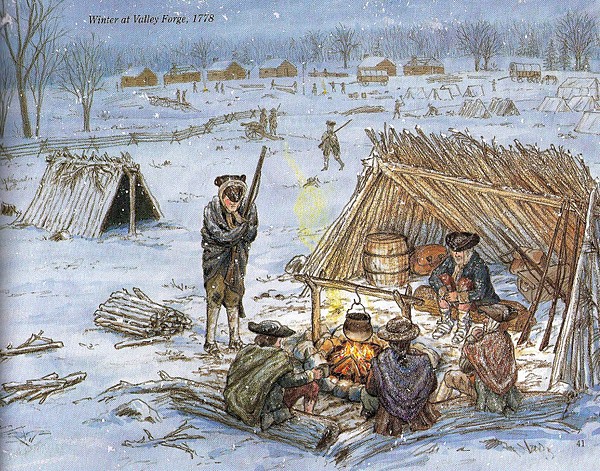
Thus, I have put an image here of men at arms around water. It may call to mind the American assault of Omaha Beach – ‘Bloody Omaha’ – but is actually from eight months earlier, the Battle of the Dnieper, in Eastern Europe. The Dnieper is a vast river, and the Soviet Red Army was determined to cross it, to pursue the Nazis, whom they had been steadily driving out of conquered Soviet territory. This battle – though little-known or remarked in the West – was so huge and horrendous that the Dnieper at some points turned red with the blood of Russian soldiers, killed by the Nazis as they tried to cross it. Just as the Volga had been stained, at Stalingrad.

We may rightly pause to lament their fate; certainly, their own ruler Stalin, cared very little about individual Russian lives. (Sound familiar?)

Here is more about why I feel it is vital to point all this out:

No one is wrong all the time. Although Hitler’s response to Germany’s defeat in World War I was in every sense criminal, even he had a point, that the treaty of Versailles, dictated by the winners, had been unfair to his country. Especially in that it explicitly obliged her to accept the entire guilt for having started the war, which simply was not true, and much of the European public knew it. Prussian militarism had certainly been a crucial factor in starting ‘The Great War’ of 1914 – 1918, but was by no means the only one. Hitler’s reaction to the staggering blows of defeat followed by defamation was maniacal and monstrous, but the source of that resentment – unlike most of his others – was not entirely delusional.

And in the interest of accuracy, fairness and of redressing dangerous and harmful misunderstanding – much as I hate to admit it, as I utterly detest him – the same is true of Vladimir Putin, current faux Czar and heartless, spendthrift waster of the lives of ordinary Russians (and Ukrainians).

Putin has many false, delusional, cruel beliefs, but as noted above, he does have at least one legitimate grievance. He, and a great many Russians of his generation, feel that their erstwhile Western Allies have never fully grasped nor appreciated the unspeakable magnitude of their country’s suffering – set upon by the Nazis in a war of annihilation against the sub-human Slavs, and their noxious regime of ‘Judeo-Bolshevism’ (a Nazi definition) – in what the Russians refer to as ‘The Great Patriotic War,’ instead of World War II.

Also, about 2 weeks after the D-Day landings, the Soviet Red Army began ‘Operation Bagration,’ a colossal counterblow at the Germans, mostly in what is now Byelorussia. This obliged Hitler, still thrashing in Normandy, to confront an even more crucial threat in the East, which was, of course, just what was intended: to force the Nazis to fight on two fronts, in the East and West (at this time, they were also still fighting in Italy; ironically, the Americans had entered Rome on June 4, two days before D-Day).

So by all means, let us remember, honor – and learn from – the valor and sacrifice of D-Day. But Americans especially, who suffered no combat on our territory, as European Russia was barbarically ravaged, should never forget that for all we paid in money and material (much of it provided to the USSR, and critical to its war effort), the Russians paid on a Biblical scale in blood and lives.

Their losses are beyond reckoning – almost beyond imagining – but aside from the gargantuan, spiteful physical damage the Germans committed, the Russians are generally held to have had approximately 20 million dead – maybe more – military and civilians (in the occupied USSR the Nazis often killed civilians, Jewish and Gentile Russians, like rodents; Jews were explicitly targeted, but non-Jews were still subhuman Slavs, killed for the most minor infractions or even simply to reduce local food consumption).

The Soviet mortality of 1941-45 was so stupendous that it altered the demographics of the nation to this day. In the absence of millions of young men killed in the fighting, the birthrate of the USSR – and of today’s Russia – never fully recovered.

American deaths in the war were approximately 420,000. A terrible toll – one of whom was my own mother’s fiancé before she met my father, and I don’t think she ever fully got over her grief. But for context, one cemetery for the mass graves dug outside Leningrad for the dead of its horrifying siege by the Nazis holds just under 500,000 victims. There are more Russian war dead – most of them civilian residents of Leningrad – in that one cemetery than all the American losses, globally, in the entire conflict.

The Soviet Union sustained deaths (a great proportion of them non-combatants) in a ratio of more than 40 to 1, as opposed to those of the U.S. If one reflects on that, the seething anger of Putin and many of his countrymen – when they hear D-Day called the ‘turning of the tide’ for Nazism – gets easier to understand. And to acknowledge as proper.

So as you honor D-Day, please also register, and honor, the epic, heroic, and far more tragic sacrifices made then by our Russian Allies – ruled by Stalin, indifferent to spending the lives of his own citizens like pocket change, to grind Hitler’s war machine to a halt, and begin to reverse it.

Victory was paid for with a nightmarish trauma for the Russian people from which they will probably never recover, persisting in their folk memory after the last eye-witnesses are gone. They are right to expect that we, in the West, step outside our own historical reference ‘bubble’ and at the very least be aware of what they went through. And to appreciate it.

(Russians are not the only ones who notice, and abhor, the apparent American tendency to assume that anything in which we were not directly involved, cannot be very important. Our nearest neighbors, the Mexicans and Canadians, would almost certainly agree, even though their grievances are not as bitter as having a national calamity of apocalyptic proportions overlooked or disregarded. As many Russians feel we have done to them. But we are all citizens of the same world.)

Their suffering was incomparably worse than America’s, or even Britain, which endured the Blitz, but didn’t have millions of German troops rampaging on its soil, all indoctrinated to believe that the residents were essentially two-legged vermin, and acting accordingly, as they did with the Russians – Slavic and Jewish. No one in the West – not even the conquered French – had to endure anything like that at Hitler’s hands.

So today’s Russians have a right to our gratitude, and respect, for the unimaginably greater sorrows they endured and overcame.

The Nazis capitulated at Stalingrad on January 31, 1943; perhaps we should remember that date – with awestruck salutes for the resolute courage of those triumphant Russians, struggling in the jaws of Hell on Earth, as that battle surely was – just as we recall June 6, 1944. To do so might even help to calm the frenzy of East-West recriminations that still linger.